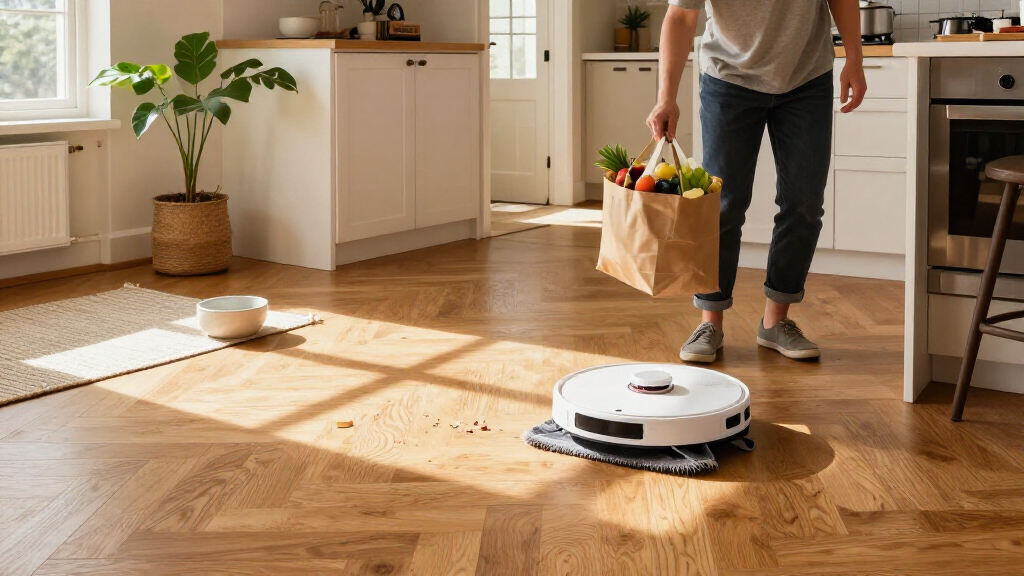
Robot vacuum mop combos can vacuum and wipe floors in one routine, but the amount of hands-on care varies widely. I rank the Dreame L40 Ultra Gen 2 as the best overall for buyers who want a more automated cleaning setup, while the Roborock Qrevo CurvX stands out as a premium alternative and the Roomba 115X Combo offers a simpler route with an AutoEmpty dock. The main tradeoffs are how well a model handles both tasks, how much its dock automates, and how much maintenance it leaves to you. More automation can reduce routine work, but it also means a larger dock and more parts to maintain. Read on for the full comparison and advice on matching a combo to your home.

Get cleaning gear delivered free with Prime
- Fast, free delivery on millions of items
- Prime Video, Amazon Music and more included
- Member-only deals all year
Complete the kit


Key Takeaways
- Dock features create the clearest divide: AutoEmpty models reduce bin-emptying, while AutoWash and higher-automation systems address more of the mop-care routine.
- Premium automation is not the right fit for every home: The Dreame L40 Ultra Gen 2 and Roborock Qrevo CurvX are stronger candidates for buyers seeking less manual work, but their more involved dock setups can take up more space.
- Self-emptying and mopping solve different chores: Models such as the Roborock Q10 S5+ and Q7 M5+ pair a self-emptying dock with mopping, but buyers should check what mop maintenance remains manual.
- Basic combos can suit smaller or simpler routines: The Tikom G8000 Max and ROPVACNIC 5200 Pa are worth comparing when a straightforward vacuum-and-mop approach matters more than a highly automated dock.
- Brand familiarity is not a substitute for feature matching: The Roomba 105, 115X, Plus 405, and Max 875 differ in dock and mop-care approach, so buyers should compare each model’s routine rather than choosing by brand alone.
| Dreame L40 Ultra Gen 2 Robot Vacuum and Mop |  | Best Overall | Suction power: 25,000 Pa | Battery capacity: 5,200 mAh | Battery life: Up to 231 minutes in Quiet Mode | VIEW LATEST PRICE | See Our Full Breakdown |
| iRobot Roomba 115X Combo Robot Vacuum and Mop with AutoEmpty Dock |  | Best for Low-Touch Debris Disposal | Suction power: 15,000 Pa | Coverage per charge: Up to 900 sq. ft. | Battery life: 173 minutes | VIEW LATEST PRICE | See Our Full Breakdown |
| UMMUND T13S Robot Vacuum and Mop Combo, 8000 Pa, App and Remote Control |  | Best for Hard-Floor Basics | Maximum suction power: 8,000 Pa | Battery capacity: 2,600 mAh | Runtime: Up to 160 minutes in Quiet Mode; 100 minutes in Standard Mode; 70 minutes in Maximum Mode | VIEW LATEST PRICE | See Our Full Breakdown |
| iRobot Roomba 105 Combo Robot Vacuum and Mop with AutoEmpty Dock |  | Best for Flexible Cleaning Modes | Navigation: ClearView LiDAR | Cleaning modes: Vacuum, mop, or vacuum and mop | AutoEmpty capacity: Up to 75 days of debris | VIEW LATEST PRICE | See Our Full Breakdown |
| Roborock Q10 S5+ Robot Vacuum and Mop |  | Best for Carpet-and-Hard-Floor Homes | Suction: 10,000 Pa | Dust bag capacity: 2.7 L | Claimed hands-free cleaning: Up to 70 days | VIEW LATEST PRICE | See Our Full Breakdown |
| eufy C28 Robot Vacuum and Mop Combo |  | Best for Low-Maintenance Mopping | Suction power: 15,000 Pa | Mop type: 28 cm HydroJet roller mop | Mop rotation speed: 270 RPM | VIEW LATEST PRICE | See Our Full Breakdown |
| ROPVACNIC Robot Vacuum and Mop Combo, 5200 Pa |  | Best for Flexible Controls | Suction power: 5,200 Pa | Cleaning functions: Vacuuming and electronic mopping | Surface recommendation: Hardwood and low-pile carpets | VIEW LATEST PRICE | See Our Full Breakdown |
| LVKANGDA D17S MAX Robot Vacuum and Mop with Self-Emptying Base |  | Best for Multi-Floor Mapping | Suction power: Up to 12,000 Pa | Navigation: dToF laser navigation | Saved maps: Up to 5 floors | VIEW LATEST PRICE | See Our Full Breakdown |
| Roborock Qrevo CurvX Robot Vacuum and Mop |  | Best Premium Feature Set | Suction power: 22,000 Pa | Height: 7.98 cm | Maximum threshold crossing: 4 cm | VIEW LATEST PRICE | See Our Full Breakdown |
| Tikom G8000 Max Robot Vacuum and Mop Combo |  | Best Slim, Straightforward Combo | Suction power: 5,000 Pa | Dustbin capacity: 450 ml | Water tank capacity: 300 ml | VIEW LATEST PRICE | See Our Full Breakdown |
| iRobot Roomba Plus 405 Combo Robot Vacuum and Mop with AutoWash Dock |  | Best for Low-Maintenance Mopping | Model: Roomba Plus 405 (G181) | Type: 2-in-1 robot vacuum and mop | Navigation: ClearView LiDAR | VIEW LATEST PRICE | See Our Full Breakdown |
| Roborock Q7 M5+ Robot Vacuum and Mop with Self-Emptying Dock |  | Best for Strong Vacuuming and Simple Mopping | Model: Q7 M5+ | Maximum suction: 10,000 Pa | Navigation: PreciSense LiDAR | VIEW LATEST PRICE | See Our Full Breakdown |
| H6 Pro Robot Vacuum and Mop with 6000Pa Suction, LiDAR Navigation, and Self-Emptying |  | Best for Multi-Level Mapping | Suction power: 6000 Pa | Navigation: 360° LiDAR with multi-level mapping | Dust collection station: 3 L | VIEW LATEST PRICE | See Our Full Breakdown |
| Shark Matrix Plus 2-in-1 Robot Vacuum and Mop |  | Best Bagless Option | Model: AV2610WA | Navigation: 360° LiDAR mapping with obstacle avoidance | Mopping speed: Up to 100 scrubs per minute | VIEW LATEST PRICE | See Our Full Breakdown |
| iRobot Roomba Max 875 Robot Vacuum and Mop Combo |  | Best Premium Roller Mop | Cleaning surfaces: Hard floors and carpets are described; surface recommendation lists carpet | Navigation: Precision laser mapping and navigation with AI obstacle avoidance | Battery life: 210 minutes | VIEW LATEST PRICE | See Our Full Breakdown |
| robot vacuum mop combo | Navigation | Suction power | Battery life |
|---|---|---|---|
| Dreame L40 Ultra Gen 2 Robot V | — | 25,000 Pa | Up to 231 minutes in Quiet Mode |
| iRobot Roomba 115X Combo Robot | LiDAR | 15,000 Pa | 173 minutes |
| UMMUND T13S Robot Vacuum and M | — | — | — |
| iRobot Roomba 105 Combo Robot | ClearView LiDAR | — | — |
| Roborock Q10 S5+ Robot Vacuum | LiDAR with multi-level mapping | — | 150 minutes |
| eufy C28 Robot Vacuum and Mop | LiDAR | 15,000 Pa | Up to 140 minutes |
| ROPVACNIC Robot Vacuum and Mop | — | 5,200 Pa | Up to 120 minutes |
| LVKANGDA D17S MAX Robot Vacuum | dToF laser navigation | Up to 12,000 Pa | — |
| Roborock Qrevo CurvX Robot Vac | — | 22,000 Pa | — |
| Tikom G8000 Max Robot Vacuum a | — | 5,000 Pa | — |
| iRobot Roomba Plus 405 Combo R | ClearView LiDAR | — | — |
| Roborock Q7 M5+ Robot Vacuum a | PreciSense LiDAR | — | 150 minutes |
| H6 Pro Robot Vacuum and Mop wi | 360° LiDAR with multi-level mapping | 6000 Pa | Up to 150 minutes |
| Shark Matrix Plus 2-in-1 Robot | 360° LiDAR mapping with obstacle avoidance | — | — |
| iRobot Roomba Max 875 Robot Va | Precision laser mapping and navigation with AI obstacle avoidance | — | 210 minutes |
More Details on Our Top Picks
Dreame L40 Ultra Gen 2 Robot Vacuum and Mop
The Dreame L40 Ultra Gen 2 is the most capable all-in-one cleaner in this group for buyers who want stronger vacuuming and less mop upkeep. Its 25,000 Pa suction is the highest stated figure among these five, while the dock empties the robot, washes the mop pads, and dries them with hot air. Extendable brushes and mops are aimed at edges and awkward gaps that can be missed by a basic robot. Compared with the Roborock Q10 S5+, the Dreame offers more suction and dock-based mop washing, while the Roborock provides a vibrating mop and a specified carpet-lifting system. The tradeoff is that Dreame’s auto-detergent dispenser is sold separately, and its Wi-Fi is limited to 2.4 GHz. I’d choose it for a home that will benefit from hands-off mop care, not for someone seeking a simple, low-feature setup.
Pros:- Highest stated suction power among these five products
- Dock empties debris, washes mop pads, and dries them with hot air
- Extendable brushes and mops can reach edges and spaces under furniture
- Long stated Quiet Mode runtime of up to 231 minutes
Cons:- Auto-detergent dispenser is sold separately
- Wi-Fi support is limited to 2.4 GHz
- The listing specifies use in the USA, limiting suitability elsewhere
Best for: Households with mixed hard floors and carpets that want strong suction, corner reach, and a dock that washes and dries the mops
Not ideal for: Buyers who want detergent dispensing included or need compatibility with 5 GHz Wi-Fi
- Suction power:25,000 Pa
- Battery capacity:5,200 mAh
- Battery life:Up to 231 minutes in Quiet Mode
- Cleaning coverage:Up to 1,679 ft²
- Mop lift:0.41 in (10.5 mm)
- Suction levels:5
- Control:App, remote, and voice
- Connectivity:2.4 GHz Wi-Fi
Our verdict“Choose the Dreame if you want a high-suction combo with dock-based mop washing and drying, and can accept the separate detergent dispenser and 2.4 GHz Wi-Fi requirement.”
iRobot Roomba 115X Combo Robot Vacuum and Mop with AutoEmpty Dock
The Roomba 115X Combo suits buyers who want vacuuming and mopping in one pass but care more about reducing dustbin chores than automating mop care. Its 2.5 L allergen-trapping bag is designed to hold debris for up to three months, and LiDAR navigation helps it map rooms for planned cleaning. No Mop Zones give users a way to keep the washable microfiber pad away from rugs. Compared with the Roomba 105 Combo, the 115X lists a longer claimed debris-bag interval, while the 105 offers separate vacuum-only and mop-only modes and states that it avoids carpets while mopping. The 115X’s listing describes vacuum-and-mop cleaning in one pass, so buyers wanting more control over cleaning modes may prefer the 105. It also lacks a stated mop-washing dock, and setup requires 2.4 GHz Wi-Fi.
Pros:- Vacuums and mops in one pass
- AutoEmpty dock uses a 2.5 L allergen-trapping bag
- LiDAR navigation maps rooms and supports obstacle avoidance
- No Mop Zones help protect rugs from the mop pad
Cons:- No mop-washing or mop-drying function is specified
- Setup requires a 2.4 GHz Wi-Fi network
- Mop pad, filters, and brushes need periodic maintenance
Best for: Busy households that want a mapped vacuum-and-mop routine and infrequent debris-bag changes
Not ideal for: Rug-heavy homes seeking explicit carpet avoidance while mopping, or buyers who want a dock to wash mop pads
- Suction power:15,000 Pa
- Coverage per charge:Up to 900 sq. ft.
- Battery life:173 minutes
- Dust bag capacity:2.5 L
- Navigation:LiDAR
- Cleaning modes:Vacuum and mop
- Mop pad:Washable microfiber
- Connectivity:2.4 GHz Wi-Fi required for setup
Our verdict“Pick the 115X if a long debris-bag interval matters more than automated mop-pad washing or separate cleaning modes.”
UMMUND T13S Robot Vacuum and Mop Combo, 8000 Pa, App and Remote Control
The UMMUND T13S is the straightforward pick for smaller homes with mostly hard floors and no need for a self-emptying station. It vacuums and mops at the same time using a combined dust-and-water tank, and its 12.13-inch-wide, 3.23-inch-tall body is sized to reach under some furniture. A remote, app, buttons, and Google Assistant voice control offer more ways to start a cleaning run than a basic button-only model. Unlike the Roborock Q10 S5+, the T13S does not list LiDAR mapping, a self-emptying dock, or carpet-aware mop lifting; the Roborock is a better fit for mixed-floor homes that need those features. The T13S is also specified for hard floors, with no carpet suitability given. Runtime falls to 70 minutes at maximum suction, so larger spaces may call for quieter or standard settings.
Pros:- Vacuums and mops hard floors at the same time
- Slim, lightweight design can reach under some furniture
- Includes app, remote, button, and Google Assistant voice control
- Brushless air intake is designed to reduce pet-hair clogs
Cons:- Carpet suitability is not specified
- Runtime falls to 70 minutes at maximum suction
- No self-emptying dock or LiDAR navigation is listed
Best for: Apartment dwellers with mostly tile, wood, or other hard floors who want simultaneous vacuuming and mopping with remote or app control
Not ideal for: Homes with substantial carpeting, large cleaning areas, or buyers who want LiDAR mapping and a self-emptying dock
- Maximum suction power:8,000 Pa
- Battery capacity:2,600 mAh
- Runtime:Up to 160 minutes in Quiet Mode; 100 minutes in Standard Mode; 70 minutes in Maximum Mode
- Dust and water capacity:370 ml
- Cleaning modes:Auto, spot, and edge
- Dimensions:12.13 × 12.13 × 3.23 in
- Weight:7.3 lb
- Connectivity:2.4 GHz Wi-Fi and Bluetooth
Our verdict“Choose the T13S for a compact, control-friendly cleaner on hard floors, but look to the Roborock Q10 S5+ for carpet handling and mapped, dock-supported cleaning.”
iRobot Roomba 105 Combo Robot Vacuum and Mop with AutoEmpty Dock
The Roomba 105 Combo makes sense for homes where one room needs mopping, another needs vacuuming, and rugs need protection during wet cleaning. Its vacuum-only, mop-only, and combined modes give it more task-by-task flexibility than the Roomba 115X, whose listed cleaning mode is vacuum and mop. ClearView LiDAR supports room mapping and targeted schedules, while the robot is designed to avoid carpets during mopping. The AutoEmpty dock stores up to 75 days of debris, reducing dustbin handling, though it does not list the mop washing and hot-air drying found on the Dreame L40 Ultra Gen 2. The 105’s suction and edge-cleaning figures are comparisons with Roomba 600-series robots, not direct measurements that can be compared with the Pa ratings of the other picks. Its 2.4 GHz Wi-Fi requirement and limited approved cleaning solutions narrow the setup choices.
Pros:- Offers vacuum-only, mop-only, and combined cleaning modes
- ClearView LiDAR supports mapping and targeted room schedules
- Designed to avoid carpets while mopping
- AutoEmpty dock holds up to 75 days of debris
Cons:- Dock is specified for debris disposal, not mop washing or drying
- Requires a 2.4 GHz Wi-Fi network
- Compatible cleaning solutions are limited to those listed by iRobot
Best for: Households with a mix of rugs and hard floors that want room-specific scheduling and separate vacuum, mop, or combined runs
Not ideal for: Buyers who want a dock that washes and dries the mop, or who need Wi-Fi beyond 2.4 GHz
- Navigation:ClearView LiDAR
- Cleaning modes:Vacuum, mop, or vacuum and mop
- AutoEmpty capacity:Up to 75 days of debris
- Surface recommendation:Carpet and hard floor
- Mop scrubbing:SmartScrub; 2× deeper than standard mop mode, as stated by the manufacturer
- Edge cleaning:20% better than Roomba 600-series robots, as stated by the manufacturer
- Wi-Fi:2.4 GHz
- Included:AutoEmpty Dock and extra mop pad
Our verdict“Choose the Roomba 105 for flexible room-by-room cleaning and rug protection; choose the Dreame L40 Ultra Gen 2 if automated mop washing and drying matter more.”
Roborock Q10 S5+ Robot Vacuum and Mop
The Roborock Q10 S5+ is the more balanced choice for homes that move between carpets and hard floors but do not need a dock that washes mop pads. Its VibraRise 2.0 vibrating mop is specified for up to 3,000 scrubs per minute, and the mop lifts up to 8 mm when carpet is detected. LiDAR mapping and ReactiveTech obstacle avoidance support planned routes, while the 2.7 L dust bag is designed for up to 70 days between maintenance. Compared with the UMMUND T13S, the Q10 S5+ adds mapped navigation, carpet-aware mop lifting, and self-emptying; the tradeoff is a larger station and more involved app-based setup. It also falls well short of the Dreame L40 Ultra Gen 2’s stated suction and dock features. The 70-day interval is a product claim and can vary with household debris and cleaning frequency.
Pros:- VibraRise mop system adds sonic scrubbing on hard floors
- Mop lifts up to 8 mm when carpets are detected
- LiDAR mapping and ReactiveTech obstacle avoidance support planned cleaning
- 2.7 L dust bag is designed for up to 70 days between maintenance
Cons:- No automatic mop washing or drying is specified
- Wi-Fi is limited to 2.4 GHz
- The claimed 70-day maintenance interval may vary with use
Best for: Households with both carpet and hard flooring that want mapped cleaning, carpet-aware mopping, and reduced debris-bin maintenance
Not ideal for: Buyers who need mop pads washed and dried automatically, or those seeking a compact, low-maintenance station
- Suction:10,000 Pa
- Dust bag capacity:2.7 L
- Claimed hands-free cleaning:Up to 70 days
- Mopping system:VibraRise 2.0 dual-zone sonic vibration
- Mopping frequency:Up to 3,000 scrubs per minute
- Mop lift:Up to 8 mm
- Navigation:LiDAR with multi-level mapping
- Battery life:150 minutes
Our verdict“Pick the Q10 S5+ for carpet-aware mopping and mapped cleaning with self-emptying, but choose the Dreame if a mop-washing dock and stronger stated suction take priority.”
eufy C28 Robot Vacuum and Mop Combo
The eufy C28 makes its case as a mop-focused combo: its HydroJet roller cleans itself, and the all-in-one station empties dust, washes and dries the mop, and collects wastewater. That reduces the hands-on work that comes with simpler combos such as the Tikom G8000 Max, which has a separate water tank but no comparable mop-cleaning station. The C28 also pairs 15,000 Pa suction with LiDAR navigation and a brush designed to resist hair tangles, giving it a stronger feature mix for homes with hard floors and shedding pets. Its limits matter, though: the mop lifts only 10.8 mm, and the recommended carpet coverage is short pile. The station’s 75-day maintenance interval is also based on handling 95% of maintenance, not eliminating upkeep.
Pros:- Self-cleaning roller mop with station-based washing and drying
- Station empties the dustbin and collects wastewater
- 15,000 Pa stated suction and LiDAR navigation
- Tangle-resistant brush is designed for long hair and pet fur
Cons:- 10.8 mm mop lift limits clearance over rugs
- Surface recommendations cover hard floors and short carpets, not deeper pile
- The stated 75-day maintenance interval assumes the station handles 95% of maintenance
Best for: Households with mostly hard floors, pets, and a preference for automated mop washing and dust disposal.
Not ideal for: Homes with medium- or high-pile carpets, or buyers who need the mop to clear taller rugs reliably.
- Suction power:15,000 Pa
- Mop type:28 cm HydroJet roller mop
- Mop rotation speed:270 RPM
- Navigation:LiDAR
- Mop lift:10.8 mm
- Battery life:Up to 140 minutes
- Dust bag capacity:3 L
- Operating noise:54.89 dB
Our verdict“Choose the C28 if automated mop care matters more than cleaning carpets beyond short pile.”
ROPVACNIC Robot Vacuum and Mop Combo, 5200 Pa
The ROPVACNIC suits buyers who want several ways to run a basic vacuum-and-mop routine without relying on an app alone. App, remote, touchpad, and voice controls let different household members start or schedule cleaning in the way they prefer. Its adjustable electronic mopping and three suction levels offer more control than the fixed-mode approach implied by the Tikom G8000 Max’s four cleaning modes, while the brush-free design is intended to reduce pet-hair tangling. That said, the ROPVACNIC is a simpler pick than the eufy C28, which adds an automated station for mop washing and dust disposal. The ROPVACNIC’s 5,200 Pa suction and 120-minute battery life are suited to routine upkeep, but its floor guidance is limited to hardwood and low-pile carpet, so it is not the flexible choice for varied flooring.
Pros:- App, remote, touchpad, and voice control options
- Adjustable electronic mopping and three suction levels
- Brush-free design aims to reduce pet-hair tangles
- Returns to its dock to recharge
Cons:- Recommended for hardwood and low-pile carpet, limiting carpet versatility
- 120-minute battery life is shorter than the listed runtime of the Tikom G8000 Max
- No mop-washing or self-emptying station is specified
Best for: Households that want app, remote, and voice operation for routine cleaning on hardwood and low-pile carpet.
Not ideal for: Buyers seeking an automated mop-washing dock, extended runtime, or support for thicker carpets.
- Suction power:5,200 Pa
- Cleaning functions:Vacuuming and electronic mopping
- Surface recommendation:Hardwood and low-pile carpets
- Battery life:Up to 120 minutes
- Power levels:3
- Control options:App, remote, touchpad, and voice
- Voice assistant compatibility:Amazon Echo and Google Home
- Filter:Multi-layer optimized high-efficiency filtration
Our verdict“Pick the ROPVACNIC if you value multiple control options over a self-cleaning dock or broader carpet coverage.”
LVKANGDA D17S MAX Robot Vacuum and Mop with Self-Emptying Base
The D17S MAX is the mapping-oriented pick here, with dToF laser navigation and storage for up to five floor maps. That makes it a better fit for a multi-level home than the Tikom G8000 Max, whose listed features focus on basic sensors and cleaning modes rather than saved maps. It also offers automatic recharge and resume, so a longer cleaning job can continue after the robot returns to charge. Suction reaches 12,000 Pa, and a hair-cutting brush system is intended to reduce brush maintenance. The tradeoff is that its 250 ml dustbox and 300 ml water tank are modest for a robot covering several floors; the self-emptying base helps with dust, but the water tank still needs attention. Its 160-minute runtime is specified for quiet mode, not every cleaning setting.
Pros:- Stores maps for up to five floors
- dToF laser navigation with app-based no-go zones
- Automatically recharges and resumes cleaning
- Hair-cutting brush system aims to limit hair wrapping
Cons:- 250 ml dustbox and 300 ml water tank may call for frequent attention
- 160-minute runtime is specified for quiet mode
- Self-emptying base does not remove the need to refill the water tank
Best for: Owners of multi-level homes who want saved maps, no-go zones, and cleaning that can resume after recharging.
Not ideal for: Buyers who want large onboard dust and water capacity or expect maximum runtime while using stronger settings.
- Suction power:Up to 12,000 Pa
- Navigation:dToF laser navigation
- Saved maps:Up to 5 floors
- Dustbox capacity:250 ml
- Water tank capacity:300 ml
- Runtime:Up to 160 minutes in quiet mode
- Dimensions:12.99 × 12.99 × 3.94 inches
- Surface recommendation:Hardwood, tile, low-pile carpet, and medium-pile carpet
Our verdict“Choose the D17S MAX for saved multi-floor maps and recharge-resume cleaning, provided you can manage its smaller onboard tanks.”
Roborock Qrevo CurvX Robot Vacuum and Mop
The Roborock Qrevo CurvX is the most feature-heavy option in this group, pairing 22,000 Pa suction with dual spinning mops and a dock that washes and dries the pads, empties dust, and refills the robot’s tanks. Compared with the eufy C28, it adds a slimmer 7.98 cm body, a 17 mm mop lift, and stated recognition of 108 object types, giving it a more elaborate toolkit for mixed flooring and obstacle avoidance. Its adjustable chassis and 4 cm threshold-crossing specification may also help with transitions between rooms. That capability comes with added setup and dock upkeep, and the robot only supports 2.4 GHz Wi-Fi. Buyers who want a straightforward combo without a large multifunction dock may find the Tikom G8000 Max easier to accommodate.
Pros:- 22,000 Pa stated suction with dual spinning mops
- Dock handles mop washing and drying, dust emptying, and tank refilling
- Slim 7.98 cm profile and 17 mm mop lift
- AI obstacle recognition lists 108 object types
Cons:- Wi-Fi support is limited to 2.4 GHz
- Feature-rich robot and dock may take more setup and ongoing care
- Large dock functions may be unnecessary for buyers seeking a simple combo
Best for: Buyers seeking a high-spec combo for mixed hard floors and carpets, with automated mop care and advanced obstacle recognition.
Not ideal for: Anyone with only 5 GHz Wi-Fi or limited space and patience for a multifunction dock and its upkeep.
- Suction power:22,000 Pa
- Height:7.98 cm
- Maximum threshold crossing:4 cm
- Mop lift:17 mm
- Hot water mop washing:80°C (176°F)
- Warm air drying:113°F
- Obstacle recognition:108 object types
- Connectivity:2.4 GHz Wi-Fi
Our verdict“Choose the Qrevo CurvX for its broad automation and premium navigation features, if its dock and 2.4 GHz Wi-Fi fit your home.”
Tikom G8000 Max Robot Vacuum and Mop Combo
The Tikom G8000 Max keeps the combo concept straightforward: it can vacuum and mop at the same time, and its 3-inch body is designed to reach under some low furniture. The 450 ml dustbin and 300 ml water tank give it defined onboard capacity, while 150 minutes of listed battery life and automatic recharging suit routine cleaning across several rooms. Unlike the eufy C28, it does not automate mop washing or dust disposal, so owners handle tank care themselves. It is also a less advanced mapping proposition than the LVKANGDA D17S MAX, which saves maps for up to five floors. In return, Tikom offers app, remote, voice, and button controls plus spot, edge, zig-zag, and manual modes. Carpet guidance is limited to short- and medium-pile types, with performance beyond those unspecified.
Pros:- Vacuums and mops simultaneously
- 3-inch height can help it reach under low furniture
- Up to 150 minutes of listed battery life with automatic recharging
- App, remote, voice, and button controls with four cleaning modes
Cons:- Separate 300 ml water tank requires owner refilling and care
- No self-emptying or mop-washing dock is specified
- Carpet guidance covers short- and medium-pile types; other carpet performance is unspecified
Best for: Buyers who want a low-profile, easy-to-operate vacuum-and-mop combo for hard floors and supported carpet types.
Not ideal for: Households wanting a self-cleaning mop dock, saved multi-floor maps, or clearly specified performance on high-pile carpets.
- Suction power:5,000 Pa
- Dustbin capacity:450 ml
- Water tank capacity:300 ml
- Maximum battery life:Up to 150 minutes
- Height:3 inches
- Dimensions:12.6 × 12.6 × 3 inches
- Noise level:45 dB
- Cleaning modes:Spot, edge, zig-zag, and manual
Our verdict“Pick the G8000 Max for a slim, multi-control combo that handles routine vacuuming and mopping without a complex dock.”
iRobot Roomba Plus 405 Combo Robot Vacuum and Mop with AutoWash Dock
I’d put the Roomba Plus 405 Combo on the list for buyers who want the mop handled as automatically as the vacuum. Its AutoWash dock empties debris, washes the dual spinning pads, and dries them, reducing the hands-on cleanup that comes with a basic mop attachment. ClearView LiDAR supports room mapping and targeted zones, while automatic carpet lift helps keep wet pads off rugs during combo cleaning. Compared with the Roborock Q7 M5+, this model adds dock-based pad washing and drying; the Q7 instead emphasizes high stated suction and a large dust bag. The tradeoff is that the 405’s dock and pad system add complexity, and the stated debris interval depends on use. I’d skip it if you prefer a simple, manually maintained mop setup.
Pros:- AutoWash dock empties debris and washes and dries mop pads
- Four cleaning modes allow vacuuming and mopping to be scheduled separately or together
- ClearView LiDAR supports room mapping and customized cleaning zones
- Mop pads lift automatically when carpet is detected
Cons:- The dock and pad-washing system add more components to maintain than a basic self-emptying setup
- The stated 75-day debris capacity depends on usage conditions
- Provided suction and scrubbing claims do not give a direct performance figure for comparison
Best for: Households with mixed hard floors and rugs that want the dock to wash and dry mop pads between runs
Not ideal for: Buyers seeking a basic, low-complexity mop attachment or those who want cleaning claims backed by directly comparable performance figures
- Model:Roomba Plus 405 (G181)
- Type:2-in-1 robot vacuum and mop
- Navigation:ClearView LiDAR
- Cleaning modes:Vacuum, mop, combo clean, vacuum then mop
- Suction levels:4
- Mop system:DualClean spinning mop pads with automatic carpet lift
- Dock:AutoWash dock with self-emptying, pad washing, and pad drying
- Stated debris capacity:Up to 75 days, depending on usage conditions
Our verdict“Choose the Roomba Plus 405 if automated mop-pad care matters more to you than a simpler setup or a stated high suction figure.”
Roborock Q7 M5+ Robot Vacuum and Mop with Self-Emptying Dock
The Roborock Q7 M5+ suits buyers who prioritize vacuum pickup and mapped coverage over automated mop care. Its stated 10,000 Pa suction, PreciSense LiDAR, and anti-tangle brush design make it the more vacuum-focused choice beside the Roomba Plus 405, whose standout advantage is a dock that washes and dries its pads. The Q7 M5+ has a large 2.7 L dust bag rated for up to 7–9 weeks between emptying, plus three water-flow settings for adjusting a pass across different hard floors. That mopping still requires filling and maintaining the water system; it does not have the 405’s pad-washing dock. I’d choose it for scheduled, mapped cleaning and a long dust-bag interval, but not if you want the robot to take over mop cleanup too.
Pros:- 10,000 Pa stated maximum suction for a vacuum-focused cleaning setup
- PreciSense LiDAR supports mapped routes, schedules, and no-go zones
- 2.7 L dust bag is rated for up to 7–9 weeks between emptying
- Anti-tangle brush design is intended to reduce pet hair wrap
Cons:- Mopping requires manually filling and maintaining the water system
- Wi-Fi support is limited to 2.4 GHz
- Does not provide the pad washing and drying offered by the Roomba Plus 405
Best for: Pet owners and busy households who want strong stated suction, mapped schedules, and less frequent dust-bag changes
Not ideal for: Buyers who want a dock to wash and dry mop components or whose home Wi-Fi network does not support 2.4 GHz
- Model:Q7 M5+
- Maximum suction:10,000 Pa
- Navigation:PreciSense LiDAR
- Dust bag capacity:2.7 L
- Stated emptying interval:Up to 7–9 weeks
- Battery life:150 minutes
- Water-flow settings:3
- Wi-Fi:2.4 GHz only
Our verdict“Pick the Q7 M5+ if mapped vacuuming and a long dust-bag interval matter more than hands-off mop maintenance.”
H6 Pro Robot Vacuum and Mop with 6000Pa Suction, LiDAR Navigation, and Self-Emptying
I’d favor the H6 Pro for homes where cleaning plans need to follow the robot between floors. Its 360° LiDAR with multi-level mapping and restricted-zone controls give it a distinct role beside the Roborock Q7 M5+, which lists LiDAR mapping but does not specify multi-level maps. The H6 Pro also combines sweeping, vacuuming, and mopping, and its 3 L collection station is stated to support up to 90 days of hands-free debris handling. App, touch, and voice controls offer several ways to start or schedule a run. The tradeoff is the smaller 250 ml dustbin and 310 ml water tank on the robot, which may need attention during larger jobs despite the large station. I’d choose it for mapped, multi-floor routines, not for long runs that demand minimal tank refills.
Pros:- 360° LiDAR supports multi-level mapping and restricted cleaning zones
- 3 L collection station is stated to support up to 90 days of debris collection
- Combines sweeping, vacuuming, and mopping in one robot
- Supports app, touch, voice, Alexa, and Google Assistant controls
Cons:- The 250 ml dustbin may need attention during larger jobs
- The 310 ml water tank may require refilling for extensive mopping
- The stated 90-day hands-free period depends on use and does not remove the need to maintain the water system
Best for: Owners of multi-story homes who want saved floor maps, voice controls, and a self-emptying station
Not ideal for: Households with large cleaning areas that want fewer mid-job water refills or who need clearly specified performance comparisons
- Suction power:6000 Pa
- Navigation:360° LiDAR with multi-level mapping
- Dust collection station:3 L
- Robot dustbin:250 ml
- Water tank:310 ml
- Battery life:Up to 150 minutes
- Cleaning functions:Sweeping, vacuuming, and mopping
- Controls:App, touch, voice, Alexa, and Google Assistant
Our verdict“Choose the H6 Pro if multi-level mapping and flexible controls outweigh the need for larger onboard tanks.”
Shark Matrix Plus 2-in-1 Robot Vacuum and Mop
The Shark Matrix Plus is the bagless choice in this group, a practical distinction for buyers who would rather empty a base than replace dust bags. Its base is rated to hold up to 60 days of debris and includes HEPA filtration; by comparison, the Roborock Q7 M5+ uses a 2.7 L bag rated for up to 7–9 weeks. Shark pairs LiDAR mapping and obstacle avoidance with simultaneous vacuuming and sonic mopping on hard floors, while its self-cleaning brushroll is designed to limit hair wrap. The main compromise is the mop’s surface scope: it is for hard floors, not carpet. The product information also leaves battery runtime and charging time unspecified, making it harder to judge suitability for large homes. I’d pick it for bagless upkeep, not mixed-surface mopping.
Pros:- Bagless XL base avoids replacement dust bags
- Base is rated for up to 60 days of debris and includes HEPA filtration
- LiDAR mapping and obstacle avoidance support targeted cleaning
- Sonic mopping runs alongside vacuuming on hard floors
Cons:- Mopping is intended for hard floors and does not cover carpet
- Battery runtime and charging time are not provided
- The 60-day debris capacity is a stated estimate, not a fixed interval for every home
Best for: Buyers who want a bagless self-empty base, HEPA filtration, and vacuuming alongside hard-floor mopping
Not ideal for: Homes that need the robot to mop carpet or buyers who need stated runtime and charging-time figures before choosing
- Model:AV2610WA
- Navigation:360° LiDAR mapping with obstacle avoidance
- Mopping speed:Up to 100 scrubs per minute
- Stated base capacity:Up to 60 days of dirt and debris
- Base:Bagless XL HEPA self-empty base
- Filtration:Captures 99.97% of dust and allergens down to 0.3 microns
- Included mop pads:2 reusable microfiber pads
- Recommended surfaces:Carpets and hard floors; mopping is intended for hard floors
Our verdict“Choose the Shark Matrix Plus if you want bagless debris collection and hard-floor mopping, and can accept unspecified runtime.”
iRobot Roomba Max 875 Robot Vacuum and Mop Combo
The Roomba Max 875 is the most stain-focused option here, pairing a heated PowerSpin roller mop with SealForce suction and an AutoWash Dock. The roller runs at 300 RPM with 18 N of downward pressure, while heated mop water and dock wash-and-dry cycles target tougher floor residue. Compared with the Roomba Plus 405, this model uses a roller rather than dual spinning pads and offers a stated 210-minute battery life; the 405, by contrast, explicitly lists four cleaning modes and automatic pad lift. LiDAR and AI obstacle avoidance add navigation support, and the dock empties debris for up to 90 days. The tradeoffs are the unclear carpet guidance—the surface recommendation lists carpet even though hard-floor cleaning is also described—and manufacturer warranty details available only by request. I’d choose it for stain-oriented mopping, not a clearly documented all-surface setup.
Pros:- Heated PowerSpin roller mop is designed to loosen tough stains
- Roller speed and downward pressure are specified at 300 RPM and 18 N
- AutoWash Dock washes and dries the roller and empties debris
- LiDAR mapping, AI obstacle avoidance, and a stated 210-minute battery life support longer mapped runs
Cons:- Surface guidance is unclear: carpet is listed as a recommendation despite described hard-floor use
- Manufacturer warranty details are available only by request
- The heated roller and wash dock add system complexity compared with the Roomba Plus 405’s spinning-pad setup
Best for: Buyers focused on stubborn hard-floor stains who want a heated roller mop and an automated wash-and-dry dock
Not ideal for: Shoppers who need clear carpet-mopping guidance or want warranty terms readily available before purchase
- Cleaning surfaces:Hard floors and carpets are described; surface recommendation lists carpet
- Navigation:Precision laser mapping and navigation with AI obstacle avoidance
- Battery life:210 minutes
- Roller mop speed:300 RPM
- Downward mop pressure:18 N
- Mop water temperature:140°F
- Dock wash and drying temperatures:176°F wash water; 131°F drying air
- Debris bag capacity:Up to 90 days
- Dimensions and weight:14.2 x 14 x 3.9 inches; 6.8 pounds
Our verdict“Pick the Roomba Max 875 if heated roller scrubbing is your priority and you can resolve its carpet guidance before buying.”

How We Picked
I compared the 15 robot vacuum mop combos on the factors that shape day-to-day ownership: vacuuming and mopping capability, navigation and control options, dock automation, floor compatibility, and the effort required to maintain the robot. A combo is only useful when its mop system suits the home’s floors and cleaning habits, so I weighed the vacuum and mop functions together rather than treating a mop attachment as an automatic advantage.
The ranking gives more weight to balanced cleaning and practical automation than to a single headline specification. Models with self-emptying, mop washing, or other dock functions earn credit when those features reduce recurring chores, but they do not automatically outrank simpler options that may suit smaller homes or lighter cleaning schedules. I also account for usability and tradeoffs, including dock footprint, manual mop care, and the difference between app-based controls and a remote. The resulting list places the Dreame L40 Ultra Gen 2 first for its broad appeal, with the Roborock Qrevo CurvX as a premium alternative and simpler or more task-specific picks below.
Factors to Consider When Choosing Robot Vacuum Mop Combos
Before choosing among robot vacuum mop combos, I would focus less on the word “combo” and more on how the machine fits into your household routine. These broader checks can help you avoid paying for automation you will not use—or choosing a basic unit that leaves too much work behind.
Decide how much mop care you want to handle
A robot may mop the floor without washing or drying its own mop pads. Those are separate tasks, and they can determine whether the machine feels convenient after the first few runs. Ask what you will need to do after a cleaning cycle: remove a pad, rinse it, refill a tank, or clean the dock. A self-emptying base mainly reduces dust-bin handling; it does not mean the mop system is self-maintaining. Buyers with frequent messes may value mop-care automation more than a stronger suction figure. If you mop only occasionally, a simpler system may be easier to live with than a large, feature-rich dock.
Match the mopping system to your floors
Hard floors and rugs in the same room require more thought than a home with one consistent surface. Check how the robot handles rug edges and whether its mop can be lifted, removed, or otherwise kept away from carpet. A damp wiping pad is also not the same as scrubbing away dried spills, so set expectations around the kind of dirt it can address. Avoid assuming a robot can safely mop every surface just because the product includes a mop function. If you have delicate flooring, follow the flooring maker’s cleaning guidance and test a cautious routine first. For mostly carpeted homes, prioritize vacuuming and treat mopping as a secondary feature.
Check navigation against your actual floor plan
Navigation matters most when the robot must work around several rooms, furniture, cords, and changing obstacles. A small open area may not need the same mapping capabilities as a multi-room layout, so do not pay extra for features your home cannot benefit from. Look for clear information about room mapping, keep-out zones, scheduling, and how the robot responds when a route is blocked. App controls can make room-by-room routines easier, while a remote can be more comfortable for buyers who prefer simple commands. Before buying, consider whether you can keep floors clear enough for the robot to move reliably. Even capable navigation cannot pick up loose cables or reliably resolve every cluttered corner.
Measure the dock, not just the robot
Self-emptying and mop-service docks can reduce routine chores, but the base needs a suitable spot and room for access. Measure the height and width of the intended location, then allow space for the robot to leave and return without being boxed in. A dock near an outlet and an easy-to-reach water source, when relevant to its care routine, can make daily use less awkward. Think about where you will store replacement bags, pads, and cleaning supplies as well. A compact robot paired with a bulky base may not suit a tight apartment or narrow hallway. If space is limited, compare the value of each dock function against the footprint it adds.
Compare ownership chores, not just automation labels
Terms such as self-emptying, self-washing, or auto-cleaning describe different jobs, not a robot that needs no attention. Check the manual or product details for tasks such as cleaning filters, clearing hair from brushes, rinsing parts, and replacing consumables. Pet hair, long hair, and fine dust can change how often those chores arise, even when a dock handles some routine work. A machine with more automation may still require regular upkeep to perform well. Compare the full maintenance routine across models rather than counting features on a spec sheet. This helps reveal whether a simpler model is genuinely lower effort or merely shifts the work to a different task.
Pay for features that solve a real household problem
Extra dock functions and advanced controls make sense when they remove chores you currently do often. For a busy home with frequent floor messes, automated dust disposal or mop care may provide practical value. For a small space with light traffic, a basic combo can cover routine dust and surface wiping without a complex base. Suction figures alone do not describe how well a robot navigates, handles edges, or manages its mop. Also check whether app features, scheduling, and room controls work with the way your household shares devices and routines. I would choose a balanced setup that fits the floor plan over a higher specification that solves no recurring problem.
Frequently Asked Questions
Is a robot vacuum mop combo a good choice for a home with both rugs and hard floors?
It can be, but the key question is how the robot handles a rug while its mop is attached. Check whether the mop lifts or whether you need to remove it or set a no-mop zone before cleaning. Also consider how much of your home is carpet, since a combo may be a weaker fit if mopping is rarely useful. For mixed floors, room controls and dependable mapping can help you set different routines. If the product details do not clearly explain rug handling, avoid assuming the mop will stay away from carpet automatically.
Does a self-emptying dock also clean the mop?
No. Self-emptying usually refers to moving debris from the robot’s dustbin into the dock, while mop washing and drying are separate functions. A model may have one kind of automation without the other, so check exactly which chores its base handles. You may still need to rinse or replace the mop pad and refill a water tank. This distinction matters if your main goal is reducing contact with dirty mop pads rather than avoiding dust-bin emptying. Compare the listed dock tasks, not just the phrase “self-emptying.”
Should I choose an app-controlled model or one with a remote?
Choose based on how you expect to direct cleaning, not on which control sounds more advanced. An app can be helpful for schedules, room selection, and setting boundaries, especially in a multi-room home. A remote may offer a simpler way to start or steer a cleaning run without navigating app menus. Check whether the model supports the controls you actually want, since functions vary across products. If more than one person will operate the robot, think about which option will be easiest for everyone to use consistently.
How much dock space should I leave for a robot vacuum mop combo?
Plan for the dock’s full footprint and for the robot to approach and leave it freely. Measure the spot before ordering, including nearby furniture, doorways, and the space needed to remove tanks or service parts. A mop-care base may require more room and more frequent access than a basic charging dock. Avoid placing the base somewhere that makes routine cleaning or refilling inconvenient. The product’s setup instructions are the best guide to clearances, since a tight fit can disrupt docking even when the robot itself is compact.
When is it worth choosing a more automated combo over a simpler one?
More automation is most useful when the tasks it removes are chores you currently do often. A busy household with regular dust, pet hair, or hard-floor messes may benefit from a dock that handles more than charging. If you run the robot infrequently or mop only now and then, the extra dock functions may add footprint and maintenance without much daily benefit. Compare what the dock empties, washes, or dries, then decide whether those specific tasks matter to you. A simpler model can be the better fit when you prefer fewer parts and do not mind handling the mop yourself.
Conclusion
For the broadest mix of vacuuming, mopping, and reduced routine work, I would start with the Dreame L40 Ultra Gen 2 as the best overall pick. Buyers who want a premium alternative should compare the Roborock Qrevo CurvX, while those seeking a simpler option with an AutoEmpty dock can look at the iRobot Roomba 115X Combo as a beginner-friendly starting point. For value-focused buyers who want a more straightforward combo, the Tikom G8000 Max is a sensible model to compare against the ROPVACNIC 5200 Pa. If self-emptying is the priority, consider the Roborock Q10 S5+ or Q7 M5+, and if mop washing matters more, examine the Roomba Plus 405 Combo and its AutoWash dock. My final advice is to choose by the chores you want to remove, the surfaces in your home, and the space available for the dock—not by feature count alone.
Fall Picks
fall essentials
As an affiliate, we earn on qualifying purchases.