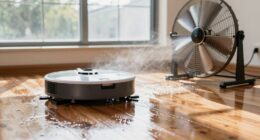
Robot vacuums detect and avoid stairs using a combination of sensors like infrared, ultrasonic, and cliff sensors that constantly scan your environment. These sensors quickly identify drop-offs or sudden drops, sending signals to the vacuum’s control system. Smart algorithms interpret this data in real time, making the vacuum slow down, stop, or change course to prevent falls. If you want to discover how these systems work together, keep exploring how technology keeps your home safe.
Key Takeaways
- Robot vacuums use cliff sensors to detect sudden drops like stairs, preventing falls.
- Infrared and ultrasonic sensors continuously scan surroundings for obstacles and drop-offs.
- Sensor signals are processed by navigation algorithms to identify hazards in real time.
- When a drop is detected, the vacuum stops, reverses, or navigates around the edge.
- Integration of sensors and algorithms ensures safe, efficient cleaning without falling hazards.

Robot vacuums have become increasingly sophisticated, and one key feature that enhances their safety and efficiency is their ability to detect and avoid stairs. This capability relies heavily on advanced sensor technology and smart navigation algorithms. When you set your robot vacuum to clean, these systems work seamlessly to prevent falls and damage, allowing it to navigate your home safely.
Sensor technology is at the heart of stairs detection. These sensors, such as infrared, ultrasonic, or cliff sensors, continuously scan the environment around the vacuum. Infrared sensors emit beams of light that bounce back when they hit nearby surfaces, helping the vacuum determine proximity. Ultrasonic sensors send sound waves and measure the time it takes for echoes to return, giving a detailed understanding of the surroundings. Cliff sensors, specifically designed to detect sudden drops like stairs, are positioned near the bottom of the vacuum. When these sensors detect a notable drop-off, they send immediate signals to the device’s control system, prompting it to stop or change direction. This real-time sensing prevents the vacuum from tumbling down stairs or falling off ledges.
Infrared, ultrasonic, and cliff sensors help robot vacuums detect drops and prevent falls in real time.
Navigation algorithms complement sensor technology by interpreting and responding to the data collected. These algorithms analyze the sensor inputs to identify potential hazards like stairs or uneven flooring. They help the vacuum create an internal map of your space, recognizing areas where drops may occur. When approaching an edge, the algorithms instruct the vacuum to slow down, halt, or navigate around the hazard altogether. They also enable the device to learn the layout of your home over time, improving its ability to detect stairs in different rooms and under various lighting or surface conditions.
Together, sensor technology and navigation algorithms form a robust safety system. The sensors provide the raw data, while the algorithms process that data to make real-time decisions. If the vacuum detects a cliff or drop-off, it immediately stops or reverses direction, preventing accidents. This intelligent coordination ensures your robot vacuum can clean thoroughly without risking damage or safety hazards.
In essence, your robot vacuum’s ability to detect and avoid stairs is a blend of precise sensors and clever programming. This synergy allows it to navigate complex environments confidently, giving you peace of mind that your device is working safely and effectively. As technology advances, these systems will only become more accurate and reliable, making robot vacuums safer and more efficient for every home.
Frequently Asked Questions
Do Robot Vacuums Work on Uneven or Textured Stairs?
Robot vacuums generally struggle on uneven or textured stairs because their sensor sensitivity varies with stair material. If the sensors aren’t sensitive enough, they might not detect the edge properly, risking falls. Textured surfaces can sometimes confuse sensors, especially if they’re designed for smooth floors. To guarantee safety, check your vacuum’s sensor specifications and consider models with advanced, adjustable sensors that adapt to different stair materials.
Can Robot Vacuums Accidentally Fall From High Balconies?
Think of your robot vacuum as a cautious explorer near a cliff. While designed for balcony safety, it’s possible for accidental falls if sensors fail or edges are unclear. To prevent this, make certain balcony barriers are secure and keep the vacuum away from ledges. Though rare, accidental falls can happen if sensors are obstructed. Regularly check and maintain your device to keep your robot safe and your balcony secure.
How Do Robot Vacuums Handle Stairs During Power Outages?
During a power outage, your robot vacuum relies on its pre-programmed power outage navigation and stair sensor calibration to avoid stairs. It may pause or stop moving when power is lost, but its sensors are designed to detect edges and prevent falls. Make sure to keep the sensors clean and calibrated regularly so it continues to navigate safely. You can also manually guide or reposition it if needed during outages.
Are Stair Detection Features Adjustable for Different Home Layouts?
You might wonder if stair detection features are adjustable for your home. Many robot vacuums allow you to customize sensor calibration through their software, making it easier to adapt to different layouts. You can often tweak settings or update firmware to improve stair detection accuracy. Check your device’s app or user manual for specific options, ensuring your vacuum navigates safely without false alarms or missed stairs.
What Maintenance Is Required to Keep Stair Sensors Functioning?
To keep your stair sensors functioning properly, you need to perform regular sensor calibration. Check for dust or debris that may obstruct the sensors and clean them gently with a soft cloth. Avoid obstacle cleaning around the sensors to prevent damage or misreading. Regular maintenance ensures your robot vacuum’s stair detection remains accurate, helping it avoid falls and navigate your home efficiently. This simple upkeep keeps your device operating safely and effectively.
Conclusion
Now that you know how robot vacuums detect and avoid stairs, you can trust them to clean safely without falling. With advanced sensors and smart technology, these devices are designed to protect your home and themselves. Isn’t it reassuring to think your vacuum won’t take a tumble while you focus on other tasks? So, next time you set it to clean, relax—your robot is smarter than you think, keeping stairs and accidents out of its path.