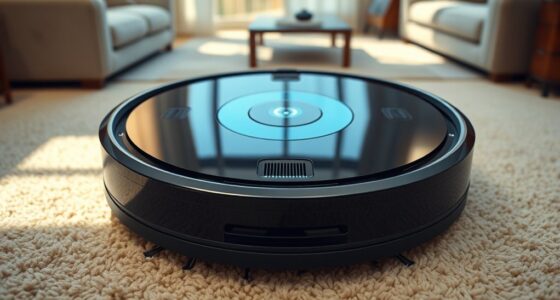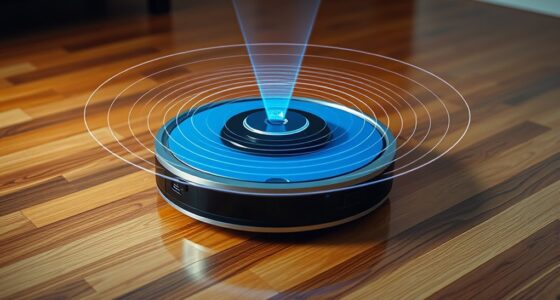

AI-powered room recognition automatically identifies spaces using cameras and sensors, adapting to layout or decor changes with minimal effort. It offers greater convenience, more accurate categorization, and smarter home automation. Manual naming, on the other hand, relies on static labels that require maintenance and pose fewer privacy concerns. If you keep exploring, you’ll discover how to choose the best option for your needs and privacy preferences.
Open a free Amazon Business account
Business pricing, bulk buying and tax-exempt orders.
As an affiliate, we earn on qualifying purchases.
Key Takeaways
- AI-powered recognition automatically detects and updates room labels based on environmental cues, reducing manual effort.
- Manual naming relies on user input, offering greater control but requiring ongoing updates for layout changes.
- AI systems enhance smart home automation by adapting to environmental changes in real-time, unlike static manual labels.
- Privacy concerns are higher with AI recognition due to continuous data collection, while manual labeling involves minimal privacy risks.
- User preference depends on balancing automation and convenience versus control and privacy considerations.

Artificial intelligence is transforming the way we identify and interact with different rooms by enabling accurate, real-time recognition. Instead of manually labeling each space, AI-powered room recognition systems can detect and distinguish rooms automatically, making smart home integration seamless and more intuitive. This technology uses cameras, sensors, and machine learning algorithms to analyze environmental features such as lighting, furniture, and spatial arrangements. As a result, your smart home can adapt dynamically—adjusting lighting, climate, or media based on which room you’re in—without you needing to specify it manually. This automation enhances convenience and creates a more personalized living experience.
However, with these advancements come concerns about privacy. AI systems that recognize rooms often rely on continuous data collection, including images and sensor inputs, raising questions about how your data is stored, processed, and protected. You might worry about unauthorized access or potential misuse of your personal environment. That’s why implementing robust privacy measures is vital. Many manufacturers now offer options to control data sharing or disable certain features if privacy is a priority. Being aware of these privacy concerns helps you make informed decisions about integrating AI-powered recognition into your home.
Privacy concerns arise with continuous data collection; control settings help safeguard your personal environment.
Compared to manual naming, AI-driven recognition offers significant advantages. Manually labeling rooms—like “living room,” “kitchen,” or “bedroom”—can be tedious and prone to errors, especially when multiple people are involved or the layout changes. Manual naming also requires ongoing upkeep; if you rearrange furniture or add new spaces, you need to remember to update labels. AI systems, on the other hand, learn from environmental cues, making them more adaptable and less prone to mistakes. They can recognize a room based on its unique characteristics, even if the layout shifts or decor changes. This makes your smart home more responsive and reduces the user effort involved in maintaining an accurate room map.
That said, manual naming still has its place, especially for those concerned about privacy or who prefer greater control over their data. Manual labels are straightforward, don’t require continuous data collection, and pose fewer privacy risks. Yet, they lack the flexibility and real-time accuracy that AI-powered recognition offers. Ultimately, your choice depends on your preferences for convenience, security, and privacy. If you value automation and a more seamless smart home experience, AI-powered recognition is a compelling option. Still, being mindful of privacy concerns and choosing systems with strong security features ensures you benefit from this technology without compromising your personal space.
AI-powered room recognition system
As an affiliate, we earn on qualifying purchases.
As an affiliate, we earn on qualifying purchases.
Frequently Asked Questions
How Accurate Is Ai-Powered Room Recognition Across Different Building Types?
You’ll find AI-powered room recognition highly accurate across different building types, especially when it leverages detailed building layout data and sensor integration. These systems adapt well to various structures by analyzing spatial features and sensor inputs, reducing errors. While accuracy can vary depending on the complexity of the layout and sensor quality, ongoing improvements continue to boost reliability, making AI a dependable solution for room identification in diverse environments.
Can AI Identify Rooms Based on Their Function or Purpose?
Think of AI as a skilled detective, capable of uncovering a room’s purpose through furniture identification and occupancy detection. By analyzing these clues, it can distinguish a conference room from a break room or classroom. This smart system doesn’t rely solely on labels; instead, it interprets visual cues and activity patterns, making accurate function identification possible even in complex or dynamic environments.
What Are Privacy Concerns Related to AI Room Recognition Systems?
You might worry that AI room recognition systems could compromise your data privacy, especially if they collect images or occupancy data without clear user consent. These systems can track your movements and identify spaces, raising concerns about how your information is stored and used. To protect yourself, guarantee that proper user consent is obtained and data privacy policies are transparent, giving you control over your personal information and how it’s shared.
How Does AI Handle Room Changes or Renovations Over Time?
AI systems handle room changes or renovations through adaptive learning and contextual adjustments. As you update a room, the AI continuously learns from new data, recognizing altered layouts or features. It adapts its algorithms to account for renovations, ensuring accurate recognition over time. This ongoing process means the AI stays current, reducing errors caused by changes and maintaining reliable room identification without needing manual reprogramming.
Is Ai-Powered Recognition Cost-Effective for Small-Scale Facilities?
AI-powered recognition can be cost-effective for small-scale facilities, especially if you conduct a thorough cost analysis upfront. It reduces manual effort and minimizes errors, saving you time and money. While initial setup costs might seem high, scalability options allow you to expand gradually without huge investments. Overall, if your facility plans growth or frequent changes, AI offers a smart, long-term solution that can pay off quickly.
As an affiliate, we earn on qualifying purchases.
Conclusion
So, which approach truly suits your needs—AI-powered room recognition or manual naming? While AI offers speed and accuracy, manual labeling provides personalized context. Are you ready to rely on technology to organize your space, or do you prefer the human touch? Ultimately, it depends on your priorities—efficiency or customization. Whichever you choose, embracing the right method can make your environment more intuitive and accessible. After all, isn’t a smarter space worth the effort?
automatic room detection sensors
As an affiliate, we earn on qualifying purchases.
As an affiliate, we earn on qualifying purchases.
As an affiliate, we earn on qualifying purchases.
Flea & tick season Picks
flea and tick prevention
As an affiliate, we earn on qualifying purchases.