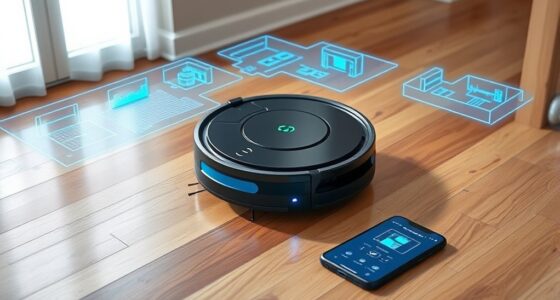
LiDAR in robot vacuums works by using laser pulses to scan your environment in real-time, creating detailed maps that help the device navigate accurately. It detects obstacles, such as furniture or toys, by bouncing laser beams back, allowing it to avoid collisions. Unlike other sensors, LiDAR performs well in all lighting conditions and can map multiple floors. This technology makes cleaning more efficient and reliable—stick around to discover exactly how it enhances your vacuum’s performance.

Get cleaning gear delivered free with Prime
- Fast, free delivery on millions of items
- Prime Video, Amazon Music and more included
- Member-only deals all year
Key Takeaways
- LiDAR uses laser pulses to create detailed, real-time 3D maps of the environment for precise navigation.
- It measures distances by emitting laser beams that bounce back, detecting obstacle size and location accurately.
- LiDAR’s environmental data enables advanced obstacle detection and avoidance, even in low-light or transparent conditions.
- It builds comprehensive floor plans, supporting features like room-specific cleaning and multi-floor mapping.
- Overall, LiDAR enhances cleaning efficiency by ensuring accurate navigation, reducing collisions, and optimizing routes.

LiDAR technology has revolutionized robot vacuums by enabling precise and efficient navigation. When you look at modern robotic cleaners, you might notice how seamlessly they move around your home, avoiding furniture and walls without missing a spot. This impressive performance mainly comes down to the advanced mapping accuracy that LiDAR provides. Unlike traditional sensors, LiDAR uses laser pulses to create detailed, real-time maps of your environment. It scans your space rapidly, capturing precise distances between the robot and surrounding objects, which allows for highly accurate mapping. This means your robot can plan ideal cleaning routes, ensuring every inch of your floor is covered without redundancy or oversight. You won’t find your vacuum bumping into things as often because it knows exactly where everything is, thanks to the detailed maps generated by LiDAR.
Obstacle detection is another critical aspect where LiDAR shines. As your robot moves, it continuously emits laser beams that bounce back from obstacles, informing the robot about their location and size. This process happens so quickly that the robot can adapt instantly, changing directions to avoid furniture, pet bowls, or even small objects like shoes or toys. Unlike infrared or camera-based sensors, LiDAR isn’t easily fooled by lighting conditions or transparent objects. It reliably detects obstacles in various environments, whether your living room is brightly lit or dimly lit. This sturdy obstacle detection not only helps prevent collisions but also allows the robot to navigate complex spaces with confidence. It can maneuver around tight corners, under tables, and along walls with a level of precision that used to be impossible in earlier vacuum models.
Moreover, the combination of high mapping accuracy and obstacle detection means your robot vacuum can build a thorough floor plan of your entire home. This map isn’t just useful for navigation; it also enables features like room-specific cleaning and scheduling. You can tell your robot to focus on high-traffic areas or avoid delicate zones, all based on the detailed maps created by LiDAR. The technology also allows for efficient multi-floor mapping, so if you have a multi-level house, the robot can remember different layouts. Additionally, real-time data processing ensures the robot responds instantly to changes in its environment, maintaining efficiency and safety. Overall, LiDAR’s ability to precisely detect obstacles and generate accurate maps transforms your cleaning experience. It ensures your robot operates intelligently, avoids mishaps, and cleans thoroughly, all while saving you time and effort.
As an affiliate, we earn on qualifying purchases.
Frequently Asked Questions
How Does Lidar Differ From Other Sensors Used in Robot Vacuums?
You might wonder how LiDAR differs from other sensors in robot vacuums. LiDAR offers superior sensor accuracy by using laser beams to create detailed 3D maps of your space, even in low light. It also processes data quickly, allowing your vacuum to navigate efficiently. Compared to infrared or ultrasonic sensors, LiDAR provides more precise obstacle detection and better room mapping, making your cleaning smarter and more thorough.
Can Lidar Operate Effectively in All Lighting Conditions?
Think of LiDAR as a lighthouse guiding your vacuum through darkness and daylight alike. It operates effectively in various lighting conditions, thanks to its laser sensors that are unaffected by ambient light. However, sensor accuracy can sometimes be compromised by lighting interference from reflective surfaces or bright sunlight. Overall, LiDAR’s ability to “see” in low light makes it reliable, but certain environments may pose minor challenges.
What Are the Limitations of Lidar Technology in Robot Vacuums?
You should know that lidar in robot vacuums has limitations, especially regarding sensor accuracy in challenging environments. Environmental interference, like reflective surfaces or dust, can distort data, reducing performance. Additionally, lidar may struggle in very bright or dark areas, affecting navigation. These factors mean you might experience less precise cleaning or navigation issues, so understanding lidar’s constraints helps you better manage your expectations for your robot vacuum’s efficiency.
How Does Lidar Impact the Cleaning Efficiency of Robot Vacuums?
Imagine you’re in the year 3024, and LiDAR’s still the star tech. It boosts your robot vacuum’s cleaning efficiency by providing precise mapping accuracy and quick obstacle detection. This means your vacuum navigates smoothly, covers every inch, and avoids obstacles efficiently. As a result, your cleaning sessions are faster, more thorough, and less stressful, making LiDAR indispensable for a smarter, more effective cleaning experience.
Is Lidar Technology Safe for Pets and Humans?
You’re likely wondering if LiDAR technology is safe for pets and humans. Rest assured, LiDAR uses low-energy laser pulses, which are considered safe for both pet safety and human health. It doesn’t emit harmful radiation or cause any known health issues. As long as you follow manufacturer guidelines, you can enjoy the benefits of a smart, efficient vacuum without worrying about safety concerns for your loved ones.
robot vacuum with multi-floor mapping
As an affiliate, we earn on qualifying purchases.
As an affiliate, we earn on qualifying purchases.
Conclusion
Now that you know how LiDAR maps your space with incredible precision, imagine what’s next. As technology advances, the line between smart and autonomous blurs even further, revealing possibilities you haven’t yet dreamed of. Will future robot vacuums become so intuitive they anticipate your needs before you even realize them? One thing’s certain: with LiDAR leading the charge, the future of home cleaning is more exciting—and more mysterious—than ever.
As an affiliate, we earn on qualifying purchases.
As an affiliate, we earn on qualifying purchases.
Fall Picks
fall essentials
As an affiliate, we earn on qualifying purchases.