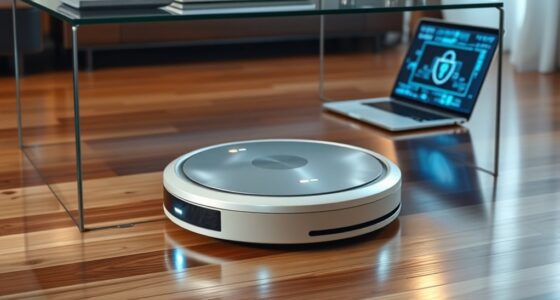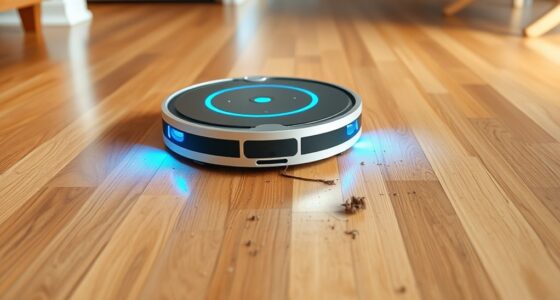
AI-powered vacuum robots use advanced sensors like infrared, ultrasonic, and LiDAR to detect obstacles such as cords and curtains in real time. They create detailed maps of your environment, recognize fragile items, and respond proactively by slowing down, rerouting, or lifting objects. Machine learning helps these robots improve obstacle recognition over time, ensuring safer navigation around tangled cords and delicate curtains. If you keep exploring, you’ll discover how these smart features work together to keep your floors spotless.
Key Takeaways
- AI-powered sensors detect cords and curtains early, allowing robots to slow down or reroute proactively.
- Advanced obstacle detection differentiates fragile items from hazards, enabling safer navigation around cords and curtains.
- Environment mapping creates real-time virtual layouts, helping robots avoid entanglements with flexible or hanging objects.
- Continuous learning improves obstacle recognition over time, enhancing avoidance of tangled cords and billowing curtains.
- Dynamic route planning adjusts paths based on new obstacles, preventing robots from getting stuck or tangled.
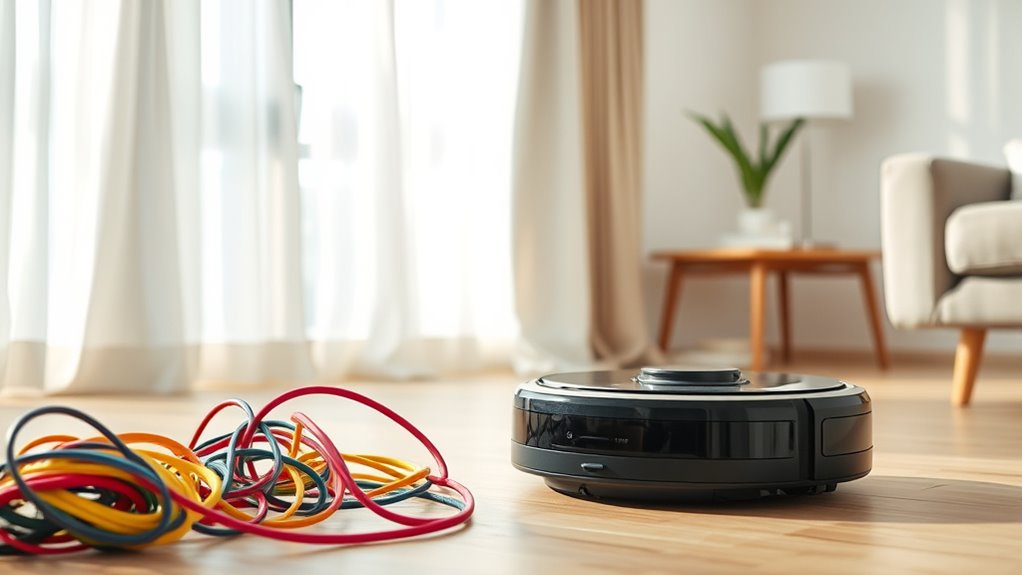
Have you ever wondered how AI-powered robots manage to navigate around tangled cords and billowing curtains without getting stuck? It all comes down to advanced robot navigation and obstacle detection systems that work seamlessly to keep these machines moving smoothly through complex environments. When you set a robot vacuum in a room, it doesn’t just blindly bump into everything; instead, it uses a combination of sensors and algorithms to map out its surroundings and adapt on the fly. This process begins with obstacle detection, where sensors like infrared, ultrasonic, or LiDAR scan the environment continuously, identifying obstacles in real-time. These sensors help the robot build a detailed map of the area, pinpointing the location of cords, curtains, furniture, and other potential hazards.
Once the robot detects an obstacle, its navigation system quickly processes this information to determine the best course of action. Instead of just stopping or backing away randomly, it calculates a new path that avoids entanglement or obstruction. This intelligent navigation allows the robot to maneuver around cords that might otherwise cause it to get stuck, pulling back or adjusting its route before a problem occurs. The robot’s ability to detect obstacles early and respond proactively makes it highly effective at avoiding common pitfalls like tangled cords or billowing curtains caught in its path.
The obstacle detection technology also enables the robot to distinguish between different types of objects. For instance, it recognizes fragile items or areas it shouldn’t enter, such as pet bowls or stairs. If it detects a curtain moving or a cord lying across the floor, it often responds by slowing down, changing direction, or lifting slightly—if equipped with such features—to prevent entanglement. Some robots even use machine learning to improve their obstacle detection over time, learning from previous encounters with cords, curtains, or other objects. This continuous improvement helps ensure they navigate more efficiently and safely with each use.
Robot navigation isn’t just about avoiding physical obstacles; it’s also about understanding the environment holistically. Many systems incorporate mapping technologies that create a virtual layout of the space, allowing the robot to plan its cleaning or movement routes intelligently. When cords or curtains are detected, the robot updates its map accordingly, avoiding problematic areas altogether. This dynamic, adaptive approach means you won’t need to worry about tangled cords or curtains halting your robot’s progress. Instead, it handles these challenges gracefully, maintaining smooth, efficient operation thanks to sophisticated obstacle detection and smart navigation. Additionally, recent advancements incorporate artificial intelligence to enhance obstacle recognition and decision-making, further improving navigation accuracy.
Frequently Asked Questions
How Do Ai-Powered Vacuums Detect Cords and Curtains?
You can depend on AI-powered vacuums to detect cords and curtains through advanced cord detection and obstacle mapping. They use sensors and cameras to identify obstacles, including cords, curtains, and furniture, in real-time. The vacuum maps your space, recognizing potential hazards and adjusting its path automatically. This smart navigation prevents tangles and ensures thorough cleaning without damaging your belongings, making your cleaning routine hassle-free.
Can AI Distinguish Between Different Types of Obstacles?
Yes, AI can distinguish different types of obstacles through advanced obstacle recognition. It uses sensor integration, combining data from cameras, infrared, and ultrasonic sensors to identify objects. This enables your vacuum to differentiate between cords, curtains, and furniture, adjusting its path accordingly. By analyzing obstacle shapes, sizes, and textures, AI guarantees efficient cleaning while avoiding tangles and collisions, making your cleaning experience smoother and more effective.
What Sensors Do AI Robots Use for Obstacle Avoidance?
You might worry your AI robot can’t navigate complex spaces, but it uses advanced sensors like lidar, cameras, and infrared to avoid obstacles. Through sensor fusion, it combines data for a clear picture, enabling obstacle mapping that prevents tangles and crashes. This smart integration guarantees your robot moves smoothly around cords and curtains, giving you peace of mind and a tidy home without constant supervision.
How Does AI Update Its Navigation Algorithms Over Time?
You see, AI updates its routing algorithms through machine learning, continuously learning from new data and experiences. It analyzes past performance, identifies inefficiencies, and adapts its strategies accordingly. This process, called routing optimization, helps AI robots improve their obstacle avoidance and path planning over time. By constantly refining their algorithms, they become smarter, more efficient, and better at maneuvering around tangled cords and curtains.
Are There Limitations to AI in Avoiding Delicate Objects?
AI can struggle with avoiding delicate objects because it relies on sensors and pre-programmed data, which may not always recognize fragile items. Manual calibration helps improve accuracy, but limitations remain. You can also use user customization to set specific no-go zones or prioritize safety. However, AI still might accidentally bump or slightly damage delicate objects if it hasn’t been properly calibrated or if it encounters unfamiliar items.
Conclusion
So, next time your AI-powered vacuum glides effortlessly past your chaos of cords and curtains, remember—it’s not just smart technology at work. Ironically, despite its precision, it’s still steering through the mess we created. While you relax, your robot’s probably secretly chuckling at how we try to outsmart tangled cords, only to be outsmarted by a machine that sees right through our clutter. Guess who’s really in control of the chaos now?