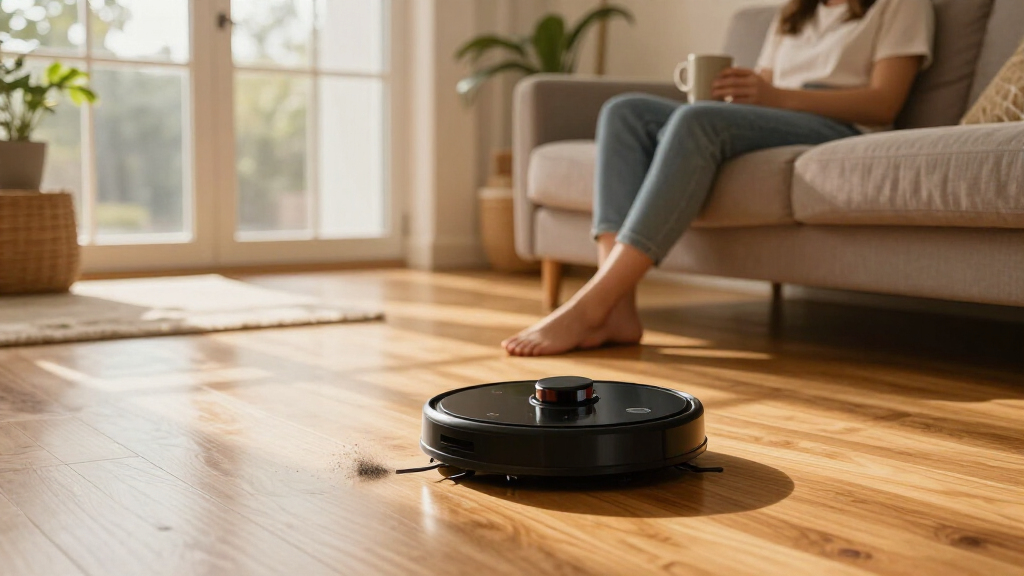
Hardwood floors are the easiest surface for a robot vacuum to clean — and the easiest to damage. That tension is why the Roomba Combo j9+ and the Roborock S8+ get compared constantly: both are flagships, both vacuum and mop, both dock themselves and empty their bins, and both cost enough that buyers expect the machine to actually protect a floor they paid thousands to install. The comparison is not really “which robot is best.” It is “which robot is best when the dominant surface in the house is hardwood, and you plan to use the mopping function on it.” Those two questions have different answers. iRobot built the Combo j9+ around mopping flexibility: the pads lift fully out of the way when the robot detects carpet, so it can vacuum the whole house while wet without dragging a damp pad onto rugs. Roborock built the S8+ around suction and navigation: 6,000 Pa of pull, dual rubber brushes that resist hair tangles, and lidar mapping that cleans in efficient straight lines instead of the bump-and-wander pattern older Roombas were known for. If your home is mostly open hardwood with area rugs, the retractable mop system on the Roomba is a genuine advantage. If your hardwood is punctuated by pet hair, dust buildup, and furniture to maneuver around, the Roborock is the stronger daily cleaner. This guide compares them head-to-head on the criteria that matter specifically for hardwood, tells you where the gaps are large and where they are cosmetic, and gives a direct recommendation for each type of buyer.

Get cleaning gear delivered free — and shop member deals
- Fast, free delivery on millions of items
- Access to Prime Big Deal Days deals on October 6–7
- Prime Video, Amazon Music and more included

iRobot Roomba 115X Combo Robot Vacuum & Mop with AutoEmpty Dock
- ✔ Suction Power: 15,000 Pa
- ✔ Coverage per Charge: Up to 900 sq ft
- ✔ AutoEmpty Bag Capacity: 2.5 L

ROPVACNIC Robot Vacuum and Mop Combo, 5200Pa Suction Robotic Cleaner
- ✔ Suction Power: 5200Pa
- ✔ Function: Vacuum and mop combo
- ✔ Water Tank: High-capacity, 4-stage water adjustment

iRobot Roomba 115X Combo Robot Vacuum & Mop with 10,000 Pa Suction and LiDAR Navigation
- ✔ Suction Power: 10,000 Pa
- ✔ Cleaning Coverage: Up to 900 sq ft per charge
- ✔ Navigation: ClearView LiDAR
At a Glance
| Criteria | iRobot Roomba Combo j9+ | Roborock S8+ | Winner |
|---|---|---|---|
| Dry debris pickup on hardwood | Good; single dual-action rubber brush, strong on dust and crumbs | Excellent; 6,000 Pa suction, dual rubber brushes, superior fine debris pickup | B |
| Mopping system for hardwood | Excellent; retractable pads, dedicated solution tank, wet edge-sweeping brush | Good; vibrating mop with lift, but lift is limited (~5mm) and single tank | A |
| Floor and finish safety | Good; pad retraction prevents wet contact with carpet | Good; low mop lift can dampen low-pile carpet edges | A |
| Navigation and coverage | Camera-based vSLAM; thorough but slower, more passes | Excellent; lidar maps, straight-line passes, room-level control | B |
| Pet hair handling | Very good; strong pickup but brush can wrap long hair | Excellent; picks up embedded fur along baseboards | B |
| Hair tangle resistance | Moderate; single brush edge collects some tangles | Excellent; dual split brushes actively shed hair into the bin | B |
| Obstacle avoidance | Excellent; detects cords, pet waste, laundry | Moderate; AI obstacle avoidance is decent but less reliable than Roomba’s | A |
| Self-empty dock and maintenance | Excellent; auto-empty plus pad washing and drying in dock | Good; auto-empty dock standard, mop washing only on Ultra variants | A |
iRobot Roomba 115X Combo Robot Vacuum & Mop with AutoEmpty Dock
When we weigh everything a hardwood floor needs from a robot — thorough coverage, controlled mopping, and minimal daily effort — the Roomba 115X Combo with AutoEmpty Dock is the most complete package in this lineup. Its 15,000 Pa suction is the strongest here, roughly triple the ROPVACNIC’s output, which translates directly into fewer passes needed to lift fine dust and ground-in grit from bare floors before it can scratch a finish.The ClearView LiDAR navigation is the other major differentiator. Rather than bouncing around the room like budget robots, this model maps your home and cleans in neat, systematic rows, even in low light. On hardwood, that methodical coverage matters: it reduces the debris scatter that random-navigation robots leave along baseboards and inside corners. The ROPVACNIC relies on sensor-based obstacle detection instead, which works but produces less predictable paths.The self-emptying dock is what elevates this pick above its 10,000 Pa sibling. The 2.5L AllergenLock bag traps 99% of pollen and mold and holds up to three months of debris, so the machine genuinely disappears from your routine. If you dislike handling dustbins — or anyone in the household has allergies — this alone justifies choosing this version over the others.The tradeoffs are real, though. Both Roombas in this guide cover up to 900 sq ft per charge, so larger homes will need multiple runs, and setup demands 2.4 GHz Wi-Fi. Filters and brushes are consumables requiring replacement every 3–6 months, which adds to long-term ownership costs the ROPVACNIC largely avoids.
Pros:
- Strongest suction in this lineup at 15,000 Pa for thorough bare-floor pickup
- Self-emptying dock with a 2.5L allergen-trapping bag lasts up to 3 months
- LiDAR navigation delivers systematic row cleaning and obstacle avoidance in low light
- No Mop Zones keep area rugs and carpet edges dry during mopping runs
Cons:
- Coverage tops out around 900 sq ft per charge, so bigger homes need multiple runs
- Requires 2.4 GHz Wi-Fi for setup, which may not suit every router
- Filters and brushes need replacement every 3-6 months, adding running costs
Best for: Owners of small-to-medium homes who want vacuuming, mopping, and emptying to be as close to fully automatic as possible.
Not ideal for: Large homes over roughly 900 sq ft, or buyers unwilling to pay extra for the convenience of a self-emptying dock.
Bottom line: If hands-off hardwood care is the goal, this is the machine that delivers it — maximum suction, orderly navigation, and months between empties.
“If hands-off hardwood care is the goal, this is the machine that delivers it — maximum suction, orderly navigation, and months between empties.”
ROPVACNIC Robot Vacuum and Mop Combo, 5200Pa Suction Robotic Cleaner
Not everyone needs LiDAR maps and a self-emptying dock — and that is exactly where the ROPVACNIC Robot S1 earns its place. It tackles the two jobs hardwood-and-pet households care about most — vacuuming scattered hair and mopping dust films — with 5200Pa suction that, while modest next to the Roombas, is ample for bare floors, where debris sits on the surface rather than embedding in fibers.Its standout feature for wood is the electronically controlled mop with four adjustable water levels. Compared with the Roombas’ fixed three-level approach, this finer granularity lets you dial output down to a barely-damp pass for sealed floors and up for stickier residue — a genuinely thoughtful design for moisture-sensitive hardwood. The 3-point cleaning system with dual rotating side brushes sweeps debris from edges into the suction path efficiently.Where this model pulls ahead of both Roombas for pet owners is the no-entanglement design. Hair that wraps around a brush is a maintenance headache; here it collects cleanly for disposal. Both Roombas fight this too — the 10,000 Pa version has anti-hair-wrap brushes — but the ROPVACNIC’s approach is effective and avoids premium pricing.Be realistic about the compromises. There is no self-emptying dock, so bin duty falls to you, and the compact dustbin fills faster in shedding season. Navigation is sensor-based rather than LiDAR, so cleaning paths are less orderly, and there are no No Mop Zones — you will need to use physical barriers (included with most robots) to keep rugs dry. It also struggles on high-pile carpet, though for a hardwood-first home that is a minor concern.
Pros:
- Four-stage water adjustment gives precise moisture control on sealed hardwood
- No-entanglement design makes pet hair cleanup notably easier
- App control, Alexa and Google Assistant voice commands, and scheduled cleaning
- Self-recharge and obstacle detection at a friendlier price than the Roombas
Cons:
- Smaller dustbin capacity means more frequent emptying
- No No Mop Zones, so rugs need physical protection during mopping
- Sensor-based navigation is less systematic than LiDAR row cleaning
Best for: Budget-conscious buyers and pet households with mostly hardwood or low-pile flooring who don’t mind emptying the bin themselves.
Not ideal for: Homes with lots of area rugs over hardwood (no No Mop Zones) or anyone who wants months of hands-free upkeep.
Bottom line: The smart pick if you want capable vacuum-and-mop performance and pet-hair handling on hardwood without paying for a dock or LiDAR mapping.
“The smart pick if you want capable vacuum-and-mop performance and pet-hair handling on hardwood without paying for a dock or LiDAR mapping.”
iRobot Roomba 115X Combo Robot Vacuum & Mop with 10,000 Pa Suction and LiDAR Navigation
Sandwiched between its dock-equipped sibling and the value-focused ROPVACNIC, the Roomba 115X Combo with 10,000 Pa suction is the middle path — and for many hardwood homes, the sweet spot. You get the same ClearView LiDAR navigation, the same No Mop Zones, and the same single-pass vacuum-and-mop design as the top pick, without paying for the AutoEmpty station.Its signature advantage over both other machines is SmartScrub. Where the ROPVACNIC’s mop glides and the 15,000 Pa model relies on pad pressure alone, SmartScrub applies more aggressive scrubbing action for dried-on messes — footprints, kitchen spills, tracked-in residue. For kitchens and dining areas adjoining hardwood, this is a meaningful difference in mopping quality, not a marketing flourish.Compared with the AutoEmpty version, you give up three months of hands-free disposal and about a third of the suction. In practice, 10,000 Pa is still nearly double the ROPVACNIC’s output and more than enough for bare floors, where dust and crumbs sit loosely on the surface. The anti-hair-wrap brushes rival the ROPVACNIC’s no-entanglement design for pet households, and edge-and-corner cleaning addresses the baseboard zones where random robots struggle.The honest drawbacks: the washable microfiber pad must be laundered by hand between mopping sessions — more upkeep than tossing a bag — and consumables still need replacing every 3–6 months. The 2.4 GHz Wi-Fi requirement and 900 sq ft per-charge ceiling are shared with its sibling, so very large homes should plan accordingly.
Pros:
- SmartScrub delivers deeper mopping for dried-on messes than the other two picks
- LiDAR navigation with neat-row cleaning and low-light obstacle avoidance
- No Mop Zones protect rugs and carpets from getting wet
- Anti-hair-wrap brushes make it a strong pet-hair performer
Cons:
- Washable mop pad requires manual laundering after each mopping run
- Filters and brushes need replacement every 3-6 months
- Requires 2.4 GHz Wi-Fi for setup
Best for: Buyers who want premium navigation and serious mopping performance on hardwood but don’t need the self-emptying dock.
Not ideal for: Anyone who wants maximum automation — skip up to the AutoEmpty model — or those wanting to avoid recurring filter and brush purchases.
Bottom line: The balanced choice — Roomba-grade navigation and the best scrubbing action here, at a lower commitment than the self-emptying flagship.
“The balanced choice — Roomba-grade navigation and the best scrubbing action here, at a lower commitment than the self-emptying flagship.”
As an Amazon Associate we earn from qualifying purchases.
Key Differences
The single biggest functional split is mopping design. The Roomba Combo j9+ is one of the few robots whose mop pads retract fully upward and inward when the machine detects carpet, meaning you can run a combined vacuum-and-mop job across a mixed-floor home without the robot dragging a soaked pad across a rug. Its dock also washes and hot-air dries the pads automatically, which matters on hardwood where a dirty pad smeared across the floor is worse than no mopping at all. The Roborock S8+ uses the excellent VibraRise vibrating mop, which scrubs better than passive drag pads, but it only lifts about 5mm — enough for short carpet pile to survive, but the risk of slight dampness at carpet edges is real. On a pure-hardwood home this disadvantage mostly disappears, and the Roborock’s more aggressive scrubbing becomes an asset.
The second split, and the one that favors Roborock decisively, is dry cleaning. The S8+ pulls 6,000 Pa of suction through dual rubber brushes that run in opposite directions, which does two things on hardwood: it captures fine dust that settles into board seams, and it feeds hair into the bin instead of wrapping it around the brush. The Roomba’s single main brush is competent, but long human hair tends to collect at the brush ends and needs manual trimming. The Roborock’s lidar navigation is also a practical advantage — it cleans in methodical lanes, knows exactly where it has been, and finishes jobs faster, while the camera-based Roomba is thorough but slower and can struggle in low light under beds and sofas.
The third split is obstacle avoidance, where iRobot wins. The Combo j9+ is among the best robots sold at recognizing and steering around phone chargers, socks, and — famously — pet waste, which is a genuine floor-saver if you have a dog. The Roborock’s avoidance is adequate but more error-prone with dark objects and thin cables. Neither weakness is fatal, but each defines the failure mode: a Roborock that eats a shoelace, or a Roomba that misses dust along a baseboard.
Detailed Comparison
Dry debris pickup on hardwood (Roborock S8+ wins — moderate)
Hardwood is where suction matters most visibly, because debris doesn’t hide in pile — it either gets picked up or gets pushed around. The Roborock S8+ wins this clearly. Its 6,000 Pa suction and dual rubber brushes capture fine dust along plank seams and baseboards in a single pass, where the Roomba often needs a second pass to match. The gap is moderate rather than enormous — the j9+ is not a weak cleaner, and on visible crumbs and everyday tracked-in dirt both robots leave a floor that looks clean. The difference shows up in the dust you don’t see: after a few weeks of Roborock runs, less fine grit accumulates along edges, and grit is what micro-scratches a hardwood finish over time. For a household with kids or pets, that edge compounds.
Mopping system for hardwood (iRobot Roomba Combo j9+ wins — major)
This is the Roomba’s strongest card and the main reason to buy it over the Roborock. The Combo j9+ carries a dedicated cleaning-solution tank, wets its pads on demand, retracts them completely for carpet, and returns to the dock to wash and hot-dry the pads after each job — a closed loop that keeps the pad from becoming a bacteria farm. The Roborock’s VibraRise mop actually scrubs harder thanks to its vibrating plate, and dried footprints or kitchen smears come off more easily, but the system is more manual: one water tank, pads you rinse yourself on the standard S8+, and a modest 5mm lift that can leave the edge of a low rug damp. If your home is 100 percent hardwood, the Roborock’s superior scrubbing arguably wins on cleaning quality. If hardwood is mixed with rugs or carpet, the Roomba’s full retraction is the difference between a set-and-forget robot and one you have to schedule around.
Floor and finish safety (iRobot Roomba Combo j9+ wins — minor)
Neither robot uses anything that will scratch a properly sealed hardwood floor — both ride on soft wheels and pads. The real safety question is water. Both let you control wetness, and both are safe on polyurethane-finished floors, which describe the vast majority of modern hardwood. The Roomba edges ahead because its pad washing and drying routine means the pad itself stays cleaner, reducing the chance of dragging grit or grime across the finish. One caution applies equally to both: never run either on waxed or oiled hardwood with any meaningful moisture, and keep both on the lowest wetness setting if your finish is older. The gap here is minor in day-to-day use but favors Roomba for anyone meticulous about their finish.
The Roborock S8+ uses lidar and cleans in straight, overlapping lanes. The Roomba uses camera-based mapping, which is accurate in good light but slower and occasionally disoriented in dark hallways or under furniture. In practice, the Roborock finishes a 1,500-square-foot main floor noticeably faster, hits edges more predictably, and lets you draw no-go zones and room-specific cleaning with more precision. The Roomba’s coverage is thorough — it just achieves thoroughness through persistence rather than planning. If your hardwood floors include a lot of furniture legs, dining chairs, and tight passages, the Roborock’s methodical approach misses less. The gap is moderate and consistent.
Pet hair handling (Roborock S8+ wins — moderate)
For shedding pets on hardwood, the Roborock is the better tool. Higher suction lifts embedded fur, and the dual counter-rotating rubber brushes move hair into the bin instead of winding it around the brush core. The Roomba picks up pet hair well in open areas, but longer hairs accumulate at the brush ends and require weekly scissors maintenance. With a short-haired dog the difference is minor; with two long-haired dogs or heavy human shedding, it becomes the difference between emptying a bin and disassembling a brush roll every weekend. Roborock wins, and the gap widens with hair volume.
Obstacle avoidance (iRobot Roomba Combo j9+ wins — moderate)
iRobot’s obstacle recognition is among the best available. The Combo j9+ reliably identifies cords, socks, towels, and pet accidents and steers around them — the pet-waste avoidance alone has saved many floors. The Roborock S8+’s AI avoidance is acceptable but more hit-and-miss, especially with dark-colored objects and thin cables, and it will occasionally try to eat a phone charger. On a cluttered family floor, the Roomba’s advantage is real and worth paying for; in a tidy home where the floor is picked up before runs, it rarely matters. Roomba wins by a moderate margin in cluttered households, a minor one otherwise.
Self-empty dock and maintenance (iRobot Roomba Combo j9+ wins — moderate)
Both docks auto-empty the dustbin into a bag you replace every couple of months, and both work well. The Roomba’s dock goes further: it refills the mop tank, washes the pads, and dries them with hot air, making it the lower-touch system overall. The standard S8+ dock only handles dust; mop maintenance on the base model is manual. Roborock sells higher trims (S8 MaxV Ultra and successors) that close this gap, but at higher prices. At like-for-like pricing, the Roomba demands less of your time if you mop regularly. Advantage Roomba, moderately.
iRobot Roomba Combo j9+: Pros and Cons
Pros:
- Best-in-class obstacle avoidance, including pet waste detection
- Fully retracting mop pads make mixed hardwood-and-rug homes truly hands-off
- Dock washes and hot-dries mop pads automatically
- Mopping system with dedicated solution tank cleans sealed hardwood well
Cons:
- Camera navigation is slower and less reliable in dark areas
- Single main brush wraps long hair and needs regular manual cleaning
- Lower suction means more fine-dust residue along baseboards
- Consumables (solution, pad replacements) add running cost
Roborock S8+: Pros and Cons
Pros:
- 6,000 Pa suction and dual rubber brushes excel at fine debris and pet hair
- Lidar navigation with straight-line coverage is faster and more precise
- VibraRise mop scrubs dried-on dirt better than drag pads
- Dual brushes shed hair into the bin — minimal tangle maintenance
Cons:
- Mop lift is only about 5mm; low-pile carpet edges can get damp
- Standard dock does not wash mop pads (manual rinse required)
- Obstacle avoidance is less dependable with cables and dark objects
- iRobot ecosystem users lose existing app routines and accessories
Who Should Choose What
Choose iRobot Roomba Combo j9+ if:
- Your hardwood floors are mixed with rugs or carpet and you want one robot to vacuum and mop without babysitting
- You have a dog and cluttered floors — pet waste and cord avoidance are worth real money to you
- You want the lowest-maintenance ownership experience: the dock handles the pads so you barely touch the machine
- Your home has dark hallways or you care less about speed and more about not missing obstacles
Choose Roborock S8+ if:
- Your home is mostly or entirely hardwood, so the limited mop lift doesn’t matter
- Pet hair or long human hair is your primary enemy — the dual brushes will save you weekly maintenance
- You want faster, methodical whole-floor coverage with precise no-go zones
- You mop mainly for kitchen smears and footprints, where the vibrating scrubber is stronger
Skip both if: Your floors include waxed or unfinished hardwood that must stay dry — use a dry-only robot vacuum (any Roomba j-series vacuum-only model or Roborock Q-series) and a proper mop instead.
Value for Money
Both robots sit in flagship territory, and neither is cheap, so the value question is which flagship feature set you will actually use. The Roomba Combo j9+’s retracting-mop system and pad-washing dock justify their premium only in mixed-floor homes. If every room is hardwood, you are paying iRobot’s top price largely for a carpet-safety feature you don’t need, while getting less suction and slower navigation — poor value. The Roborock S8+ typically sells for meaningfully less than the Combo j9+ while delivering better vacuuming, better navigation, and comparable (and on scrubbing, better) mopping on hard surfaces. On a pure-hardwood home it is both the better cleaner and the better value. On a mixed-floor home with pets and clutter, the Roomba’s automation depth starts to look cheap compared with replacing a rug a damp pad ruined or cleaning up after an avoided — or not avoided — accident.
Final Verdict
If your home is predominantly hardwood, buy the Roborock S8+. It vacuums better, navigates faster, handles hair without tangles, scrubs harder, and usually costs less — a clean sweep of the criteria that matter on hard floors. Choose the Roomba Combo j9+ specifically when your hardwood shares the house with rugs and carpet, when obstacle avoidance (especially around pets and cables) is a priority, or when you want the most automated mopping loop on the market. The deciding factor is your floor mix, not brand loyalty: single-surface hardwood homes belong to the Roborock; mixed-floor, pet-heavy, clutter-prone homes belong to the Roomba. And if your hardwood is waxed or unfinished, skip both and buy a vacuum-only model.
Frequently Asked Questions
Is the Roborock S8+ mopping safe on hardwood floors?
Yes, on standard polyurethane-sealed hardwood. The VibraRise mop uses controlled water amounts and a vibrating pad, and you can set low wetness levels. Do not use wet mopping on waxed, oiled, or unfinished hardwood with either robot.
Can the Roomba j9+ mop and vacuum in the same run without wetting carpets?
Yes. Its mop pads retract fully upward and inward when carpet is detected, so the pads stay clear of rug surfaces. This is the main advantage over the Roborock S8+, which only lifts its mop about 5mm.
Which robot is better for pet hair on hardwood?
The Roborock S8+. Its 6,000 Pa suction and dual counter-rotating rubber brushes capture embedded fur and shed hair into the bin. The Roomba picks up pet hair well but wraps long hair around its single brush, requiring more manual cleaning.
Does the Roborock S8+ dock wash the mop pads?
The standard S8+ dock auto-empties dust only; you rinse the mop cloth yourself. The pad-washing and hot-drying dock is found on the S8 MaxV Ultra and later Max trims at higher prices. The Roomba Combo j9+ dock washes and dries pads as standard.
Which is better for a large open-plan hardwood floor?
The Roborock S8+. Its lidar-based straight-line navigation covers large open areas faster and more completely, and its stronger suction handles the fine dust that settles across wide plank floors.
Halloween Picks
halloween
As an affiliate, we earn on qualifying purchases.