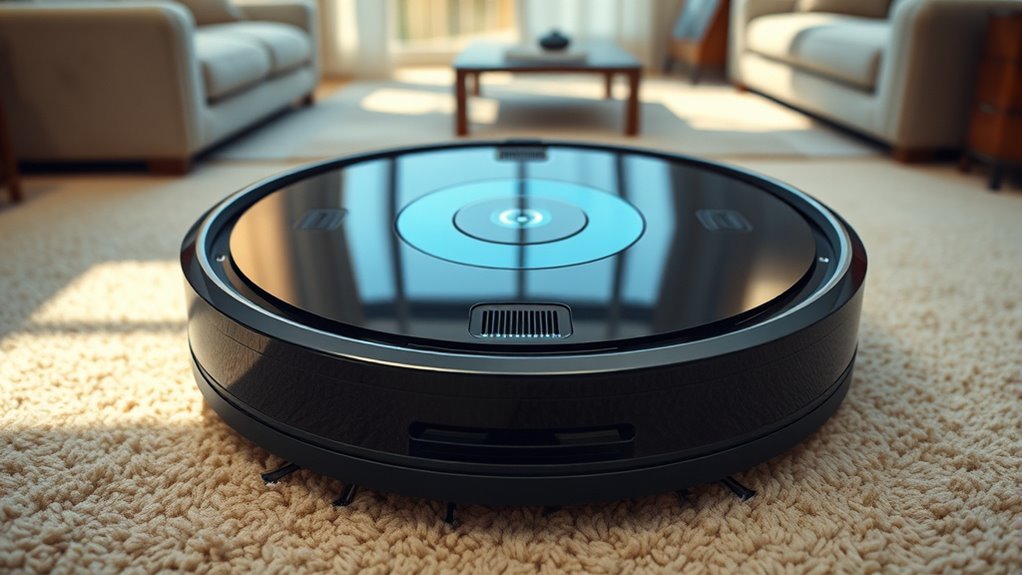

Robot vacuums miss spots mainly because of their sensors and mapping systems hitting limitations. Poor lighting, reflective surfaces, and clutter can confuse the sensors, leading to inaccurate maps. Complex room layouts or obstacles the device doesn’t recognize can cause missed areas or repeated cleaning. Sometimes, navigation errors or stuck situations happen because of these flaws. Want to understand how these issues can be minimized? Keep exploring to learn effective solutions to improve your vacuum’s coverage.
Key Takeaways
- Poor lighting and reflective surfaces can distort sensor readings, leading to inaccurate mapping.
- Complex room layouts and cluttered environments challenge the robot’s navigation and coverage.
- Obstacle detection failures cause the vacuum to miss or avoid certain areas.
- Inaccurate maps result in missed spots and repeated cleaning of the same areas.
- Regular maintenance and environment optimization improve mapping accuracy and reduce missed spots.
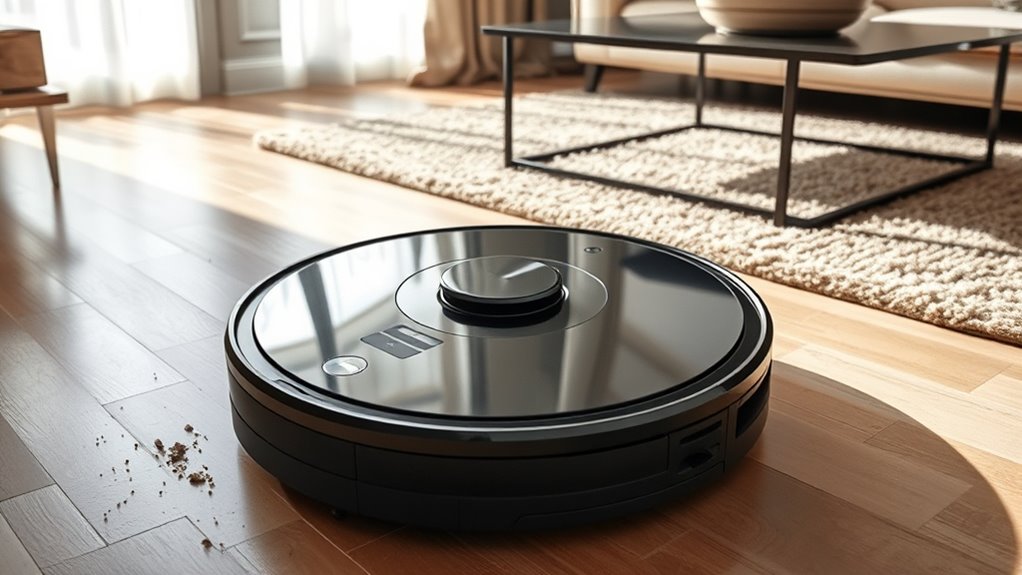
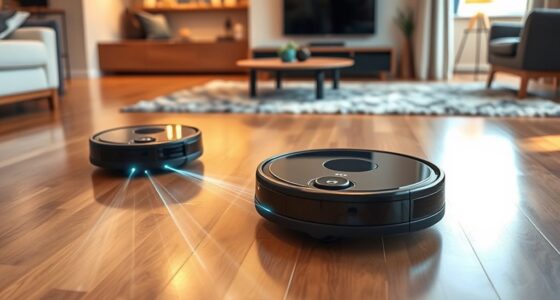
Have you ever wondered if your robot vacuum is really cleaning every corner of your home? Many users find themselves asking this question after noticing missed spots or uneven cleaning patterns. One key reason behind this is limitations in mapping accuracy. Modern robot vacuums rely on sensors and cameras to create a digital map of your space, but these systems aren’t perfect. Factors like poor lighting, reflective surfaces, or complex room layouts can interfere with how accurately the vacuum can understand and remember your home’s layout. When the mapping isn’t precise, the vacuum might overlook certain areas or revisit the same spots repeatedly, wasting time and missing sections altogether.
Even the best robot vacuums can miss spots due to mapping errors caused by poor lighting or complex layouts.
Obstacle detection also plays a significant role in this issue. Most robot vacuums are equipped with sensors designed to identify furniture, walls, and other objects in their path. However, these sensors can sometimes be fooled or fail to recognize smaller or oddly shaped items. If the obstacle detection isn’t reliable, the robot may avoid certain areas or get stuck trying to navigate around obstacles. This not only leaves some parts of your floor uncleaned but can also cause the vacuum to spend extra time trying to find an alternative route. In some cases, the vacuum might bump into furniture or get stuck, preventing it from completing its cleaning cycle effectively.
The combination of imperfect mapping accuracy and obstacle detection means that your robot vacuum’s ability to thoroughly clean your home isn’t always guaranteed. When the mapping system misreads or loses track of its position, it can create gaps in coverage. Even with advanced features like simultaneous localization and mapping (SLAM), errors can still occur, especially in cluttered or dynamic environments. Similarly, if obstacle detection isn’t up to par, the vacuum may avoid certain areas altogether or repeatedly bump into objects, disrupting its cleaning pattern. These limitations are often compounded in homes with complex layouts, multiple levels, or lots of small objects.
Understanding these constraints helps you set realistic expectations and troubleshoot issues more effectively. Regularly clearing clutter and ensuring good lighting can improve mapping accuracy, while placing obstacles or furniture in predictable locations can help your vacuum navigate more smoothly. Additionally, upgrading your device or performing regular maintenance can significantly enhance performance. Keep in mind that no robot vacuum is flawless, and some spots might still get missed despite the most advanced technology. Recognizing the roles of mapping accuracy and obstacle detection allows you to optimize your cleaning routines and get the most out of your device, ensuring cleaner floors with fewer missed spots.

HBFEYSZY Laser Distance Sensor, Compatible for Roborock S7, S5 Max, S6 Robot Vacuum Cleaner, LDS Lidar Motor Replacement Accessories Parts(S7 MaxV Ultra)
Imagine your robot gliding smoothly around chairs and tables, no more bumping into walls—this laser sensor calculates distances…
As an affiliate, we earn on qualifying purchases.
As an affiliate, we earn on qualifying purchases.
Frequently Asked Questions
Can Robot Vacuums Clean Stairs or Uneven Surfaces?
Robot vacuums generally can’t clean stairs or uneven surfaces effectively. They lack the necessary sensors and design features for stair cleaning, so you’ll need to do that manually. For uneven surfaces like thick carpets or irregular flooring, some models handle it better, but they still might struggle with deep cleaning or shifting smoothly. Always check your vacuum’s specifications to see if it’s suitable for your home’s specific uneven surfaces.
How Often Should I Update the Robot Vacuum’s Software?
Your robot vacuum’s software updates are like secret weapons that keep it running smoothly. You should check for updates every month or so—think of it as giving your device a fresh boost of superpowers. Regular maintenance routines, including software updates, prevent glitches and improve mapping accuracy. Don’t ignore these updates; they’re essential to make sure your vacuum cleans efficiently and never misses a spot, no matter how big or tiny.
Do Robot Vacuums Work Well on Thick Carpets?
When it comes to thick carpeting, robot vacuums can struggle with vacuum performance. You might notice they don’t clean as thoroughly because the dense fibers can clog brushes or hinder suction. To improve results, choose a model with strong motors and good brush technology designed for thick carpets. Regular maintenance like cleaning brushes and filters also helps. While some vacuums handle thick carpeting better, expect some limitations depending on the device.
Can Robot Vacuums Detect and Avoid Pet Messes?
You might wonder if robot vacuums can detect and avoid pet messes. While they excel at picking up pet hair and allergens, most lack the ability to recognize and steer clear of pet messes. Advanced models with better sensors can sometimes detect larger spills, but they generally don’t identify smaller or fresh pet messes. So, you’ll still need to oversee and clean up pet messes manually to ensure thorough cleanliness.
Are Robot Vacuums Effective in Cluttered or Crowded Rooms?
In cluttered or crowded rooms, robot vacuums face navigation challenges that can hinder their effectiveness. Obstacles like furniture, cords, or toys may block their path or cause them to miss spots. Although many models improve obstacle avoidance, you might still notice missed areas. To get the best results, clear clutter when possible and choose a vacuum with advanced sensors. This helps guarantee thorough cleaning despite the navigation challenges.
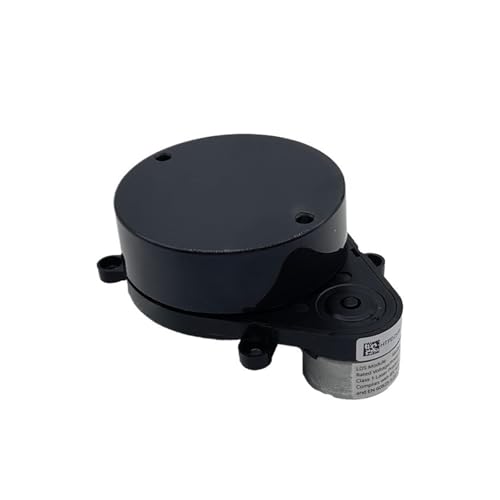
UKDNAEUF Compatible for Roborock S8 S85 S8. Distance Sensor Vacuum Cleaner LDS Replacement Accessories LDS06RR
Environmental adaptation: It can work stably in dark or strong light environment, and adapt to complex family environments
As an affiliate, we earn on qualifying purchases.
As an affiliate, we earn on qualifying purchases.
Conclusion
So, now you see that robot vacuums are like explorers with a map drawn in sand—they can’t see every detail. Their mapping limitations mean some spots will always be missed, no matter how clever they seem. But understanding these quirks helps you work around them. Think of your vacuum as a diligent but imperfect friend—you’ll just need to help fill in the gaps to keep your floors spotless and happy.

Shark AV2501AE AI Robot Vacuum with XL HEPA Self-Empty Base, Bagless, 60-Day Capacity, LIDAR Navigation, Perfect for Pet Hair, Compatible with Alexa, Wi-Fi Connected, Carpet & Hard Floor, Black
INCREDIBLE SUCTION: Powerful Shark suction picks up dirt and debris on all floor types—tackling even the toughest of…
As an affiliate, we earn on qualifying purchases.
As an affiliate, we earn on qualifying purchases.

Peak Select 2-Inch Robotic Vacuum Bumper Extender – Anti-Stuck Guard for Robot Vacuums, Prevents Getting Trapped Under Furniture or Beds
Prevent Robot Vacuums from Getting Stuck – Designed to raise your vacuum by 2 inches, these bumper extenders…
As an affiliate, we earn on qualifying purchases.
As an affiliate, we earn on qualifying purchases.