If you’re comparing lidar and camera navigation for robot vacuums, lidar-based models are generally smarter because they provide more precise mapping and obstacle detection. They perform reliably regardless of lighting, making them better suited for complex or cluttered spaces. Cameras, on the other hand, excel at visual recognition but rely on good lighting conditions. To understand which system fits your needs best and how they truly differ, keep exploring these options further.
Open a free Amazon Business account
Business pricing, bulk buying and tax-exempt orders.
As an affiliate, we earn on qualifying purchases.
Key Takeaways
- LiDAR offers highly accurate mapping and obstacle detection regardless of lighting, making it more reliable in complex or cluttered environments.
- Camera systems excel at visual object recognition and contextual awareness, such as identifying cords or small objects.
- LiDAR performs consistently in all lighting conditions, ensuring thorough cleaning without reliance on ambient light.
- Cameras may struggle in poor lighting or with reflective surfaces, which can hinder navigation accuracy.
- Overall, LiDAR is smarter for precise mapping and obstacle avoidance, while cameras enhance visual recognition and contextual understanding.
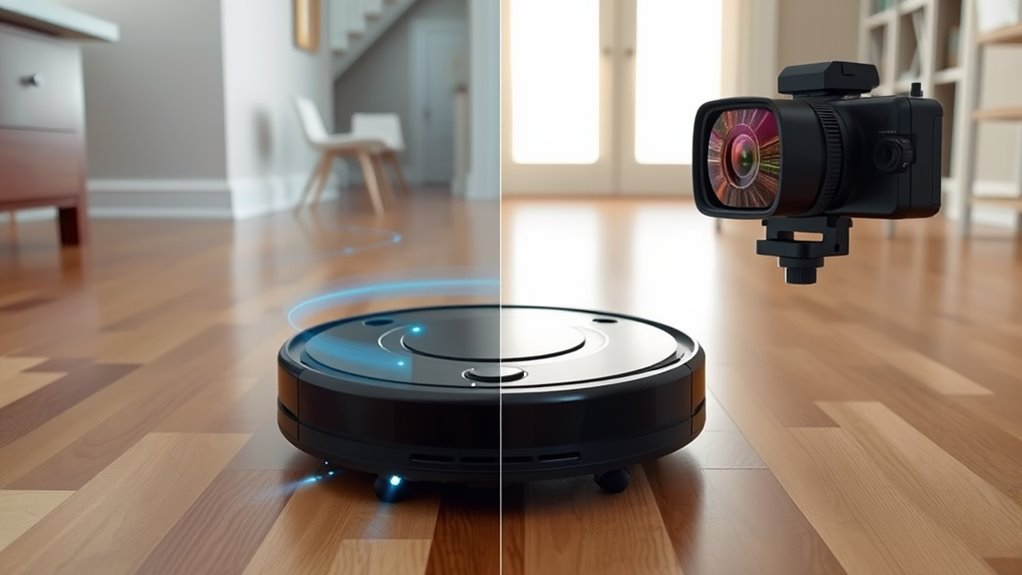
When it comes to autonomous navigation, choosing between LiDAR and camera systems is essential for ensuring safety and efficiency. Both technologies have unique strengths that can considerably influence a robot vacuum’s performance, especially in areas like mapping accuracy and obstacle detection. If you prioritize precise mapping, LiDAR usually takes the lead because it emits laser pulses to create detailed 3D maps of your environment. This laser data allows the robot to understand the layout of your space with high precision, helping it navigate complex rooms and avoid obstacles with greater certainty. The superior mapping accuracy means fewer missed spots and a more thorough clean, even in cluttered or dynamic environments. Additionally, LiDAR’s ability to detect obstacles at various distances and heights reduces the chances of bumping into furniture or missing objects, providing a smoother, safer cleaning experience. Moreover, LiDAR systems typically perform well in different lighting conditions, unlike camera systems that can be affected by poor lighting or reflections.
On the other hand, camera systems leverage visual data to interpret your environment. Cameras capture real-time images, allowing the robot to recognize objects, surfaces, and even changes in lighting conditions. While this can enhance obstacle detection, especially for identifying specific items like cords or small objects, camera-based navigation can sometimes struggle with accuracy. Poor lighting, reflections, or transparent objects may interfere with the camera’s ability to create a reliable map. Consequently, camera systems often have less precise mapping capabilities compared to LiDAR. They may also be more susceptible to errors in obstacle detection, particularly in complex or cluttered spaces. However, cameras excel at providing contextual information—such as identifying areas that need extra attention or recognizing when the robot is in a different room—adding a layer of intelligence that can improve navigation over time. The integration of visual recognition with other sensors can further enhance the robot’s ability to adapt to various environments.
Choosing between the two depends on your priorities. If you want a robot vacuum with highly accurate mapping and reliable obstacle detection, LiDAR is generally the smarter choice. It offers consistent performance regardless of lighting conditions and can handle complex environments efficiently. But if you prefer a system that can visually identify objects and adapt to changes in its surroundings more contextually, a camera-based system might suit you better. Ultimately, understanding how each technology influences mapping accuracy and obstacle detection helps you select the robot vacuum that matches your cleaning needs and environment.
Frequently Asked Questions
How Do Environmental Factors Affect Lidar and Camera Navigation?
Environmental factors profoundly impact sensor interference and weather resilience in robot navigation. You’ll find that lidar can struggle in fog, rain, or snow, as moisture and particles disrupt its laser signals. Cameras, on the other hand, may have difficulty in low light or glare, affecting their accuracy. To keep your robot effective, consider models with weather-resistant features and sensors designed to minimize interference in various conditions.
Which Technology Offers Better Performance in Pet Hair Removal?
When it comes to pet hair removal, sensor accuracy plays a big role in a robot vacuum’s effectiveness. Cameras tend to do better here because they can better identify and focus on pet hair, especially on uneven surfaces. Lidar sensors may miss some pet hair, but they excel at mapping and navigation. Overall, a vacuum with a combination of sensors provides the best performance for pet hair removal.
Are There Any Privacy Concerns With Camera-Based Navigation?
Did you know that 81% of consumers worry about privacy implications with smart devices? Camera-based navigation can raise privacy concerns because it captures images and videos of your home, potentially exposing sensitive data. While manufacturers implement data security measures, you should stay cautious about who has access to this information. Always review privacy policies and consider the trade-offs between convenience and data security to protect your home’s privacy.
What Is the Maintenance Cost Difference Between Lidar and Camera Systems?
When comparing maintenance costs, lidar systems generally cost more due to complex sensor calibration and delicate hardware that needs frequent adjustments. Camera systems tend to be more affordable initially and require less calibration, but their durability may vary with exposure to dust and debris. You’ll find that lidar’s advanced sensors can lead to higher ongoing costs, while camera systems often need simpler upkeep, making them more budget-friendly over time.
How Do Lidar and Camera Systems Perform in Low-Light Conditions?
In low-light conditions, lidar systems excel because they don’t rely on ambient light and can perform effective night vision. They provide reliable obstacle detection even in darkness, ensuring thorough cleaning. Cameras, however, struggle without sufficient light, reducing their accuracy in obstacle detection and navigation. So, if you need a vacuum that works well in the dark, lidar-based models are your best choice for consistent performance and safety.
Conclusion
Think of lidar and cameras as two guides on a journey—you choose which leads you through the maze better. Lidar acts like a seasoned explorer, mapping every corner with precision, while cameras are like keen-eyed scouts, relying on sight and context. Neither is perfect alone, but together, they form a trusted team, steering the complexity of your home. Ultimately, the smartest robot vacuum combines both, like a wise traveler with both a map and sharp eyes—ensuring no corner is left unseen.
Flea & tick season Picks
flea and tick prevention
As an affiliate, we earn on qualifying purchases.