

AI object recognition helps robots see and tell apart items like toys and cables by analyzing visual information with advanced machine learning and image processing. You can think of it as giving robots the ability to identify objects based on shapes, colors, and textures. They learn from thousands of labeled images to improve accuracy and distinguish similar items. As these technologies get better, robots become more capable of understanding their environment—if you keep exploring, you’ll discover how they do it in detail.

Get cleaning gear delivered free with Prime
- Fast, free delivery on millions of items
- Prime Video, Amazon Music and more included
- Member-only deals all year
Key Takeaways
- Robots use machine learning algorithms trained on labeled images to identify toys and cables accurately.
- Image processing techniques highlight features like edges and textures, aiding object differentiation.
- Deep neural networks analyze complex visual patterns to distinguish similar objects, such as plush toys and plastic figures.
- AI systems combine visual data to recognize object attributes like color, size, and shape for precise identification.
- Continuous learning improves robotic perception, enabling better handling of diverse toys and tangled cables in real environments.
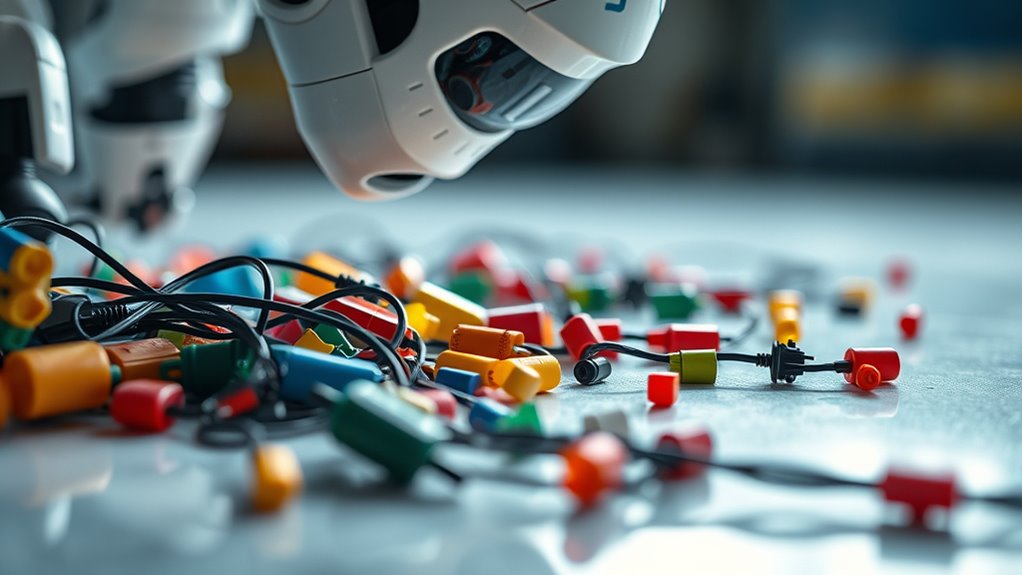
Have you ever wondered how computers can identify and categorize objects in images with such accuracy? It’s a fascinating process that relies heavily on machine learning and image processing. When a computer is taught to recognize objects, it doesn’t do so through simple rules; instead, it learns from vast amounts of data. Machine learning algorithms analyze countless images, picking up on patterns and features that distinguish one object from another. This training enables the system to make predictions about new images it encounters, identifying objects like toys, cables, or even complex scenes with impressive precision.
Computers recognize objects by learning patterns from vast image datasets with machine learning.
Image processing plays a vital role in this. It involves transforming raw images into a format that machines can understand better. Techniques like filtering, edge detection, and segmentation help highlight important features within an image. For example, when a robot scans a cluttered room, image processing helps it differentiate between a toy car and a pile of cables by emphasizing edges, shapes, and textures. These processed images become the foundation for the machine learning models to analyze and classify objects accurately.
The whole process begins with data collection. Developers feed the system thousands of labeled images—pictures where objects are already identified. The machine learning model then learns to recognize patterns associated with each label. Over time, it improves its accuracy through iterative training and validation. When the robot sees a new object, it compares the visual features it detects against its learned patterns. If it recognizes a toy, it might say, “That’s a toy car,” or if it spots a tangled cable, it can classify and even help in organizing or avoiding it.
Deep learning, a subset of machine learning, has revolutionized this field. Using neural networks that mimic the human brain’s structure, these models can analyze complex images and understand subtle differences between similar objects. This is why modern robots can distinguish between a plush teddy bear and a plastic action figure or tell apart different types of cables based on thickness, color, and texture.
In essence, machine learning and image processing work together to give robots the ability to see and understand their environment. They transform raw pixels into meaningful information, allowing machines to recognize objects with remarkable accuracy. Vetted Whether it’s sorting toys, avoiding obstacles, or identifying cables, AI object recognition continues to improve, making robots more capable and versatile in everyday tasks.
AI object recognition robot toys
As an affiliate, we earn on qualifying purchases.
As an affiliate, we earn on qualifying purchases.
Frequently Asked Questions
How Accurate Is AI in Identifying Overlapping Objects?
You’ll find AI’s accuracy in identifying overlapping objects varies, but it’s improving thanks to occlusion handling and advanced feature extraction techniques. When objects overlap, AI uses these methods to distinguish each item by analyzing visible features, even if parts are hidden. While some challenges remain, recent models achieve high accuracy in complex scenes, making object recognition more reliable. With ongoing development, expect AI to become even better at handling overlaps.
Can AI Recognize Objects in Low-Light or Cluttered Environments?
You might think AI struggles in low-light or cluttered environments, but it’s evolving fast. With night vision and advanced clutter management techniques, AI can now recognize objects even in challenging conditions. Cameras equipped with infrared or thermal sensors help improve visibility, while sophisticated algorithms filter through clutter for accurate identification. So, yes, AI’s getting better at seeing in the dark and managing clutter, making robots more effective in complex settings.
How Does AI Handle New or Unseen Object Types?
When you introduce new or unseen object types, AI handles this through transfer learning and diverse training datasets. It leverages pre-trained models to adapt quickly, recognizing similarities with known objects. This process allows you to improve recognition accuracy even for unfamiliar items by fine-tuning the system with additional data. As a result, your AI becomes more flexible, better equipped to identify new objects in various environments without extensive retraining.
What Are the Limitations of Current AI Object Recognition?
You should know that current AI object recognition faces limitations like reliance on extensive visual datasets, which may lack diversity and cause poor performance on unseen objects. Additionally, algorithm robustness can be compromised by variations in lighting, angles, or occlusion. These factors make it challenging for AI systems to consistently identify objects accurately in real-world environments, highlighting the need for improved training data and more resilient algorithms.
How Do Robots Differentiate Similar-Looking Objects?
You notice that robots differentiate similar-looking objects by using depth perception and texture analysis. Depth perception helps them understand spatial relationships, making it easier to distinguish objects based on distance or size. Texture analysis allows robots to identify subtle surface differences, like smoothness or pattern, which are essential for telling objects apart. By combining these techniques, robots improve their accuracy in recognizing and differentiating objects that appear alike.
Cable identification and organization tools
As an affiliate, we earn on qualifying purchases.
As an affiliate, we earn on qualifying purchases.
Conclusion
Now that you understand how AI object recognition helps robots identify toys and cables, you might wonder just how much smarter they’ll get someday. With these advancements, robots are becoming more capable of understanding their environment and assisting you in daily tasks. Isn’t it exciting to think about a future where machines can see and interpret the world just like we do? As technology evolves, the possibilities are endless—are you ready to see what’s next?
Machine learning image processing devices
As an affiliate, we earn on qualifying purchases.
As an affiliate, we earn on qualifying purchases.
Robotic object detection sensors
As an affiliate, we earn on qualifying purchases.
As an affiliate, we earn on qualifying purchases.
Halloween Picks
halloween
As an affiliate, we earn on qualifying purchases.