Robot vacuums with data encryption can help protect information sent between a cleaner, its app, and cloud services, but encryption details are not equally clear across brands. My best overall pick is the iRobot Roomba 105 Combo with AutoEmpty Dock for buyers who want a recognizable connected-vacuum ecosystem, while the Dreame L40 Ultra Gen 2 and Roborock Qrevo 2 Pro stand out for buyers prioritizing advanced cleaning features. The key tradeoff is that app-based mapping and automation can add convenience while collecting more household data than a basic remote-controlled model. Product descriptions alone do not verify encryption methods, retention policies, or account protections, so I separate documented privacy information from features that still need confirmation. Read on for the lineup, the privacy checks I recommend, and help matching a model to your needs.

Get cleaning gear delivered free with Prime
- Fast, free delivery on millions of items
- Prime Video, Amazon Music and more included
- Member-only deals all year
Complete the kit


Key Takeaways
- Privacy documentation separates the shortlist: the supplied product details list cleaning and connectivity features, but do not specify encryption protocols, data retention periods, or account-security options for any model.
- Connected convenience brings more privacy questions: the Dreame L40 Ultra Gen 2 and Roborock Qrevo 2 Pro offer high-suction, app-connected cleaning, while buyers should check what mapping and cloud features transmit.
- The eufy 11S MAX is the simplest connectivity choice: its listed remote control and quiet, thin design make it a candidate for buyers who want fewer app-dependent features, though its encryption practices still need checking.
- Self-emptying docks add both convenience and system complexity: the Tikom, Roomba 105 Combo, and Bagotte models reduce bin-emptying work, but buyers should review account and network settings for the robot and its connected services.
- Cleaning specifications do not establish privacy quality: suction figures, navigation labels, and voice-control compatibility cannot substitute for clear vendor statements about encryption, storage, sharing, and software support.




| robot vacuums with data encryption | Suction power |
|---|---|
| Robot Vacuum and Mop | 6500Pa |
| Tikom Robot Vacuum and Mop wit | 6000Pa |
| eufy 11S MAX Robot Vacuum Clea | — |
| Dreame L40 Ultra Gen 2 Robot V | 25,000Pa |
| iRobot Roomba 105 Combo Robot | — |
| ROPVACNIC Robot Vacuum and Mop | 5200Pa |
| Robot Vacuum and Mop Combo | 5000Pa |
| Roborock Qrevo 2 Pro Robot Vac | 20,000Pa |
| Bagotte Robot Vacuum and Mop C | 6000Pa |
More Details on Our Top Picks
Robot Vacuum and Mop, 6500Pa Suction, 2-in-1 Robotic Vacuum with Gyro Navigation, 200 Min Runtime, App/Remote/Voice Control, Pet Hair, Hard Floor, Carpet
The E8S is the practical choice for buyers who want a vacuum-and-mop combo and long cleaning sessions without adding a self-emptying dock. Its 200-minute runtime exceeds the Tikom’s listed 150 minutes, which may help cover larger areas before recharging. Gyro navigation provides systematic coverage, though it lacks the 360° LiDAR mapping and multi-floor maps listed for the Tikom. For a privacy-conscious home, the control options include a remote and buttons, but app and voice use add connected-device considerations; the supplied product information does not specify encryption, so I can’t verify its data protections. The 2.4GHz-only Wi-Fi requirement may also complicate setup, and the modest water tank means mopping requires hands-on refills. Choose it for runtime and basic versatility, not verified privacy safeguards or low-maintenance mopping.
Pros:- Listed runtime of up to 200 minutes supports longer cleaning sessions.
- 6500Pa suction is specified for vacuuming debris and pet hair.
- Combines vacuuming and mopping with selectable cleaning modes.
- Remote and button control offer alternatives to app use.
Cons:- Product information does not document encryption or other data-security protections.
- 2.4GHz-only Wi-Fi limits compatibility with some home network setups.
- The 200ml water tank requires manual refilling for mop use.
Best for: Buyers with a larger hard-floor area who want long runtime, basic app or voice control, and are comfortable refilling the water tank.
Not ideal for: Privacy-focused buyers who require documented encryption, or households using only 5GHz Wi-Fi and expecting LiDAR mapping or automated mop care.
- Suction power:6500Pa
- Runtime:Up to 200 minutes
- Battery capacity:2600mAh
- Water tank capacity:200ml
- Dustbin capacity:300ml
- Navigation:Gyro inertial navigation
- Control options:App, remote, and Google Assistant voice control
- Wi-Fi:2.4GHz only
Our verdict“Pick the E8S for long runtime and basic two-in-one cleaning, but skip it if documented encryption or LiDAR mapping is a must.”
Tikom Robot Vacuum and Mop with Self-Emptying Base
The Tikom’s clearest advantage is not a stated security feature but the option to rely on its self-emptying base and scheduled cleaning, reducing how often owners need to interact with the app. Its 3L dock and up-to-five floor maps make it a stronger fit for multi-level homes than the E8S, while 360° LiDAR gives it more detailed mapping than that model’s gyro navigation. The product details list app and Alexa control but do not confirm data encryption; buyers seeking proof of encrypted storage or transmission should ask the manufacturer before connecting it. Its dual-band Wi-Fi is more flexible than the E8S’s 2.4GHz-only connection, though mop mode requires removing the holder or setting no-go zones. Battery life is shorter than the E8S’s listed 200 minutes, and mapping features bring a learning curve.
Pros:- 3L self-emptying base reduces routine debris-bin maintenance.
- 360° LiDAR navigation supports detailed mapping and obstacle avoidance.
- Stores up to five floor maps for multi-floor homes.
- Works with both 2.4GHz and 5GHz Wi-Fi.
Cons:- Product information does not specify encryption or data-handling protections.
- Mop use requires removing the holder or creating no-go zones.
- Listed 150-minute battery life is shorter than the E8S’s 200 minutes.
Best for: Households with pets or multiple mapped floors that want a self-emptying dock and can keep routine cleaning schedules simple.
Not ideal for: Buyers who need documented encryption, very long uninterrupted runtime, or a mop that switches modes without manual setup or no-go zones.
- Suction power:6000Pa
- Self-emptying dustbin:3L
- Battery life:Up to 150 minutes
- Navigation:360° LiDAR
- Floor maps:Up to 5
- Wi-Fi:2.4GHz and 5GHz
- App control:Yes
- Voice control:Alexa
Our verdict“Choose the Tikom if automated emptying and LiDAR mapping matter more than verified encryption or seamless mop-mode changes.”
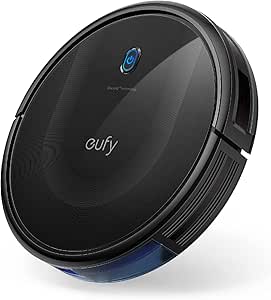
eufy 11S MAX Robot Vacuum Cleaner, Super Thin, Quiet
For buyers trying to limit a robot vacuum’s network footprint, the eufy 11S MAX is the most straightforward option here: it has no Wi-Fi or app support. That means the supplied specifications describe no app-based mapping or cloud-connected control, though they also make no explicit encryption claim; this is a simpler connectivity profile, not proof of a certified security standard. Compared with the Tikom and Roomba 105 Combo, it gives up mapped cleaning, voice control, and remote app management in exchange for operation by remote and buttons. Its 2.85-inch profile suits homes with low furniture, and BoostIQ adjusts suction across surfaces. The tradeoff is a shorter listed runtime than the E8S and no mopping or self-emptying dock, so it fits buyers who value basic vacuuming over automation.
Pros:- No Wi-Fi or app connection is listed, reducing app and network dependence.
- 2.85-inch profile can reach under some low-clearance furniture.
- BoostIQ adjusts suction for different surfaces.
- Remote control and onboard buttons support operation without an app.
Cons:- No explicit encryption or security certification is provided.
- No app, Wi-Fi, voice control, or smart mapping.
- Vacuum-only design lacks mopping and a self-emptying dock.
Best for: Privacy-minded buyers who want an app-free robot for routine vacuuming, especially in homes with low-clearance furniture.
Not ideal for: Buyers who need mopping, mapped room-by-room control, voice commands, or documented encryption certification.
- Profile:2.85 inches
- Battery life:Up to 100 minutes
- Suction technology:BoostIQ
- Control:Remote control and buttons
- Connectivity:No Wi-Fi or app support
- Obstacle sensing:Infrared obstacle sensors
- Drop sensing:Drop-sensing technology
- Surface compatibility:Hardwood floors and other surfaces
Our verdict“Choose the eufy 11S MAX for simple, app-free vacuuming and a slim profile, not for connected features or a documented encryption standard.”
Dreame L40 Ultra Gen 2 Robot Vacuum and Mop with 25,000Pa Suction
The Dreame L40 Ultra Gen 2 is the feature-rich choice for buyers who want a robot vacuum and mop to handle more of the routine work, with a self-cleaning dock, long listed cleaning time, and carpet-aware modes. Its 25,000Pa suction is far above the E8S’s 6500Pa specification, while mop lifting helps reduce wetting on carpet. The tradeoff is a more connected setup: it supports app control and voice assistants, but the supplied product details do not state whether data is encrypted or explain retention and sharing. The Tikom offers self-emptying and LiDAR mapping too, with a more explicit multi-floor-map count; the Dreame’s differentiators are its stronger stated suction and dock functions. It is limited to 2.4GHz Wi-Fi, and the detergent dispenser is optional, so its upkeep features are not all included.
Pros:- Listed 25,000Pa suction is the highest specified among these five products.
- Self-cleaning dock reduces some routine maintenance.
- Mop lifting and carpet-focused modes support mixed-floor homes.
- Up to 231 minutes of cleaning time is suited to longer sessions.
Cons:- Product data does not document encryption or explain connected-data handling.
- 2.4GHz-only Wi-Fi may not suit every home network.
- Optional detergent dispenser adds a separate purchase and is not included as standard.
Best for: Buyers seeking a premium vacuum-and-mop system with a self-cleaning dock, carpet-aware modes, and long cleaning sessions.
Not ideal for: Buyers who require documented encryption, dual-band Wi-Fi, or a setup that avoids optional add-ons and connected controls.
- Suction power:25,000Pa
- Battery capacity:5200mAh
- Cleaning time:Up to 231 minutes
- Cleaning area:Up to 1679 ft²
- Wi-Fi:2.4GHz
- Voice assistants:Alexa, Siri, and Google Home
- Mop lifting:0.41 inches
- Dock:Self-cleaning dock
Our verdict“Choose the Dreame for high stated suction and dock-assisted cleaning, but verify its data protections directly if encryption is a requirement.”
iRobot Roomba 105 Combo Robot Vacuum & Mop with AutoEmpty Dock
The Roomba 105 Combo suits buyers who want LiDAR mapping, an AutoEmpty dock, and the choice to vacuum, mop, or do both in one connected system. Its listed 75-day debris capacity makes it a lower-maintenance alternative to the E8S, which has no self-emptying dock in the supplied specs. Like the Tikom, it maps the home, but the Roomba’s details highlight adjustable water flow and a microfiber pad rather than a stated multi-floor-map count. App and voice control add convenience, yet the product data does not confirm encryption or describe how maps and account data are protected. That makes it a poor fit for anyone who needs documented security assurances before connecting a device. The mop is intended for routine upkeep, not heavily soiled floors, and Wi-Fi is limited to 2.4GHz.
Pros:- AutoEmpty dock is listed for up to 75 days of debris.
- LiDAR mapping supports mapped cleaning coverage.
- Offers vacuum-only, mop-only, and combined cleaning modes.
- Adjustable water flow provides some control over routine mopping.
Cons:- Product information does not confirm encryption or explain map-data handling.
- 2.4GHz-only Wi-Fi excludes some network setups.
- Mopping may not handle heavily soiled floors effectively.
Best for: Buyers who want an app-controlled vacuum-and-mop with LiDAR mapping and an AutoEmpty dock for routine household cleaning.
Not ideal for: Privacy-focused households requiring documented encryption, homes dependent on 5GHz Wi-Fi, or buyers expecting heavy-duty mopping.
- AutoEmpty dock capacity:Up to 75 days of debris
- Suction:70X more power-lifting suction
- Navigation:LiDAR mapping
- Cleaning modes:Vacuum, mop, or combo
- Mop:Microfiber pad with adjustable water flow
- Wi-Fi:2.4GHz
- Control:App, voice assistant, and buttons
Our verdict“Pick the Roomba 105 Combo for mapped cleaning and reduced bin maintenance, but seek direct encryption details before connecting it.”
ROPVACNIC Robot Vacuum and Mop Combo 5200Pa Suction Robotic Cleaner
The ROPVACNIC S1 earns a place for buyers who want a vacuum-and-mop combo with a specific focus on reducing hair tangles. Its dual electric side brushes are described as no-entanglement, a useful distinction for pet owners who regularly deal with loose fur. The 5200Pa suction is solid on paper, though it falls short of the Bagotte’s 6000Pa and well below the Roborock Qrevo 2 Pro’s 20,000Pa rating. A four-stage water adjustment gives more control over mopping than the supplied details for some rivals, but the product data does not specify mapping, battery runtime, or encryption practices. Alexa and Google Assistant compatibility adds convenience, while setup may take patience. I’d choose it for hair handling and adjustable mopping, not for buyers prioritizing verified data protection or advanced mapping.
Pros:- Dual electric side brushes are described as designed to prevent hair tangles.
- 5200Pa suction and vacuum-mop functionality cover routine floor cleaning.
- Four-stage water adjustment allows different mopping output.
- Alexa and Google Assistant compatibility offers voice control.
Cons:- No encryption, data handling, or security certification details are provided.
- Setup may be complex for users who want a straightforward first run.
- Suction is lower than the listed 6000Pa Bagotte and 20,000Pa Roborock.
Best for: Pet owners who want a combined vacuum and mop with a stated tangle-resistant brush design and adjustable water flow.
Not ideal for: Privacy-first buyers seeking documented encryption or security practices, and households that need specified mapping or runtime details.
- Suction power:5200Pa
- Cleaning functions:Vacuuming and mopping
- Water tank adjustment:Four-stage adjustment
- Cleaning modes:Multiple customizable modes
- Voice assistants:Alexa and Google Assistant
- Pet-hair design:No-entanglement dual electric side brushes
Our verdict“Choose the ROPVACNIC if pet-hair handling and adjustable mopping matter more than documented privacy safeguards or advanced navigation.”
Robot Vacuum and Mop Combo, 5000Pa Self-Charging Robotic Vacuum with Alexa & App Control, 3-in-1 for Pet Hair, Carpet, and Floors
This model is the lineup’s flexible midrange-style pick on features: it combines 5000Pa suction, carpet auto-boost, obstacle avoidance, and up to 120 minutes of runtime. That mix makes it more clearly suited to homes with both rugs and hard floors than the ROPVACNIC, whose supplied details emphasize mopping adjustment and pet-hair handling instead. It also offers app, remote, and voice control, but those connected controls raise the same unanswered privacy question: the product information gives no encryption or data-handling details. The 250ml capacity may mean refills during larger mopping jobs, and the feature set could take time to learn. Compared with the Bagotte’s LiDAR and multi-floor mapping, navigation details here are less specific, so I’d favor it for mixed-surface cleaning rather than mapping-focused control.
Pros:- Carpet auto-boost adapts suction for carpeted areas.
- Obstacle avoidance and five cleaning modes support varied routines.
- Up to 120 minutes of runtime is specified.
- App, remote, and voice controls provide several operation options.
Cons:- No encryption or connected-data handling information is supplied.
- The 250ml capacity may require refilling during larger mopping sessions.
- Navigation and mapping specifications are less detailed than the Bagotte’s LiDAR and multi-floor mapping.
Best for: Households with a mix of carpets and hard floors that want carpet auto-boost, voice control, and a stated 120-minute runtime.
Not ideal for: Privacy-focused buyers who require published encryption information, or large homes where a 250ml water capacity would make mopping refills inconvenient.
- Suction power:5000Pa
- Runtime:Up to 120 minutes
- Water capacity:250ml
- Cleaning modes:Five
- Navigation features:Intelligent navigation and obstacle avoidance
- Carpet feature:Carpet auto-boost
- Control options:App, remote, and voice control
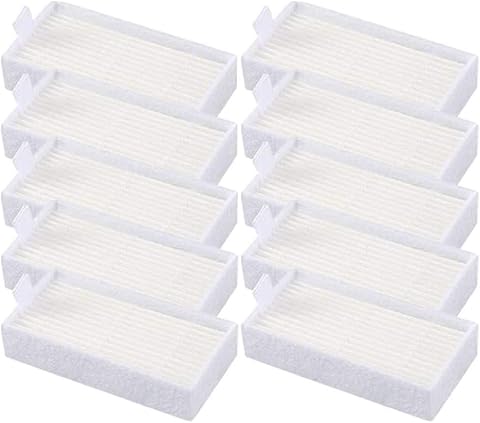
- Filter type:Sponge
- Warranty:2 years
Our verdict“Pick this model for mixed flooring and flexible controls, but skip it if documented data protections or detailed mapping are your priority.”
Roborock Qrevo 2 Pro Robot Vacuum and Mop, 20,000Pa Suction
The Roborock Qrevo 2 Pro is the clear power-and-automation choice here, with 20,000Pa suction, obstacle avoidance, automatic dust emptying, and a self-cleaning dock. Those capabilities put it well above the ROPVACNIC’s 5200Pa and the Bagotte’s 6000Pa on stated suction, while making the Qrevo better suited to buyers seeking a more hands-off cleaning routine. Heated mop washing and drying are also specified, which may help with dock-based upkeep. But this roundup is about data encryption, and the product details mention only 2.4GHz Wi-Fi compatibility—not encryption methods, retention practices, or security updates. Its advanced dock and app-linked functions also bring more maintenance and connectivity dependence than a simpler robot. I’d select it for cleaning capability, not as a proven privacy leader.
Pros:- 20,000Pa stated suction is the highest in this four-product group.
- Automatic dust emptying and a self-cleaning dock reduce routine handling.
- Obstacle avoidance and smart mapping support more automated cleaning.
- Mop washing and drying temperatures are specified.
Cons:- No encryption, data-retention, or security-update details are provided.
- Full functionality requires a 2.4GHz Wi-Fi connection.
- Advanced dock features may add maintenance needs and operational complexity.
Best for: Buyers with pets or busy households who want powerful suction, obstacle avoidance, and an automated dust-and-mop dock.
Not ideal for: Privacy-conscious shoppers who require published encryption or data-retention information, and buyers who prefer a low-maintenance, less connected robot.
- Suction power:20,000Pa
- Maximum mop water temperature:149°F
- Mop drying temperature:113°F
- Cleaning noise level:54 dB
- Wi-Fi compatibility:2.4GHz
- Dock features:Automatic dust emptying and self-cleaning
- Navigation features:Obstacle avoidance and smart mapping
- Brush feature:Anti-tangle system
Our verdict“Choose the Qrevo 2 Pro for premium cleaning automation and suction, not if documented encryption is a non-negotiable buying requirement.”
Bagotte Robot Vacuum and Mop Combo, 6000Pa LiDAR Navigation, Self-Emptying Station, Wi-Fi/App/Voice Control, Suitable for Carpets & Hard Floors
The Bagotte stands out for pairing LiDAR navigation and multi-floor mapping with a self-emptying station rated for up to 90 days of operation. That makes it a stronger fit for buyers who want repeatable room coverage and less frequent dust-bin handling than the ROPVACNIC, whose supplied specifications do not list mapping or an auto-empty dock. Its 6000Pa suction sits between that model’s 5200Pa and the Roborock Qrevo 2 Pro’s 20,000Pa, while the 150-minute battery life is the longest runtime specified among these four products. Still, the connected app and voice controls come without published encryption or data-handling information. The self-emptying station also adds hardware and setup complexity. I’d rank it for mapping and reduced upkeep, not for verified privacy credentials.
Pros:- LiDAR navigation and multi-floor mapping support structured room cleaning.
- Self-emptying station is specified for up to 90 days of operation.
- 150-minute battery life is the longest runtime listed among these four products.
- 6000Pa suction and vacuuming, sweeping, and mopping cover several floor-care tasks.
Cons:- No encryption, data-retention, or security-update details are provided.
- Self-emptying hardware and app setup may add complexity.
- Its 6000Pa suction is below the Roborock Qrevo 2 Pro’s stated 20,000Pa.
Best for: Multi-room households that want LiDAR mapping, saved multi-floor layouts, and less frequent dust-bin emptying.
Not ideal for: Buyers who require documented encryption practices, or those who want a simpler robot without a self-emptying station and connected controls.
- Suction power:6000Pa
- Navigation:LiDAR
- Mapping:Multi-floor mapping
- Self-emptying capacity:Up to 90 days of operation
- Battery life:150 minutes
- Dustbin or station capacity:3 liters
- Cleaning path width:8.88 inches
- Filter type:HEPA
- Dimensions:11.5 × 11.5 × 2.85 inches
Our verdict“Choose the Bagotte for mapped multi-floor cleaning and reduced bin maintenance, but not as a privacy-verified option.”
How We Picked
I compared the nine listed models on the evidence available for this roundup: product features, connectivity requirements, cleaning design, automation, and the privacy questions a buyer should resolve before connecting a robot to home Wi-Fi. A product name or feature list does not confirm that traffic is encrypted, that stored maps are protected, or that a company follows a particular retention policy. I treated those points as unverified unless explicit documentation was supplied, rather than assigning security claims based on brand reputation or assumptions.
The ranking balances cleaning usefulness with how clearly a buyer can evaluate the privacy tradeoff. Models with richer app, mapping, voice, or self-emptying features may suit households seeking automation, but they also call for closer checks on data practices. Simpler control options can reduce dependence on connected features, though they do not prove stronger encryption. Since the supplied details do not establish comparative security protocols, this roundup distinguishes product roles and points out what buyers should verify before purchase instead of presenting any model as independently verified to be the most secure.
Factors to Consider When Choosing Robot Vacuums With Data Encryption
Shopping for a connected cleaner means evaluating two separate things: how well it handles your floors and what happens to the information it generates. I recommend treating encryption as a vendor claim to verify, not an assumption based on an app, brand name, or navigation feature.
Check What Is Encrypted, Not Just Whether Encryption Is Mentioned
A useful privacy statement should clarify whether encryption protects data in transit, stored account information, and any maps or cleaning history kept in the cloud. A general claim that a product is secure may not explain which data it covers or whether protection applies between the robot and the service. Look for technical or support documentation that names the data categories and describes how the app connects to the robot. If the information is unclear, ask the manufacturer before buying or choose a model whose connected features you can avoid. Do not treat Wi-Fi support, app access, or voice control as evidence of encryption.
Decide Whether Your Floor Map Needs to Leave the Home
Navigation systems can differ in how much household layout information they create and how they use it. A map can make room-by-room cleaning easier, but it may also reveal the arrangement of rooms or recurring routines. Ask whether maps are stored only on the device, synced to an account, or retained by a cloud service, and whether you can delete them. A common mistake is to focus on whether a model has LiDAR or another navigation label instead of checking where the resulting data goes. If you do not need detailed maps, favor a simpler cleaning setup and turn off features you will not use.
Treat App, Voice, and Remote Controls as Different Privacy Choices
App control, voice assistants, and a physical remote each create different dependencies. Voice commands may involve another provider, while app features may require an account and internet access; a remote can offer basic control without the same everyday reliance on cloud-linked services. Before buying, check whether scheduled cleaning, room selection, or status updates still work when internet access is disabled. Avoid granting microphone, location, or contact permissions unless a feature clearly needs them. A model with fewer connected controls may be less convenient, but it can make the privacy setup easier to understand.
Review Account Security and Data-Deletion Controls
Encryption is only one part of account protection. Check whether the service supports multi-factor authentication, unique passwords, device-session management, and a straightforward way to remove an account or delete stored maps. Also find out how long cleaning histories are retained and whether deletion applies to backups or shared services. Buyers often create an account during setup and never revisit its settings, leaving optional sharing or history features enabled by default. Set aside time after installation to review privacy controls, restrict access, and remove data you do not need.
Weigh Automation Against the Number of Connected Components
A self-emptying dock or mop-washing station can reduce household chores, but an automated setup may include more devices, sensors, and app functions to manage. More hardware does not automatically mean weaker security, yet it can make it harder to tell which component communicates with the network or stores information. Check whether the dock has separate connectivity, whether firmware updates cover the whole system, and how long the manufacturer supports updates. If you mainly want scheduled vacuuming, a simpler robot may be easier to maintain and audit. Pay for extra automation when you will use it, not just because the feature list is longer.
Plan for Updates and Support Before You Commit
Connected products depend on software support after the initial setup. Look for a published update process, a way to install firmware updates, and a clear support channel for security questions. A model that receives cleaning improvements but lacks transparent security-update information may be a poor fit for a privacy-focused home. Check whether the robot remains usable if its app or cloud service changes, and whether basic controls survive an account outage. This matters especially for buyers who expect to keep a vacuum for years: the purchase decision should include the service behind the hardware.
Frequently Asked Questions
Can I tell from a product listing whether a robot vacuum encrypts my data?
Usually not from cleaning specifications alone. Suction, navigation, app control, and voice compatibility describe operation, not encryption. Look for a privacy policy or security page that identifies what data is encrypted in transit and at rest, how maps are handled, and whether information is shared with service providers. If the listing does not answer those questions, contact the manufacturer before purchase. For this lineup, the supplied details do not confirm specific encryption methods for any model.
Is a robot vacuum without app control automatically more private?
No. A remote-controlled model may reduce the need for an account or cloud features, but that does not prove the device has no wireless communication or that its data is protected. Check the manual and privacy terms for network behavior, companion apps, and data collection. You can also ask whether core cleaning works without internet access and leave optional connectivity disabled. Fewer connected features can simplify your privacy choices, but they are not a substitute for security documentation.
Should I avoid a robot vacuum that creates room maps?
Not necessarily; maps can make room selection and scheduled cleaning more useful. The decision depends on whether the map stays on the robot, syncs to an account, or is retained by a cloud service, and whether you can erase it. Ask the manufacturer how maps are protected and whether they are needed for basic cleaning. If detailed mapping feels unnecessary, choose a simpler navigation approach or disable map-related features where possible. Do not assume a particular navigation technology tells you where the map is stored.
Does a self-emptying dock create extra privacy or security concerns?
A self-emptying dock does not by itself establish a security problem, but it adds a component to understand. Check whether the dock communicates independently, whether it relies on the same app account, and whether firmware updates cover the dock as well as the robot. Also review what status or usage data the system records. If the dock mainly saves you from frequent bin emptying, that convenience may be worthwhile; if you want the simplest connected setup, compare it with a basic model and decide whether the added automation justifies the extra system complexity.
What should I do if a manufacturer will not explain its encryption or data-retention practices?
Ask direct questions through the company’s support channel and keep the response for reference. Request details about encryption in transit and at rest, map storage, retention, deletion, third-party sharing, and security-update support. If answers remain vague, treat the privacy claims as unverified rather than filling in the gaps with assumptions. You may choose a model with fewer connected features or wait until the company publishes clearer documentation. For a household with sensitive privacy needs, transparency is a meaningful part of the buying decision.
Conclusion
For an all-around connected option, I would start with the iRobot Roomba 105 Combo with AutoEmpty Dock, while checking its current privacy documentation before setup; it is my best overall fit in this comparison. The best value choice depends on the specific bundle and the privacy details the seller or manufacturer can verify, so I would compare the ROPVACNIC and 5000Pa combo listings on support and connectivity before deciding. For best premium, the Dreame L40 Ultra Gen 2 and Roborock Qrevo 2 Pro offer the most ambitious cleaning specifications here, but their richer feature sets call for careful review of mapping and cloud practices. For best for beginners, the eufy 11S MAX has a simpler listed control approach than app-heavy options, though I would still verify its data handling. If your specific need is reduced day-to-day maintenance, compare the self-emptying Tikom, Roomba, and Bagotte models; if privacy is your main filter, choose only after confirming encryption, retention, deletion, and update policies directly with the manufacturer.