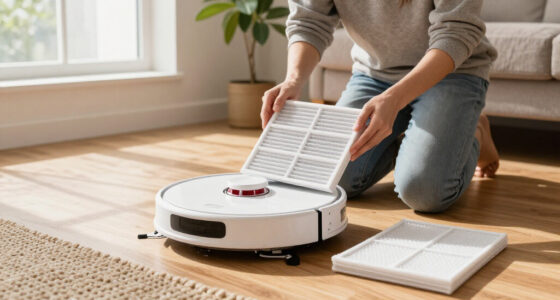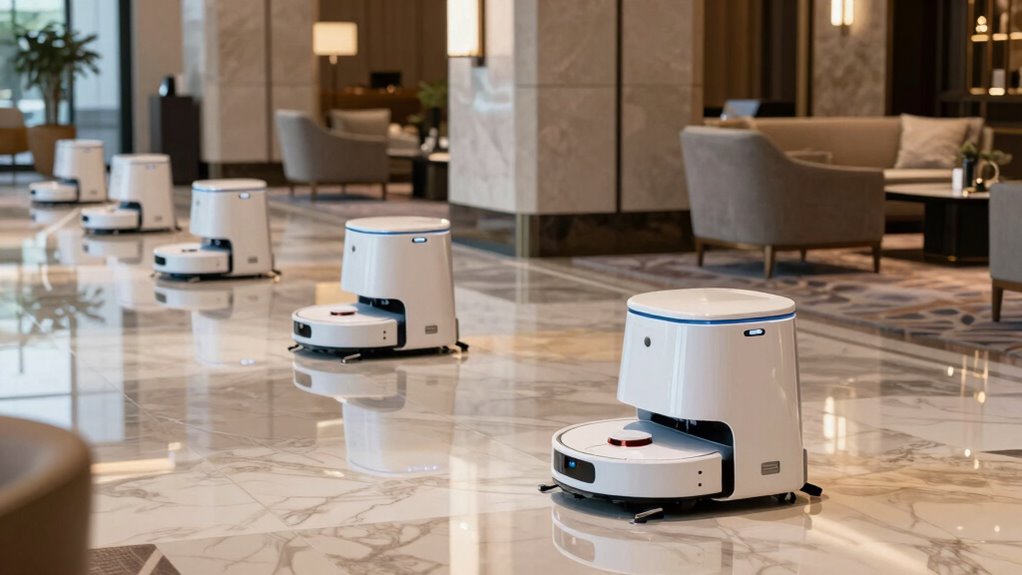
A hotel robot cleaner has to do more than cross an open room: it needs to match the property’s floor mix, cleaning schedule, and staff capacity. I put the ILIFE X1000 first for its 20,000Pa suction, large 3L dustbin, and extended battery setup, which make it the strongest listed choice for carpet-focused vacuuming in larger spaces. The Autonomous Commercial Floor Cleaning Robot is the better fit when a property needs several floor-care functions and unattended operation, while the 10,000Pa self-emptying combo offers a more approachable maintenance story for smaller zones.

Get cleaning gear delivered free with Prime
- Fast, free delivery on millions of items
- Prime Video, Amazon Music and more included
- Member-only deals all year
The tradeoff is significant: these products range from household-style robots with limited documented commercial capacity to a dedicated commercial machine covering sweeping, scrubbing, and mopping. I rank them by hotel relevance, carpet-cleaning potential, route planning, runtime, and the clarity of the available specifications—not by suction figures alone. A hotel buyer should confirm service support, safety procedures, replenishment needs, and suitability for the specific flooring before choosing.
Complete the kit


Key Takeaways
- The ILIFE X1000 is my lead pick for hotel carpet vacuuming because its stated 20,000Pa suction, 3L dustbin, LiDAR-based navigation, and up-to-210-minute runtime suit larger cleaning runs; confirm carpet performance and battery configuration with the supplier.
- The Autonomous Commercial Floor Cleaning Robot is the most purpose-built property option, with sweeping, scrubbing, vacuuming, mop washing, and up to 20 hours of battery life, but its workflow and deployment needs are less suited to a small hotel.
- The 10,000Pa self-emptying combo is the strongest middle ground for guest-room wings or compact common areas where LiDAR mapping and reduced dustbin handling matter more than a clearly documented commercial-duty design.
- The 6500Pa gyro model and ROPVACNIC combo are household-oriented choices in the supplied descriptions; consider them for limited, supervised zones rather than relying on them as a hotel-wide cleaning fleet.
- For carpet deep cleaning, compare brush design, carpet-specific test results, and sustained performance—not just Pa ratings—and treat every stated runtime or coverage figure as a supplier claim to verify.
| ILIFE X1000 Household & Commercial Robot Vacuum Cleaner, 20,000Pa |  | Best Overall for Hotel Carpet Vacuuming | Suction: 20,000Pa | Motor: 250W brushless motor | Battery life: Up to 210 minutes | VIEW ON AMAZON | See Our Full Breakdown |
| Autonomous Commercial Floor Cleaning Robot |  | Best for Full-Service Commercial Floor Care | Functions: Sweeping, mopping, vacuuming, scrubbing, dust removal | Listed cleaning area: 5,000 sq. ft. | Listed efficiency: Up to 1,440 square meters per hour | VIEW ON AMAZON | See Our Full Breakdown |
| Robot Vacuum and Mop Combo with Self-Emptying, 10,000 Pa Suction, Laser Navigation, and Smart Mapping |  | Best for Smaller Hotel Zones with Less Emptying | Suction: 10,000Pa | Self-emptying dustbin: 3.5L | Runtime: 160 minutes | VIEW ON AMAZON | See Our Full Breakdown |
| Robot Vacuum and Mop, 6500Pa Suction, 2-in-1 Robotic Vacuum with Gyro Navigation, 200 Min Runtime, App/Remote/Voice Control, Ideal for Pet Hair, Hard Floor, Carpet |  | Best for Budget-Conscious, Supervised Trial Zones | Suction: 6500Pa | Runtime: Up to 200 minutes | Battery: 2600mAh | VIEW ON AMAZON | See Our Full Breakdown |
| ROPVACNIC Robot Vacuum and Mop Combo 5200Pa Suction |  | Best for Pet-Hair Pickup in Small Mixed-Floor Areas | Suction: 5200Pa | Cleaning: Vacuuming and mopping | Water tank: High-capacity with four-stage adjustment | VIEW ON AMAZON | See Our Full Breakdown |
| commercial robot vacuum for hotel | Navigation | Suction | Battery life |
|---|---|---|---|
| ILIFE X1000 Household & Commer | LiDAR, 3D ToF, stereo-camera | 20,000Pa | Up to 210 minutes |
| Autonomous Commercial Floor Cl | LiDAR with obstacle avoidance | — | Up to 20 hours |
| Robot Vacuum and Mop Combo wit | dToF LiDAR | 10,000Pa | — |
| Robot Vacuum and Mop | Gyro inertial navigation with infrared sensors | 6500Pa | — |
| ROPVACNIC Robot Vacuum and Mop | High-coverage sensing with obstacle detection | 5200Pa | Not specified |
More Details on Our Top Picks
ILIFE X1000 Household & Commercial Robot Vacuum Cleaner, 20,000Pa
The ILIFE X1000 earns my top position because it makes the clearest case for handling long, demanding vacuum runs: the listed 20,000Pa suction, a 3L dustbin, and up to 210 minutes of battery life are a more hotel-relevant combination than the smaller bins and household framing of the other vacuum-and-mop combos. Its LiDAR, 3D ToF, and stereo-camera navigation also give it a stronger documented navigation package than the gyro-based 6500Pa model.
For carpet deep cleaning, this is the most promising choice in the group, but I would not treat the suction number as proof of deep carpet extraction. The listing does not specify carpet test results, brush construction, carpet-height limits, or how suction changes over a full run. I would request those details before assigning it to guest corridors or carpeted public areas. Its commercial positioning is a step up from the ROPVACNIC and 10,000Pa household combos, though the dedicated multi-function commercial robot is a better match if scrubbing and mop automation matter as much as vacuuming.
The main cost of that capability is complexity: the product is described as intended for large spaces and may need technical setup. The dual detachable batteries could support extended operation, but the supplied specifications give a runtime figure rather than a clear charging or battery-swap workflow. I would choose it for a property prioritizing vacuum work and a large bin, and skip it for a small inn that does not need its commercial-scale setup.
Pros:- Highest stated suction in this lineup at 20,000Pa.
- 3L dustbin reduces emptying interruptions on extended routes.
- LiDAR, 3D ToF, and stereo-camera navigation are aimed at larger indoor spaces.
- Up to 210 minutes of stated battery life supports longer cleaning sessions.
Cons:- Carpet-specific extraction results and brush details are not provided.
- Commercial features may add setup and technical support demands.
- Battery configuration and the practical meaning of dual detachable batteries need supplier clarification.
Best for: Hotels with large carpeted zones seeking a high-suction vacuum platform and a large dustbin, subject to supplier confirmation of carpet performance and service support.
Not ideal for: Small properties, teams seeking a simple plug-in household robot, or buyers who need verified carpet deep-cleaning test data before purchase.
- Suction:20,000Pa
- Motor:250W brushless motor
- Battery life:Up to 210 minutes
- Dustbin:3L
- Navigation:LiDAR, 3D ToF, stereo-camera
- Battery setup:Dual detachable batteries, per description
Our verdict“I rank the ILIFE X1000 first for hotel carpet vacuuming potential, but I would verify carpet results, battery workflow, and commercial support before deploying it property-wide.”
Autonomous Commercial Floor Cleaning Robot
Where the ILIFE X1000 is the more compelling carpet-vacuum prospect, this machine is the more complete hotel floor-care system. It combines sweeping, vacuuming, scrubbing, and mopping with automatic mop washing, mop lifting, docking, route planning, and status monitoring. The description gives a claimed cleaning area of 5,000 square feet and up to 20 hours of battery life, making it the most explicitly commercial option here.
That feature mix is especially relevant to hard-floor lobbies, corridors, and other shared spaces where one vacuum-only unit would leave work for staff. LiDAR navigation, no-go zones, and app-based reports can help a team schedule cleaning around guest traffic. Against the ILIFE, its advantage is breadth of floor care and unattended mop upkeep, not a stated suction figure; the listing provides no suction measurement or carpet-specific performance result. Although carpet is listed among applicable surfaces, I would ask the supplier what vacuuming mode and results to expect on the hotel’s carpet before treating it as the deep-cleaning pick.
This is not the easiest entry point for a small property. The range of functions, customization, and potential accessory questions suggest a more involved purchase and deployment process than the ROPVACNIC or 6500Pa household-style options. I would also verify how the coverage figure is measured, what the 20-hour battery claim means in normal cleaning cycles, and whether installation, training, consumables, and support are available. For a large hotel with substantial hard flooring, its commercial workflow can outweigh the added complexity.
Pros:- Combines multiple floor-care functions in one machine.
- Automatic mop washing, lifting, and docking reduce hands-on upkeep.
- LiDAR route planning, no-go zones, reports, and app monitoring support managed operations.
- Lists a 5,000-square-foot cleaning area and up to 20 hours of battery life.
Cons:- No suction rating or carpet-specific cleaning result is supplied.
- Customization and accessories may require separate supplier discussions.
- Its broad commercial feature set may be more than a small property needs.
Best for: Hotels with large hard-floor public areas that want scheduled sweeping, scrubbing, mopping, and vacuuming in one commercial system.
Not ideal for: Small hotels or buyers focused mainly on proven carpet deep cleaning, since suction and carpet test data are not specified.
- Functions:Sweeping, mopping, vacuuming, scrubbing, dust removal
- Listed cleaning area:5,000 sq. ft.
- Listed efficiency:Up to 1,440 square meters per hour
- Battery life:Up to 20 hours
- Navigation:LiDAR with obstacle avoidance
- Automation:Auto-docking, mop lifting, automatic mop washing
- Surfaces:Includes marble, tile, concrete, wood, and carpet
- Warranty:1 year
Our verdict“I would choose this over the ILIFE for a hard-floor hotel that needs automated scrubbing and mop care, but not as my first carpet deep-cleaning recommendation.”
This combo sits between the commercial-scale ILIFE and the household-focused 5200Pa and 6500Pa models. It offers 10,000Pa suction, dToF LiDAR mapping, and a 3.5L self-emptying dustbin, so its strongest hotel argument is reduced routine handling in a limited zone—not a clearly established whole-property commercial duty cycle. The 160-minute runtime is shorter than the stated figures for the ILIFE and the 6500Pa robot, but mapping and self-emptying may matter more when a unit is assigned to a compact guest-room wing.
For carpet, the listing includes automatic suction boost and claims compatibility with carpets, giving it a more explicit carpet-related feature than the ROPVACNIC description. Still, it does not provide carpet-height limits, brush details beyond an anti-tangle design, or independent deep-cleaning results. I would consider it for daily debris pickup on mixed surfaces, then confirm whether its brush and cleaning pattern suit the carpet pile in a hotel. The ILIFE remains the stronger listed candidate for a larger carpet workload because of its higher stated suction and 3L onboard bin, while this model’s self-emptying design may reduce staff visits to the robot.
The supplied claim of 90 days of hands-free cleaning should be treated as a marketing target, not a guaranteed hotel interval: occupancy, debris, cleaning frequency, and carpet load can shorten it. Battery life also varies by mode, and the hair-cutting function activates only after cleaning, so it does not eliminate all brush maintenance. I would use it where mapped routes and less frequent dust handling are priorities, not as a substitute for a commercial service plan.
Pros:- 3.5L self-emptying dustbin can reduce frequent manual emptying.
- dToF LiDAR supports mapped routes and obstacle avoidance.
- 10,000Pa suction and stated carpet auto-boost offer a mixed-floor feature set.
- Anti-tangle design targets hair-related brush maintenance.
Cons:- The 160-minute runtime is below the stated maximum for the ILIFE and 6500Pa model.
- No commercial-duty rating or carpet extraction test result is supplied.
- Hands-free duration depends on cleaning frequency and debris load.
Best for: Smaller hotels or guest-room wings that want mapped mixed-floor cleaning and a self-emptying base to limit routine bin handling.
Not ideal for: Large properties needing a documented commercial fleet solution, or carpet-heavy hotels that require verified deep-cleaning results.
- Suction:10,000Pa
- Self-emptying dustbin:3.5L
- Runtime:160 minutes
- Navigation:dToF LiDAR
- Battery:3200mAh
- Modes:Silent, Standard, Powerful, Max
- Carpet feature:Automatic suction boost, per description
- Brush design:Anti-tangle design with hair-cutting feature
Our verdict“I would choose this for a smaller mapped zone where self-emptying matters, but the ILIFE is a better starting point for a hotel’s larger carpet workload.”
Robot Vacuum and Mop, 6500Pa Suction, 2-in-1 Robotic Vacuum with Gyro Navigation, 200 Min Runtime, App/Remote/Voice Control, Ideal for Pet Hair, Hard Floor, Carpet
The 6500Pa robot is a household-style choice with one practical advantage for smaller hotel areas: its stated 200-minute runtime is longer than the 10,000Pa self-emptying model’s 160 minutes, and it offers app, remote, and voice control. Gyro navigation uses systematic zigzag cleaning, which is more structured than a random-only route, but it is not the LiDAR mapping approach found on the ILIFE, the commercial floor-care robot, and the self-emptying combo.
Its suction figure places it above the ROPVACNIC’s 5200Pa listing, but neither description establishes commercial carpet deep-cleaning performance. For a hotel, the 300ml dustbin is a more pressing limitation than the headline suction: staff may need to empty it often in busy or carpeted areas. The 200ml water tank also narrows its usefulness for large mopping routes. Compared with the ILIFE’s 3L dustbin and commercial positioning, this unit makes more sense as a supervised cleaner for a small office, staff room, or limited guest-room test area than as a primary corridor machine.
Setup is another consideration. It requires 2.4GHz Wi-Fi, and the description flags that some users may find setup complex. Remote control can offer a fallback when app setup is inconvenient, but it does not replace mapped scheduling or commercial monitoring. I would consider it when a hotel wants to evaluate robot cleaning in a contained area without adopting a larger commercial platform, and skip it for unattended daily coverage across a large property.
Pros:- Up to 200 minutes of stated runtime.
- 6500Pa stated suction exceeds the ROPVACNIC’s listed 5200Pa.
- Zigzag gyro navigation provides systematic cleaning routes.
- App, remote, and Google Assistant voice control are available.
Cons:- The 300ml dustbin and 200ml water tank are small for larger hotel areas.
- Gyro navigation lacks the listed LiDAR mapping of several competitors.
- Requires 2.4GHz Wi-Fi and setup may take extra effort.
Best for: Small properties testing robot cleaning in a contained hard-floor or low-pile-carpet zone with staff nearby to manage the bin and water tank.
Not ideal for: Hotels needing a large-capacity, mapped, unattended cleaner or a documented carpet deep-cleaning solution.
- Suction:6500Pa
- Runtime:Up to 200 minutes
- Battery:2600mAh
- Dustbin:300ml
- Water tank:200ml
- Navigation:Gyro inertial navigation with infrared sensors
- Controls:App, remote, Google Assistant voice control
- Wi-Fi:2.4GHz
Our verdict“I would use this as a supervised trial-zone robot, not as a hotel-wide replacement for the ILIFE’s larger-capacity commercial-oriented setup.”
ROPVACNIC Robot Vacuum and Mop Combo 5200Pa Suction
ROPVACNIC comes fifth because its strongest points—pet-hair handling, customizable cleaning modes, and adjustable mopping—are household conveniences rather than evidence of hotel-scale endurance. Its 5200Pa suction is the lowest stated figure in this group, and the listing does not specify battery life. That makes it harder to plan a hotel route around than the 200-minute 6500Pa model or the ILIFE, which states up to 210 minutes.
Within a small zone, though, the no-entanglement design and dual electric side brushes could help with loose hair along room edges. Its high-coverage sensing and obstacle detection are more useful than an unspecified navigation system, but the supplied details do not identify LiDAR or provide a coverage map. The 6500Pa model has a clearer runtime claim, while the 10,000Pa self-emptying combo offers more explicit mapping and a larger dust-handling system. ROPVACNIC’s distinction is its adjustable water flow and combined vacuum-mop setup, not commercial scale or carpet extraction.
I would consider it for a small hard-floor area where pet hair or light daily debris is a concern and staff can check the route and tank. Its compact design is listed for low-pile carpets, but I would not assign it to deep-clean hotel carpet without supplier evidence. The feature set may take time to configure, and an unspecified battery duration leaves a basic planning question unanswered. For a hotel-wide role, the ILIFE or dedicated commercial cleaner has a stronger case.
Pros:- No-entanglement design and dual side brushes target pet hair and edges.
- Vacuuming and mopping combine in one compact unit.
- Four-stage water adjustment supports different mopping needs.
- App and voice controls allow customization.
Cons:- Battery life is not specified, limiting route planning confidence.
- Lowest stated suction figure among the five products.
- Navigation details do not confirm LiDAR mapping or hotel-scale coverage.
Best for: Small, supervised hotel zones with pet hair, hard floors, and occasional low-pile-carpet cleaning where adjustable mopping is useful.
Not ideal for: Large hotels, carpet-heavy properties seeking deep cleaning, or teams that need a confirmed long runtime and mapped route planning.
- Suction:5200Pa
- Cleaning:Vacuuming and mopping
- Water tank:High-capacity with four-stage adjustment
- Navigation:High-coverage sensing with obstacle detection
- Controls:Smartphone app, Alexa, Google Assistant
- Brushes:No-entanglement design with dual electric side brushes
- Surfaces:Hard floors and low-pile carpets
- Battery life:Not specified
Our verdict“I would choose ROPVACNIC for a small pet-hair-prone hard-floor zone, but its undocumented runtime and lower suction make it the weakest fit here for hotel carpet deep cleaning.”

How We Picked
I ranked these five options for hotel operations, not general household convenience. I gave the most weight to evidence of commercial-scale use, the ability to cover larger areas without constant staff intervention, navigation that can handle furniture and changing routes, dust capacity, and the range of floor-care tasks. For hotels with carpet, I also looked for stated suction and carpet-related features, while recognizing that suction figures alone do not prove deep-cleaning performance.
The product descriptions are uneven. The Autonomous Commercial Floor Cleaning Robot lists broad floor-care functions and long battery life, while the ILIFE X1000 provides the strongest stated suction and a 3L dustbin. The remaining products emphasize household use, pet hair, app controls, or mopping. I have not treated those claims as independent test results, and I have not assumed unlisted capabilities such as fleet management, commercial warranties, or confirmed service coverage. Buyers should request details on carpet testing, charging and docking, consumables, maintenance, warranty terms, and local technical support before deployment.
My order reflects the best fit for a hotel use case, not a claim that one machine suits every property. A carpeted hotel should favor verified vacuum performance and dependable coverage; a hard-floor property may gain more from scrubbing and mop care. Smaller properties can reasonably place more weight on ease of setup and manageable upkeep, while larger sites should check whether the stated coverage and runtime support their actual routes and operating hours.
| commercial robot vacuum for hotel | Battery life | Navigation |
|---|---|---|
| ILIFE X1000 Household & Commer | Up to 210 minutes | LiDAR, 3D ToF, stereo-camera |
| Autonomous Commercial Floor Cl | Up to 20 hours | LiDAR with obstacle avoidance |
| Robot Vacuum and Mop Combo wit | — | dToF LiDAR |
| Robot Vacuum and Mop | — | Gyro inertial navigation with infrared sensors |
| ROPVACNIC Robot Vacuum and Mop | Not specified | High-coverage sensing with obstacle detection |
Factors to Consider When Choosing Commercial Robot Vacuum For Hotels
I would choose a hotel robot by matching its operating role to the property rather than buying the largest suction number available. A machine assigned to carpeted corridors needs different evidence from one maintaining a tiled lobby or cleaning a small staff room.
Match the machine to the floor plan
Start by dividing the property into use cases: carpeted guest corridors, hard-floor lobbies, back-of-house routes, and smaller rooms with limited access. The ILIFE X1000 is the best listed vacuum-led candidate for larger carpeted areas, while the Autonomous Commercial Floor Cleaning Robot is built around broader floor care, including scrubbing and mop washing. If you only need to maintain a compact zone, the household-style models may be easier to trial, but their descriptions do not establish hotel-wide duty capacity.
Measure route length, furniture density, thresholds, elevator access, and hours when guests are present. Ask suppliers to confirm how the robot handles doors, temporary obstacles, carpet transitions, and restricted areas. A strong fit on paper can still fail if the machine cannot return to its dock or if its route interrupts housekeeping and guest traffic.
Read suction claims alongside carpet evidence
Pa figures help compare stated suction, but they do not establish carpet deep cleaning by themselves. Brush design, airflow, carpet pile, sealing, passes, and sustained performance all affect what debris a robot can remove. The ILIFE leads this group on stated suction at 20,000Pa; the 10,000Pa combo lists carpet boost, and the 6500Pa model also names carpet in its title. None of the supplied descriptions gives an independent hotel-carpet test result.
For a carpet-heavy property, request demonstrations or written performance details for the exact carpet type, including pickup of embedded dust and hair. Check whether brush rolls are replaceable and how often filters and brushes need service. I would treat the ROPVACNIC’s low-pile carpet compatibility as a limited-use claim, not a deep-cleaning endorsement.
Compare autonomy and staff workload
Autonomy is more than a long runtime. A useful hotel robot needs a route it can repeat, a dependable return-to-dock process, manageable bin capacity, and cleaning alerts that staff can act on. The dedicated commercial machine lists app reporting, no-go zones, auto-docking, and automatic mop washing. The ILIFE’s 3L dustbin can reduce emptying stops, while the 10,000Pa combo relies on a self-emptying base and a 3.5L capacity.
Confirm how much of a stated runtime remains available after mapping, high-suction operation, or mopping. Ask whether batteries are removable, how long charging takes, and whether the unit resumes a route after charging. A long runtime is useful only if the robot can complete the assigned work safely and predictably within the hotel’s cleaning window.
Decide whether mopping belongs in the same unit
A combined vacuum and mop can simplify equipment for small areas, but water tanks and cloth maintenance add staff tasks. The 6500Pa model lists a 200ml water tank, while ROPVACNIC offers adjustable water flow. These household-style combos are not equivalent to the commercial robot’s scrubbing and automatic mop-washing workflow. For a lobby with frequent spills or a broad hard-floor area, ask about cleaning solution compatibility, dirty-water handling, pad hygiene, and drying time.
Hotels should also separate dust pickup from wet cleaning when the operational plan requires it. A mop attachment that works for light upkeep may not replace a scheduled floor scrub. Check whether carpet detection lifts or disables the mop, and how the machine avoids wetting rugs or carpet transitions.
Check deployment, safety, and after-sales support
Before committing, confirm warranty coverage, replacement parts, technical support, consumable availability, and who will perform routine maintenance. The commercial floor-care robot lists a one-year warranty, while the other supplied descriptions do not provide comparable warranty detail. Ask for written terms rather than assuming a consumer product receives commercial support simply because it is used in a hotel.
Plan around guest safety: confirm obstacle detection, emergency stop procedures, noise levels, signage, and policies for operation near guests and staff. Test the robot during a controlled shift before expanding its route. I would also verify app permissions, Wi-Fi requirements, data handling, and whether route maps can be managed by the hotel’s team. Those operational details can matter more than a headline feature when the machine is expected to work every day.
Frequently Asked Questions
Which robot is the strongest choice for hotel carpet deep cleaning?
The ILIFE X1000 is my leading candidate based on its stated 20,000Pa suction, 3L dustbin, and up-to-210-minute runtime. However, the supplied details do not include carpet extraction test results, brush specifications, or carpet-pile limits. I would ask the supplier for evidence on the hotel’s actual flooring before treating any robot in this lineup as a deep-cleaning replacement for commercial carpet equipment.
Is the highest suction rating enough to choose a hotel robot?
No. Suction ratings are useful for comparing listed claims, but carpet performance also depends on the brush, airflow, contact with the surface, cleaning pattern, and sustained operation. Dustbin capacity, route planning, maintenance, and the ability to handle the hotel’s carpet type affect real operations. I would use suction as one screening point and request carpet-specific results before purchase.
Which option is best for hard-floor hotel lobbies?
The Autonomous Commercial Floor Cleaning Robot is the clearest match for a large hard-floor lobby because it lists sweeping, scrubbing, vacuuming, mopping, automatic mop washing, and docking. It also provides LiDAR navigation and app-based monitoring. Its broader capability may be unnecessary for a small lobby, and I would confirm cleaning capacity, safe operating hours, and support arrangements with the supplier.
Can household robot vacuums handle hotel operations?
They may suit a limited, supervised area, but a household description does not establish commercial-duty reliability. The 6500Pa and ROPVACNIC models have smaller or unspecified capacity details, and ROPVACNIC does not list battery life. Before using either beyond a trial zone, confirm route coverage, maintenance intervals, warranty terms, replacement parts, and how the product performs under repeated hotel schedules.
What should I confirm before buying a robot cleaner for a hotel?
I would confirm flooring compatibility, carpet results, runtime under the intended mode, dust and water capacity, obstacle handling, charging behavior, noise, warranty, service availability, consumables, and app or network requirements. Ask how the robot handles guest traffic and restricted areas, and check whether the listed cleaning-area figure reflects the route and conditions in your building. A short supervised trial can reveal practical issues before wider deployment.
Conclusion
For a hotel prioritizing carpet vacuuming, I would start with the ILIFE X1000 and make the purchase conditional on carpet-specific evidence and a clear service plan. For a large property with expansive hard floors and a need to automate scrubbing and mop care, the Autonomous Commercial Floor Cleaning Robot is the more suitable operational platform. Smaller properties seeking mapped routes and fewer bin-emptying visits should look at the 10,000Pa self-emptying combo, while the 6500Pa and ROPVACNIC models make more sense as supervised trial options for contained zones. My final choice would follow a route test on the hotel’s actual floors, not the headline specification alone.