TL;DR

Get cleaning gear delivered free with Prime
- Fast, free delivery on millions of items
- Prime Video, Amazon Music and more included
- Member-only deals all year
A Hunker report describes a YouTube creator’s approach to turning a free wood pallet into a floor-standing bike rack with individual slots for tires. The design can be adapted for bikes without kickstands, but the report does not provide load testing, safety certification or a cost estimate for added materials.
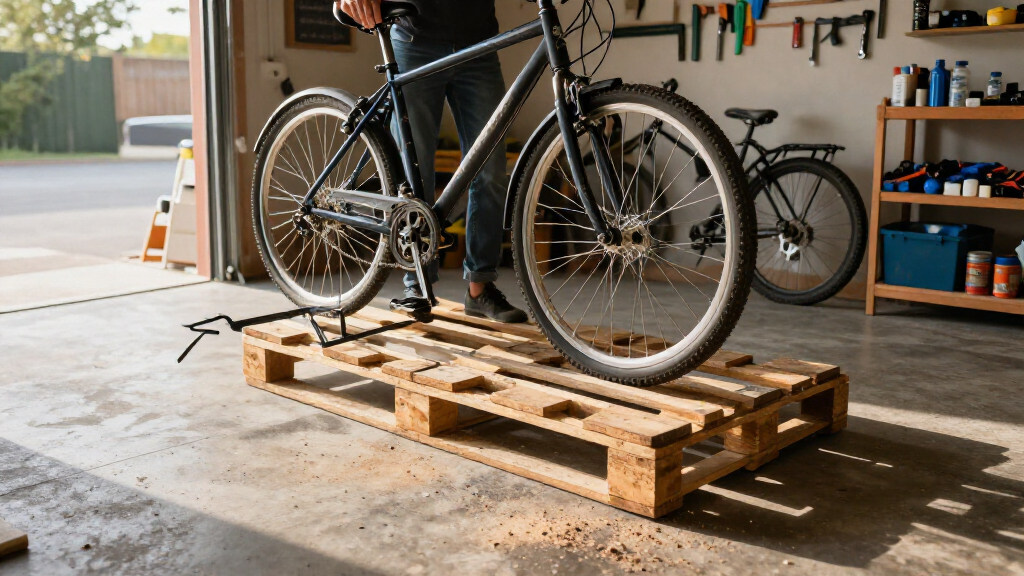
Hunker has reported on a DIY garage bike rack made by cutting and re-spacing an old wood pallet, based on a project shared by YouTube user This Dad Goes to 11. The floor-standing design gives bikes individual wheel slots; a second pallet section and braces can be added for bicycles that do not stand securely on their own.
The basic build starts with cutting a pallet lengthwise, close to one side of its center support, to create a narrower, single-row base. The creator then removes and repositions deck boards to form slots that hold each bike tire. The spacing needs to let a tire slide in without forcing it while limiting side-to-side movement, according to the Hunker report.
The report says the featured rack held five bikes, using a slat on either side of each tire. That is an example from one build, not a stated capacity for every pallet: the number of slots depends on the pallet’s dimensions and the bicycles. Existing nails may be reused if they are in good condition, while damaged or missing fasteners can be replaced with wood screws. Sanding the assembled rack can reduce splinter risks; sealing or finishing is optional.
For bikes that lack kickstands or training wheels, the report describes a more supported version based on a separate tutorial by YouTube user Your Own Adventure. It uses the other pallet half as an upright tire support, with added 2-by-4 lumber at the base and brackets to join the upright to the floor section. Removed pallet slats can also be used as diagonal braces. This version takes more material and assembly than the basic rack.
A Low-Cost Route to Bike Storage
The project offers households a way to assign bikes separate parking spaces without buying a purpose-built rack, provided they already have a suitable pallet and basic tools. Keeping bikes together on the garage floor may make them easier to access and can free space elsewhere, though the source does not document measured space savings or compare the design with commercial storage products.
Its adaptable layout is the main practical feature: builders can change the slot spacing for their bicycles and use the additional upright support for bikes that would otherwise tip. The report characterizes the project as beginner-friendly, but that is an assessment of the design, not a guarantee that every pallet is safe or sturdy enough for the job.
Products Worth Considering

Dreame L50 Ultra Robot Vacuum and Mop

Dyson Purifier Hot+Cool HP1

Shark Navigator Lift-Away Upright Vacuum (NV360)
As an affiliate, we earn on qualifying purchases.
How the Pallet Becomes a Rack
The design addresses a common garage-storage problem described in Hunker’s report: multiple bicycles can be difficult to store together because handlebars, wheels and other equipment take up room. Rather than hanging bikes from walls or ceilings, this approach keeps them at floor level for quick access. The source does not establish that it works in every garage; users need enough clearance for the bikes and rack.
The reported construction has two paths. The simpler version uses a modified pallet base for bikes that can remain upright with their own kickstands or training wheels. The reinforced option adds a perpendicular upper section, a 2-by-4 base and metal brackets or similar connectors for bikes needing more support. These are descriptions of the tutorials, not independent engineering tests.
“The rack provides a dedicated parking space for each bike.”
— Hunker, reporting on the project by YouTube user This Dad Goes to 11
Capacity and Pallet Condition
The source does not give the pallet’s dimensions, wood grade, condition, maximum load or a tested limit for how many bicycles a rack can safely hold. Its five-bike example should not be treated as a universal capacity. It also does not report whether the finished rack was tested for stability, how well it performs over time, or whether the design suits every tire width and bike frame.
Builders will need to inspect their own pallet and fasteners and decide whether the wood is sound enough for reuse. The source does not specify pallet treatment or provide a testing standard for reused wood. It also does not include a complete materials list, total build time or cost for the reinforced version.
Measure Before Cutting Wood
The next step for anyone considering the project is to measure the available garage space and the bikes’ tires, then plan the slot layout before cutting or moving slats. The Hunker report recommends adjusting the spacing to the pallet and the number of bikes rather than assuming the featured five-bike arrangement will fit every build.
After assembly, the rack can be sanded and, if desired, finished or sealed. The report suggests labeling spaces with family members’ names as a way to make returning bikes to their places easier. It gives no scheduled follow-up or testing results, so questions about long-term durability and safe capacity remain unanswered by the source.
Key Questions
How many bikes can the pallet rack hold?
The Hunker report describes one rack holding five bikes. Capacity depends on the pallet’s size, the number and width of tires, and the slot layout; the source gives no tested maximum.
Will the basic rack work for bikes without kickstands?
The report says bikes without kickstands or training wheels may need additional vertical support. Its reinforced option uses the second pallet section, 2-by-4 lumber and brackets.
What tools and materials are described?
The basic build uses an old pallet, a circular saw and a hammer or crowbar to adjust slats. Wood screws may replace damaged nails. The supported version also uses 2-by-4 lumber and brackets, according to the report.
Does the rack need a finish?
Hunker describes finishing or sealing as optional. It recommends sanding the rack to reduce splinters, especially when the pallet is rough.
Source: hunker.com