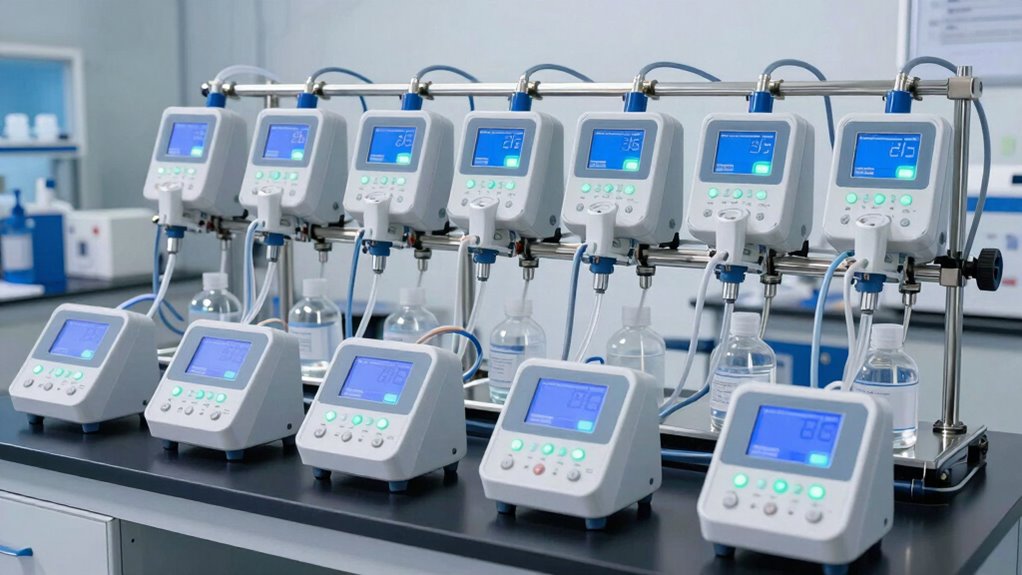

A pH controller with a dosing pump can monitor water and add corrective solution when readings move outside a chosen range, but the options differ in how much they automate. I rank the Bluelab IntelliDose Wi-Fi Controller Kit as best overall for buyers seeking a connected control-and-dosing setup, while the Milwaukee MC720 stands out as a focused automated dosing kit and the DANOPLUS Wi-Fi controller adds ORP and temperature monitoring. The main tradeoff is between an integrated system that simplifies routine corrections and a flexible controller that may require a separate pump or more setup. Probe upkeep, dosing limits, and compatibility matter as much as app features. Continue reading for the full breakdown and guidance on matching a controller to your system.

Get cleaning gear delivered free with Prime
- Fast, free delivery on millions of items
- Prime Video, Amazon Music and more included
- Member-only deals all year
Complete the kit


Key Takeaways
- Integrated dosing is the central distinction: the Bluelab IntelliDose kit and Milwaukee MC720 are more directly aimed at automated correction than monitor-first products such as the Bluelab Pro Controller Wi-Fi Reservoir Monitor.
- Connected features serve different jobs: the DANOPLUS combines pH, ORP, and temperature readings, while the Wi-Fi Bluelab options emphasize remote reservoir oversight and dosing workflows.
- Dual-relay models offer flexibility, not automatic simplicity: the WiFi 3-in-1 monitor, dual-relay automatic controller, and TEKCOPLUS TK402PLUS may suit multi-device setups, but buyers should verify pump control and outputs before choosing.
- Similar product names can hide different system roles: the two Milwaukee MC122 listings are pH controllers, while the MC720 is the listed automated dosing pump kit; check the exact model and included accessories.
- More readings do not replace sound dosing safeguards: a useful setup still depends on suitable pumps, conservative dose limits, calibration, and a probe suited to the solution being monitored.
| DANOPLUS Smart pH, ORP, and Temperature Controller with Wi-Fi App Monitoring |  | Best for Multi-Parameter Monitoring | Measurements: pH, ORP, and temperature | Connectivity: 2.4 GHz Wi-Fi; Tuya Smart app | Outputs: Dual relay-controlled power outputs | VIEW ON AMAZON | See Our Full Breakdown |
| Bluelab Pro Controller Wi-Fi Reservoir Monitor |  | Best for Expandable Reservoir Dosing | Measurements: pH, conductivity, and temperature | Connectivity: Built-in Wi-Fi | pH probe connection: BNC | VIEW ON AMAZON | See Our Full Breakdown |
| Smart pH Controller with Dosing Pump |  | Best Ready-to-Run Dual Dosing Setup | Dimensions: 7.7 x 4.7 x 1.7 inches | Temperature compensation: Yes | Temperature units: Switchable °C/°F | VIEW ON AMAZON | See Our Full Breakdown |
| Milwaukee Instruments MC122 pH Controller |  | Best for Straightforward Plug-In Control | pH range: 0.0 to 14.0 | Set-point range: 5.5 to 9.5 pH | Accuracy: 0.2 pH | VIEW ON AMAZON | See Our Full Breakdown |
| Bluelab pH Controller Wi-Fi with Automated Nutrient Dosing | 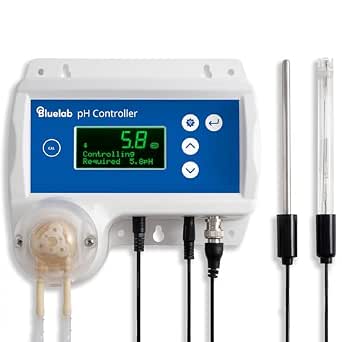 | Best Premium Integrated Wi-Fi Doser | Model: BCTPHC02 | Connectivity: Wi-Fi with Edenic.io integration | Pump type: Built-in variable-speed peristaltic | VIEW ON AMAZON | See Our Full Breakdown |
| Bluelab IntelliDose Wi-Fi Controller Kit |  | Best for Multi-Input Grow Operations | Dosing capacity: Up to 9 nutrients, additives, and pH dosing | Outputs: 4 × 24 VDC | Monitored metrics: EC, CF, TDS, temperature, and pH | VIEW ON AMAZON | See Our Full Breakdown |
| Milwaukee Instruments pH Controller – MC122 |  | Best for Aquarium CO₂ Control | Model: MC122 | Display: LED | Control: User-selectable pH set point with visual LED notification | VIEW ON AMAZON | See Our Full Breakdown |
| Milwaukee Instruments MC720 Automated pH Dosing Pump Kit |  | Best Ready-to-Use Hydroponic Pump Kit | Included components: MC122 pH Controller and MP810 Dosing Pump | pH setting range: 5.5–9.5 pH | Pump type: Peristaltic | VIEW ON AMAZON | See Our Full Breakdown |
| WiFi 3-in-1 pH, EC, and Temperature Monitor with Dual Relay Outputs |  | Best for App-Based Water Monitoring | Measurements: pH, electrical conductivity (EC), and water temperature | Connectivity: Wi-Fi; Tuya app | Outputs: Dual relay outputs | VIEW ON AMAZON | See Our Full Breakdown |
| Automatic pH Controller with Dosing Pumps, Dual Relays, and Data Chart Display |  | Best for Two-Way pH Correction | Control type: Automatic pH-up and pH-down dosing | Outputs: Dual relay | Temperature compensation: Automatic (ATC) | VIEW ON AMAZON | See Our Full Breakdown |
| TEKCOPLUS TK402PLUS Digital pH Controller with Dual Relay Output |  | Best for pH Up-and-Down Automation | Brand: TEKCOPLUS | Model: TK402PLUS | Display: LCD | VIEW ON AMAZON | See Our Full Breakdown |
More Details on Our Top Picks
DANOPLUS Smart pH, ORP, and Temperature Controller with Wi-Fi App Monitoring
The DANOPLUS earns this role by tracking pH, ORP, and temperature in one wall-mounted unit, a broader monitoring brief than the Bluelab pH Controller Wi-Fi with Automated Nutrient Dosing, which focuses on pH dosing. Its two relay-controlled outputs can respond to configured limits, so it can operate compatible equipment as readings change. Replaceable BNC probes help with long-term upkeep, while temperature compensation can account for readings across its stated 0–50°C range. The tradeoff is that this is not a clearly specified all-in-one dosing system: the product details do not identify compatible pumps, so buyers need to confirm their equipment will work with the relays. App monitoring also depends on 2.4 GHz Wi-Fi and Tuya Smart. I would choose it for broad water oversight, not for a ready-to-run dosing package.
Pros:- Monitors pH, ORP, and temperature in one unit
- Dual relays can respond to configured pH or ORP limits
- Detachable BNC probes can be replaced as they wear
- Tuya Smart app monitoring and automatic temperature compensation
Cons:- Compatible dosing pumps and controlled devices are not specified
- App monitoring requires a 2.4 GHz Wi-Fi connection
Best for: Aquarium, pool, or hydroponic system owners who want app-accessible pH, ORP, and temperature monitoring with relay control for compatible equipment.
Not ideal for: Growers who want a confirmed, included dosing pump or a single-brand dosing system that is ready to pair without checking relay compatibility.
- Measurements:pH, ORP, and temperature
- Connectivity:2.4 GHz Wi-Fi; Tuya Smart app
- Outputs:Dual relay-controlled power outputs
- Probe connections:Detachable, replaceable BNC pH and ORP probes
- Temperature compensation:0–50°C
- Installation:Wall mountable
- Protection:Integrated fuse
Our verdict“Choose the DANOPLUS when multi-parameter monitoring matters more than having a dosing pump included and confirmed compatible.”
Bluelab Pro Controller Wi-Fi Reservoir Monitor
This Bluelab is a strong fit for growers who want to build an automated reservoir system around a controller rather than buy a controller and pump in one package. It monitors pH, conductivity, and temperature, and can automate dosing when paired with compatible Bluelab PeriPod dosers. That ecosystem link is its main distinction from the DANOPLUS, whose relays are described for compatible equipment but whose pump compatibility is unspecified. Safety lockouts, high and low visual alarms, and recovery after power loss help reduce the chance of uncontrolled dosing or missed conditions. The tradeoff is that dosing requires the PeriPod hardware, and mobile control runs through Edenic.io. Compared with the Bluelab pH Controller Wi-Fi with Automated Nutrient Dosing, this model is better suited to users who need conductivity monitoring and a modular setup, rather than a built-in pump.
Pros:- Monitors pH, conductivity, and temperature
- Supports automated dosing with compatible PeriPod dosers
- Dosing lockouts and power-loss recovery add operational safeguards
- High and low visual alarms flag readings outside limits
Cons:- Automated dosing requires separate compatible Bluelab PeriPod dosers
- Mobile control uses the Edenic.io service
Best for: Hydroponic growers who monitor pH, conductivity, and temperature and want to add compatible PeriPod dosers to a modular reservoir setup.
Not ideal for: Buyers seeking an all-in-one controller with an included dosing pump, or those who do not want to rely on Edenic.io for mobile control.
- Measurements:pH, conductivity, and temperature
- Connectivity:Built-in Wi-Fi
- pH probe connection:BNC
- Cable length:2 m (6 ft)
- Dosing compatibility:Bluelab PeriPod dosers
- Safety features:Dosing lockouts and auto-resume after power loss
- Alerts:High and low visual alarms
Our verdict“Pick this controller if you want conductivity monitoring and room to expand with PeriPod dosers, rather than a built-in pump.”
Smart pH Controller with Dosing Pump
For buyers who want the pump in the box, this controller offers a more direct setup than the Bluelab Pro Controller Wi-Fi Reservoir Monitor, which depends on separate PeriPod dosers for automated dosing. The included peristaltic pump works with dual relays for pH-up and pH-down control, while temperature compensation supports readings as conditions change. Its LCD also displays a three-day pH and temperature chart, giving growers a short-term view of fluctuations without relying on an app. Mounting hardware and tubing are included, which can simplify installation. The main limits are the lack of a stated measurement accuracy and a short chart history; buyers needing detailed records or published precision figures may prefer a better-documented system. Compared with the Milwaukee MC122, it offers a supplied pump and dual-direction dosing, but less clarity on accuracy.
Pros:- Includes a peristaltic dosing pump for a ready-to-assemble system
- Dual relays support pH-up and pH-down dosing
- LCD shows current readings and a three-day data chart
- Temperature compensation with switchable °C and °F units
Cons:- No measurement accuracy specification is provided
- Data chart covers only three days
Best for: Hydroponic growers or aquarium keepers who want a locally displayed pH controller with an included pump for pH-up and pH-down dosing.
Not ideal for: Users who need a published accuracy specification, long-term data history, or app-based remote monitoring.
- Dimensions:7.7 x 4.7 x 1.7 inches
- Temperature compensation:Yes
- Temperature units:Switchable °C/°F
- Display:LCD
- Data logging:Three-day pH and temperature chart
- Relay outputs:Dual
- Included accessories:Peristaltic dosing pump, L-bracket, silicone tubing, fastening nuts, and mounting screws
Our verdict“Choose this model for included dual-direction dosing and on-unit trend viewing, provided short data history and unspecified accuracy meet your needs.”
Milwaukee Instruments MC122 pH Controller
The MC122 suits buyers who value a simple, locally controlled pH setup over Wi-Fi features or broader water monitoring. It has a power plug socket for automated dosing and arrives with a double-junction pH probe, calibration solution, power adapter, and mounting kit. That makes it a more complete basic controller package than the DANOPLUS, whose compatible pump is not specified, though the DANOPLUS tracks ORP and temperature as well. The MC122’s 0.2 pH accuracy and manual two-point calibration suit routine hydroponic or aquarium control, but they may not meet higher-precision needs. Its set-point range is also limited to 5.5–9.5 pH, so it is less flexible outside that interval. I’d choose it for uncomplicated plug-based dosing, not for remote oversight or dual-direction pump automation.
Pros:- Includes double-junction probe, calibration solution, power adapter, and mounting kit
- Power plug socket supports automated dosing with compatible equipment
- No assembly is required for setup
- Manual two-point calibration is provided
Cons:- Specified accuracy is 0.2 pH, which may not suit precision-critical work
- Set-point range is limited to 5.5–9.5 pH
- Calibration is manual and no built-in dosing pump is specified
Best for: Hydroponic and aquarium owners who want a basic pH controller with a supplied probe, calibration solution, and socket for compatible dosing equipment.
Not ideal for: Growers seeking Wi-Fi monitoring, automatic calibration, dual-direction dosing, or control outside the 5.5–9.5 pH set-point range.
- pH range:0.0 to 14.0
- Set-point range:5.5 to 9.5 pH
- Accuracy:0.2 pH
- Calibration:2-point manual
- Display:LED
- Included probe:MA911B/2 double-junction pH probe
- Included items:12V DC power adapter, 20 ml pH 7.01 calibration solution, screwdriver, mounting kit, and probe holder
Our verdict“Choose the MC122 for basic plug-in pH control with key setup accessories, but skip it if you need remote monitoring or finer precision.”
Bluelab pH Controller Wi-Fi with Automated Nutrient Dosing
This Bluelab is the most integrated choice here for growers who want remote pH oversight and a built-in dosing pump. Unlike the Bluelab Pro Controller Wi-Fi Reservoir Monitor, it does not require separate PeriPod dosers for its stated pH dosing function; its variable-speed peristaltic pump is part of the system. Wi-Fi access through Edenic.io supports mobile monitoring, while dosing lockouts, high and low alerts, and auto-resume after power loss provide safeguards during unattended operation. Its 120 ml/min maximum flow rate is a useful planning figure, though the product details do not specify a dosing accuracy or broader conductivity monitoring. That makes it less versatile as a complete reservoir monitor than the Pro Controller, which measures conductivity and temperature. I’d favor this model when direct, connected pH adjustment matters more than tracking additional water parameters.
Pros:- Built-in variable-speed peristaltic pump handles automated pH dosing
- Wi-Fi and Edenic.io support remote monitoring and control
- Dosing lockouts and auto-resume help manage interruptions
- High and low pH alerts flag out-of-range conditions
Cons:- Full mobile control relies on Edenic.io integration
- Product details do not specify conductivity or temperature monitoring
- A dosing accuracy figure is not provided
Best for: Hydroponic growers who want app-connected pH monitoring and a built-in automated pump for reservoir adjustment.
Not ideal for: Buyers who need conductivity and temperature readings in the same controller, or who prefer to avoid the Edenic.io app service.
- Model:BCTPHC02
- Connectivity:Wi-Fi with Edenic.io integration
- Pump type:Built-in variable-speed peristaltic
- Maximum flow rate:120 ml/min (4.06 fl oz)
- Cable length:2 meters (6 feet)
- Safety features:Dosing lockouts and auto-resume after power loss
- Alerts:High and low pH alerts
Our verdict“Choose this Bluelab for integrated Wi-Fi pH dosing with an included pump, but opt for the Pro Controller if conductivity monitoring is a priority.”
Bluelab IntelliDose Wi-Fi Controller Kit
The Bluelab IntelliDose Wi-Fi Controller Kit suits growers who need more than a single pH correction loop: it can handle up to nine nutrients, additives, and pH dosing, while monitoring pH, conductivity, TDS, and temperature. That wider view can help coordinate reservoir management across systems from NFT to drip and aeroponics. Compared with the Milwaukee Instruments MC720, which focuses on pH adjustment with a peristaltic pump, IntelliDose is built for broader nutrient automation and reporting. Its safeguards, alarms, and dosing lockouts add protection against overdosing or running dry. The tradeoff is a more involved setup: remote access needs both internet and IntelliLink, and controlling 120/240 VAC equipment requires a separate Power Relay. I’d choose it for connected, multi-input growing setups, not a simple standalone tank.
Pros:- Supports dosing for up to nine nutrients, additives, and pH inputs
- Monitors pH, EC/CF, TDS, and temperature
- Dosing safeguards, alarms, and lockouts help reduce dosing mistakes
- Edenic integration supports remote monitoring, alerts, and history reporting
Cons:- Remote access requires internet service and Bluelab IntelliLink
- A separate Bluelab Power Relay is needed to control 120/240 VAC equipment
Best for: Hydroponic growers managing several nutrient and pH inputs across multiple growing methods who want monitoring and alerts in one system.
Not ideal for: Growers seeking a basic plug-in pH controller or remote access without buying and connecting Bluelab IntelliLink.
- Dosing capacity:Up to 9 nutrients, additives, and pH dosing
- Outputs:4 × 24 VDC
- Monitored metrics:EC, CF, TDS, temperature, and pH
- Compatible growing systems:NFT, DFT/DWC, soil, media, drip, and aeroponics
- Remote access:Edenic integration through Bluelab IntelliLink; internet access required
- Additional equipment control:120/240 VAC pumps, heaters, and chillers with a separate Bluelab Power Relay
Our verdict“Choose IntelliDose for connected grow operations that need multi-input nutrient dosing and monitoring, rather than a single-purpose pH pump kit.”
Milwaukee Instruments pH Controller – MC122
The Milwaukee Instruments MC122 is a focused controller for aquarium owners who need a set-point switch for CO₂ or ozone dosing, rather than a complete hydroponic dosing system. Its selectable target and visual LED notification make it easier to see when the controller is calling for connected equipment. Unlike the Milwaukee Instruments MC720, the MC122 listing does not include a dosing pump, so buyers must supply compatible dosing equipment separately. That keeps the controller’s role straightforward, but it also means it is not a ready-to-run pH adjustment kit. A probe, holder, mounting kit, and calibration solution are included, giving aquarium users the basic setup components. Regular calibration remains part of ownership, and the aquarium-oriented design makes this a less natural fit for growers seeking automated nutrient-reservoir dosing.
Pros:- User-selectable pH set point
- LED notification shows when control output is active
- Includes probe, probe holder, mounting kit, and calibration solution
- Designed for aquarium CO₂ or ozone dosing applications
Cons:- A dosing pump is not listed as included
- Aquarium-focused design may not suit hydroponic reservoir automation
- Regular probe calibration is needed to maintain measurement accuracy
Best for: Aquarium keepers who want a set-point pH controller to switch compatible CO₂ or ozone equipment and already have suitable dosing hardware.
Not ideal for: Hydroponic growers looking for an included dosing pump or a complete pH-up/pH-down automation kit.
- Model:MC122
- Display:LED
- Control:User-selectable pH set point with visual LED notification
- Intended use:Aquarium CO₂ or ozone dosing
- Included components:Controller, pH probe, probe holder, mounting kit, and calibration solution
- Power adapter:12 VDC
- Material:Plastic
Our verdict“Pick the MC122 for aquarium set-point control when you already have compatible dosing equipment, but choose the MC720 for a pump-included hydroponic kit.”
Milwaukee Instruments MC720 Automated pH Dosing Pump Kit
The Milwaukee Instruments MC720 pairs the MC122 controller with an MP810 peristaltic dosing pump, making it the clearest choice here for buyers who want a dedicated pH dosing kit rather than a broad monitoring platform. Its 5.5–9.5 pH target range covers acidic and alkaline adjustment for hydroponic solutions and fertilization mixing tanks. Compared with the standalone MC122, the MC720 removes the need to source a pump separately; compared with the broader Bluelab IntelliDose, it is much more focused and does not offer multi-nutrient dosing or the same range of monitored metrics. That simplicity is useful if pH is the main control task, but the pump still needs an appropriate acid or alkaline solution, and the stated applications center on aqueous solutions and mixing tanks.
Pros:- Includes both the MC122 pH controller and MP810 dosing pump
- Automatically measures solution pH and doses to the selected target
- Adjustable target range from 5.5 to 9.5 pH
- Peristaltic pump provides a low-flow dosing approach
Cons:- Requires separate acid or alkaline adjustment solution
- Designed for aqueous solutions and specific mixing-tank uses
- Less suited than multi-input controllers to broader nutrient automation
Best for: Hydroponic growers and mixing-tank operators who want a matched controller-and-pump kit for automatic pH adjustment.
Not ideal for: Growers who need remote monitoring, multi-nutrient dosing, or control across a wider range of equipment.
- Included components:MC122 pH Controller and MP810 Dosing Pump
- pH setting range:5.5–9.5 pH
- Pump type:Peristaltic
- Intended use:Hydroponic systems and fertilization mixing tanks
- Controller function:Measures solution pH and doses acid or alkaline adjustment as needed
Our verdict“Choose the MC720 when you want a dedicated, pump-included pH adjustment system for hydroponic solution or a fertilization mixing tank.”
WiFi 3-in-1 pH, EC, and Temperature Monitor with Dual Relay Outputs
This WiFi 3-in-1 monitor is a fit for growers who want pH, EC, and temperature readings in an app, with dual relay outputs available for connected control equipment. Tuya access, configurable alerts, and graph history make it more useful for remote observation than the pump-focused Milwaukee Instruments MC720, which is built around direct pH dosing but does not list app-based monitoring. The distinction matters: this unit can support automatic dosing only when compatible equipment is connected, so it is not a complete dosing-pump kit on its own. Automatic temperature compensation supports readings across its stated temperature range, while exportable data helps track changes over time. Buyers should be comfortable with Wi-Fi and Tuya, and should confirm that their pump or other control gear works with the relays.
Pros:- Monitors pH, EC, and water temperature in one unit
- Tuya app supports remote readings and configurable alerts
- Dual relay outputs can operate compatible dosing or control equipment
- Offers temperature compensation, graph history, and data export
Cons:- Wi-Fi and the Tuya app are required for remote monitoring
- Dosing depends on compatible external equipment rather than an included pump
- Buyers need to confirm relay compatibility with their intended setup
Best for: Hydroponic growers who prioritize app access, pH and EC alerts, and trend records, and already have compatible pumps or controls.
Not ideal for: Buyers who expect a dosing pump included or want a self-contained pH correction kit without app or network setup.
- Measurements:pH, electrical conductivity (EC), and water temperature
- Connectivity:Wi-Fi; Tuya app
- Outputs:Dual relay outputs
- Temperature compensation:Automatic temperature compensation (ATC)
- Operating temperature range:32–122°F (0–50°C)
- Data history:Hourly, daily, weekly, and monthly graphs; export available
- Applications:Hydroponics, aquariums, laboratories, spas, pools, aquaculture, and water purification
Our verdict“Choose this monitor for app-connected pH and EC tracking with relay-based automation, but select the MC720 if you need a pump included.”
Automatic pH Controller with Dosing Pumps, Dual Relays, and Data Chart Display
This automatic pH controller stands out for its stated ability to dose pH up and pH down through dual relays, a useful distinction for aquarium owners and hydroponic growers who need correction in either direction. Its display also tracks pH and temperature trends over three days and reports MAX, MIN, average, and dose count. Compared with the Milwaukee Instruments MC720, which specifies a peristaltic pump and a 5.5–9.5 target range, this model emphasizes two-way relay control and on-device tracking, but the supplied description does not state its measurement accuracy or control range. That missing information makes it harder to judge precision before purchase. The wall-mounted format suits a fixed installation, while the short chart history is less helpful for long-term analysis than the Tuya monitor’s longer graph intervals.
Pros:- Supports automatic pH-up and pH-down dosing through dual relays
- Displays pH and temperature trends over three days
- ATC supports consistent pH readings as water temperature changes
- MAX, MIN, average, and dose-count functions help track operation
Cons:- The product data does not specify measurement accuracy or control range
- Chart history is limited to three days
- Pump type and detailed pump specifications are not provided
Best for: Aquarium keepers and hydroponic growers who want wall-mounted, two-way pH correction with basic on-device dosing and trend records.
Not ideal for: Buyers who need a clearly specified pH range, stated measurement accuracy, longer-term charts, or a documented pump type.
- Control type:Automatic pH-up and pH-down dosing
- Outputs:Dual relay
- Temperature compensation:Automatic (ATC)
- Data chart history:3 days
- Additional functions:MAX, MIN, average, and dose count
- Mounting:Wall-mounted
- Intended use:Aquariums and hydroponic nutrient reservoirs
Our verdict“Choose this model for two-way pH control and short-term on-device tracking, but favor the MC720 when specified range and pump details matter more.”
TEKCOPLUS TK402PLUS Digital pH Controller with Dual Relay Output
I’d shortlist the TK402PLUS for growers or aquarium keepers who need a controller to handle both pH-up and pH-down dosing modes, rather than just monitor readings or trigger a single correction. Its dual relay outputs support that two-direction approach, while automatic temperature compensation and pH and temperature trend displays add useful context when checking how conditions have changed. Compared with the Milwaukee Instruments MC122, this model’s described strength is its dual-relay dosing control and three-day history, not simply pH regulation. The tradeoff is that the listing names only the main controller unit with socket as included; dosing pumps are not listed, so buyers may need compatible dosing hardware separately. I’d choose it for control flexibility, but not for a ready-to-run pump kit.
Pros:- Dual relay outputs support automatic pH-up and pH-down dosing modes.
- Automatic temperature compensation supports pH monitoring as temperature changes.
- LCD shows maximum, minimum, and average readings for reviewing measurement variation.
- Three-day pH and temperature trends help track changes beyond the current reading.
Cons:- Dosing pumps are not listed among the included components.
- The product data does not specify relay ratings or dosing-pump compatibility.
- The listed operating temperature is 1 °C, without a stated operating range.
Best for: Hydroponic growers and aquarium keepers who want a controller for pH-up and pH-down dosing and already have, or plan to source, compatible dosing equipment.
Not ideal for: Buyers who want a complete plug-and-play dosing-pump kit, since the listed included component is only the controller main unit with socket.
- Brand:TEKCOPLUS
- Model:TK402PLUS
- Display:LCD
- Relay outputs:Dual
- Temperature compensation:Automatic
- Operating temperature:1 °C
- Dimensions:7.68 × 4.72 × 1.7 in
- Weight:8 oz
- Included components:pH controller main unit with socket
Our verdict“Choose the TK402PLUS if you need dual-direction pH control and trend tracking, but plan to provide compatible dosing pumps separately.”

How We Picked
I compared these options by how directly they meet the request for pH monitoring paired with dosing, then weighed control flexibility, remote visibility, included system components, and the work required to keep readings dependable. A controller that can monitor several parameters may be useful, but I gave greater weight to whether its listed role clearly supports automated dosing rather than assuming every controller includes a pump.
The order favors products with a clear connection between monitoring and dosing, followed by options suited to narrower needs such as remote reservoir checks, added water-quality readings, or dual-relay control. Model-name overlap and missing detail about pump inclusion make verification part of the ranking logic: a buyer should confirm probe type, output behavior, dosing accessories, and compatibility before purchase. Where a listing identifies a monitor or controller without clear dosing hardware, I treat it as a less direct fit for this roundup.
Factors to Consider When Choosing Ph Controller With Dosing Pump
Before choosing a model, I would map the controller to the whole dosing loop: what it measures, what triggers dosing, what hardware moves the solution, and what happens if readings or equipment fail. These checks can matter more than the number of app features.
Confirm Whether the Pump Is Actually Included
A controller can provide a relay or dosing signal without including a pump, tubing, or solution container. Read the included-components list rather than relying on the product title, especially for monitor-first units and controllers with relay outputs. A separate pump can offer more choice in flow rate and placement, but it adds compatibility checks and another device to install. Confirm that the controller can switch the pump type you plan to use and that the pump’s flow is appropriate for your system volume. If the listing is unclear, treat the pump as a separate purchase until confirmed.
Match Dosing Speed to System Volume
A pump that delivers solution too quickly can overshoot the target before the probe has time to register the change throughout the water. Small reservoirs often call for finer, slower additions than large systems, even when both use the same pH target. Check whether the controller supports dosing intervals, run-time limits, or other ways to restrain each correction. Also account for circulation and probe placement: a probe near the injection point may read a concentrated plume instead of a mixed sample. When specifications omit dose-control detail, plan for conservative manual adjustment or seek confirmation before relying on unattended dosing.
Treat Probe Care as Part of the Purchase
Automated dosing only helps when the probe produces trustworthy readings, and probes need calibration and appropriate storage. Compare the replacement-probe path, calibration procedure, and cleaning needs before committing to a connected system. A low-maintenance promise is less useful if replacement parts are difficult to identify or the probe is poorly matched to the water or nutrient solution. Keep calibration supplies and a manual meter available if a bad reading could trigger repeated dosing. Routine probe checks are a safeguard, not an optional extra.
Choose Remote Monitoring for a Real Workflow
Wi-Fi can help when you need to check a reservoir from another room or track conditions while away, but it does not make dosing safe by itself. Consider whether alerts, charts, and app access address a specific oversight problem, and whether the controller remains usable if the network is unavailable. A local display and clear controls may matter more for a nearby system that you inspect often. For remote use, check what the app reports, whether it distinguishes a reading alert from a dosing event, and what happens after a power or connection interruption. Do not assume that a Wi-Fi label means every function can be controlled remotely.
Verify Relay Logic and Fail-Safe Behavior
Dual-relay outputs can support more than one controlled device, but the number of relays alone does not confirm that a unit can safely manage separate acid and base pumps. Check whether outputs are independently configurable, how the controller handles readings outside range, and whether dosing stops after a set run time or sensor fault. Using incompatible correction solutions at once can cause unwanted reactions, so control logic matters as much as output count. Ask whether the system prevents contradictory commands and whether a manual override is available. If these details are absent, use the controller in a supervised setup until its behavior is clear.
Plan for Chemical Handling and Placement
The controller is only one part of a chemical-handling setup. Place dosing lines so solution enters a well-mixed area and cannot siphon into the reservoir when the pump is off. Keep correction solutions stored and routed separately, and follow the product instructions for dilution, ventilation, and protective equipment. Consider whether the probe cable, pump tubing, and controller enclosure can stay dry and secure where you plan to install them. A compact kit can simplify layout, while a separate controller and pump may offer better placement choices. Sketching the water path before installation can reveal tubing or access problems early.
Frequently Asked Questions
Does every pH controller in this roundup include a dosing pump?
No. The lineup includes products described as monitors or controllers as well as kits specifically identified with automated dosing, so the title alone is not enough to confirm what arrives in the box. Check the included-parts list for the pump, tubing, probe, and any required power supply. A relay output may let a controller operate a compatible pump without supplying one. If pump inclusion is not explicit, confirm it with the seller before planning an installation.
Can I use a dual-relay controller for both pH-up and pH-down dosing?
Possibly, but a dual-relay label does not prove that the outputs can independently and safely control two correction pumps. Confirm how the relays are configured, whether the controller prevents opposing outputs from running together, and whether it supports separate dosing limits. The physical setup also needs separate, clearly labeled lines and suitable placement to avoid mixing concentrated solutions. If the control logic is not documented, do not assume unattended two-way dosing is supported.
Should I choose a Wi-Fi monitor or a controller with a dosing pump?
Choose based on whether your main need is visibility or automatic correction. A Wi-Fi monitor can help you spot changes remotely, but it may not operate a pump or correct the water without additional hardware. A dosing kit can reduce routine manual intervention, yet it still needs calibration, suitable dose limits, and occasional supervision. If you already check the system frequently, a simpler controller may be enough; if access is difficult, remote alerts can add value. Verify which functions remain available when the network is down.
How often will I need to calibrate and maintain the pH probe?
Calibration frequency depends on the probe, solution, and how stable readings need to be; follow the specific manufacturer’s schedule rather than assuming one interval fits every setup. Regular checks help prevent a worn or contaminated probe from triggering unnecessary doses. Cleaning and proper storage also affect readings and probe life. Keep calibration solution on hand and compare questionable readings with a separate meter before changing dosing settings. Maintenance is especially important when the controller operates without someone watching each correction.
Is the Milwaukee MC122 the same as the MC720 dosing kit?
No, the listed models have different stated roles: the MC122 is identified as a pH controller, while the MC720 is identified as an automated pH dosing pump kit. The roundup also contains two MC122 entries with slightly different naming, so verify the exact model number and included accessories on the product page. Do not assume the MC122 listing includes the pump hardware associated with the MC720 kit. Matching the model to your intended control-and-dosing setup can prevent buying a controller when you need a complete kit.
Conclusion
For the broadest fit among these options, I’d start with the Bluelab IntelliDose Wi-Fi Controller Kit as best overall, while confirming its included components and compatibility with your setup. The Milwaukee MC720 is my pick for buyers focused on automated dosing; the DANOPLUS suits those who also want ORP and temperature monitoring. For beginners, a clearly packaged kit with straightforward controls is a better starting point than a relay-only controller that requires separate hardware and setup. Buyers seeking a value-focused or premium choice should compare what is actually included, the remote features they will use, and ongoing probe upkeep rather than relying on labels alone. If you need dual-device control, investigate the dual-relay models closely and verify their dosing logic before choosing.
Halloween Picks
halloween
As an affiliate, we earn on qualifying purchases.