For a smart vacuum that fits into a connected home, I’d start with the Roborock Q7 M5+ for its strong suction, self-emptying base, and useful mapping features. The eufy E25 stands out for buyers who want a more hands-off vacuum-and-mop system, while the Wyze Robot Vacuum offers a simpler route to LiDAR-based mapping. The main tradeoffs are smart-home compatibility, automation depth, and maintenance: a vacuum can have powerful cleaning but limited integrations, or offer flexible app control without a self-emptying dock. I compare all 13 options by how well their features support everyday routines, not just by suction claims. Read on for the full breakdown and a guide to choosing the right connected cleaner for your home.

Get cleaning gear delivered free with Prime
- Fast, free delivery on millions of items
- Prime Video, Amazon Music and more included
- Member-only deals all year
Complete the kit


Key Takeaways
- Smart-home fit is more than voice control: Mapping, room selection, scheduled routines, and dependable app controls can matter more day to day than a basic voice command.
- The Roborock Q7 M5+ leads on a balanced feature set: It combines high stated suction, mapping, and a self-emptying base, though buyers should check which integrations and functions are supported in their region.
- Self-emptying bases change the maintenance equation: The MONSGA, Tikom L8000 Plus, Shark Navigator, and other dock-equipped models suit buyers seeking fewer dustbin trips, but their stations take up space and need upkeep.
- Premium cleaning features and smart-home breadth are separate strengths: The eufy E25 emphasizes a roller-mop system and high stated suction; those features do not automatically mean it offers the widest platform integrations.
- Compact or simpler models make different compromises: The SwitchBot K11+ targets small-space convenience, while the Lefant M210 and ROPVACNIC S1 may appeal to buyers who want a more basic setup, with fewer advanced mapping or dock conveniences than higher-ranked picks.
| MONSGA Robot Vacuum and Mop with Self-Emptying Base, 8000 Pa Suction |  | Best for Multi-Floor Smart Homes | Suction power: 8000 Pa | Mapping: LiDAR; stores up to 5 floor plans | Dust bag capacity: 4 L | VIEW ON AMAZON | See Our Full Breakdown |
| Tikom L8000 Plus Robot Vacuum and Mop with Self-Emptying Base |  | Best for Flexible Wi-Fi Setup | Maximum suction: 6000 Pa | Navigation: 360° LiDAR | Saved maps: Up to 5 | VIEW ON AMAZON | See Our Full Breakdown |
| Roborock Q7 M5+ Robot Vacuum and Mop – Up to 7–9 Weeks Self-Empty, 10,000 Pa Suction |  | Best for Pet Hair and Strong Suction | Suction power: 10,000 Pa | Navigation: LiDAR | Dust bag capacity: 2.7 L | VIEW ON AMAZON | See Our Full Breakdown |
| Lefant M210 Robot Vacuum Cleaner |  | Best Compact Voice-Controlled Pick | Model: M210 | Dimensions: 11-inch diameter; 2.99-inch height | Maximum runtime: Up to 120 minutes in low suction mode | VIEW ON AMAZON | See Our Full Breakdown |
| eufy E25 Robot Vacuum and Mop Combo, 20,000 Pa, HydroJet Roller Mop |  | Best Premium Smart Dock | Suction power: 20,000 Pa | Mop system: HydroJet roller; refreshes with clean water twice per second | Dock functions: Auto-emptying, mop washing, 50°C hot-air drying, and water refilling | VIEW ON AMAZON | See Our Full Breakdown |
| iRobot Roomba 115X Combo Robot Vacuum and Mop |  | Best for Mapped Vacuum-and-Mop Cleaning | Suction power: 10,000 Pa | Coverage per charge: Up to 900 sq ft | Navigation: ClearView LiDAR | VIEW ON AMAZON | See Our Full Breakdown |
| Wyze Robot Vacuum with LiDAR Mapping |  | Best for Straightforward App-Based Mapping | Navigation: LiDAR mapping with seven sets of sensors | Suction power: 2,100 Pa | Cleaning modes: Quiet, Standard, Strong | VIEW ON AMAZON | See Our Full Breakdown |
| SwitchBot K11+ Robot Vacuum and Mop |  | Best for Broad Smart-Home Compatibility | Suction power: 6,000 Pa | Dust bag capacity: 4 liters | Advertised dust storage: Up to 90 days | VIEW ON AMAZON | See Our Full Breakdown |
| Roborock Q7 L5 Robot Vacuum and Mop Combo |  | Best for Multi-Floor Mapping | Suction: 8,000 Pa | Water tank capacity: 270 ml | Battery life: 150 minutes | VIEW ON AMAZON | See Our Full Breakdown |
| Tikom G8000 Max Robot Vacuum and Mop Combo |  | Best for Flexible, Low-Profile Cleaning | Suction power: 5,000 Pa | Dustbin capacity: 450 ml | Water tank capacity: 300 ml | VIEW ON AMAZON | See Our Full Breakdown |
| Shark Navigator Robot Vacuum with 30-Day Self-Emptying Base, White (AV2110S) |  | Best for Pet-Hair Homes | Model: AV2110S | Navigation: LiDAR SmartPath | Base capacity: Bagless base holds up to 30 days of debris | VIEW ON AMAZON | See Our Full Breakdown |
| Robot Vacuum and Mop with Self-Emptying Station, 6000Pa Suction, and LiDAR Mapping |  | Best for Multi-Floor Smart Control | Maximum suction: 6000Pa | Dust bag capacity: 4L | Advertised hands-free duration: Up to 120 days | VIEW ON AMAZON | See Our Full Breakdown |
| ROPVACNIC S1 Robot Vacuum and Mop Combo |  | Best for Low-Pile Floors and Simple Voice Control | Maximum suction: Up to 5200Pa | Functions: Vacuuming and mopping | Water adjustment: Four stages | VIEW ON AMAZON | See Our Full Breakdown |
| smart vacuum for smart home integration | Suction power | Navigation |
|---|---|---|
| MONSGA Robot Vacuum and Mop wi | 8000 Pa | — |
| Tikom L8000 Plus Robot Vacuum | — | 360° LiDAR |
| Roborock Q7 M5+ Robot Vacuum a | 10,000 Pa | LiDAR |
| Lefant M210 Robot Vacuum Clean | — | — |
| eufy E25 Robot Vacuum and Mop | 20,000 Pa | — |
| iRobot Roomba 115X Combo Robot | 10,000 Pa | ClearView LiDAR |
| Wyze Robot Vacuum with LiDAR M | 2,100 Pa | LiDAR mapping with seven sets of sensors |
| SwitchBot K11+ Robot Vacuum an | 6,000 Pa | LDS LiDAR |
| Roborock Q7 L5 Robot Vacuum an | — | LiDAR with multi-floor mapping |
| Tikom G8000 Max Robot Vacuum a | 5,000 Pa | — |
| Shark Navigator Robot Vacuum w | — | LiDAR SmartPath |
| Robot Vacuum and Mop with Self | — | — |
| ROPVACNIC S1 Robot Vacuum and | — | — |
More Details on Our Top Picks
MONSGA Robot Vacuum and Mop with Self-Emptying Base, 8000 Pa Suction
The MONSGA is a strong fit for homes where one saved map is not enough: its LiDAR system stores up to five floor plans and supports no-go zones, making it easier to tailor cleaning across levels. Alexa and Google Assistant add straightforward voice control, while app, remote, and onboard-button controls give households alternatives if not everyone uses the same smart-home setup. Compared with the Tikom L8000 Plus, it offers higher stated suction and a larger 4 L dust bag, but Tikom supports both 2.4 and 5 GHz Wi-Fi; this MONSGA is limited to 2.4 GHz. Its self-emptying base reduces routine dust handling, though the 460 ml water tank still needs manual refilling for mopping. Choose it for broad floor-plan coverage, not for a fully hands-off mop routine.
Pros:- LiDAR stores up to five floor plans and supports no-go zones.
- 4 L self-emptying bag is specified for up to 90 days of reduced dust-bin maintenance.
- 8000 Pa suction, carpet boost, and anti-tangle brushes suit mixed floors and pet hair.
- Works with Alexa and Google Assistant, with app, remote, and button controls as alternatives.
Cons:- Connects only to 2.4 GHz Wi-Fi, unlike the dual-band Tikom L8000 Plus.
- The 460 ml water tank requires manual refilling.
- No mop-washing or mop-drying function is listed for the dock.
Best for: Multi-level households with pets that want several saved maps, voice control, and less frequent dust-bin emptying.
Not ideal for: Homes set up exclusively on 5 GHz Wi-Fi or buyers who want the dock to handle mop washing and water refills.
- Suction power:8000 Pa
- Mapping:LiDAR; stores up to 5 floor plans
- Dust bag capacity:4 L
- Water tank capacity:460 ml
- Maximum runtime:Up to 160 minutes
- Coverage:Up to 2,690 sq ft
- Connectivity and voice:2.4 GHz Wi-Fi; Alexa and Google Assistant
- Warranty:2 years
Our verdict“Choose the MONSGA if you need strong vacuuming and saved maps for multiple floors, and can work with 2.4 GHz Wi-Fi and manual mop refills.”
Tikom L8000 Plus Robot Vacuum and Mop with Self-Emptying Base
The Tikom L8000 Plus earns its place for buyers whose smart-home network includes both 2.4 and 5 GHz Wi-Fi, a compatibility advantage over the 2.4 GHz-only MONSGA and Roborock Q7 M5+. Its 360-degree LiDAR saves as many as five maps, while scheduling, no-go zones, and Alexa control make targeted routines easier to manage. When a larger job outlasts its battery, it can recharge and resume, so coverage is less dependent on finishing in one run. The tradeoff is a lower stated suction figure than the MONSGA and Roborock, and the 150-minute maximum is specified for gentle suction mode. Mopping also needs attention: remove the mop holder or exclude carpeted areas with a no-go zone. It is the connectivity-led pick, not the most hands-off mop setup.
Pros:- Supports both 2.4 GHz and 5 GHz Wi-Fi, unlike several alternatives in this lineup.
- 360-degree LiDAR saves up to five floor maps and supports no-go zones.
- Automatically recharges and resumes cleaning for longer jobs.
- App scheduling and Alexa compatibility allow routine control without using the robot’s physical controls.
Cons:- 6000 Pa maximum suction is below the MONSGA’s 8000 Pa and Roborock Q7 M5+’s 10,000 Pa.
- The stated 150-minute runtime applies to gentle suction mode.
- During mopping, carpet must be excluded or the mop holder removed.
Best for: Smart-home households with dual-band Wi-Fi that want multi-floor maps, scheduled cleaning, and recharge-and-resume support.
Not ideal for: Buyers seeking the strongest listed suction or a mop routine that can pass carpet without manual setup or mapped exclusions.
- Maximum suction:6000 Pa
- Navigation:360° LiDAR
- Saved maps:Up to 5
- Dustbag capacity:3 L
- Maximum runtime:150 minutes; specified for gentle suction mode
- Connectivity:2.4 GHz and 5 GHz Wi-Fi
- Voice control:Alexa compatible
- Cleaning modes:Sweeping and mopping; 3 suction levels and 3 water-flow settings
Our verdict“Pick the Tikom if dual-band Wi-Fi and mapped cleaning routines matter more than leading suction or a more automated mop dock.”
Roborock Q7 M5+ Robot Vacuum and Mop – Up to 7–9 Weeks Self-Empty, 10,000 Pa Suction
The Roborock Q7 M5+ is the strongest choice here for buyers prioritizing pet-hair pickup and high stated suction: its 10,000 Pa rating leads the MONSGA and Tikom models, and its dual anti-tangle brushes are designed to limit hair wrap. LiDAR navigation and the Roborock app bring mapped control, while the sealed 2.7 L bag is specified for seven to nine weeks between emptying. That interval is shorter than the MONSGA’s stated up-to-90-day period, but the Roborock pairs its dust-management system with particularly forceful vacuuming. It also vacuums and mops with three adjustable water-flow levels. The smart-home fit has limits: the app requires 2.4 GHz Wi-Fi, and the supplied data lists app control rather than Alexa or Google Assistant support. Choose this for app-led cleaning, not voice-assistant breadth.
Pros:- 10,000 Pa suction is higher than the MONSGA and Tikom models in this batch.
- Dual anti-tangle brushes are designed to reduce hair wrap from pets and long hair.
- LiDAR navigation supports mapped cleaning through the Roborock app.
- Sealed dust bag is specified for seven to nine weeks of reduced manual emptying.
Cons:- App connectivity is limited to 2.4 GHz Wi-Fi.
- The stated self-empty interval is shorter than the MONSGA’s up-to-90-day claim.
- Only three water-flow settings are specified, and voice-assistant compatibility is not listed.
Best for: Pet owners who want high stated suction, anti-tangle brushes, mapped app control, and a self-emptying dock.
Not ideal for: Households that require 5 GHz Wi-Fi or want documented Alexa or Google Assistant voice control.
- Suction power:10,000 Pa
- Navigation:LiDAR
- Dust bag capacity:2.7 L
- Self-empty duration:7–9 weeks
- Brush system:Dual anti-tangle main and side brushes
- Mop water flow:3 adjustable levels
- App connectivity:2.4 GHz Wi-Fi only
Our verdict“Choose the Roborock for strong, pet-focused vacuuming with app-based mapping, but skip it if dual-band Wi-Fi or voice-assistant support is a requirement.”
Lefant M210 Robot Vacuum Cleaner
The Lefant M210 is the practical choice for homes where fitting under furniture matters more than mapped, room-by-room control. At 2.99 inches tall and 11 inches in diameter, its compact shape can reach under some low-clearance furnishings, while the brushless suction port avoids a roller where pet hair could wind around. That makes it a simpler pet-hair option than the Roborock Q7 M5+, whose appeal centers on stronger suction, LiDAR mapping, and a self-emptying base. The Lefant instead offers six cleaning modes, app scheduling, and Alexa or Google Assistant commands, plus automatic recharging. Its smart-home integration is useful but less location-aware: no LiDAR mapping or saved floor plans are listed. The 120-minute runtime is in low suction mode, and zigzag mode is not recommended for carpets, so this is best for smaller, simpler layouts.
Pros:- 2.99-inch height can fit beneath some low-clearance furniture.
- Brushless suction port is designed to avoid hair wrapping around a roller brush.
- Supports Alexa and Google Assistant alongside app control and scheduling.
- Six cleaning modes and automatic self-charging offer flexible basic automation.
Cons:- No LiDAR mapping or saved floor plans are listed, unlike the MONSGA and Tikom.
- The 120-minute maximum runtime applies to low suction mode.
- Zigzag mode is not recommended for carpets, limiting its fit for mixed-floor homes.
Best for: Apartment dwellers and pet owners who need a slim robot with app scheduling and Alexa or Google Assistant control.
Not ideal for: Multi-floor homes or buyers who want LiDAR maps, room-specific cleaning, a self-emptying dock, or dependable carpet-focused zigzag cleaning.
- Model:M210
- Dimensions:11-inch diameter; 2.99-inch height
- Maximum runtime:Up to 120 minutes in low suction mode
- Cleaning modes:Zigzag, random, spot, edge, scheduled, and manual
- Controls:App, Alexa, and Google Assistant
- Sensors:6D infrared anti-collision sensors
- Charging:Automatic self-charging
- Battery type:Lithium iron phosphate
Our verdict“Choose the Lefant for compact, voice-controlled cleaning in a simpler home, not for mapped routines or advanced dock automation.”
eufy E25 Robot Vacuum and Mop Combo, 20,000 Pa, HydroJet Roller Mop
The eufy E25 stands apart by making its dock part of the cleaning system: it empties dust, washes and hot-air dries the roller mop, and refills water. That level of upkeep automation goes beyond the dust-only self-emptying bases on the MONSGA and Tikom. Its HydroJet roller refreshes with clean water twice per second, while 20,000 Pa suction and anti-tangle brushes target debris and pet hair. Laser-guided mapping stores up to five floor plans, and the robot supports Alexa, Google Assistant, and Siri, giving it broader listed voice integration than the Roborock Q7 M5+. The tradeoffs are a 125-minute standard vacuum-and-mop runtime and 2.4 GHz-only Wi-Fi. Its 110 V US power specification also makes it a poor fit for buyers outside that power market.
Pros:- All-in-one dock empties dust, washes and hot-air dries the mop, and refills water.
- HydroJet roller refreshes with clean water twice per second.
- Laser-guided mapping stores up to five floor plans.
- Supports Alexa, Google Assistant, and Siri.
Cons:- Wi-Fi connectivity is limited to 2.4 GHz.
- The stated runtime is up to 125 minutes in standard vacuum-and-mop mode.
- Power compatibility is specified as 110 V US.
Best for: US households seeking a mapped vacuum-mop with broad voice-assistant support and a dock that manages dust, mop washing, drying, and water refills.
Not ideal for: Buyers using 5 GHz-only networks, homes outside the stated 110 V US power compatibility, or those who prefer a simpler dock and fewer maintenance systems.
- Suction power:20,000 Pa
- Mop system:HydroJet roller; refreshes with clean water twice per second
- Dock functions:Auto-emptying, mop washing, 50°C hot-air drying, and water refilling
- Dust bag duration:Approximately 75 days
- Mapping:Laser-guided; stores up to 5 floor plans
- Runtime:Up to 125 minutes in standard vacuum-and-mop mode
- Connectivity:2.4 GHz Wi-Fi only
- Voice assistants:Alexa, Google Assistant, and Siri
- Power compatibility:110 V US
Our verdict“Choose the eufy E25 if you want the most automated mop maintenance and broad voice control, provided 2.4 GHz Wi-Fi and 110 V US power suit your home.”
iRobot Roomba 115X Combo Robot Vacuum and Mop
The Roomba 115X Combo is a strong fit for buyers who want room mapping and vacuuming-plus-mopping in one run without stepping up to a model centered on a self-emptying base. Its ClearView LiDAR maps rooms and helps it avoid obstacles, while No Mop Zones give rug owners a way to keep damp cleaning away from carpeted areas. Compared with the Wyze Robot Vacuum, it adds mopping and much higher stated suction, but the Wyze offers room selection and no-go zones with a longer stated runtime. The Roomba’s 900-square-foot coverage limit makes it better suited to small and medium homes than sprawling layouts. Setup also requires 2.4 GHz Wi-Fi, and routine filter and brush replacements add upkeep.
Pros:- Combines vacuuming and mopping in one pass.
- ClearView LiDAR maps rooms and helps avoid obstacles.
- No Mop Zones help protect rugs from damp cleaning.
- Washable microfiber pad and adjustable cleaning settings.
Cons:- Coverage is limited to up to 900 square feet per charge.
- Setup requires 2.4 GHz Wi-Fi.
- Filters and brushes need replacement every 3–6 months.
Best for: People in small or medium-sized homes who want mapped vacuuming and mopping with a way to keep rugs dry.
Not ideal for: Owners of large homes who need more than 900 square feet of coverage per charge, or households whose Wi-Fi setup depends on a band other than 2.4 GHz.
- Suction power:10,000 Pa
- Coverage per charge:Up to 900 sq ft
- Navigation:ClearView LiDAR
- Cleaning modes:Vacuum and mop
- Mop pad:Washable microfiber
- Carpet protection:No Mop Zones
- Wi-Fi requirement:2.4 GHz for setup
- Charging:Returns to dock to recharge
Our verdict“Choose the Roomba 115X Combo for mapped, rug-aware vacuuming and mopping in a small or medium home, but look elsewhere for larger coverage.”
Wyze Robot Vacuum with LiDAR Mapping
The Wyze Robot Vacuum is the lineup’s more focused choice for buyers who want mapped vacuuming and useful app controls without adding a mop system. LiDAR guides it along straight paths, and room selection plus no-go zones let you direct cleaning around household routines. Its up-to-110-minute runtime and automatic recharge-and-resume feature help it handle longer sessions, though the product data does not specify dustbin capacity or charging time. Compared with the Roomba 115X Combo, Wyze gives up mopping and its higher stated suction, but it still offers map-based room controls and three selectable power modes. That makes it a practical option for mixed floors and pet hair, rather than a choice for buyers seeking broad smart-home ecosystem support or automated floor washing.
Pros:- LiDAR mapping supports straight cleaning paths.
- App offers room selection and no-go zones.
- Three suction modes suit different floor-cleaning needs.
- Automatically recharges and resumes cleaning when needed.
Cons:- Does not include a mopping function.
- Dustbin capacity and charging time are not specified.
- Its 2,100 Pa suction is lower than the listed suction of the Roomba 115X Combo and Roborock Q7 L5.
Best for: Apartment and smaller-home residents who want LiDAR room mapping, app-selected cleaning areas, and no-go zones for vacuuming.
Not ideal for: Buyers who want a vacuum-and-mop robot, self-emptying, or clear dustbin-capacity information before choosing.
- Navigation:LiDAR mapping with seven sets of sensors
- Suction power:2,100 Pa
- Cleaning modes:Quiet, Standard, Strong
- Runtime:Up to 110 minutes
- Obstacle clearance:Up to 0.8 in (20 mm)
- Control:Wi-Fi and app control
- Mapping controls:Room selection and no-go zones
- Recharge behavior:Automatic charging and cleaning resume
Our verdict“Pick the Wyze for app-directed, mapped vacuuming; choose the Roomba 115X Combo instead if mopping is part of your routine.”
SwitchBot K11+ Robot Vacuum and Mop
The SwitchBot K11+ makes the most sense for buyers who want a robot that fits into several smart-home ecosystems, including Matter, Alexa, Google Home, Apple Home, and Home Assistant. That breadth sets it apart from the Roborock Q7 L5, whose listed voice compatibility is Amazon Echo and Google Home. The K11+ also pairs 6,000 Pa suction with LDS navigation and a self-emptying station, while its 3.6-inch height can help it reach under lower furniture. Its anti-tangle brush is aimed at hair-prone homes, though listed surface recommendations focus on hard floors and short-pile carpet. The advertised 90-day dust storage is a claim, not a guaranteed interval, and the product lists just one power level. This is the integration-first pick, not the most adjustable cleaner.
Pros:- Supports Matter, Alexa, Google Home, Apple Home, and Home Assistant.
- Self-emptying station uses a 4-liter dust bag.
- Slim 3.6-inch profile can fit under lower furniture.
- LDS navigation, 6,000 Pa suction, and an anti-tangle brush.
Cons:- The advertised dust storage of up to 90 days is not a guaranteed duration.
- Only one power level is listed.
- Surface recommendations focus on hard floors and short-pile carpet.
Best for: Smart-home households using Matter, Apple Home, Home Assistant, or multiple voice platforms who also want a compact self-emptying robot.
Not ideal for: Buyers who need several selectable suction levels or regularly clean thick and long-pile carpets.
- Suction power:6,000 Pa
- Dust bag capacity:4 liters
- Advertised dust storage:Up to 90 days
- Height:3.6 inches
- Navigation:LDS LiDAR
- Battery life:150 minutes
- Smart-home compatibility:Matter, Alexa, Google Home, Apple Home, Home Assistant
- Threshold climbing:1.7 cm
Our verdict“Choose the K11+ if broad smart-home integration and a slim self-emptying design matter more than adjustable suction settings.”
Roborock Q7 L5 Robot Vacuum and Mop Combo
The Roborock Q7 L5 is a better match for homes where floor-by-floor maps and scheduled cleaning matter more than a self-emptying base. LiDAR mapping, multi-floor support, no-go zones, and app or voice control give it a clear smart-home role; it can also vacuum and mop at once. Its 8,000 Pa suction and anti-tangle brushes make it a stronger listed cleaning specification than the Wyze Robot Vacuum, which vacuums only and has 2,100 Pa suction. The tradeoff is a combined water-tank-and-dustbin component, which may make switching between wet and dry cleaning less convenient than a setup with separate containers. It also supports only 2.4 GHz Wi-Fi, and its listed voice options are narrower than the SwitchBot K11+’s compatibility range.
Pros:- LiDAR navigation supports multi-floor mapping.
- Vacuuming and mopping can run simultaneously.
- Anti-tangle brushes are designed to reduce hair wrap.
- App scheduling, no-go zones, and voice control are supported.
Cons:- Supports only 2.4 GHz Wi-Fi.
- Water tank and dustbin are part of an integrated combo component.
- Listed voice compatibility covers Amazon Echo and Google Home, not the broader range listed for the SwitchBot K11+.
Best for: Multi-story households that want LiDAR maps, app scheduling, no-go zones, and simultaneous vacuuming and mopping.
Not ideal for: Buyers seeking self-emptying, wider smart-home platform support, or separate water and dust containers.
- Suction:8,000 Pa
- Water tank capacity:270 ml
- Battery life:150 minutes
- Navigation:LiDAR with multi-floor mapping
- Surface compatibility:Carpet, laminate, tile, vinyl, wood, marble
- Controls:App, button, voice
- Voice compatibility:Amazon Echo, Google Home
- Noise level:60 dB
Our verdict“Choose the Q7 L5 for multi-floor mapping and combined cleaning, but skip it if you need a self-emptying base or wider smart-home compatibility.”
Tikom G8000 Max Robot Vacuum and Mop Combo
The Tikom G8000 Max suits buyers who want several ways to control a low-profile vacuum-and-mop robot, including app, remote, voice, and onboard buttons. At 2.99 inches tall, it is shorter than the SwitchBot K11+, which may help it reach beneath furniture where that model cannot. The G8000 Max also offers up to 150 minutes of runtime, though that figure is specified for quiet mode, and its 5,000 Pa suction is below the Roborock Q7 L5’s 8,000 Pa. Unlike the Q7 L5, its supplied details do not list LiDAR mapping, multi-floor maps, or no-go zones, so its smart-home case is more about control flexibility than detailed navigation. Carpet use is described for short- and medium-pile surfaces.
Pros:- Vacuuming and mopping can run in one cleaning session.
- App, remote, voice, and button controls offer flexible operation.
- 2.99-inch height can suit spaces beneath low furniture.
- Automatic recharging and up to 150 minutes of runtime in quiet mode.
Cons:- The 150-minute runtime is specified for quiet mode.
- Carpet recommendations are limited to short- and medium-pile carpets.
- Product details do not list LiDAR mapping or multi-floor maps, unlike the Roborock Q7 L5.
Best for: Buyers who want a slim vacuum-and-mop robot with app, remote, voice, and button controls for hard floors and shorter-pile carpets.
Not ideal for: Households that need detailed LiDAR maps, multi-floor navigation, or dependable cleaning on thick carpet.
- Suction power:5,000 Pa
- Dustbin capacity:450 ml
- Water tank capacity:300 ml
- Battery life:Up to 150 minutes
- Height:2.99 inches
- Noise level:45 dB
- Filter type:HEPA
- Control methods:App, remote, voice, and button
- Cleaning modes:Spot, edge, zig-zag, and manual
Our verdict“Pick the G8000 Max for flexible controls and low-clearance cleaning, but choose a mapping-focused model if precise room-by-room automation is your priority.”
Shark Navigator Robot Vacuum with 30-Day Self-Emptying Base, White (AV2110S)
The Shark Navigator AV2110S pairs LiDAR mapping with Alexa and Google Assistant support, making it a strong fit for homes where scheduled, room-focused cleaning needs to slot into an existing smart-home routine. Its orderly-row navigation and app-based no-go zones offer more control over where it cleans than the simpler obstacle-detection approach listed for the ROPVACNIC S1. The anti-hair-wrap brushroll is a practical choice for pet households, while the bagless base holds debris for up to 30 days, avoiding disposable dust bags. Compared with the Robot Vacuum and Mop with 6000Pa Suction, this Shark focuses on vacuuming rather than adding mopping and multi-floor maps. The tradeoff is a narrower cleaning toolkit, and the supplied details give no battery runtime or measured cleaning results to help gauge coverage.
Pros:- LiDAR mapping supports orderly cleaning rows and app-set no-go zones.
- Alexa and Google Assistant compatibility fits common smart-home routines.
- Bagless self-emptying base is specified to hold up to 30 days of debris.
- Anti-hair-wrap brushroll is designed for pet hair on carpets and hard floors.
Cons:- It vacuums only, unlike the two vacuum-and-mop options in this group.
- Battery runtime and charging time are not provided.
- No cleaning performance measurements are supplied.
Best for: Pet owners who want mapped, scheduled vacuuming and Alexa or Google Assistant control without adding a mop function.
Not ideal for: Buyers who want one robot to vacuum and mop, or who need published runtime and cleaning measurements before choosing.
- Model:AV2110S
- Navigation:LiDAR SmartPath
- Base capacity:Bagless base holds up to 30 days of debris
- Brushroll:Self-cleaning with anti-hair wrap
- Floor compatibility:Carpets, rugs, and hard floors
- App control:SharkClean app; schedules, target areas, and no-go zones
- Voice control:Amazon Alexa and Google Assistant
- Included:Robot vacuum, self-empty base, and one side brush
Our verdict“Choose the Shark Navigator if smart scheduling, mapped boundaries, and pet-hair-focused vacuuming matter more than mopping or multi-floor mapping.”
Robot Vacuum and Mop with Self-Emptying Station, 6000Pa Suction, and LiDAR Mapping
This LiDAR vacuum-and-mop combo is the most adaptable option here for households that want app-based control across several floors. It can save up to four floor plans, set no-go zones, and schedule cleaning by room, while Alexa and Google Assistant add voice control. Its 4L dust bag is advertised for up to 120 days of hands-free cleaning, a longer stated interval than the Shark Navigator’s 30-day bagless base; actual time between changes will depend on use. Adjustable suction and water flow let owners tailor runs to different surfaces, and carpet boost helps it respond to carpeted areas. Unlike the ROPVACNIC S1, its mapping is explicitly described as saving multiple floor plans. The compromise is that mopping is positioned for footprints and minor stains, not heavier messes, and the advertised hands-free duration is not a fixed guarantee.
Pros:- Saves up to four LiDAR floor maps for multi-level homes.
- App controls include room scheduling, no-go zones, suction settings, and water-flow settings.
- 4L self-emptying dust bag is advertised for up to 120 days of hands-free cleaning.
- Alexa and Google Assistant support provide voice-control options.
Cons:- Mopping is intended for footprints and minor stains rather than deep cleaning.
- The advertised 120-day interval may vary with household conditions and use.
- The supplied details do not specify battery runtime or charging time.
Best for: Households with multiple floors that want saved maps, room-by-room schedules, voice commands, and both vacuuming and light mopping.
Not ideal for: Buyers who expect the mop to remove stubborn or dried-on stains, or who need a guaranteed interval between dust-bag changes.
- Maximum suction:6000Pa
- Dust bag capacity:4L
- Advertised hands-free duration:Up to 120 days
- Mapping:360° LiDAR; saves up to four floor maps
- Cleaning functions:Vacuuming and mopping
- Suction settings:Three levels
- Water-flow settings:Three levels
- Controls:App, Amazon Alexa, and Google Assistant
- Mapping and carpet features:No-go zones, virtual walls, and carpet boost
Our verdict“Pick this model for flexible app and voice control across multiple floors, provided light-duty mopping meets your needs.”
ROPVACNIC S1 Robot Vacuum and Mop Combo
The ROPVACNIC S1 suits buyers who want app and voice control for routine vacuuming and mopping but do not need the more elaborate mapping described for the multi-floor 6000Pa combo. It supports scheduled cleaning, Alexa and Google Assistant commands, and automatic recharging, with four water-flow stages and three suction levels for basic adjustments. Its brush-free main design and dual rotating side brushes are intended to limit pet-hair tangles, a different approach from the Shark Navigator’s anti-hair-wrap brushroll. The S1 is specified for wood, hard floors, and low-pile carpets, so it is a less flexible pick for homes with thicker carpet or rugs. Unlike the 6000Pa model, the supplied details do not list saved maps, room selection, or no-go zones, and they also omit battery life and dustbin capacity.
Pros:- App and Alexa or Google Assistant controls support scheduled cleaning.
- Vacuuming and mopping are combined in one robot.
- Four-stage water adjustment and three suction levels allow basic cleaning changes.
- Brush-free main design is intended to reduce pet-hair tangling.
Cons:- Floor compatibility is limited to wood, hard floors, and low-pile carpets.
- No saved-map or no-go-zone functions are listed in the product details.
- Battery life and dustbin capacity are not provided.
Best for: Apartment dwellers with mostly hard floors or low-pile carpet who want scheduled cleaning, voice commands, and a combined vacuum-and-mop robot.
Not ideal for: Homes with medium- or high-pile carpet, or smart-home users who require saved maps and app-set no-go zones.
- Maximum suction:Up to 5200Pa
- Functions:Vacuuming and mopping
- Water adjustment:Four stages
- Suction levels:Three
- Controls:Smartphone app and voice commands
- Voice assistants:Amazon Alexa and Google Assistant
- Navigation features:Obstacle detection and automatic recharging
- Brush design:Brush-free main design with dual rotating side brushes
- Floor compatibility:Wood, hard floors, and low-pile carpets
Our verdict“Choose the ROPVACNIC S1 for app- and voice-controlled upkeep on hard floors and low-pile carpet, not for mapped cleaning or thicker rugs.”
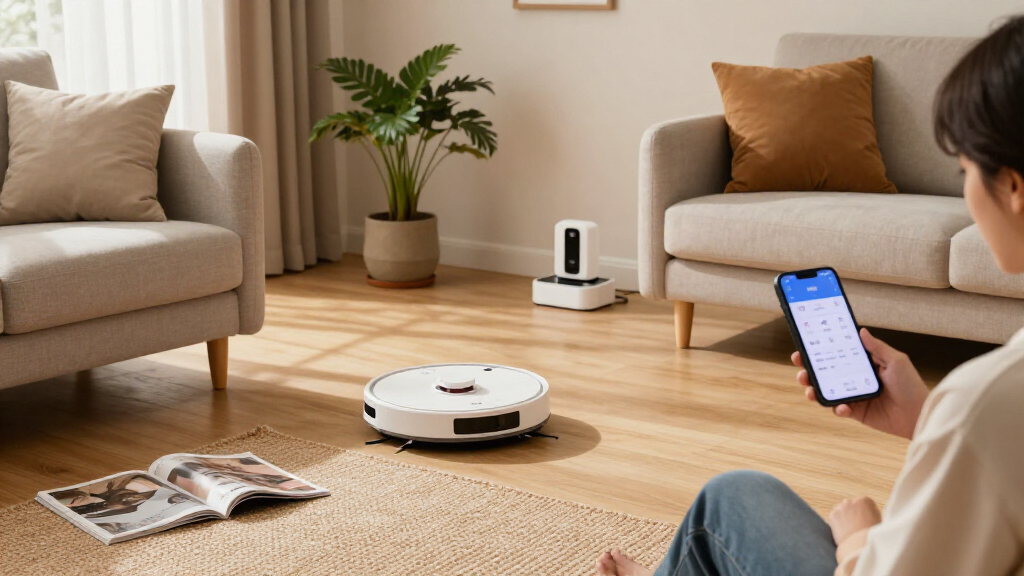
How We Picked
I ranked these vacuums around the needs behind smart-home integration: useful app controls, room mapping and scheduling, voice-assistant or platform compatibility where specified, and the ability to fit cleaning into repeatable home routines. I also weighed cleaning versatility, stated suction, dock automation, maintenance demands, footprint, and whether each model’s feature mix seemed appropriate for its intended buyer. High suction figures alone did not earn a leading position; a connected cleaner should be manageable and useful after the first setup.
The order favors models that combine connected controls with practical automation and a clear role. The Roborock Q7 M5+ ranks first for its balance of mapping, self-emptying, and strong stated suction; models such as the eufy E25 or SwitchBot K11+ rank for more specific priorities rather than broad appeal. Where the supplied product details do not confirm a particular smart-home platform or integration, I avoid treating compatibility as a given. Buyers should verify current app, assistant, and regional support before choosing.
Factors to Consider When Choosing Smart Vacuum For Smart Home Integration
A smart vacuum can be part of a genuinely useful home routine, but the word “smart” covers very different capabilities. I’d match the vacuum’s controls to the devices and habits already in your home, then weigh convenience against dock size, maintenance, and the work you still need to do manually.
Check Platform Compatibility Before Buying
Start with the voice assistant or smart-home platform you already use, then confirm that the exact vacuum model works with it. A listing may mention app control or voice commands without supporting every platform—or every command—you expect. Check whether integration lets you start a clean, pause it, or target rooms, rather than assuming it can trigger all features. If you rely on routines, find out whether the vacuum can be called by those routines and whether it needs a separate app or account connection. A basic voice start can be convenient, but it is not the same as coordinated room-by-room automation. When compatibility details are unclear, treat that uncertainty as a meaningful buying drawback.
Prioritize Mapping That Matches Your Floor Plan
Mapping matters most when you want to clean selected rooms, set boundaries, or build repeatable schedules around different parts of the home. A compact apartment with open rooms may not need advanced map management, while a multi-level or cluttered layout can benefit from more control. Check whether the model supports room naming, no-go areas, and multiple maps if those functions matter to you; do not infer them from “smart navigation” alone. Mapping also takes initial setup and occasional adjustment, especially after furniture changes. A vacuum with a simple schedule may be the better fit if you rarely need targeted cleaning. Avoid paying for map features you will not use, but do not expect random or limited navigation to provide precise room routines.
Decide How Much Hands-Off Maintenance You Want
A self-emptying base can reduce how often you handle collected dust, which is useful for busy households or frequent cleaning schedules. It does not eliminate maintenance: bags or bins still need attention, and docks take up floor space and may add noise during emptying. Mop systems bring their own chores, such as refilling water, cleaning pads or rollers, and dealing with dirty-water components where included. Buyers sometimes focus on automation claims and overlook the recurring tasks that keep a vacuum working well. If you prefer a smaller setup or do not mind emptying the robot yourself, a simpler model can be easier to place and maintain. Choose automation based on the chores you actually want to remove, not on the number of features in the listing.
Treat Suction Claims as One Part of Cleaning Performance
Stated suction figures can help compare models from the same maker, but they do not by themselves predict how well a robot will handle your carpets, rugs, or pet hair. Brush design, navigation, floor transitions, and the ability to reach edges also shape everyday results. For mixed flooring, look for a cleaning setup suited to both carpet pickup and hard-floor debris rather than choosing solely by the largest number. If you want vacuuming and mopping, check whether the mop design is intended for routine maintenance or more involved scrubbing. Consider what the robot can do without you moving rugs or clearing every small object first. A strong headline specification is less useful if the robot cannot clean the areas you care about reliably.
Balance Dock Convenience Against Space and Upkeep
Self-emptying and multifunction docks can make cleaning feel more automatic, but they need a suitable location near power and enough clearance for the robot to return. Measure the intended spot before buying, including room for opening covers or removing containers. Larger stations can be a poor fit for narrow hallways or homes where the base would sit in a busy walkway. Also check what the dock automates and what remains manual; self-emptying does not necessarily mean automatic mop washing or drying. A smaller vacuum with a basic dock may integrate more easily into a compact home, even if it requires more frequent attention. The right station is the one your household can accommodate and maintain.
Plan for Privacy, Network Stability, and Shared Control
Connected vacuums rely on an app and a home network, so think about who will manage the device and how dependable that connection is in the areas it needs to clean. Mapping features can involve storing a layout of your home, making the maker’s privacy settings and account controls worth reviewing. In a shared household, check whether other people can access the controls or whether routines depend on one person’s phone. A stable connection can make remote starts and schedule changes easier, but basic onboard scheduling may matter if the network is interrupted. Keep the app updated and confirm whether key cleaning functions remain available without cloud access. These practical details can matter more than adding another voice command.
Frequently Asked Questions
How can I tell whether a robot vacuum will work with my existing smart-home setup?
Check the manufacturer’s compatibility list for the exact model and your specific assistant or platform; do not rely on a general “smart” label. Look for the functions you plan to use, such as starting a clean, selecting a room, or running a routine. Some integrations offer only basic start and stop commands, while more detailed controls may stay inside the vacuum’s own app. Confirm whether setup requires linking accounts and whether availability varies by country. If integration is central to your choice, verify it before buying rather than treating it as an optional feature.
Is LiDAR mapping worth choosing over a simpler robot vacuum?
LiDAR mapping is most useful when you want the robot to follow an organized route, clean selected rooms, or work around defined boundaries. It can be less valuable in a small, open space where you are happy to run a general cleaning cycle. Mapping does not remove the need to pick up cords or small objects, and maps may need edits after changes to the home. Consider how often you will use room-level control before paying for it. If you mainly want a scheduled pass over open floors, a simpler model may meet your needs with less setup.
Should I choose a self-emptying vacuum if I have pets?
A self-emptying base can reduce how often you empty the robot’s bin, which can help when frequent cleaning collects a lot of hair and debris. It does not guarantee fewer tangles or better pet-hair pickup, so check brush design and maintenance requirements as well. The base itself needs space and still requires bag or bin changes. Homes with pets may also benefit from room targeting so high-shedding areas can be cleaned more often. Choose the dock for reduced bin handling, not as a substitute for checking how the vacuum handles hair.
Will a robot vacuum and mop replace a regular mop?
A robot mop is generally best treated as a way to maintain hard floors between deeper cleans, not as a complete replacement for manual mopping. Its results depend on the mop design, floor type, and how much dried-on dirt is present. Check how the pad or roller is cleaned and whether the robot can avoid rugs or carpet while mopping. A combined vacuum-and-mop model can save routine effort, but it may still need you to refill water and clean mop components. If your floors often have sticky spills or heavy grime, keep a manual cleaning option available.
What should I verify when the product listing does not name supported smart-home platforms?
Do not assume that app control means compatibility with your preferred voice assistant or home-automation system. Search the manufacturer’s support information for the model number and confirm which commands are available, whether a hub is required, and whether features vary by region. If you cannot find clear documentation, ask the seller or manufacturer before purchase. Think about whether the vacuum remains useful through its own app if an integration is unavailable. For a buyer who depends on routines, unclear compatibility is a reason to favor a better-documented alternative.
Conclusion
For a connected home that needs a balanced cleaner, I’d choose the Roborock Q7 M5+ as the best overall pick, while checking current platform support before purchase. The MONSGA or Tikom L8000 Plus makes more sense as a value-minded choice if self-emptying and everyday app control matter more than premium mop features. For a premium cleaning setup, the eufy E25 is the standout for buyers drawn to its HydroJet roller mop and high stated suction, though those features should not be mistaken for broad smart-home compatibility. The Wyze Robot Vacuum is a reasonable starting point for beginners who want LiDAR mapping without centering their choice on a large cleaning station. For compact homes, consider the SwitchBot K11+; for a simpler, less automation-focused setup, compare the Lefant M210 and ROPVACNIC S1. Match your final choice to verified integrations, your floor plan, and the maintenance you are willing to handle.