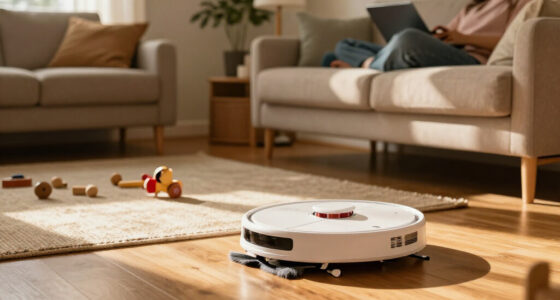
For a robot vacuum for tile and grout, I’d start with the Dreame L40 Ultra Gen 2 as the best overall pick: its 25,000Pa suction and mop system make it the strongest all-around match here for hard floors and embedded debris. The Roborock Q7 M5+ stands out for strong suction and self-emptying, while the eufy E25’s HydroJet roller mop suits homes that want a more active approach to floor washing. The main tradeoff is between vacuuming power, mop design, and how much upkeep you want from a dock. Grout can hold fine dirt that a basic pass may leave behind, so navigation and repeatable coverage matter alongside suction. Read on for the full breakdown and guidance on matching features to your floors.

Get cleaning gear delivered free with Prime
- Fast, free delivery on millions of items
- Prime Video, Amazon Music and more included
- Member-only deals all year
Complete the kit



Key Takeaways
The Dreame L40 Ultra Gen 2 leads on listed suction at 25,000Pa, giving it the strongest stated vacuuming spec in this lineup; that alone does not guarantee better grout cleaning, since brush contact and navigation also matter.
Roller mops set the eufy E25 and C28 apart. Their HydroJet designs make them distinct options for buyers prioritizing active mopping, while traditional mop-pad combos focus more on routine light cleaning.
Self-emptying is not the same as hands-off floor care. Several models include self-emptying or extended dock support, but mop pads, rollers, tanks, and docks can still need regular attention.
Navigation and mapping separate planned coverage from basic automation. LiDAR and multi-floor mapping on selected models can help with room-by-room routines and no-go zones; simpler gyro or app-controlled options may need more supervision.
High suction figures are not directly comparable proof of grout performance. Brush design, floor texture, debris type, and the robot’s ability to follow a consistent route all affect results, so choose by your floor and cleaning routine rather than the largest number alone.
| Dreame D20 Air Plus Robot Vacuum and Mop, 20,000Pa Powerful Suction |  | Best for Pet Hair and Low-Maintenance Tile Cleaning | Suction power: 20,000Pa | Navigation: LiDAR | Dust bag capacity: 4L | VIEW ON AMAZON | See Our Full Breakdown |
| Roborock Q7 L5 Robot Vacuum and Mop Combo, 8,000Pa Suction |  | Best for Multi-Floor Mapping | Suction power: 8,000Pa | Navigation: LiDAR | Water tank capacity: 270ml | VIEW ON AMAZON | See Our Full Breakdown |
| Dreame L40 Ultra Gen 2 Robot Vacuum and Mop with 25,000Pa Suction |  | Best Premium Grout-Care System | Suction power: 25,000Pa | Battery life: 231 minutes | Mopping system: DuoScrub | VIEW ON AMAZON | See Our Full Breakdown |
| MONSGA Robot Vacuum and Mop with 8000Pa Suction, Self-Emptying, 90 Days Runtime |  | Best for Large Homes and Long Cleaning Intervals | Maximum suction: 8,000Pa | Water tank capacity: 460ml | Dust capacity: 4L | VIEW ON AMAZON | See Our Full Breakdown |
| ROPVACNIC Robot Vacuum and Mop Combo 5200Pa Suction Robotic Cleaner |  | Best for Simple, Smaller-Home Cleaning | Suction power: 5,200Pa | Battery life: 120 minutes | Battery type: Lithium-ion | VIEW ON AMAZON | See Our Full Breakdown |
| Robot Vacuum and Mop with Self-Emptying Station, 6000Pa Suction, LiDAR Navigation, and Smart Mapping |  | Best for Long Gaps Between Maintenance | Suction power: 6000Pa | Dust bag capacity: 4L | Mapping: LiDAR | VIEW ON AMAZON | See Our Full Breakdown |
| eufy E25 Robot Vacuum and Mop Combo, 20,000 Pa, HydroJet Roller Mop |  | Best for Active Mop Care | Maximum suction: 20,000 Pa | Mop system: HydroJet roller mop | Mop washing: Automatic | VIEW ON AMAZON | See Our Full Breakdown |
| iRobot Roomba 105 Robot Vacuum Cleaner |  | Best Beginner Vacuum-Only Pick | Navigation: LiDAR | Surface recommendation: Carpet and hard floor | Suction claim: 70x more power-lifting suction | VIEW ON AMAZON | See Our Full Breakdown |
| Robot Vacuum and Mop, 6500Pa Suction, 2-in-1 Robotic Vacuum with Gyro Navigation, 200 Min Runtime, App/Remote/Voice Control, Suitable for Pet Hair, Hard Floors, and Carpets |  | Best for Long Cleaning Runs | Suction power: 6500Pa | Runtime: Up to 200 minutes | Battery capacity: 2600mAh | VIEW ON AMAZON | See Our Full Breakdown |
| iRobot Roomba 105 Combo Robot Vacuum & Mop with AutoEmpty Dock |  | Best for Set-and-Forget Vacuuming and Mopping | AutoEmpty interval: Up to 75 days | Suction: 70x more power-lifting suction | Navigation: LiDAR | VIEW ON AMAZON | See Our Full Breakdown |
| Tikom Robot Vacuum and Mop Combo G8000 Max |  | Best for Simple, Low-Profile Cleaning | Suction power: 5,000Pa | Battery life: Up to 150 minutes | Height: 2.99 inches | VIEW ON AMAZON | See Our Full Breakdown |
| iRobot Roomba 415X Robot Vacuum & Mop Combo |  | Best for Low-Maintenance Pet Homes | Suction power: 20,000Pa | Self-emptying duration: Up to 90 days | Mop pad heating temperature: 113°F | VIEW ON AMAZON | See Our Full Breakdown |
| Lefant M2 Plus Robot Vacuum and Mop Combo |  | Best for Multi-Floor Mapping | Suction power: 6,000Pa | Battery runtime: Up to 140 minutes | Dustbin capacity: 250ml | VIEW ON AMAZON | See Our Full Breakdown |
| Roborock Q7 M5+ Robot Vacuum and Mop |  | Best for Strong Vacuuming with Long Bin Intervals | Maximum suction: 10,000Pa | Battery life: 150 minutes | Self-emptying interval: Up to 7–9 weeks | VIEW ON AMAZON | See Our Full Breakdown |
| eufy C28 Robot Vacuum Cleaner and Mop Combo |  | Best for Active Roller Mopping | Surface recommendation: Hard floor, wooden floor, and short wool carpet | Battery life: 140 minutes | Cleaning path width: 11.02 inches | VIEW ON AMAZON | See Our Full Breakdown |
| robot vacuum for tile and grout | Suction power | Navigation | Battery life |
|---|---|---|---|
| Dreame D20 Air Plus Robot Vacu | 20,000Pa | LiDAR | 150 minutes |
| Roborock Q7 L5 Robot Vacuum an | 8,000Pa | LiDAR | 150 minutes |
| Dreame L40 Ultra Gen 2 Robot V | 25,000Pa | — | 231 minutes |
| MONSGA Robot Vacuum and Mop wi | — | — | — |
| ROPVACNIC Robot Vacuum and Mop | 5,200Pa | — | 120 minutes |
| Robot Vacuum and Mop with Self | 6000Pa | — | Not specified |
| eufy E25 Robot Vacuum and Mop | — | — | — |
| iRobot Roomba 105 Robot Vacuum | — | LiDAR | — |
| Robot Vacuum and Mop | 6500Pa | Gyro inertial navigation | — |
| iRobot Roomba 105 Combo Robot | — | LiDAR | — |
| Tikom Robot Vacuum and Mop Com | 5,000Pa | — | Up to 150 minutes |
| iRobot Roomba 415X Robot Vacuu | 20,000Pa | LiDAR mapping and obstacle recognition | — |
| Lefant M2 Plus Robot Vacuum an | 6,000Pa | LiDAR | — |
| Roborock Q7 M5+ Robot Vacuum a | — | PreciSense LiDAR | 150 minutes |
| eufy C28 Robot Vacuum Cleaner | — | — | 140 minutes |
More Details on Our Top Picks
Dreame D20 Air Plus Robot Vacuum and Mop, 20,000Pa Powerful Suction
For tile and grout, the D20 Air Plus pairs high stated suction with LiDAR coverage and a self-emptying dock. That combination suits homes where crumbs and pet hair collect along grout lines and cleaning runs need to happen often. Its 4L dust bag reduces how frequently you handle debris, while the dual anti-tangle brush design addresses hair pickup. Compared with the Roborock Q7 L5, it has substantially higher stated suction and an auto-empty dock, but the Q7 L5 lists a 270ml water tank and multi-floor mapping details that are useful for buyers prioritizing mop setup and floor-by-floor organization. The main tradeoff is that the D20’s listed mop details are limited, so suction and maintenance convenience are better-supported reasons to choose it than grout-scrubbing performance. It also requires 2.4GHz Wi-Fi and app setup.
Pros:- 20,000Pa stated suction is the highest among these five picks, supporting pickup of loose debris from grout lines.
- Auto-empty dock with a 4L dust bag cuts down on routine dustbin emptying.
- LiDAR navigation supports organized room coverage.
- Dual anti-tangle brushes are designed to reduce pet-hair wrap.
Cons:- The supplied product data gives few details about mop-water capacity or mop-cleaning functions.
- 2.4GHz Wi-Fi support may not fit households relying on 5GHz-only networks.
- App control is part of the setup, which may frustrate buyers seeking a simple button-only routine.
Best for: Pet owners with tile-heavy homes who want strong debris pickup, mapped coverage, and less frequent dustbin handling.
Not ideal for: Buyers seeking detailed mop controls or a clearly specified water tank for regular grout-focused mopping, or households that only use 5GHz Wi-Fi.
- Suction power:20,000Pa
- Navigation:LiDAR
- Dust bag capacity:4L
- Battery life:150 minutes
- Surface recommendations:Carpet, wood, tile
- Brush feature:Dual anti-tangle brushes
- Control methods:App, button, voice
- Wi-Fi compatibility:2.4GHz
Our verdict“Choose the D20 Air Plus if pet hair and hands-off debris collection matter more than having detailed, documented mopping features.”
Roborock Q7 L5 Robot Vacuum and Mop Combo, 8,000Pa Suction
The Q7 L5 is the mapping-focused choice for tile homes where repeatable room coverage matters more than a self-emptying dock. LiDAR navigation and multi-floor support give it a clearer fit for homes with more than one level than the ROPVACNIC, whose supplied details emphasize controls and cleaning modes rather than floor-map memory. Its 8,000Pa suction and dual anti-tangle brushes cover everyday dry debris and pet hair, while the 270ml water tank adds a defined mopping capacity. On grout, though, the listing does not describe a dedicated scrubbing mechanism, so I would treat its mop as maintenance cleaning rather than a replacement for targeted grout scrubbing. The compromise is capacity: the combined water tank and dustbin limit how much it can hold, and it lacks the D20 Air Plus’s stated auto-emptying convenience.
Pros:- LiDAR navigation and multi-floor mapping help organize cleaning across levels.
- 8,000Pa stated suction and dual anti-tangle brushes target routine debris and pet hair.
- 270ml water tank gives buyers a specific capacity for planning mop runs.
- App and voice control work with Amazon Echo and Google Home.
Cons:- Combined water tank and dustbin constrain capacity during longer cleaning sessions.
- No self-emptying dock is listed, unlike the Dreame D20 Air Plus and MONSGA.
- The supplied details do not identify a specialized grout-scrubbing action.
Best for: Owners of multi-level homes with tile floors who want mapped routes, app scheduling, and a clearly stated mop-water capacity.
Not ideal for: Large, debris-heavy households that want a self-empty dock or extended cleaning between tank and bin emptying.
- Suction power:8,000Pa
- Navigation:LiDAR
- Water tank capacity:270ml
- Battery life:150 minutes
- Noise level:60dB
- Filter:Washable
- Mapping:Multi-floor support
- Control methods:App, voice
Our verdict“Pick the Q7 L5 for multi-floor mapping and defined mop capacity, but skip it if you want a self-emptying system.”
Dreame L40 Ultra Gen 2 Robot Vacuum and Mop with 25,000Pa Suction
The L40 Ultra Gen 2 is the most feature-rich pick here for buyers who want vacuuming and active mop upkeep in one system. Its DuoScrub mopping system, mop washing, hot-air drying, and extendable side brush and mop offer more than the basic mop details listed for the Roborock Q7 L5. That broader cleaning setup can help maintain tiled surfaces and reach along edges, while 25,000Pa stated suction and obstacle avoidance add capability for mixed debris and busy rooms. A 231-minute battery life also exceeds the other four options in this batch. The tradeoff is complexity: this is more machinery and automation than a buyer seeking simple damp maintenance may need. The supplied details also say optional auto-dispensers are sold separately, and 2.4GHz Wi-Fi is required. The mopping system is the standout, but the listing does not promise that it replaces manual grout scrubbing.
Pros:- DuoScrub mopping, mop washing, and hot-air drying provide a more involved floor-care system than the other listed picks.
- 25,000Pa stated suction is the strongest figure in this group.
- 231-minute battery life supports longer cleaning sessions.
- Extendable side brush and mop, plus obstacle avoidance, target edges and room navigation.
Cons:- Optional auto-dispensers are sold separately.
- 2.4GHz Wi-Fi requirement may not work with 5GHz-only networks.
- Its many automated functions may be unnecessary for buyers who only need routine dust pickup and light mopping.
Best for: Tile-heavy households that want an advanced mop-washing and drying system, long runtime, and detailed automated cleaning.
Not ideal for: Buyers who want a straightforward, lower-complexity robot or expect a robot mop to remove established grime from grout without manual work.
- Suction power:25,000Pa
- Battery life:231 minutes
- Mopping system:DuoScrub
- Mop care:Mop washing and hot-air drying
- Mop lifting:10.5mm
- Navigation features:Precise obstacle avoidance
- Wi-Fi compatibility:2.4GHz
- Surface recommendations:Wood, marble, tile
Our verdict“Choose the L40 Ultra Gen 2 if you want the most complete automated mop-care setup here and are comfortable with added system complexity.”
MONSGA Robot Vacuum and Mop with 8000Pa Suction, Self-Emptying, 90 Days Runtime
MONSGA makes the strongest case for larger homes that need broad coverage and less frequent dust disposal. Its 4L dust capacity, self-emptying system, and stated 160-minute runtime suit repeated runs across several rooms; LiDAR mapping and memory for five floor maps add organization for multi-level layouts. For tile and grout, the 460ml water tank is a more substantial stated mop capacity than the Roborock Q7 L5’s 270ml tank, while both offer LiDAR navigation. The Q7 L5, however, lists a washable filter and a 60dB noise figure that MONSGA’s supplied data does not provide. This model’s 8,000Pa suction is well below the Dreame D20 Air Plus and L40 Ultra Gen 2, so buyers prioritizing maximum stated suction should choose one of those instead. It also requires 2.4GHz Wi-Fi and a North American 120V outlet.
Pros:- 4L dust capacity and self-emptying system reduce routine debris handling.
- LiDAR mapping supports up to five saved floor maps.
- 460ml water tank has greater stated capacity than the Roborock Q7 L5’s 270ml tank.
- 160-minute runtime supports longer cleaning sessions than the ROPVACNIC’s 120 minutes.
Cons:- 8,000Pa stated suction is lower than the Dreame D20 Air Plus and L40 Ultra Gen 2.
- Requires 2.4GHz Wi-Fi and a 120V outlet.
- The supplied data does not specify noise level or detailed mop-washing functions.
Best for: Owners of larger or multi-level homes who want a self-emptying dock, multiple saved maps, and fewer interruptions for bin emptying.
Not ideal for: Buyers who prioritize the highest stated suction, need a robot for a non-North-American power setup, or lack 2.4GHz Wi-Fi.
- Maximum suction:8,000Pa
- Water tank capacity:460ml
- Dust capacity:4L
- Runtime:160 minutes
- Battery capacity:3,200mAh
- Mapping technology:LiDAR
- Saved floor maps:Up to 5
- Voltage:120V
Our verdict“Pick MONSGA for mapped, extended cleaning with less frequent dust handling, not for the strongest suction or a documented advanced mop system.”
ROPVACNIC Robot Vacuum and Mop Combo 5200Pa Suction Robotic Cleaner
The ROPVACNIC is the simpler fit for smaller tile areas and buyers who want several ways to start a cleaning run. App, remote, and voice controls make it less dependent on one control method than the Roborock Q7 L5, which lists app and voice control. Its adjustable electric mopping and multiple modes add flexibility for routine hard-floor upkeep, while the pet-hair brush design is useful for everyday loose fur. But its 5,200Pa suction and 120-minute battery life are the lowest and shortest figures among these five models, making it less suited to large homes or heavy debris in grout lines. Unlike MONSGA, it has no self-emptying dust system listed, and its supplied surface recommendations name hardwood and low-pile carpet rather than tile. That makes tile use plausible from the description, but less clearly documented than on the Dreame models.
Pros:- App, remote, and voice control offer several operating options.
- Adjustable electric mopping and multiple cleaning modes support routine floor maintenance.
- Pet-hair-focused brush design targets loose fur.
- Auto-docking returns the robot to its charging station.
Cons:- 5,200Pa stated suction is lower than the other four products in this batch.
- 120-minute battery life is the shortest listed here.
- No self-emptying dock or water-tank capacity is specified, and listed surface recommendations omit tile.
Best for: People in smaller homes with mostly smooth floors who want app, remote, or voice operation and light, scheduled mopping.
Not ideal for: Owners of large tile-heavy homes, households with substantial pet hair, or buyers who need a self-emptying dock and clearly stated tile compatibility.
- Suction power:5,200Pa
- Battery life:120 minutes
- Battery type:Lithium-ion
- Control methods:App, remote, voice
- Compatible devices:Amazon Echo, Google Home, smartphones
- Power levels:3
- Form factor:Round
- Filter:Multi-layer high-efficiency filtration
Our verdict“Choose the ROPVACNIC for flexible controls and routine cleaning in a smaller home, but favor a higher-suction model for extensive tile and grout.”
Robot Vacuum and Mop with Self-Emptying Station, 6000Pa Suction, LiDAR Navigation, and Smart Mapping
For tile and grout, this model’s combination of 6000Pa suction, adjustable water flow, and LiDAR mapping makes it a practical choice for regular vacuuming plus light damp mopping. The 4L dust bag is its clearest advantage: the stated interval of up to 120 days between emptying can mean less routine handling than the Roomba 105 Combo’s 75-day AutoEmpty claim. LiDAR maps and no-go zones also help keep the robot out of areas where a damp mop is unwanted. The tradeoff is that the listing gives no battery runtime, and full scheduling and room selection depend on app or voice controls. Mopping should not be mistaken for grout scrubbing; buyers may still need to clean stubborn, set-in grime by hand.
Pros:- 4L dust bag and a stated interval of up to 120 days before emptying
- LiDAR mapping supports room-based cleaning and no-go zones
- 6000Pa suction is suited to everyday debris and pet hair
- Three water-flow settings offer some control over damp mopping
Cons:- Battery life and cleaning runtime are not specified
- Full scheduling and room-selection features rely on app or voice control
- The mop cloth may need removal for vacuum-only runs
Best for: Busy households with mostly hard floors that want mapped cleaning and fewer dust-bag changes.
Not ideal for: Shoppers who need a stated runtime or expect a robot mop to scrub deeply soiled grout.
- Suction power:6000Pa
- Dust bag capacity:4L
- Mapping:LiDAR
- No-go zones:Supported
- Water-flow settings:3 levels
- App compatibility:Yes
- Voice control:Amazon Alexa, Google Assistant
- Battery life:Not specified
Our verdict“Choose it for mapped hard-floor upkeep with infrequent dust-bag changes, but not if a known runtime or hands-free mop maintenance is a priority.”
eufy E25 Robot Vacuum and Mop Combo, 20,000 Pa, HydroJet Roller Mop
The eufy E25 is the most mop-focused pick in this group: its HydroJet roller mop and automatic mop washing are aimed at keeping cleaning more continuous than a basic robot with a water tank and cloth. That makes it a stronger fit for households that mop tile often, while its self-emptying and self-refilling features reduce other routine tasks. The listed 20,000 Pa suction also gives it a much higher stated figure than the 6000Pa mapped model in this batch, though suction numbers alone do not tell you how well a robot lifts dirt from grout lines. Compared with the E25, the Roomba 105 Combo offers a clear 75-day emptying interval, while the E25 listing does not specify one. It also has just one listed power level, and 57 dB may be noticeable.
Pros:- HydroJet roller mop with automatic mop washing
- Self-emptying and self-refilling reduce routine maintenance
- Listed 20,000 Pa suction and obstacle avoidance
- App, button, and voice-control options
Cons:- Only one power level and one speed are listed
- The listed 57 dB noise level may be noticeable at home
- No self-emptying interval or runtime is provided in the supplied specs
Best for: Pet households with extensive tile or other hard flooring that want a robot to wash its mop automatically.
Not ideal for: Buyers seeking multiple suction settings, a documented battery runtime, or a quiet cleaning cycle.
- Maximum suction:20,000 Pa
- Mop system:HydroJet roller mop
- Mop washing:Automatic
- Self-refilling:Yes
- Obstacle avoidance:Yes
- Noise level:57 dB
- Listed capacity:2.5 liters
- Compatible devices:Amazon Echo, Google Home, smartphones, tablets
Our verdict“Pick the E25 if automatic mop washing matters more than adjustable power or clearly stated runtime and dock intervals.”
iRobot Roomba 105 Robot Vacuum Cleaner
Tile and grout do not always call for a mop attachment: loose crumbs and dust can collect in floor joints, and a straightforward vacuum avoids leaving moisture behind. The Roomba 105 is the vacuum-only choice here, with LiDAR navigation, dirt detection, and self-charging with resume cleaning listed among its features. That makes it simpler in purpose than the Roomba 105 Combo, which adds mop modes and an AutoEmpty dock, and a better fit for buyers who already mop separately. The description calls out 70x suction, but does not give an absolute suction figure or a runtime, so it is harder to compare directly with models such as the 6500Pa gyro-navigation combo. Its 2.4 GHz Wi-Fi requirement may also rule it out for buyers whose network setup does not support that band.
Pros:- LiDAR navigation supports organized floor coverage
- Dirt detection sensor can respond to messier areas
- Self-charging and resume cleaning are listed
- App, button, and voice control are supported
Cons:- Vacuum-only design does not mop tile
- No specific battery runtime or absolute suction figure is provided
- Requires a 2.4 GHz Wi-Fi network
Best for: First-time robot-vacuum buyers with tile and hard floors who want scheduled vacuuming without managing a mop pad.
Not ideal for: Households looking for automated damp mopping, self-emptying, or a clearly stated runtime.
- Navigation:LiDAR
- Surface recommendation:Carpet and hard floor
- Suction claim:70x more power-lifting suction
- Dirt detection:Sensor included
- Cleaning modes:Eco mode
- Filter:Cartridge
- Connectivity:2.4 GHz Wi-Fi
- Controls:App, button, voice
Our verdict“Choose this Roomba for mapped, vacuum-only maintenance on tile, but opt for the Roomba 105 Combo if you want mopping and an AutoEmpty dock.”
Robot Vacuum and Mop, 6500Pa Suction, 2-in-1 Robotic Vacuum with Gyro Navigation, 200 Min Runtime, App/Remote/Voice Control, Suitable for Pet Hair, Hard Floors, and Carpets
With a stated 200-minute runtime, this combo is the clearest choice for covering a large floor area in one run without moving to a dock mid-clean. Its 6500Pa suction and zigzag mode suit routine debris pickup on tile, while the 200ml water tank adds a basic damp-mopping option. Unlike the LiDAR-equipped Roomba 105, its gyro navigation is described as systematic but does not come with listed smart mapping or no-go zones; buyers who need precise room selection should look at the 6000Pa LiDAR model instead. The smaller 200ml tank may need refilling during larger mopping jobs, and the 300ml dustbin means more frequent emptying than models with self-emptying stations. Treat the mop as maintenance cleaning, not a substitute for scrubbing dirty grout.
Pros:- Stated runtime of up to 200 minutes
- 6500Pa suction with zigzag, spot, and edge modes
- App, remote, and Google Assistant voice control
- Handles hard floors, tile, marble, and carpet
Cons:- Gyro navigation is not listed with LiDAR-style mapping or no-go zones
- 200ml water tank may require refills during larger mopping jobs
- 300ml dustbin needs manual emptying
Best for: Owners of larger hard-floor areas who value a stated long runtime and are comfortable emptying the bin and refilling the tank themselves.
Not ideal for: Buyers who want LiDAR room maps, no-go zones, a self-emptying dock, or extended mopping without refills.
- Suction power:6500Pa
- Runtime:Up to 200 minutes
- Battery capacity:2600mAh
- Navigation:Gyro inertial navigation
- Water tank:200ml
- Dustbin:300ml
- Cleaning modes:Zigzag, spot, edge
- Obstacle crossing:15°
- Controls:App, remote, Google Assistant voice control
Our verdict“Choose it for long, self-managed cleaning runs across broad floor areas, not for room-level mapping or low-maintenance mopping.”
iRobot Roomba 105 Combo Robot Vacuum & Mop with AutoEmpty Dock
The Roomba 105 Combo makes sense for tile owners who want one mapped machine to vacuum, mop, or do both, then handle dust disposal at its dock. Its 75-day AutoEmpty claim is a useful maintenance benchmark: it is less than the 120-day interval stated for the 6000Pa self-emptying model, but this Roomba adds multiple cleaning modes and a supplied extra mop pad. LiDAR navigation helps organize coverage, while separate vacuum and mop options give more flexibility than a basic 2-in-1 without selectable modes. The tradeoff is that the listing requires 2.4 GHz Wi-Fi and app setup, and its mopping avoids carpets, limiting simultaneous use in mixed-floor homes. No absolute suction figure or runtime is supplied, so buyers seeking a direct spec comparison may prefer the 6500Pa, 200-minute gyro model.
Pros:- AutoEmpty dock is listed for up to 75 days
- LiDAR navigation supports mapped cleaning
- Offers vacuum, mop, and combined cleaning modes
- Includes an extra mop pad
Cons:- Requires 2.4 GHz Wi-Fi setup and app control
- Mopping avoids carpets, limiting use in mixed-floor spaces
- No absolute suction figure or runtime is provided
Best for: Households with mostly tile or other hard floors that want mapped vacuuming, mopping, and automatic dust disposal.
Not ideal for: Homes with many rugs that need mopping across mixed surfaces, or buyers who avoid app and Wi-Fi setup.
- AutoEmpty interval:Up to 75 days
- Suction:70x more power-lifting suction
- Navigation:LiDAR
- Cleaning modes:Vacuum, mop, vacuum and mop
- Connectivity:2.4 GHz Wi-Fi
- Included:AutoEmpty dock, extra mop pad
Our verdict“Pick this Roomba for mapped hard-floor cleaning with an AutoEmpty dock, but skip it if carpeted areas need to be mopped too.”
Tikom Robot Vacuum and Mop Combo G8000 Max
The Tikom G8000 Max is a straightforward pick for tile and grout when you want simultaneous vacuuming and mopping without a large dock. Its 2.99-inch profile can reach beneath some low furniture where taller, station-based options such as the Roborock Q7 M5+ may not fit. The listed 5,000Pa suction and 150-minute battery provide a useful balance for routine dust, crumbs, and pet hair across hard floors, while edge and spot modes offer basic control over messes. Its 300ml water tank is the main limitation for mopping: larger tile areas may call for refills, and it lacks the automated mop care offered by the iRobot Roomba 415X. I’d choose it for accessible controls and a slim body, not for hands-off maintenance or thick carpets.
Pros:- Low 2.99-inch height can reach under some furniture.
- Vacuuming and mopping can run together.
- 150-minute battery supports longer routine cleaning runs.
- App, remote, voice, and button controls offer several ways to operate it.
Cons:- The 300ml water tank may need refilling during larger mopping jobs.
- The listing warns that it may be less effective on very thick carpets.
- Full functionality depends on completing app setup.
Best for: Households with mostly tile or other hard floors, low-clearance furniture, and a preference for app, remote, or button controls.
Not ideal for: People with large tiled areas who want extended mopping without refills, or homes where thick carpet is a major cleaning surface.
- Suction power:5,000Pa
- Battery life:Up to 150 minutes
- Height:2.99 inches
- Dustbin capacity:450ml
- Water tank capacity:300ml
- Control methods:App, remote, voice, and button
- Cleaning modes:Spot, edge, zig-zag, and manual
Our verdict“Choose the G8000 Max for a slim, uncomplicated vacuum-and-mop routine on tile, but skip it if you expect dock-based mop care or long-area mopping without refills.”
iRobot Roomba 415X Robot Vacuum & Mop Combo
For tile and grout in a busy home, the Roomba 415X puts much of its appeal in the dock rather than in a simple suction figure: it can self-empty, wash its mop, and hot-dry the pad. That combination can cut down on routine contact with collected debris and a damp mop, a step beyond the more basic Tikom G8000 Max. Its listed 20,000Pa suction, tangle-free rubber brushes, and extending edge brushes suit homes where pet hair and perimeter dust collect around hard floors. LiDAR mapping and obstacle recognition add planning and avoidance features, though the complex setup may take more effort than a simpler robot. The 10mm mop lift is useful when moving between tile and carpet, but this is a large, feature-heavy machine that may not reach tight spaces. I’d favor it for convenience, not compactness.
Pros:- Self-emptying system is specified for up to 90 days.
- Automatic mop washing and 113°F hot drying reduce manual pad care.
- Tangle-free rubber brushes are suited to pet hair.
- LiDAR mapping, obstacle recognition, and extending edge brushes support planned edge-to-edge cleaning.
Cons:- Multiple dock and mapping features can make setup more involved.
- Its large size may limit access to tight spaces.
- A 10mm mop lift may not suit every carpet transition.
Best for: Pet-owning households with substantial hard-floor cleaning to automate and a preference for dock-managed debris and mop care.
Not ideal for: Buyers who need a compact robot for narrow furniture gaps or want a simpler setup with fewer connected features.
- Suction power:20,000Pa
- Self-emptying duration:Up to 90 days
- Mop pad heating temperature:113°F
- Mop lift height:10mm
- Navigation:LiDAR mapping and obstacle recognition
- Edge brush:Extending edge brushes
- Connectivity:App and voice control
Our verdict“Pick the Roomba 415X if dock automation and pet-hair handling matter more than compact dimensions or a simple setup.”
Lefant M2 Plus Robot Vacuum and Mop Combo
The Lefant M2 Plus is the mapping-focused choice for homes with several levels or distinct tile zones. Its LiDAR navigation, multi-floor maps, and no-go zones let you define where it cleans rather than relying on a basic route, which gives it an organizational advantage over the more control-simple Tikom G8000 Max. The self-emptying station is specified with two 2.5L dust bags and up to 75 days of hands-free cleaning, reducing how often you handle vacuum debris. For grout lines, the listed 6,000Pa suction helps with loose dirt, but the 300ml water tank still calls for manual refilling during larger mopping sessions. Setup and map customization may be more than casual users want. I’d pick this over the Roborock Q7 M5+ when multi-floor mapping is the priority, while checking whether its app features fit your household.
Pros:- LiDAR supports multi-floor mapping and customizable no-go zones.
- Self-emptying station uses two 2.5L dust bags.
- Up to 140 minutes of runtime suits longer cleaning sessions.
- App, WiFi, and Alexa compatibility provide several scheduling and control options.
Cons:- Setup and map customization may feel complex for first-time robot owners.
- The 300ml water tank needs manual refilling.
- Its feature set may be excessive for a small, single-floor home.
Best for: People with multiple mapped floors or rooms who want custom no-go zones and less frequent vacuum-bin emptying.
Not ideal for: Buyers seeking a plug-and-play robot, or households that want a large water supply and minimal manual involvement in mopping.
- Suction power:6,000Pa
- Battery runtime:Up to 140 minutes
- Dustbin capacity:250ml
- Water tank capacity:300ml
- Navigation:LiDAR
- Self-emptying capacity:Two 2.5L dust bags
- No-go zones:Supported
- Connectivity:2.4GHz/5GHz WiFi, app, and Alexa
Our verdict“Choose the M2 Plus for mapped, zone-based cleaning across multiple floors, but look elsewhere if you want the simplest setup or less hands-on mopping.”
Roborock Q7 M5+ Robot Vacuum and Mop
The Roborock Q7 M5+ puts vacuum pickup ahead of intensive mop automation, making it a strong fit for tile where grit and pet hair gather in grout lines. Its 10,000Pa suction, LiDAR navigation, and dual anti-tangle brushes give it a more capable vacuuming setup than the Tikom G8000 Max, while the 2.7L dust bag is specified for 7–9 weeks of hands-free self-emptying. That reduces bin chores without the more elaborate mop-washing and drying system listed for the iRobot Roomba 415X. App control provides customizable cleaning, but the product data specifies smartphone control and 2.4GHz Wi-Fi for app use, so it is less flexible for people who prefer a remote or onboard controls. I’d shortlist it for mapped, repeatable vacuuming across tile and carpet, while treating its mopping as an added function rather than the main reason to buy.
Pros:- 10,000Pa suction is suited to lifting loose debris from hard floors and grout lines.
- LiDAR supports systematic navigation and mapping.
- Dual anti-tangle brushes are designed to reduce hair buildup.
- 2.7L dust bag is specified for 7–9 weeks of hands-free self-emptying.
Cons:- App control requires 2.4GHz Wi-Fi.
- The listed controls focus on smartphone use rather than a remote.
- The supplied details do not specify an automatic mop-washing or drying dock.
Best for: Pet-owning households with tile and some carpet that want strong mapped vacuuming and fewer debris-bin changes.
Not ideal for: People who prioritize automated mop washing and drying, or who need controls beyond smartphone app operation.
- Maximum suction:10,000Pa
- Battery life:150 minutes
- Self-emptying interval:Up to 7–9 weeks
- Dust bag capacity:2.7L
- Navigation:PreciSense LiDAR
- Brush design:Dual anti-tangle
- Cleaning path width:12.8 inches
- Noise level:65dB
Our verdict“Choose the Q7 M5+ for strong, mapped vacuuming and long intervals between bin changes, not for fully automated mop maintenance.”
eufy C28 Robot Vacuum Cleaner and Mop Combo
The eufy C28 is the distinct pick here for buyers who want a mop system to play a larger role on tile, not just trail behind vacuuming. Its HydroJet roller mop and self-cleaning feature target ongoing hard-floor care, while the listing also describes up to 75 days of automated maintenance. That makes it a different proposition from the Roborock Q7 M5+, whose standout strengths center on suction, mapping, and self-emptying. The C28 is also listed for pet hair and dust, with a washable filter and app, button, and voice control. Its 140-minute battery life suits multi-room routines, though the supplied specifications do not state a suction figure, so buyers cannot directly compare its pickup power with the Q7 M5+ or Roomba 415X from this data. Setup may take patience, and the listed operating noise is not especially quiet.
Pros:- HydroJet roller mop is designed to provide active hard-floor mopping.
- Self-cleaning mop features reduce routine pad maintenance.
- Listed 3L capacity supports the automated cleaning system.
- App, push-button, and voice controls offer flexible operation.
Cons:- The provided product data does not state a suction-power figure.
- Setup may be complex for buyers who want a simple first-run process.
- Listed noise level is 54.89dB.
Best for: Hard-floor households that want a roller-style mop with self-cleaning features and multiple control options.
Not ideal for: Buyers who need a clearly specified suction figure for comparison, quiet operation, or a very simple setup.
- Surface recommendation:Hard floor, wooden floor, and short wool carpet
- Battery life:140 minutes
- Cleaning path width:11.02 inches
- Capacity:3L
- Filter:Washable
- Controls:App, push button, and voice
- Mopping system:HydroJet roller mop with self-cleaning
- Noise level:54.89dB
Our verdict“Pick the C28 if roller mopping and mop self-cleaning matter more than easy setup or a directly comparable suction specification.”

How We Picked
I compared the 15 listed models by how their stated features address the specific demands of tile and grout: picking up dust from textured seams, covering rooms consistently, and handling routine mopping without creating excessive upkeep. I weighed suction claims alongside navigation, mapping, brush and mop design, dock functions, runtime, and controls. A high suction number could help with loose debris, but it did not automatically outrank more complete floor-care features or useful mapping.
The ranking favors models with a stronger combination of hard-floor pickup, practical mopping, and reduced day-to-day effort. That puts the Dreame L40 Ultra Gen 2 at the top on its listed suction and broad cleaning setup, with the Roborock Q7 M5+ and eufy E25 notable for different strengths. Models with fewer stated navigation or dock details remain useful for simpler needs, but rank lower where the available specifications make their fit for grout-focused cleaning less clear. Product names and listed specifications are the basis of this comparison; actual results can vary with grout depth, debris, and floor layout.
| robot vacuum for tile and grout | Navigation |
|---|---|
| Dreame D20 Air Plus Robot Vacu | LiDAR |
| Roborock Q7 L5 Robot Vacuum an | LiDAR |
| Dreame L40 Ultra Gen 2 Robot V | — |
| MONSGA Robot Vacuum and Mop wi | — |
| ROPVACNIC Robot Vacuum and Mop | — |
| Robot Vacuum and Mop with Self | — |
| eufy E25 Robot Vacuum and Mop | — |
| iRobot Roomba 105 Robot Vacuum | LiDAR |
| Robot Vacuum and Mop | Gyro inertial navigation |
| iRobot Roomba 105 Combo Robot | LiDAR |
| Tikom Robot Vacuum and Mop Com | — |
| iRobot Roomba 415X Robot Vacuu | LiDAR mapping and obstacle recognition |
| Lefant M2 Plus Robot Vacuum an | LiDAR |
| Roborock Q7 M5+ Robot Vacuum a | PreciSense LiDAR |
| eufy C28 Robot Vacuum Cleaner | — |
Factors to Consider When Choosing Robot Vacuum For Tile And Grout
Tile and grout create two different cleaning jobs: smooth tile needs dependable everyday pickup, while seams and textured areas can hold dirt that a quick pass misses. I’d choose by how your floors are laid out and how much maintenance you want to take on, not by suction figures alone.
Match the cleaning head to your grout
Grout width, depth, and texture change how easily a robot can collect debris. A smooth, sealed floor with narrow seams may do well with a conventional roller brush, while rough tile or deeper grout can call for stronger agitation and repeatable passes. Suction claims describe airflow under specified conditions, not a guaranteed result on every floor. Check whether the brush design can make close contact with the surface and whether replacement brushes are readily available. A common mistake is treating the highest Pa figure as a substitute for brush contact. If grout is deeply recessed or unsealed, a robot may reduce surface dust but still leave periodic manual scrubbing necessary.
Choose a mop style for the dirt you actually have
A basic damp pad can handle light dust and footprints, but it is not the same as scrubbing dried spills or grime caught in textured tile. Roller systems such as the HydroJet designs on the eufy E25 and C28 offer a different mopping approach from pad-based combos, though their added components bring their own cleaning needs. Think about whether you need daily damp maintenance or a more active mop action for frequent messes. Avoid assuming that a vacuum-and-mop combo replaces a dedicated hard-floor scrubber. Stronger mopping features are most useful when the robot can keep its cleaning surface fresh and you are willing to maintain the system. For occasional spills, a simpler mop may be the more sensible fit.
Treat navigation as a grout-coverage feature
Good navigation matters because consistent passes give a robot more chances to collect debris along seams and edges. LiDAR mapping and room plans can make it easier to schedule specific tile areas, set no-go zones, and repeat a useful route. Gyro navigation and simpler controls may be enough in open, uncomplicated rooms, but they offer less evidence of precise room-by-room planning. Measure thresholds and note narrow chair or cabinet clearances before choosing a model; mapping cannot help if the robot cannot reach the floor. Rugs, floor transitions, and loose cords can also interrupt an otherwise tidy route. If your tile rooms have many obstacles, prioritize mapping and obstacle handling over headline suction alone.
Decide how much dock maintenance you will accept
Self-emptying docks reduce how often you handle collected dust, but they do not make the entire robot maintenance-free. Mop pads or rollers, clean- and dirty-water tanks, filters, and brush tangles still need attention, and dock features differ by model. Before paying for a more elaborate station, ask which chores it actually automates and which remain yours. Homes with pets or frequent tracked-in grit may fill dust capacity faster than a long advertised interval suggests. A simpler dock can be a better match if you prefer fewer parts to clean or have limited space. Compare the dock’s footprint and consumables as well as its convenience claims.
Set expectations for suction, runtime, and room layout
Large open tile areas may reward longer runtime and efficient routing, while a compact home can prioritize maneuverability and easy controls. Battery figures and suction figures are not complete measures of how quickly a robot finishes a real floor plan. Multiple rooms, thresholds, furniture, and repeated coverage can all affect cleaning time. If your home has several levels, check for multi-floor mapping and plan how you will move the robot between floors. Do not pay for maximum capacity if you have a small area and are comfortable emptying a bin more often. Likewise, a long runtime matters less if the robot struggles to navigate cluttered rooms.
Think beyond purchase features to ongoing upkeep
Brushes, filters, mop components, and bags or other dock supplies are part of the ownership decision, especially when tile produces visible dust and grit. Check how easily hair can be removed from the roller and whether the mop parts can be cleaned without a complicated routine. A robot that is simple to maintain may get used more consistently than one with more automation but many components to service. Consider where the dock will sit, whether it has nearby power, and how much clearance the robot needs to leave and return. For grout, steady frequent cleaning can be more useful than an occasional high-powered run. Choose a routine you can sustain, rather than a feature list you may not use.
Frequently Asked Questions
Will a robot vacuum actually remove dirt from grout lines?
It can collect loose dust and crumbs from the surface and shallow seams, but results depend on grout depth, texture, brush contact, and navigation. A strong suction claim by itself does not prove that a model can reach deeply recessed dirt. Regular scheduled runs may help prevent debris from building up between manual cleans. If grout is unsealed, stained, or heavily soiled, a robot should be treated as maintenance rather than a replacement for periodic scrubbing. Check the floor manufacturer’s care guidance before using wet cleaning on sensitive tile or grout.
Should I choose a roller mop or a standard mop pad for tile?
Choose based on how much stuck-on residue you routinely see and how much mop maintenance you will accept. A roller design, like those listed on the eufy E25 and C28, may suit buyers who want a more active mopping system, while a standard pad can be enough for light dust and everyday marks. Neither format guarantees grout scrubbing, and cleaning performance depends on the robot’s contact, water management, and route. Check how the mop is cleaned and what parts need rinsing or replacement. If most messes are dry grit, prioritize vacuum pickup before paying extra for a more elaborate mop.
Is a self-emptying dock worth choosing if I mainly have tile?
A self-emptying dock can cut down on handling dust and grit, which is useful for frequent cleaning or homes with pets. It does not automatically wash or maintain every mop component, so check the station’s exact functions rather than treating all docks as equivalent. A larger station also needs floor space and may involve ongoing consumables. If your home is small and you do not mind emptying the robot yourself, a simpler model may be easier to live with. Prioritize the dock when reduced bin emptying is a real routine benefit, not just an appealing specification.
Do I need LiDAR or multi-floor mapping for a mostly tiled home?
Mapping is especially helpful when tile spans several rooms, furniture creates narrow paths, or you want to clean selected areas on a schedule. LiDAR and multi-floor plans can make room selection and no-go zones more manageable than basic navigation. In a small, open floor plan, simpler navigation may be adequate if you do not need precise room control. Mapping cannot overcome blocked thresholds or spaces the robot cannot physically enter. Think about your floor plan and cleaning habits before paying extra for functions you may rarely use.
Which matters more for tile and grout: suction or mopping?
It depends on the dirt you are trying to remove. Suction and brush contact matter more for dry grit, dust, and crumbs; mop design matters more for footprints and surface residue. Grout can hold both, so consistent navigation and regular cleaning can matter as much as either headline feature. The lineup illustrates why Pa figures should not be treated as a complete ranking of floor-care ability: roller-mop options differ from high-suction vacuum-focused models. If you have frequent wet spills, prioritize mop upkeep and suitability for your flooring; for tracked-in debris, focus on pickup and coverage.
Conclusion
My best overall pick is the Dreame L40 Ultra Gen 2 for its leading listed suction and broad vacuum-and-mop setup. For a strong hard-floor routine with self-emptying, I’d compare it with the Roborock Q7 M5+; buyers who put active mopping first should look closely at the eufy E25, with the C28 offering another HydroJet roller option. For a simpler, more budget-minded routine, the ROPVACNIC or Tikom may suit buyers who can accept fewer advanced dock and mapping details. Beginners should favor clear controls and a setup that fits their room layout over the longest feature list, while multi-room homes should give mapping and no-go zones more weight. If grout is deeply recessed or stained, plan for occasional manual cleaning regardless of which robot you choose.