Robot vacuums with long battery life can cover more floor before returning to charge, but the best fit depends on your layout, cleaning mode, and how much maintenance you’ll accept. I’d start with the Lefant M2 Plus for its stated 140-minute runtime and multi-floor mapping; the MONSGA stands out for its self-emptying dock, while the Tikom L8000 Plus adds a self-emptying base for buyers seeking less frequent bin emptying. Runtime claims alone don’t tell you how much floor a robot can clean, especially when mopping or stronger suction uses more power. The tradeoffs are battery endurance, navigation, cleaning features, and dock upkeep. Read on for my picks and a guide to matching a robot’s runtime to your home.

Get cleaning gear delivered free with Prime
- Fast, free delivery on millions of items
- Prime Video, Amazon Music and more included
- Member-only deals all year
Complete the kit


Key Takeaways
- The Lefant M2 Plus is the clearest runtime-led pick in this lineup, with a stated 140-minute runtime and multi-floor mapping; confirm that the advertised figure matches the cleaning mode you plan to use.
- Self-emptying addresses upkeep, not battery endurance. MONSGA, Tikom L8000 Plus, and the R11 White pair docks with their cleaning systems, but a dock does not make a single charge last longer.
- Navigation can matter as much as battery capacity. LiDAR and smart mapping on several picks can help a robot follow a more orderly route, which may reduce wasted passes in larger or divided homes.
- Strong suction and mopping can change real-world runtime. The advertised suction figures and combo features should be weighed against how often you’ll use high-power modes, not treated as proof of longer cleaning coverage.
- The eufy 11S MAX and Kilgone suit different priorities from dock-focused models. Their slim designs favor access under furniture, while buyers wanting reduced bin maintenance may prefer a self-emptying option.
| Kilgone Robot Vacuum and Mop Combo, Ultra Slim, Smart 3D Obstacle Avoidance, Tangle-Free Pet Hair Cleaner for Hard Floors & Carpet |  | Best for Low-Clearance Homes | Battery capacity: 2600mAh | Battery life: Up to 120 minutes | Chassis height: 2.8 inches | VIEW ON AMAZON | See Our Full Breakdown |
| MONSGA Robot Vacuum and Mop, 90 Days Self-Emptying with 8000Pa Suction |  | Best for Large Homes | Battery life: Up to 160 minutes | Coverage: Up to 2,690 sq ft | Suction power: 8000Pa | VIEW ON AMAZON | See Our Full Breakdown |
| Robot Vacuum and Mop, 3-in-1 Robotic Cleaner with 5000Pa Suction, LiDAR Navigation, Smart Mapping, App & Alexa Control |  | Best for Mapped Multi-Level Cleaning | Battery life: 150 minutes | Maximum coverage: 2,100 sq ft | Suction power: 5000Pa | VIEW ON AMAZON | See Our Full Breakdown |
| iRobot Roomba 415X Robot Vacuum & Mop Combo with 20,000Pa Suction and Self-Emptying Dock |  | Best for Low-Maintenance Cleaning | Suction power: 20,000Pa | Self-emptying duration: Up to 90 days | Mop care: Self-cleaning and heat-drying | VIEW ON AMAZON | See Our Full Breakdown |
| Tikom G8000 Max Robot Vacuum and Mop Combo |  | Best Value for Everyday Runs | Battery life: Up to 150 minutes in quiet mode | Suction power: 5000Pa | Dustbin capacity: 450ml | VIEW ON AMAZON | See Our Full Breakdown |
| Tikom L8000 Plus Robot Vacuum and Mop with Self-Emptying Base |  | Best for Long, Mapped Cleaning Runs | Battery life: Up to 150 minutes | Recharge and resume: Supported | Navigation: 360° LiDAR | VIEW ON AMAZON | See Our Full Breakdown |
| Lefant Robot Vacuum and Mop Combo, M2 Plus Black |  | Best for Pet Homes Seeking Less Upkeep | Battery life: Listed as 2 years; runtime in minutes not specified | Suction power: 6000 Pa | Self-emptying: Up to 75 days advertised | VIEW ON AMAZON | See Our Full Breakdown |
| ROPVACNIC Robot Vacuum and Mop Combo, 5200 Pa |  | Best for Straightforward Hardwood-Floor Cleaning | Battery life: 120 minutes | Suction power: 5200 Pa | Battery type: Lithium-ion | VIEW ON AMAZON | See Our Full Breakdown |
| Roborock Q7 L5 Robot Vacuum and Mop Combo |  | Best for Strong Suction on Longer Runs | Battery life: 150 minutes | Suction power: 8000 Pa | Water tank capacity: 270 ml | VIEW ON AMAZON | See Our Full Breakdown |
| Robot Vacuum and Mop 20,000Pa Robot Vacuum Cleaner, R11 White |  | Best for Large Homes Wanting Hands-Free Dust Collection | Battery capacity: 3200 mAh | Battery runtime: Not specified | Suction power: Claimed over 20,000 Pa | VIEW ON AMAZON | See Our Full Breakdown |
| eufy Robot Vacuum 11S MAX, Super Thin, Powerful Suction, Quiet, Self-Charging Robotic Vacuum Cleaner |  | Best for Quiet, Under-Furniture Cleaning | Profile: 2.85 inches | Runtime: Up to 100 minutes | Suction technology: BoostIQ | VIEW ON AMAZON | See Our Full Breakdown |
| robot vacuums with long battery life | Suction power | Battery life | Navigation |
|---|---|---|---|
| Kilgone Robot Vacuum and Mop C | — | Up to 120 minutes | 3D obstacle avoidance and zig-zag mapping |
| MONSGA Robot Vacuum and Mop | 8000Pa | Up to 160 minutes | LiDAR with multi-floor mapping |
| Robot Vacuum and Mop | 5000Pa | 150 minutes | LiDAR |
| iRobot Roomba 415X Robot Vacuu | 20,000Pa | — | — |
| Tikom G8000 Max Robot Vacuum a | 5000Pa | Up to 150 minutes in quiet mode | — |
| Tikom L8000 Plus Robot Vacuum | Up to 6000 Pa | Up to 150 minutes | 360° LiDAR |
| Lefant Robot Vacuum and Mop Co | 6000 Pa | Listed as 2 years; runtime in minutes not specified | LiDAR |
| ROPVACNIC Robot Vacuum and Mop | 5200 Pa | 120 minutes | — |
| Roborock Q7 L5 Robot Vacuum an | 8000 Pa | 150 minutes | LiDAR |
| Robot Vacuum and Mop 20,000Pa | Claimed over 20,000 Pa | — | 360° LDS LiDAR |
| eufy Robot Vacuum 11S MAX | — | — | — |
More Details on Our Top Picks
Kilgone Robot Vacuum and Mop Combo, Ultra Slim, Smart 3D Obstacle Avoidance, Tangle-Free Pet Hair Cleaner for Hard Floors & Carpet
The Kilgone earns its place for homes where a robot needs to reach under furniture while still covering a useful stretch of floor per charge. Its 120-minute runtime is shorter than the MONSGA’s 160 minutes and the Tikom G8000 Max’s 150 minutes, so it suits room-by-room upkeep better than a large, uninterrupted whole-home run. The 2.8-inch chassis is the standout: it can fit beneath lower-clearance furniture that taller options may miss, reducing the dusty gaps left out of routine cleaning. Zig-zag mapping and a tangle-free brush add practical help for pet hair, though the 200ml dustbin may need frequent attention in a fur-heavy home. I’d choose it for access and quiet operation, not for maximum area per charge.
Pros:- 2.8-inch height can reach beneath low-clearance furniture.
- Up to 120 minutes of runtime supports regular room-to-room maintenance.
- Tangle-free brush is suited to pet hair.
- 65dB operating noise is a plus for daytime cleaning around people.
Cons:- Shorter runtime than the MONSGA and Tikom G8000 Max.
- Small 200ml dustbin can fill quickly in homes with shedding pets.
- The provided data does not specify mop-mode noise or a separate recharge-and-resume feature.
Best for: Apartment dwellers and pet owners who need a quiet robot to clean beneath low furniture and maintain a few rooms.
Not ideal for: People cleaning large, open-plan homes in one run, since its 120-minute runtime and 200ml dustbin are more limited than the MONSGA’s.
- Battery capacity:2600mAh
- Battery life:Up to 120 minutes
- Chassis height:2.8 inches
- Dustbin capacity:200ml
- Water tank capacity:250ml
- Navigation:3D obstacle avoidance and zig-zag mapping
- Connectivity:Wi-Fi, Alexa, and Google Assistant
Our verdict“Choose the Kilgone if low furniture clearance and quiet cleaning matter more than the longer runtimes offered by the MONSGA or Tikom G8000 Max.”
MONSGA Robot Vacuum and Mop, 90 Days Self-Emptying with 8000Pa Suction
Among these five, the MONSGA has the clearest case for longer cleaning sessions: it combines a 160-minute runtime with stated coverage of up to 2,690 square feet. That gives it more headroom for a larger floor plan than the 150-minute Tikom G8000 Max or the 120-minute Kilgone. LiDAR mapping and memory for five floors also help make the long run useful across a multi-level home, while the 4L self-emptying dust bag reduces interruptions from bin maintenance. The tradeoff is a setup that asks for some time spent mapping rooms and setting zones, and its 2.4GHz-only Wi-Fi may not fit every network. I’d favor it for broad coverage and reduced upkeep, though the Roomba 415X offers more specified mop care features.
Pros:- 160-minute runtime is the longest specified among these five products.
- Stated coverage reaches up to 2,690 square feet.
- LiDAR mapping stores layouts for up to five floors.
- 4L self-emptying dust bag is designed for up to 90 days of cleaning between bag changes.
Cons:- Initial mapping and zone setup takes more effort than simpler navigation.
- 2.4GHz-only Wi-Fi can limit compatibility with some home networks.
- Large size may make tight spaces harder to navigate.
Best for: Owners of larger or multi-floor homes who want long runs, mapped rooms, and fewer trips to empty the robot.
Not ideal for: Buyers with tight spaces or a 5GHz-only Wi-Fi setup, since the robot is described as large and supports only 2.4GHz networks.
- Battery life:Up to 160 minutes
- Coverage:Up to 2,690 sq ft
- Suction power:8000Pa
- Navigation:LiDAR with multi-floor mapping
- Floor memory:Up to 5 floors
- Dust capacity:4L self-emptying dust bag
- Water tank capacity:460ml
- Wi-Fi:2.4GHz only
Our verdict“Pick the MONSGA for the longest stated runtime and broadest stated coverage in this batch, provided its size and setup suit your home.”
Robot Vacuum and Mop, 3-in-1 Robotic Cleaner with 5000Pa Suction, LiDAR Navigation, Smart Mapping, App & Alexa Control
This LiDAR model pairs 150 minutes of battery life with stated coverage of up to 2,100 square feet, making it a capable choice for a defined cleaning route across a larger home. Its recharge-and-resume function can carry a job forward after the battery runs low, a useful advantage over the provided Kilgone details, which do not specify that feature. The MONSGA runs longer and lists greater coverage, but this model offers three suction levels and three water-flow settings for households that want to tune vacuuming and mopping by room. At 3.27 inches tall, it is not as low-profile as the 2.8-inch Kilgone, and its 2.4GHz-only Wi-Fi could be a compatibility hurdle. I’d pick it for mapped flexibility, with the runtime still best suited to homes within its stated coverage.
Pros:- 150-minute runtime and stated coverage of up to 2,100 square feet.
- Recharge-and-resume supports longer jobs that exceed one charge.
- LiDAR supports multi-level mapping.
- Three suction levels and three water-flow settings allow cleaning adjustments.
Cons:- At 3.27 inches tall, it cannot reach as low as the 2.8-inch Kilgone.
- 2.4GHz-only Wi-Fi may not suit all home networks.
- Mop use can wet carpets if the robot is not removed or the area managed before cleaning.
Best for: People with multiple floors or room-specific cleaning needs who want LiDAR mapping and adjustable vacuum and mop settings.
Not ideal for: Owners of very low-clearance furniture or homes beyond its stated 2,100-square-foot coverage, where the shorter Kilgone or longer-running MONSGA may fit better.
- Battery life:150 minutes
- Maximum coverage:2,100 sq ft
- Suction power:5000Pa
- Navigation:LiDAR
- Height:3.27 inches
- Water-flow settings:3
- Suction levels:3
- Wi-Fi:2.4GHz only
Our verdict“Choose this model for adjustable mapped cleaning and recharge-and-resume, as long as its height and stated coverage suit your home.”
iRobot Roomba 415X Robot Vacuum & Mop Combo with 20,000Pa Suction and Self-Emptying Dock
The Roomba 415X makes the strongest case for buyers who want battery-powered cleaning with less hands-on upkeep: it pairs a self-emptying dock rated for up to 90 days with mop pads that clean and heat-dry after use. Those features address the chores that often follow a run, while tangle-free rubber brushes target a common source of interruptions in pet homes. Compared with the MONSGA, which also lists 90-day dust handling and a longer 160-minute runtime, Roomba gives more detail about mop care but provides no battery runtime or coverage figure in the supplied data. That makes it harder to rank for long sessions on battery life alone. Its listed 20,000Pa suction is high, though the feature-rich dock may mean more setup and a heavier unit to move.
Pros:- Self-emptying dock is specified for up to 90 days.
- Mop pads self-clean and heat-dry after use.
- Tangle-free rubber brushes are designed for pet hair.
- Mops lift 10mm over rugs.
Cons:- Battery runtime and cleaning coverage are not specified in the supplied product data.
- Advanced dock features can make setup more involved.
- The unit is described as heavy to lift or move frequently.
Best for: Busy pet-owning households that value self-emptying and automatic mop-pad care more than a clearly stated runtime.
Not ideal for: Buyers choosing primarily by battery duration or whole-home coverage, since neither figure is provided for this model.
- Suction power:20,000Pa
- Self-emptying duration:Up to 90 days
- Mop care:Self-cleaning and heat-drying
- Obstacle avoidance:Smart obstacle recognition
- Brushes:Tangle-free rubber brushes
- Mop pads:DualClean
- Rug clearance:Mops lift 10mm over rugs
- Design:46% slimmer than Roomba 105
Our verdict“Choose the Roomba 415X for reduced bin and mop maintenance, but pick the MONSGA if a stated long runtime is your deciding factor.”
Tikom G8000 Max Robot Vacuum and Mop Combo
The Tikom G8000 Max offers a useful middle ground: its up to 150-minute runtime matches the mapped LiDAR model’s stated battery life and exceeds the Kilgone’s 120 minutes, while automatic recharging helps it return to work when the battery runs low. Its 5000Pa suction and simultaneous vacuuming and mopping cover routine hard-floor maintenance in one pass. The 2.99-inch height also slips beneath more furniture than the 3.27-inch LiDAR option, although it cannot match the Kilgone’s lower 2.8-inch profile. A combined 450ml dustbin and 300ml water tank keeps the setup straightforward, but the listed 150 minutes applies to quiet mode, and carpet guidance is limited to short- and medium-pile surfaces. I’d choose it for simple daily coverage, not as a guaranteed long run at every setting.
Pros:- Up to 150 minutes of runtime in quiet mode.
- Automatic recharging helps it resume routine cleaning after the battery runs low.
- Simultaneous vacuuming and mopping reduces separate cleaning passes.
- 2.99-inch height fits beneath more furniture than the 3.27-inch LiDAR model.
Cons:- The stated runtime is for quiet mode, so other modes may run for less time.
- Carpet suitability is specified for short- and medium-pile carpets.
- Combined dustbin and water tank may need more frequent attention than the MONSGA’s self-emptying setup.
Best for: Households seeking a straightforward vacuum-and-mop routine for hard floors and short- or medium-pile carpets.
Not ideal for: People with thick-pile carpets or buyers who need confirmed 150-minute runtime outside quiet mode.
- Battery life:Up to 150 minutes in quiet mode
- Suction power:5000Pa
- Dustbin capacity:450ml
- Water tank capacity:300ml
- Height:2.99 inches
- Noise level:45dB
- Cleaning modes:Spot, edge, zig-zag, and manual
- Control methods:App, remote, voice, and buttons
Our verdict“Pick the Tikom G8000 Max for everyday mixed-floor upkeep and a long quiet-mode run, while larger homes may benefit more from the MONSGA’s longer stated runtime.”
Tikom L8000 Plus Robot Vacuum and Mop with Self-Emptying Base
The L8000 Plus pairs up to 150 minutes of runtime with recharge-and-resume, so a larger home can be cleaned across a longer session without requiring the full job to fit into one charge. Its LiDAR mapping for up to five floors and room controls also help direct that time where it matters. Compared with the ROPVACNIC, which runs for up to 120 minutes and lacks a stated mapping system, the Tikom is better suited to homes with multiple rooms or floors. The 3-liter self-emptying bag cuts down on routine bin handling, while carpet boost adds useful flexibility. The tradeoff is that the product data recommends hard floors, and mopping around carpets requires removing the mop holder or setting a no-go zone. Choose it for mapped vacuuming first, with mopping as an extra.
Pros:- Up to 150 minutes of runtime with recharge-and-resume
- LiDAR navigation stores up to five floor maps
- Self-emptying base has a 3-liter dustbag
- App supports room selection, schedules, and no-go zones
Cons:- Product data recommends hard floors
- Mop holder must be removed or carpets excluded with a no-go zone
- Only three suction levels are listed
Best for: Owners of multi-room homes who want long mapped vacuuming sessions and less frequent dustbin emptying
Not ideal for: Shoppers who need a simple vacuum-and-mop routine across mixed carpet and hard floors, since the mop holder needs manual handling or zone setup around carpets
- Battery life:Up to 150 minutes
- Recharge and resume:Supported
- Navigation:360° LiDAR
- Saved floor maps:Up to 5
- Suction power:Up to 6000 Pa
- Dustbag capacity:3 L
- Cleaning modes:Vacuuming and mopping
- Connectivity:2.4 GHz and 5 GHz Wi-Fi
Our verdict“Pick the L8000 Plus if long, mapped runs and a self-emptying base matter more than hands-free mopping across mixed flooring.”
Lefant Robot Vacuum and Mop Combo, M2 Plus Black
The M2 Plus focuses on reducing day-to-day upkeep: its self-emptying station is advertised for up to 75 days, and the listed 6000 Pa suction is aimed at household debris and pet hair. It combines vacuuming, sweeping, and mopping, with LiDAR navigation and multi-floor mapping described in the product information. Compared with the ROPVACNIC, whose stated runtime is 120 minutes but whose data does not specify multi-floor mapping, the Lefant makes a stronger case for owners who want mapped cleaning and fewer trips to empty the bin. Its battery data is less useful for this roundup, however: it says “2 years” rather than giving a runtime in minutes. Setup may also take more technical familiarity, and the hard-floor recommendation limits its fit for carpet-heavy homes. I’d choose it for pet-friendly upkeep, not for buyers who need a clear battery-runtime comparison.
Pros:- Self-emptying station is advertised for up to 75 days
- 6000 Pa suction and pet-hair pickup are listed
- LiDAR navigation and multi-floor mapping
- Combines vacuuming, sweeping, and mopping
Cons:- Battery-life specification does not state runtime in minutes
- Setup may be complex for less technically confident owners
- Product data recommends hard floors
Best for: Pet owners with hard floors who want multi-floor mapping and a self-emptying station to reduce routine bin handling
Not ideal for: Buyers choosing mainly by cleaning time per charge, since the listed battery life is given as two years rather than minutes
- Battery life:Listed as 2 years; runtime in minutes not specified
- Suction power:6000 Pa
- Self-emptying:Up to 75 days advertised
- Capacity:2.5 liters
- Navigation:LiDAR
- Mapping:Multi-floor mapping
- Filter:HEPA filter
- Surface recommendation:Hard floor
Our verdict“Choose the M2 Plus for pet-focused hard-floor cleaning and reduced bin upkeep if a clearly stated runtime is not your main requirement.”
ROPVACNIC Robot Vacuum and Mop Combo, 5200 Pa
With a stated 120-minute battery life, the ROPVACNIC offers a useful baseline for buyers who want a longer cleaning run without the extra mapping and self-emptying features found on the Tikom L8000 Plus. Its brush-free design and rotating side brushes are intended to collect pet hair from hardwood and low-pile carpet, while electronically controlled mopping adds a separate floor-care option. App, remote, touchpad, and voice controls make it flexible to operate. Compared with the Roborock Q7 L5, it has less stated suction power and no listed LiDAR or multi-floor mapping, so it is a simpler fit for smaller or more open layouts. It returns to its dock to recharge, but the data does not say it resumes cleaning afterward. Water and cleaning settings may require app setup, and its recommended surfaces leave out thicker carpets.
Pros:- Battery life is listed as 120 minutes
- Brush-free design with rotating side brushes is intended for pet hair
- Offers app, remote, touchpad, and voice controls
- Electronically controlled mopping has four water settings
Cons:- No LiDAR navigation or multi-floor mapping is listed
- Recommended surfaces are hardwood and low-pile carpets
- Cleaning settings may require setup through the app
Best for: Hardwood-floor households with pet hair that want a 120-minute runtime and several control options without prioritizing LiDAR mapping
Not ideal for: Owners of carpet-heavy or multi-floor homes who need mapped room cleaning or documented recharge-and-resume
- Battery life:120 minutes
- Suction power:5200 Pa
- Battery type:Lithium-ion
- Water adjustment:Four-stage
- Power levels:3
- Control options:App, remote, touchpad, and voice
- Voice compatibility:Amazon Echo and Google Home
- Surface recommendation:Hardwood floors and low-pile carpets
Our verdict“Pick the ROPVACNIC for a flexible, moderately long cleaning run on hardwood and low-pile carpet if mapped whole-home control is not a priority.”
Roborock Q7 L5 Robot Vacuum and Mop Combo
The Q7 L5 combines 150 minutes of battery life with 8,000 Pa suction, giving it the strongest stated suction among the products here with a clear runtime in minutes. That pairing makes it a more compelling choice for buyers who want a long session and extra pickup strength than the ROPVACNIC, which lists 120 minutes and 5200 Pa. LiDAR navigation, multi-floor mapping, and app-set no-go zones help it work through a planned route rather than relying on basic controls. It also supports simultaneous vacuuming and mopping, though the 270 ml water tank and dustbin share an integrated part, which can make upkeep less convenient than separate components. Its 2.4 GHz-only Wi-Fi may complicate setup on some networks. I’d rank it for suction and runtime, while the Tikom L8000 Plus may suit buyers who value a larger stated dustbag and dual-band Wi-Fi more.
Pros:- 150-minute battery life is specified
- 8000 Pa suction is the highest stated among these five products
- LiDAR navigation and multi-floor mapping
- Supports simultaneous vacuuming and mopping with three water levels
Cons:- Connects to 2.4 GHz Wi-Fi only
- Water tank and dustbin are an integrated combo part
- No self-emptying base is listed
Best for: Households with varied flooring that want a long stated runtime, high suction, and LiDAR-directed cleaning
Not ideal for: Buyers who need dual-band Wi-Fi or prefer a separate water tank and dustbin for simpler maintenance
- Battery life:150 minutes
- Suction power:8000 Pa
- Water tank capacity:270 ml
- Navigation:LiDAR
- Filter:Washable
- Noise level:60 dB
- Connectivity:2.4 GHz Wi-Fi only
- Surfaces:Carpet, laminate, tile, vinyl, wood, and marble
Our verdict“Choose the Q7 L5 if you want one of the longest stated runtimes here paired with high suction and mapped cleaning.”
Robot Vacuum and Mop 20,000Pa Robot Vacuum Cleaner, R11 White
The R11’s standout battery-related detail is its 3200 mAh capacity, but the product data does not give a runtime in minutes. That makes it difficult to compare directly with the Tikom L8000 Plus and Roborock Q7 L5, both of which state 150-minute runtimes and support a clearer decision for buyers focused on time per charge. The R11 instead emphasizes 20,000 Pa claimed suction, LiDAR mapping for up to four floors, and a 4-liter dustbag advertised for up to 120 days of collection. It also lists recharge-and-resume, which can help a large home get cleaned over multiple sessions. A retractable side brush and anti-tangle roller are pitched at edge debris and hair, but the product data provides no battery runtime or independent performance detail. I’d shortlist it for its capacity and mapping claims, while treating its long-run fit as unverified.
Pros:- 3200 mAh battery capacity is specified
- Recharge-and-resume is listed
- 4-liter dustbag is advertised for up to 120 days of collection
- LiDAR mapping stores up to four maps
Cons:- No runtime in minutes is provided
- 20,000 Pa suction is a product claim without supporting comparative data
- Mopping details are limited to three water-flow levels
Best for: Owners of larger homes who prioritize a large self-emptying dustbag, multi-floor maps, and recharge-and-resume
Not ideal for: Buyers comparing robot vacuums by minutes per charge, because no runtime figure is provided
- Battery capacity:3200 mAh
- Battery runtime:Not specified
- Suction power:Claimed over 20,000 Pa
- Dustbag capacity:4 L
- Dust collection interval:Up to 120 days advertised
- Navigation:360° LDS LiDAR
- Saved maps:Up to 4
- Wi-Fi:2.4 GHz and 5 GHz
Our verdict“Consider the R11 for its large dustbag and mapped multi-floor cleaning, but skip it if a verified runtime is central to your choice.”
eufy Robot Vacuum 11S MAX, Super Thin, Powerful Suction, Quiet, Self-Charging Robotic Vacuum Cleaner
The eufy 11S MAX suits buyers who want a straightforward vacuum to run daily, especially where low furniture limits access. Its 2.85-inch profile can reach beneath spaces taller robots may miss, while up to 100 minutes of runtime gives it a useful cleaning window for smaller homes or routine upkeep. That is shorter than the 140-minute runtime listed for the Lefant M2 Plus, so it is less suited to covering a larger home in one session. BoostIQ suction adjustment helps it respond to different floor surfaces, but the data does not promise strong results on thick carpet. Its quiet operation and automatic return to the charger make scheduled-feeling upkeep easier, though control is limited to a remote: there is no WiFi or app for mapping or phone control. Choose it for simple, discreet cleaning; skip it if connected features or longer coverage matter more.
Pros:- Slim 2.85-inch profile can reach under low furniture
- Up to 100 minutes of runtime supports routine cleaning
- Quiet operation is suited to use while people are at home
- BoostIQ adapts suction across different surfaces
Cons:- No WiFi or app connectivity; operation relies on the remote
- Shorter runtime than the Lefant M2 Plus’s listed 140 minutes
- May struggle with very thick carpets
Best for: People in smaller homes with low-clearance furniture who want quiet, routine vacuuming without app setup
Not ideal for: Owners of larger homes who need longer single-session runtime, app-based control, or cleaning on very thick carpets
- Profile:2.85 inches
- Runtime:Up to 100 minutes
- Suction technology:BoostIQ
- Connectivity:Remote control only
- Brush type:Single-side brush
- Charging:Self-charging
- Protection features:Anti-scratch tempered glass, infrared sensors, and drop-sensing
Our verdict“Choose the eufy 11S MAX for quiet, uncomplicated upkeep under low furniture, but pick a longer-running connected model for larger homes or app control.”
How We Picked
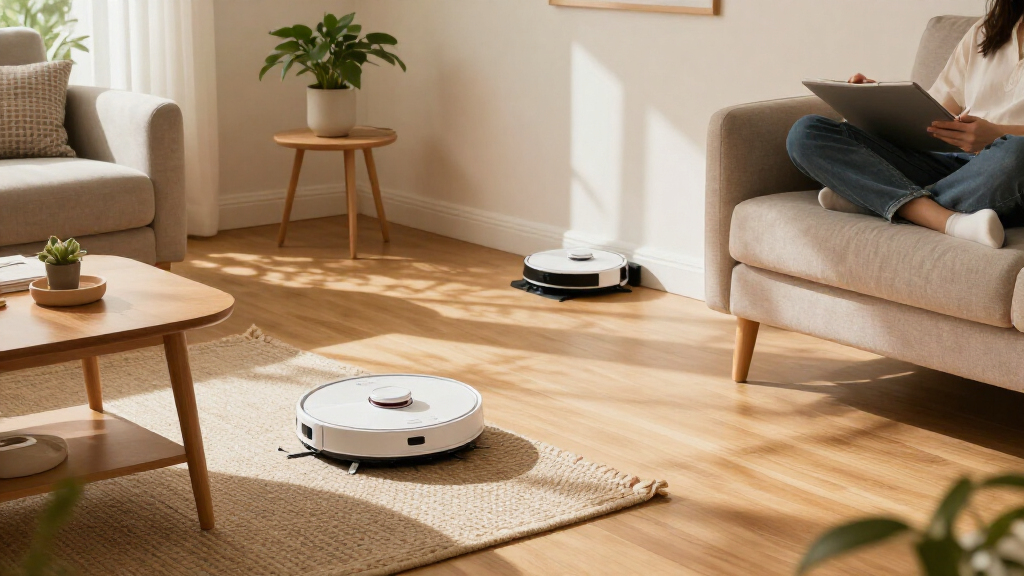
I ranked these robots around the promise of long battery life: stated runtime, navigation features that can help a robot cover rooms efficiently, and the practical effect of suction and mopping modes on a cleaning run. I also considered whether a model’s mapping, multi-floor support, or dock setup makes it a better fit for larger homes or frequent cleaning. Runtime figures are manufacturer claims and may vary with floor type, settings, and the task being run.
The Lefant M2 Plus leads on the clearest stated runtime in the provided product details. Picks with LiDAR, mapping, or self-emptying earn distinct places when those features solve common large-home or maintenance needs, while simpler and slimmer models are better matches for narrower priorities. Product titles do not provide runtime figures for every model, so I avoid treating suction power, dock capacity, or a combo label as evidence of longer battery life. Where runtime information is missing, the ranking reflects the available fit and features rather than an unsupported claim about endurance.
Factors to Consider When Choosing Robot Vacuums With Long Battery Life
Battery life is only useful when it translates into the coverage and routine you need. I’d compare the robot’s stated runtime with its navigation, cleaning modes, floor plan, and charging behavior before treating one number as decisive.
Match Runtime to Your Floor Plan
Estimate the area the robot must clean in one run, including rooms it can reach with doors open. A compact, open-plan home may need less runtime than a smaller home split across many rooms, because turns and furniture can slow coverage. Check whether the maker gives a runtime figure and what mode it applies to; a quiet or low-power setting may not reflect your everyday use. If the home has multiple levels, consider whether the robot can save separate maps and whether you’re willing to carry it between floors. Don’t assume a longer published runtime guarantees a complete clean without a recharge. A practical choice leaves some battery headroom for rugs, clutter, and occasional extra passes.
Treat Suction and Mopping as Battery Tradeoffs
High suction can help lift debris from rugs, but it may consume more power than a lower setting on hard floors. A vacuum-and-mop combo also has to manage a second task, and its runtime may differ between vacuuming alone and combined cleaning. Think about the surfaces in your home before paying for power you’ll rarely use. If most rooms are hard flooring, a moderate setting and regular schedule may cover more ground per charge than frequent maximum suction. For thick rugs or heavy pet shedding, prioritize a robot that can handle those surfaces and accept that runs may be shorter. Ask which mode a runtime claim describes whenever the listing is unclear.
Value Navigation for Efficient Coverage
Battery capacity is one part of coverage; route quality is another. Mapping and LiDAR can help a robot plan room-to-room paths, while less structured navigation may lead to repeated passes or missed areas. In a simple, uncluttered room, advanced mapping may offer little benefit, so a straightforward model can be a sensible fit. For a home with several rooms, furniture, or more than one floor, saved maps and no-go zones can reduce interruptions and make cleaning easier to schedule. Check whether the app supports the controls you actually need rather than assuming every smart feature is included. Good navigation can make a modest runtime go further, though it cannot replace a battery that is too small for the job.
Understand Recharge-and-Resume Behavior
A robot that returns to its dock when the battery runs low may still finish a large home if it can resume where it stopped. Look for a clear description of recharge-and-resume behavior, since self-charging alone only confirms that the robot can return to its base. Without resume support, a long job may require another scheduled run or manual intervention. Consider when the robot will clean: a small home can often be handled in one session, while a large multi-room plan may benefit from a split run. Keep the dock accessible so the robot can find it and charge without getting trapped by furniture or cables. This feature can matter more to whole-home coverage than a small difference in advertised minutes.
Choose a Dock for the Maintenance You Want
Self-emptying docks reduce how often you handle the robot’s dustbin, but they don’t extend battery life or remove every maintenance task. Their bags or bins still need attention, and mop-equipped models may require water and pad care. A standard charging dock takes less space and keeps the setup simpler, though you’ll empty the robot more often. In a home with pets or frequent cleaning, reduced bin handling can make a large difference to the routine. If you clean less often or have limited space near an outlet, a larger dock may be unnecessary. Compare the dock’s footprint and upkeep with the chores it removes.
Check the Details Behind Runtime Claims
Product listings may state runtime without explaining the floor type, suction level, or whether mopping was active. Those missing details make direct comparisons less reliable. Look for an official manual or specification page that defines the test conditions and describes battery capacity, charging time, and resume behavior. Treat a headline runtime as a reference point, not a guarantee for every room. Also check whether carpet detection or automatic suction changes affect how long a run lasts. If no runtime is stated, compare the robot on navigation, controls, and maintenance, and avoid assuming that a high suction figure signals a longer-lasting battery.
Frequently Asked Questions
How much runtime do I need for a whole-home clean?
There isn’t one runtime that fits every home, because floor area, room layout, and cleaning mode all affect coverage. Start with the square footage the robot can actually access and note whether it must cross rugs or navigate around furniture. A stated 140-minute runtime, like the Lefant M2 Plus listing, gives a useful comparison point, but it doesn’t prove that every home can be cleaned in one run. For a large or divided home, mapping and recharge-and-resume support can be as useful as additional minutes. Check the manufacturer’s conditions for its runtime claim before relying on it.
Does a self-emptying dock make a robot clean longer per charge?
No; a self-emptying dock handles collected debris and reduces bin emptying, while the battery determines how long the robot can clean before recharging. The dock can make frequent runs less hands-on, which is useful if you have pets or a busy household. It does not add runtime to a single cleaning session. For longer coverage, check the robot’s runtime, route planning, and whether it resumes after charging. Also account for the dock’s space and the need to replace or empty its collection bag or bin.
Should I choose more suction or longer runtime?
Choose based on the surfaces and debris the robot needs to handle most often. Stronger suction may suit rugs and pet hair, but using a high-power setting can shorten a run compared with lower suction on hard floors. If your home is mostly hard flooring, a balanced setting may deliver more coverage without requiring maximum power. If you have thick carpets or heavy shedding, cleaning performance may matter more than the longest possible run. Compare runtime claims under the modes you expect to use, since headline figures may describe a lower-power setting.
Can a robot with shorter runtime still handle a large home?
It can, if it maps the home, returns to recharge, and resumes the unfinished route; check that the specific model supports those steps. Without resume support, a robot may stop before completing the planned area or repeat sections on a later run. Room-by-room scheduling can also make a shorter runtime workable if you’re comfortable cleaning the home in stages. Keep the charging dock in a clear, reachable location so the robot can return between runs. For buyers who want one uninterrupted session, favor a longer stated runtime and verify how the robot handles low battery.
Are slim robot vacuums a good choice for longer cleaning sessions?
A slim profile helps a robot reach under low furniture, but height alone says little about battery endurance or whole-home coverage. The Kilgone and eufy 11S MAX listings emphasize slim builds, which may suit rooms with low-clearance furniture. Before choosing on that basis, measure the gaps under sofas and beds and check the robot’s height. Then compare runtime and charging behavior separately, since compact access does not guarantee more minutes per charge. A slim robot is most useful when those hard-to-reach spaces are part of your regular cleaning route.
Conclusion
For the clearest runtime-led choice, I’d pick the Lefant M2 Plus, whose listing states 140 minutes and includes multi-floor mapping. For best value in everyday convenience, the Tikom L8000 Plus pairs vacuuming and mopping with a self-emptying base, though the provided details don’t establish a standout runtime. Buyers seeking a more hands-off setup can compare the MONSGA and R11 White, both listed with self-emptying docks; treat their endurance as unconfirmed unless the manufacturer supplies runtime data. For beginners who want a simpler, slim option, consider the eufy 11S MAX, while checking its runtime before buying. If reaching beneath low furniture matters most, compare the Kilgone with the eufy; if your priority is stronger stated suction, the Roomba 415X is a distinct option, but suction alone does not establish longer battery life.