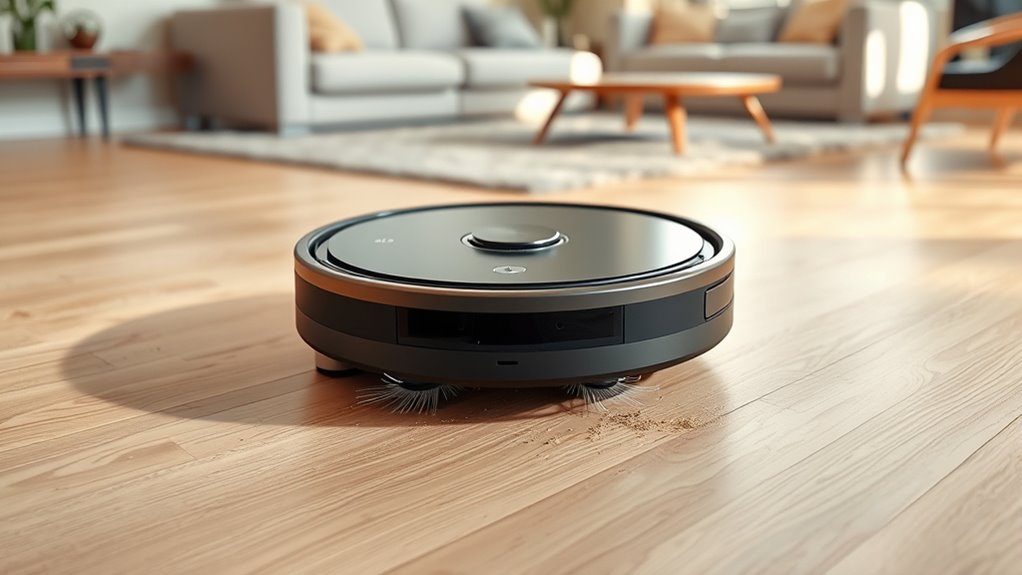

For buyers seeking robot vacuums with dual brushes, the eufy E25 stands out for homes where side and edge coverage matter, thanks to its extendable side brush and pet hair features. The T30+ adds mapping and obstacle avoidance, while the Roomba Plus 415 pairs vacuuming with mopping and self-emptying. The lineup varies in navigation, dock support, and how much routine maintenance it can take off your hands. Brush design alone does not tell the whole story: floor layout, hair, and furniture clearance affect the result too. Read on for the full comparison and guidance on choosing the right fit.

Get cleaning gear delivered free with Prime
- Fast, free delivery on millions of items
- Prime Video, Amazon Music and more included
- Member-only deals all year
Complete the kit


Key Takeaways
- Side and edge cleaning are distinct needs: the eufy E25 is the clearest fit here because its extendable side brush directly addresses reach along edges.
- Automation comes with dock tradeoffs: self-emptying models such as the T30+ and Roomba Plus 415 reduce bin trips, but their larger stations need a practical home.
- Brush claims vary across the lineup: the T30+ lists tangle-resistant brushes and the E25 lists zero-tangle pet hair handling; check the exact brush arrangement before assuming every model has dual main brushes.
- Mopping adds upkeep: the E25 and C28 use roller-mop systems, which can suit mixed-floor homes but add water and mop care beyond vacuum-only models.
- The 11S MAX is the simpler choice: its slim profile and quiet operation may suit basic cleaning, though it lacks the mapping and dock features that distinguish several higher-automation picks.


| robot vacuums with dual brushe | Navigation | Runtime | Suction power |
|---|---|---|---|
| eufy Robot Vacuum 11S MAX | — | Up to 100 minutes | — |
| T30+ Robot Vacuum and Mop with | LiDAR | Up to 240 minutes | 12,000 Pa |
| iRobot Roomba Plus 415 Robot V | LiDAR mapping and obstacle recognition | — | 20,000 Pa |
| eufy E25 Robot Vacuum and Mop | — | 125 minutes | 20,000 Pa |
| MONSGA Robot Vacuum and Mop | LiDAR mapping with multi-floor memory | Up to 160 minutes | 8,000 Pa |
| eufy C28 Robot Vacuum Cleaner | LiDAR | — | — |
| iRobot Roomba Max 715 Pet Robo | ClearView Pro LiDAR with 3D mapping | — | — |
| Dreame D20 Plus Robot Vacuum a | LDS mapping with Pathfinder | — | — |
More Details on Our Top Picks
eufy Robot Vacuum 11S MAX, Super Thin, Powerful Suction, Quiet, Self-Charging Robotic Vacuum Cleaner
The 11S MAX is the clearest fit for buyers whose main obstacle is furniture clearance: at 2.85 inches tall, it can reach beneath spaces that taller, dock-equipped models may miss. Its single side brush helps sweep debris inward along edges, but the supplied specs do not identify a dual-brush system, so I would not choose it for the roundup’s defining brush setup. Compared with the MONSGA, it gives up dual anti-tangle brushes, mapping, and app control in exchange for a simpler, quieter machine with remote operation. Its 100-minute runtime and 600 ml capacity suit routine cleaning in smaller homes, while the lack of WiFi and limited runtime make it less convenient for large or complex floor plans.
Pros:- Slim 2.85-inch profile can fit beneath low furniture
- Quiet operation suits cleaning while people are home
- Self-charging returns the robot to its dock
- Washable filter and 600 ml capacity support routine upkeep
Cons:- Product data lists one side brush, not dual brushes
- No WiFi or app control; operation relies on the remote
- 100-minute battery life may not cover large homes
Best for: People with low-clearance furniture in smaller homes who want quiet, remote-controlled cleaning and do not need app features.
Not ideal for: Pet owners specifically seeking dual anti-tangle brushes, or households needing mapped cleaning across large areas.
- Brush configuration:One side brush
- Height:2.85 inches
- Runtime:Up to 100 minutes
- Dust capacity:600 ml
- Cleaning path width:12.8 inches
- Control:Remote control
- Recommended surfaces:Hard floor, tile, and medium-pile carpet
Our verdict“Choose the 11S MAX for quiet cleaning under low furniture, but skip it if dual brushes are a firm requirement.”
T30+ Robot Vacuum and Mop with Self-Emptying, 12,000Pa Suction, Obstacle Avoidance, Carpet Detection, Tangle-Resistant Brushes, 240-Minute Runtime, 75-Day Capacity, Home Mapping, App and Alexa Control
The T30+ suits homes where a robot needs to cover a lot of ground between interruptions. Its 240-minute runtime, LiDAR mapping, no-go zones, and 3.5-liter dust capacity are more useful for large or divided layouts than the eufy 11S MAX’s 100-minute, remote-only setup. The supplied description calls its brush tangle-resistant, but does not confirm a dual-brush arrangement, so I would not count it as a clearly documented match for this roundup’s central feature. Carpet detection and obstacle avoidance add practical control, while the 12,000Pa suction rating is higher than the MONSGA’s 8,000Pa. The tradeoffs are a 2.4 GHz WiFi requirement and a stated 110–120V limit, which may restrict use depending on the home and region.
Pros:- 240-minute runtime supports long cleaning sessions
- LiDAR mapping and no-go zones help manage complex layouts
- 3.5-liter dustbin capacity reduces emptying frequency
- Carpet detection and obstacle avoidance add cleaning control
Cons:- Product data describes a tangle-resistant brush but does not confirm dual brushes
- App and voice features require 2.4 GHz WiFi
- Specified for 110–120V power
Best for: People in large, mapped homes who want extended cleaning runs, carpet detection, and a large self-emptying dust capacity.
Not ideal for: Buyers who require confirmed dual brushes or need a robot compatible with 5 GHz WiFi or power outside 110–120V.
- Brush description:Tangle-resistant brush; brush count not specified
- Suction power:12,000 Pa
- Runtime:Up to 240 minutes
- Dustbin capacity:3.5 liters
- Navigation:LiDAR
- Filter:HEPA
- Controls:App and voice
Our verdict“Pick the T30+ for mapped, long-duration cleaning if its brush configuration and regional power requirements suit your home.”
iRobot Roomba Plus 415 Robot Vacuum & Mop Combo, 20,000Pa Suction, Self-Emptying, Smart Obstacle Avoidance, Pet-Friendly Tangle-Free Brushes
The Roomba Plus 415 combines tangle-free rubber brushes with a vacuum-and-mop system, making it a stronger fit for homes that want pet-hair pickup and floor maintenance in one routine. The supplied data does not say how many vacuum brushes it has, though, so the dual-brush claim cannot be verified from these details alone. Its dock adds automatic emptying, mop-pad washing, drying, and water refill, a broader maintenance package than the T30+ description provides. Compared with the MONSGA, the Roomba lists higher suction and more mop automation; MONSGA explicitly specifies dual anti-tangle brushes and a 160-minute runtime, details absent here. The Roomba’s feature set can take more setup, and the missing runtime and brush-count figures make it harder to judge fit before purchase.
Pros:- Tangle-free rubber brushes are designed for pet hair
- Combines vacuuming and mopping
- Dock empties debris and washes, dries, and refills for mop care
- LiDAR mapping and obstacle recognition support room-based cleaning
Cons:- Brush count is not specified, so dual-brush suitability is unclear
- Runtime and exact height are not provided
- Dock and cleaning features may take more setup
Best for: Pet-owning households seeking an automated vacuum-and-mop routine with a dock that handles mop-pad care.
Not ideal for: Buyers who need confirmed dual vacuum brushes, a stated runtime, or a simpler setup with fewer dock functions.
- Brush description:Tangle-free rubber brushes; count not specified
- Suction power:20,000 Pa
- Mop pads:DualClean Mop Pads
- Navigation:LiDAR mapping and obstacle recognition
- Dock:Self-emptying, mop-pad washing and drying, automatic water refill
- Mop-pad drying temperature:113°F
- Edge cleaning:Extending brushes
Our verdict“Choose the Roomba Plus 415 for automated pet-hair vacuuming and mop care if you can confirm its brush configuration meets your needs.”
eufy E25 Robot Vacuum and Mop Combo, 20,000 Pa Suction, HydroJet Self-Clean Roller Mop, All-in-One Station, Extendable Side Brush, Zero-Tangle for Pet Hair, AI Obstacle Avoidance
The E25 is aimed at buyers who want strong vacuum pickup alongside an actively cleaned roller mop. Its extendable side brush can reach debris along edges, while the HydroJet system cleans the roller as it works. Those are useful details for side and perimeter cleaning, but the provided information does not confirm a dual main-brush setup, so its zero-tangle claim alone does not establish a match for dual brushes. Compared with the Roomba Plus 415, both offer 20,000 Pa suction and dock-based mop care; the E25 specifies a 125-minute runtime and a roller-mop system, while the Roomba lists mop-pad washing and drying. The E25’s all-in-one station and obstacle avoidance add convenience, but its 37.48-pound weight and 110V specification may constrain placement and regional compatibility.
Pros:- Extendable side brush is designed to reach along edges
- HydroJet roller mop cleans itself during operation
- All-in-one station automates emptying, refilling, and drying
- AI obstacle avoidance supports navigation around household objects
Cons:- Dual main-brush configuration is not specified
- 37.48-pound weight makes the unit and station cumbersome to move
- Listed for 110V power
Best for: People focused on edge debris and hands-free roller-mop cleaning who have space for a substantial dock.
Not ideal for: Buyers who need confirmed dual main brushes, a lightweight dock, or compatibility beyond the listed 110V supply.
- Brush details:Extendable side brush; dual main brushes not specified
- Suction power:20,000 Pa
- Mop system:HydroJet self-cleaning roller mop
- Runtime:125 minutes
- Noise level:≤61 dB
- Weight:37.48 pounds
- Controls:App, push button, and voice
Our verdict“Choose the E25 for edge-focused pickup and automated roller-mop care if its brush layout and dock size fit your home.”
MONSGA Robot Vacuum and Mop, 90 Days Self-Emptying with 8000Pa Suction
The MONSGA is the most direct match here for shoppers choosing by brush configuration: its product data explicitly lists dual anti-tangle brushes, unlike the other entries, whose supplied details do not confirm two vacuum brushes. That makes it the clearest choice for households managing pet fur, though its 8,000Pa suction is lower than the T30+ and the 20,000Pa Roomba Plus 415 and eufy E25. LiDAR mapping, multi-floor memory, and up to 160 minutes of runtime give it more structure and reach than the simpler eufy 11S MAX. A 4-liter self-emptying capacity and 460 ml water tank support less frequent intervention, but app and voice use depend on 2.4 GHz WiFi, and the stated 120V supply may not suit every region.
Pros:- Dual anti-tangle brushes are explicitly specified
- LiDAR mapping includes multi-floor memory
- Up to 160 minutes of battery life
- Self-emptying dustbin holds 4 liters and is rated for up to 90 days
Cons:- 8,000Pa suction is below the T30+, Roomba Plus 415, and eufy E25 figures
- App and voice control require 2.4 GHz WiFi
- Listed for 120V power
Best for: Pet owners who want explicitly listed dual anti-tangle brushes, mapped cleaning, and a combined vacuum-and-mop routine.
Not ideal for: Buyers prioritizing the highest listed suction, 5 GHz WiFi, or power compatibility beyond 120V.
- Brush configuration:Dual anti-tangle brushes
- Suction power:8,000 Pa
- Navigation:LiDAR mapping with multi-floor memory
- Runtime:Up to 160 minutes
- Dustbin capacity:4 liters
- Water tank capacity:460 ml
- Controls:App, push button, remote, and voice
Our verdict“Choose the MONSGA if confirmed dual anti-tangle brushes matter more to you than the higher suction figures of rival models.”
eufy C28 Robot Vacuum Cleaner and Mop Combo, 15,000 Pa, HydroJet Roller Mop
The eufy C28 earns its place for buyers who want mopping to be part of the robot’s routine, not a separate chore. Its HydroJet roller mop works alongside 15,000 Pa suction, while the all-in-one station empties debris and washes and dries the mop. That setup offers more mop care than the Dreame D20 Plus, which self-empties but has a cleaning pad and water tank. For pet owners, the listing also describes a tangle-free brush, though it does not specify dual brushes, so I would not choose it solely for a dual-brush setup. The large station takes room, and its listed noise level may bother households that run a vacuum during quiet hours. It suits homes with hard floors and regular mopping needs better than buyers seeking a compact, vacuum-first robot.
Pros:- HydroJet roller mop adds active floor cleaning
- Station automatically empties, washes, and dries
- Tangle-free brush is intended to help with pet hair
- LiDAR navigation supports efficient multi-room cleaning
Cons:- Product details do not confirm a dual-brush configuration
- Large all-in-one station needs dedicated floor space
- Listed operating noise may disrupt quiet environments
Best for: Households with pets and mostly hard floors that want automated mop washing and drying as well as vacuuming
Not ideal for: Buyers who specifically require confirmed dual brushes, have limited space for a station, or need a quiet-running robot
- Suction:15,000 Pa
- Mop system:HydroJet roller mop
- Battery life:140 minutes
- Cleaning path width:11.02 inches
- Station:Auto-emptying, mop washing, and drying
- Navigation:LiDAR
- Noise level:54.89 dB
- Recommended surfaces:Hard floor, wooden floor, short wool carpet
Our verdict“Choose the C28 if automated mop care matters more than a confirmed dual-brush design or a compact dock.”
iRobot Roomba Max 715 Pet Robot Vacuum with Self-Emptying Dock
For a roundup centered on dual brushes, the Roomba Max 715 has the clearest match here: its dual anti-tangle rubber brushes are paired with an edge-sweeping brush. Carpet Boost and dirt detection target areas that may need extra attention, while LiDAR mapping and AI obstacle avoidance help it move through a furnished home. Compared with the Dreame D20 Plus, which adds mopping and a larger stated dust bag, this Roomba is a vacuum-focused choice with a dock that stores debris for up to 90 days. The tradeoff is recurring dock-bag replacement, and scheduling or customized cleaning requires the app. I’d favor it for homes where pet hair on both carpets and hard floors is the main problem; buyers wanting mop functions should look elsewhere.
Pros:- Dual anti-tangle rubber brushes are specified
- Carpet Boost increases suction on carpet
- AI obstacle avoidance and LiDAR mapping support household navigation
- AutoEmpty dock stores debris for up to 90 days
Cons:- Dock bags need periodic replacement
- Scheduling and customized cleaning require the app
- No mop function is listed
Best for: Pet owners with carpet and hard floors who want a robot vacuum with explicitly listed dual anti-tangle brushes
Not ideal for: Buyers who want mopping, avoid app-dependent scheduling, or prefer not to replace dock bags
- Suction:30,000 Pa
- Brushes:Dual anti-tangle rubber brushes and anti-tangle edge-sweeping brush
- Self-emptying storage:Up to 90 days
- Navigation:ClearView Pro LiDAR with 3D mapping
- Obstacle avoidance:PrecisionVision AI
- Dirt detection:Advanced Dirt Detect
- Voice control:Alexa, Siri, and Google Assistant
Our verdict“Pick the Max 715 if dual anti-tangle brushes and pet-hair pickup matter more to you than mopping.”
Dreame D20 Plus Robot Vacuum and Mop
The Dreame D20 Plus stands out for buyers who want a vacuum and mop with a long stated battery life and a 5 L self-emptying dust bag. Its anti-tangle DuoBrush is designed for pet hair, giving it a more direct dual-brush fit than the eufy C28, whose supplied details do not confirm dual brushes. Compared with the Roomba Max 715, the Dreame adds mopping and adjustable water settings, while the Roomba lists stronger suction and explicit carpet-focused features. The D20 Plus therefore makes more sense for mixed-surface homes that want flexible vacuuming and light mopping than for shoppers focused only on maximum stated suction. Its Wi-Fi support is limited to 2.4 GHz, and the listing specifies USA use only, which may rule it out for some setups.
Pros:- Anti-tangle DuoBrush is designed for pet hair
- 5 L dust bag supports up to 150 days of self-emptying
- Adjustable suction and water settings tailor cleaning to surfaces
- Editable maps and voice control add cleaning flexibility
Cons:- Wi-Fi support is limited to 2.4 GHz
- Product is listed for USA use only
- 13,000 Pa suction is below the Roomba Max 715’s stated 30,000 Pa
Best for: Pet-owning households seeking an anti-tangle DuoBrush, self-emptying, and adjustable vacuum-and-mop settings
Not ideal for: Buyers with 5 GHz-only Wi-Fi, outside the listed USA use region, or seeking the strongest stated suction in this batch
- Model:D20 Plus
- Suction:13,000 Pa
- Brush:Anti-tangle DuoBrush
- Dust bag capacity:5 L
- Dustbin capacity:500 ml
- Water tank capacity:350 ml
- Battery life:180 minutes
- Navigation:LDS mapping with Pathfinder
- Wi-Fi:2.4 GHz only
Our verdict“Choose the D20 Plus if you want a pet-hair DuoBrush and mopping with long intervals between dust-bag changes.”

How We Picked
I compared the eight models by how clearly their listed brush design supports the dual-brush search, then considered what that setup means for hair pickup, edge reach, and maintenance. I also weighed navigation, obstacle handling, carpet response, runtime, dock functions, and whether a mop adds useful flexibility or extra chores. The E25 leads for buyers focused on side reach because it specifically lists an extendable side brush alongside pet-hair features. The T30+ and Roomba Plus 415 follow for shoppers who value automation, while simpler or less fully specified models rank lower when the product details provide less evidence for dual-brush performance.
These rankings reflect the supplied product information, not independent performance testing. A product title that mentions tangle-resistant or pet-friendly brushes does not by itself confirm two main brushes, so I treat that as a detail buyers should verify on the manufacturer’s specification page. I also considered who benefits from each feature: a mapping system may matter in a multi-room home, while a slim, quiet vacuum can be a better match for straightforward daily pickup.
| robot vacuums with dual brushe | Navigation |
|---|---|
| eufy Robot Vacuum 11S MAX | — |
| T30+ Robot Vacuum and Mop with | LiDAR |
| iRobot Roomba Plus 415 Robot V | LiDAR mapping and obstacle recognition |
| eufy E25 Robot Vacuum and Mop | — |
| MONSGA Robot Vacuum and Mop | LiDAR mapping with multi-floor memory |
| eufy C28 Robot Vacuum Cleaner | LiDAR |
| iRobot Roomba Max 715 Pet Robo | ClearView Pro LiDAR with 3D mapping |
| Dreame D20 Plus Robot Vacuum a | LDS mapping with Pathfinder |
Factors to Consider When Choosing Robot Vacuums With Dual Brushes
Choosing a dual-brush robot vacuum means matching the brush system to your floors and cleaning routine, then checking whether navigation and maintenance features suit your home. These broader checks can prevent a feature-rich model from becoming an awkward fit.
Confirm What “Dual Brushes” Means
Product listings can use brush terms loosely, so check whether “dual” refers to two main rollers, a main roller plus a side brush, or a broader brush system. These layouts serve different jobs: main rollers agitate debris across the floor, while a side brush sweeps material inward near edges. A model advertising an extendable side brush may improve reach without having two main rollers. Look at the manufacturer’s diagrams and replacement-part listings before comparing brush claims. If your priority is hair pickup, confirm how the rollers handle tangles and how easily you can remove wrapped hair. This small check can prevent buying a machine whose brush arrangement does not match your expectation.
Match Brush Design to Floors and Hair
Brush performance depends on the mix of hard flooring, rugs, and carpet in your home. On hard floors, side reach and effective debris pickup near walls may matter more than aggressive carpet agitation. Homes with thick rugs should check whether the robot detects carpet and adjusts its cleaning behavior. Long hair and pet fur can wrap around rollers even when a listing uses terms such as tangle-resistant. Consider how often the brush needs clearing and whether replacement parts are easy to find. If your floors vary, prioritize a model with clearly described carpet handling rather than choosing by suction claims alone.
Decide Whether Mapping Earns Its Space
Navigation changes how a robot covers a home, especially when rooms have thresholds, narrow passages, or furniture that shifts. Mapping and room controls can help target specific areas and reduce repeated passes, but they also add setup and app decisions. A simpler robot may be sufficient for one open room or a predictable layout. Before paying for advanced navigation, think about whether you will use schedules, room selection, and no-go boundaries. Also check obstacle handling if cables, toys, or pet items are often left on the floor. The best system is the one that handles your layout with little intervention.
Account for Dock Space and Upkeep
A self-emptying dock cuts down on frequent bin emptying, but it needs floor space and still requires consumables or periodic cleaning. Measure the intended spot, including clearance for the robot to approach and leave the dock. A large station may be inconvenient in a small apartment even if it reduces routine work. Check the stated dust capacity and how often the dock bag or container needs attention. Roller mops and water systems add another maintenance cycle: tanks, mop surfaces, and dirty water need care. Choose automation that removes chores you dislike without adding ones you will neglect.
Treat Mopping as a Separate Need
A vacuum-and-mop combo can help with routine hard-floor care, but mopping capability is not a substitute for picking a strong vacuum. Consider whether the mop is a passive pad or a powered roller system, and what cleaning and drying steps the design calls for. Homes with mostly carpet may gain little from a mop feature and may prefer a focused vacuum. In mixed-floor homes, check how the robot handles rugs while mopping and whether you can set no-mop zones. Water tanks and mop parts take storage and attention. Pay for a combo when you expect to use both functions regularly.
Compare the Full Ownership Routine
Runtime and bin capacity matter most when a robot must cover a large area or clean often without help. A longer listed runtime does not guarantee a single run will finish every home; layout, floor type, and navigation affect coverage. Check whether the robot resumes after recharging and whether its app makes scheduling straightforward. Replacement brushes, filters, bags, and mop parts shape the ongoing effort, so look up availability before choosing. Noise and height also affect day-to-day fit: a quieter, slimmer model may clean under furniture or during work hours more comfortably. Weigh these routine details alongside brush design to choose a robot you will keep using.
Frequently Asked Questions
How can I tell whether a robot vacuum really has dual main brushes?
Look for the manufacturer’s parts diagram or specifications that explicitly show two main rollers beneath the robot. A side brush is a separate component and does not necessarily mean the model has dual main brushes. Product titles may also use “dual brush” broadly, so confirm the layout before buying replacement parts or comparing models. If the listing is unclear, check the manual or ask the manufacturer to identify the brush assembly. This is especially useful when the search term is a firm requirement rather than a general preference.
Do dual brushes make a robot vacuum better for pet hair?
They can help move and lift debris, but the number of brushes alone does not determine pet-hair performance. Roller shape, anti-tangle design, suction, carpet behavior, and how easily hair can be removed all matter. Long hair can still wrap around a brush, so check maintenance guidance and the cost and availability of replacement rollers. For homes with shedding pets, also consider bin capacity and whether a dock reduces how often you need to empty it. Treat claims such as “tangle-free” as design descriptions, not a promise that cleaning will never be needed.
Is an extendable side brush useful if a robot has dual main brushes?
It addresses a different part of the cleaning job. Main rollers collect debris under the robot, while a side brush sweeps dirt toward the intake near walls and furniture edges. An extendable side brush may help the robot reach farther into corners, but it does not replace checking its navigation and turning behavior. If edge debris is your main concern, look for explicit side-brush reach details. For broad floor coverage, focus on the main brush system and navigation as well.
Should I choose a self-emptying vacuum if I have a small home?
It depends on whether fewer bin-emptying chores are worth the dock’s footprint. In a compact home, measure the station and its approach clearance before choosing, since a large dock can be hard to place. A smaller, simpler model may suit a modest floor area if you do not mind emptying its bin yourself. Pet hair or frequent cleaning can make a self-emptying dock more useful even in a small space. Compare the dock’s capacity and upkeep routine with the chores it removes.
Is a vacuum and mop combo a good choice for mixed floors?
It can be, if you regularly clean hard floors and the robot can manage rugs appropriately while mopping. Check whether it offers no-mop zones or another way to keep wet cleaning off carpet. A roller-mop system may offer a different cleaning approach from a basic pad, but it brings added care for water and mop parts. If most of your home is carpet, a vacuum-first model may be the more practical fit. Decide based on how often you will use the mop, not simply because it is included.
Conclusion
For buyers who prioritize side reach and pet-hair features, I would start with the eufy E25 as the best overall fit in this lineup. The MONSGA is the value-minded option to compare for self-emptying and listed suction, though its brush details deserve a closer specification check. For a more automated setup, the T30+ is the premium-leaning pick with mapping and obstacle avoidance. The eufy 11S MAX is the straightforward choice for beginners who want a slim, quiet vacuum without a more involved feature set. If you need a vacuum-and-mop design, compare the Roomba Plus 415, E25, and eufy C28 by their brush layout and upkeep requirements; for any model, verify that its main-brush configuration matches your meaning of dual brushes before choosing.