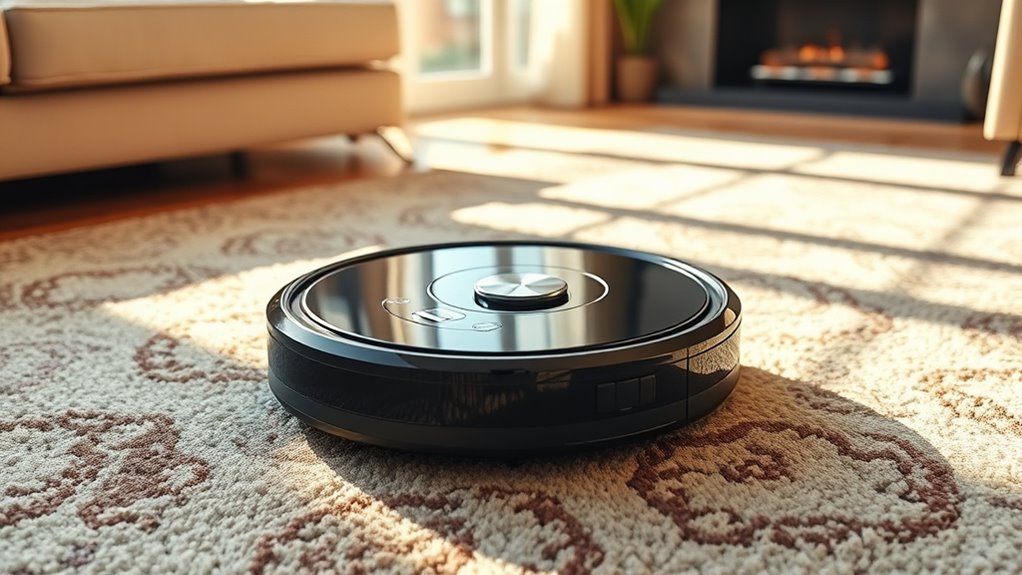

For a robot vacuum that can react when it reaches a rug, I’d start with the Shark PowerDetect AV2800ZE for its floor-sensing features and automated mop care, or the Lefant M330 Pro if you want explicit carpet avoidance while mopping without a large service station. The T30+ is the strongest fit for a large home where its long runtime, self-emptying base, and carpet detection matter more than a compact setup.

Get cleaning gear delivered free with Prime
- Fast, free delivery on millions of items
- Prime Video, Amazon Music and more included
- Member-only deals all year
Those differences matter because “carpet detection” can mean more than one thing: some models raise suction on carpet, while others avoid rugs during a mopping run. I’ve ranked these picks around how clearly their stated features address that change in floor type, then weighed navigation, maintenance, and documented limits. The tradeoff is between more automated care, more explicit rug handling, and a simpler robot that costs less effort to accommodate in your routine.
Complete the kit


Key Takeaways
- Best overall for mixed floors: Shark PowerDetect pairs floor-responsive cleaning with mapped routes and automated mop-pad care.
- Best for large homes: T30+ combines carpet detection with a 240-minute runtime and a self-emptying station.
- Best for avoiding rugs while mopping: Lefant M330 Pro explicitly avoids carpets during mopping and boosts suction on carpet while vacuuming.
- Best for mop maintenance: eufy C28 washes and dries its roller mop at the station, but its stated carpet suitability is limited to short wool carpet.
- Best simpler carpet-boost pick: The 5000Pa combo offers carpet auto-boost and app or voice control, but its listed details provide less clarity about mapping and mop automation than the other picks.


| robot vacuums with carpet detection sensor | Navigation | Runtime | Suction |
|---|---|---|---|
| Shark PowerDetect Robot Vacuum | 360° LiDAR and 3D sensors | — | — |
| T30+ Robot Vacuum and Mop with | LiDAR with home mapping | Up to 240 minutes | 12,000Pa |
| Lefant M330 Pro Robot Vacuum a | dToF LiDAR | Up to 240 minutes | — |
| eufy C28 Robot Vacuum and Mop | Camera-free LiDAR | Up to 140 minutes | 15,000Pa |
| Robot Vacuum and Mop Combo | — | Up to 120 minutes | 5,000Pa |
More Details on Our Top Picks
Shark PowerDetect Robot Vacuum and Mop Combo with 60-Day Self-Emptying Base (AV2800ZE)
The Shark takes the top position because it combines floor-type sensing with a broader set of cleaning responses and mapped control. Its five PowerDetect technologies include sensing for floor types, debris, stains, and edges, while DirtDetect and StainDetect increase cleaning in areas that need more attention. For a home with rugs, sealed hard floors, and occasional messes, that makes it a more versatile fit than the Lefant, whose clearest carpet advantage is avoiding rugs during mopping and boosting suction on carpet while vacuuming.
The dock also does more than empty the robot: it refills water for up to 30 days and washes and dries the mop pad after each cleaning. That reduces recurring pad care, though the water-refill interval is shorter than its debris capacity, which is stated as up to 60 days. LiDAR mapping, 3D sensors, app schedules, targeted cleaning, and no-go zones give buyers tools to tailor routes around their floor plan.
My reservation is that the description identifies floor-type sensing but does not spell out a specific carpet response such as a named suction boost or carpet avoidance while mopping. It also limits the stated mopping recommendation to sealed floors. Buyers who need the most explicit rug-mopping rule may prefer Lefant, while those who want a long-range self-emptying setup may favor T30+. I rank Shark first for its combination of sensing, mapping, and automated mop upkeep—not because every carpet behavior is documented in detail.
Pros:- Senses floor types along with debris, stains, and edges.
- Automatically empties debris, refills water, and washes and dries the mop pad.
- LiDAR mapping, obstacle avoidance, schedules, targeted cleaning, and no-go zones.
- Separate stated capacities for debris storage and automatic water refills support reduced routine upkeep.
Cons:- The product details do not specify exactly how it changes vacuum suction on carpet.
- Automatic water refills are specified for up to 30 days, shorter than the up-to-60-day debris capacity.
- Mopping is described for sealed floors, limiting the stated surface guidance.
Best for: Homes with a mix of carpet and sealed hard floors where app mapping and hands-off mop-pad maintenance are priorities.
Not ideal for: Buyers who need clearly specified carpet avoidance during mopping or who mop surfaces beyond the stated sealed-floor recommendation.
- Model:AV2800ZE
- Navigation:360° LiDAR and 3D sensors
- Debris capacity:Self-emptying base holds debris for up to 60 days
- Water refill:Automatic refill for up to 30 days
- Mop care:Automatically washes and dries the mop pad after each cleaning
- Floor sensing:Five PowerDetect technologies, including floor-type, debris, stain, and edge sensing
- App:SharkClean, with mapping, schedules, targeted cleaning, and no-go zones
Our verdict“I’d choose the Shark for a mapped mixed-floor home that values automatic mop care, while recognizing that its exact carpet response is less clearly described than Lefant’s.”
T30+ Robot Vacuum and Mop with Self-Emptying, 12,000Pa Suction, Obstacle Avoidance, Carpet Detection, Tangle-Resistant Brushes, 240-Minute Runtime, 75-Day Capacity, Home Mapping, App & Alexa Control
The T30+ is the scale-focused option in this group. Its 240-minute runtime, LiDAR navigation, home mapping, and self-emptying dock are aimed at longer cleaning sessions with fewer interruptions. Carpet detection is named directly in the product details, and its 12,000Pa suction and tangle-resistant rubber brush add useful muscle for carpet and pet-hair pickup. Compared with the Shark, it gives more prominent capacity and runtime figures; Shark’s stronger distinction is its more fully described mop-washing and water-refill routine.
The dock is listed with a 3.5-liter dustbin and a 75-day capacity, which can reduce how often a household needs to deal with collected debris. Its long runtime suits larger floor plans, though runtime alone does not tell me how efficiently it will cover a particular layout. I also don’t see a precise description of what the carpet sensor triggers, so I would not assume it both boosts suction and avoids rugs during mopping. Buyers who specifically want a stated mopping rule have clearer evidence with Lefant.
There are practical limits to check before choosing it. The unit supports 110–120V, with a transformer needed for 220–230V regions, and its Wi-Fi support is limited to 2.4 GHz. The listing describes a self-emptying station, but unlike Shark or eufy, the supplied details do not spell out automatic mop washing and drying. I’d rank it second because it pairs explicit carpet detection with large-home endurance, while its voltage and less-detailed mop care make it a less universal mixed-floor pick.
Pros:- Carpet detection is explicitly listed among its features.
- 240-minute runtime and LiDAR mapping suit longer cleaning routes.
- Self-emptying station is listed with a 3.5-liter dustbin and 75-day capacity.
- 12,000Pa suction and a tangle-resistant rubber brush target carpet debris and hair.
Cons:- Supports 110–120V; a transformer is needed for 220–230V regions.
- Wi-Fi support is limited to 2.4 GHz.
- The supplied details do not explain the carpet sensor’s exact response or list automatic mop washing and drying.
Best for: Owners of larger homes who want a long runtime, mapped navigation, named carpet detection, and a self-emptying station.
Not ideal for: Buyers in regions with 220–230V power who do not want to use a transformer, or anyone requiring clearly specified automatic mop washing.
- Suction:12,000Pa
- Runtime:Up to 240 minutes
- Navigation:LiDAR with home mapping
- Carpet feature:Carpet detection
- Dustbin:3.5-liter station capacity; listed 75-day capacity
- Filter:HEPA
- Connectivity:App and voice control; 2.4 GHz Wi-Fi
- Voltage:110–120V; transformer required for 220–230V regions
Our verdict“I’d pick the T30+ over the Shark when long runtime and debris capacity lead the decision, but not if voltage compatibility or fully specified mop care is a concern.”
Lefant M330 Pro Robot Vacuum and Mop with Smart Mapping, Obstacle Avoidance, and Carpet Detection
The Lefant earns a distinct place because its carpet behavior is described in practical terms: it avoids carpets while mopping and boosts suction when vacuuming carpet. That gives me a clearer answer to the common mixed-floor concern of a wet mop crossing a rug than the T30+ listing, which names carpet detection without describing its exact response. If a buyer’s main priority is keeping rugs dry while the robot handles hard floors, Lefant’s stated behavior is especially relevant.
Its dToF LiDAR mapping supports multiple floors, and the 95 mm body is designed to reach under lower furniture. A 240-minute battery life is unusually prominent in this lineup, although the supplied details do not connect that figure to a measured coverage area. Its 450 ml dustbin and 200 ml water tank are more modest than dock-based systems, so this is not the hands-off capacity leader. Shark and eufy offer more detailed automatic mop care; Lefant instead keeps the robot’s floor response and slim form at the center.
The maintenance routine needs attention: the water tank should be emptied after mopping to help prevent leaks and floor stains. The listed Wi-Fi support is 2.4 GHz, despite the title’s reference to 2.4G/5G, so I’d verify that network compatibility before setup. Its stated surface recommendation is hard floor, even though carpet detection and boost are listed. I’d take that as a reason to check the carpet-cleaning expectations carefully rather than treating it as a dedicated carpet specialist.
Pros:- Explicitly avoids carpets while mopping and boosts suction on carpet during vacuuming.
- 95 mm body is designed to reach beneath more low-clearance furniture.
- dToF LiDAR supports route planning and multi-floor mapping.
- 240-minute battery life and app scheduling support longer cleaning routines.
Cons:- The water tank should be emptied after mopping to help prevent leaks and stains.
- Wi-Fi support is listed as 2.4 GHz despite the title’s 2.4G/5G wording.
- Surface recommendation is hard floor, so its carpet-use guidance is less broad than its detection features may suggest.
Best for: People with rugs and hard floors who want explicit carpet avoidance during mopping, plus a slim robot for cleaning under furniture.
Not ideal for: Buyers who want an all-in-one station, minimal tank maintenance, or broad stated carpet-surface recommendations.
- Navigation:dToF LiDAR
- Mapping:Multi-floor mapping
- Carpet response:Avoids carpet while mopping; boosts suction on carpet while vacuuming
- Height:95 mm
- Runtime:Up to 240 minutes
- Dustbin:450 ml
- Water tank:200 ml
- Connectivity:App and voice control; 2.4 GHz Wi-Fi
Our verdict“I’d choose Lefant when keeping wet mopping off rugs matters more than dock automation, and skip it if emptying a small water tank after each run sounds inconvenient.”
eufy C28 Robot Vacuum and Mop
The eufy C28 is the most mop-focused option here. Its HydroJet roller mop cleans itself continuously, and the all-in-one station empties dust, washes and dries the mop, and collects wastewater. Automatic mop lifting is specified at 10.8 mm, which can help keep the roller clear of short carpet during a mixed cleaning run. That is a different approach from Lefant’s explicit carpet avoidance while mopping: eufy describes lifting, while Lefant describes avoiding rugs.
For vacuuming, the listed 15,000Pa suction and DuoSpiral brush designed to reduce hair tangles make this a strong candidate for homes where pet hair and hard-floor mopping both matter. LiDAR navigation maps rooms without cameras, and the stated obstacle avoidance covers objects at least 3 × 3 × 3 cm. Compared with Shark, eufy gives a more specific mop system and a stated lift height; Shark offers broader named sensing for debris, stains, edges, and floor types. The C28’s carpet recommendation is limited to short wool carpet, which should guide expectations.
This is not the most flexible carpet-first choice in the roundup. Buyers with thick rugs or a wide variety of carpet types may prefer a model with a broader stated carpet recommendation, and the obstacle specification does not promise avoidance of very small objects. Its 140-minute battery life is also shorter than the 240-minute figures listed for T30+ and Lefant. I’d put it fourth because its dock and roller mop are unusually well specified, but its narrower carpet guidance makes it less suited to shoppers whose main concern is varied carpeting.
Pros:- HydroJet roller mop and station automate mop washing, drying, and wastewater collection.
- Automatic mop lift is specified at 10.8 mm for short carpets.
- 15,000Pa suction and DuoSpiral brush are designed to address debris and hair tangles.
- Camera-free LiDAR mapping supports room navigation.
Cons:- Carpet suitability is specified only for short wool carpet.
- Obstacle avoidance is specified for objects at least 3 × 3 × 3 cm.
- 140-minute battery life is shorter than the 240-minute runtimes listed for T30+ and Lefant.
Best for: Homes centered on hard floors and short wool carpet where automated roller-mop washing, drying, and wastewater collection are priorities.
Not ideal for: Homes with thick or varied carpeting, or buyers who want the longest listed runtime or avoidance of very small objects.
- Suction:15,000Pa
- Mop:HydroJet self-cleaning roller; 270 RPM
- Mop lift:10.8 mm
- Navigation:Camera-free LiDAR
- Runtime:Up to 140 minutes
- Carpet guidance:Hard floors, wooden floors, and short wool carpet
- Obstacle avoidance:Objects at least 3 × 3 × 3 cm
- Station:Empties dust, washes and dries mop, and collects wastewater
Our verdict“I’d choose the C28 for automated roller-mop care on hard floors with short wool rugs, not as my first pick for homes dominated by carpet.”
Robot Vacuum and Mop Combo, 5000Pa Self-Charging Robotic Vacuum Cleaner with Alexa & App Control, 3-in-1 Smart Obstacle Avoidance, Ideal for Pet Hair, Carpet, and Floors
This 3-in-1 model is the simpler choice for shoppers who want carpet auto-boost without making a self-cleaning station the centerpiece of the purchase. Its 5,000Pa suction, five cleaning modes, obstacle avoidance, and stated 120-minute runtime cover a basic vacuum-and-mop routine across wood, carpet, and tile. Unlike the Shark and eufy, it does not list a dock that washes or dries the mop; unlike Lefant, it does not specify carpet avoidance during mopping. Its strongest carpet-specific point is the named automatic boost.
App, remote, and voice controls give buyers several ways to start or direct cleaning, including Alexa support. The 120-minute runtime may work for smaller or moderately sized areas, but it is shorter than the 240-minute figures listed for T30+ and Lefant. It is also the only pick here whose supplied specifications center on a 250 ml capacity without a detailed dock system. That keeps the setup comparatively uncomplicated, while making frequent emptying or water refills more likely than with the larger station-based options.
The listing describes upgraded navigation and obstacle avoidance, but it does not specify LiDAR or multi-floor mapping as the other mapped options do. App and voice functions require Wi-Fi, and setup may feel involved for buyers who want a quick start. I rank it fifth because the carpet boost is useful but less fully contextualized: the provided details do not explain sensor behavior during mopping or offer the advanced mapping and maintenance features of the higher-ranked choices. It makes sense as a feature-led basic pick, not as the most documented carpet-management system.
Pros:- Carpet auto-boost is explicitly listed.
- 5,000Pa suction and five cleaning modes support different routine tasks.
- App, remote, and Alexa or voice controls offer flexible operation.
- Up to 120 minutes of runtime and self-charging support scheduled cleaning.
Cons:- The 250 ml capacity may require attention on larger cleaning jobs.
- App and voice features require Wi-Fi, and setup may feel complex.
- The supplied details do not specify LiDAR mapping or carpet avoidance while mopping.
Best for: Buyers who want a relatively straightforward vacuum-and-mop robot with carpet auto-boost, voice control, and a stated 120-minute runtime.
Not ideal for: Large homes, buyers who need carpet avoidance while mopping, or shoppers seeking LiDAR mapping and automated mop care.
- Suction:5,000Pa
- Carpet feature:Carpet auto-boost
- Runtime:Up to 120 minutes
- Cleaning modes:Five
- Capacity:250 ml
- Controls:App, remote, and voice control
- Surface recommendation:Wood, carpet, and tile
- Warranty:Two years
Our verdict“I’d choose this model for basic carpet auto-boost and flexible controls, but I’d move to Lefant or Shark if rug-safe mopping or more detailed mapping matters.”

How We Picked
I ranked these five models for shoppers whose main question is how a robot responds when it encounters carpet. A general claim of multi-surface cleaning isn’t enough on its own: I looked for stated carpet detection, suction adjustment, carpet avoidance during mopping, or mop lifting. Those functions serve different needs, so I distinguish them rather than treating them as interchangeable.
I also compared the supporting details that shape everyday use: navigation and obstacle avoidance, runtime, onboard capacity, dock functions, mop care, and controls. That is why the Shark leads for a balanced mixed-floor setup, while the T30+ earns the large-home role and Lefant is the clearest pick for keeping a mop away from rugs. The eufy’s advanced station and mop system are compelling, though its carpet guidance is narrower; the 5000Pa combo supplies a basic auto-boost feature but offers fewer specific details about carpet handling beyond that.
I used the supplied product descriptions and specifications, not hands-on testing. Where the information does not state a capability—such as exactly how a sensor distinguishes rugs from other surfaces—I avoid assuming it. I also treat practical limits as part of the ranking: stated voltage and Wi-Fi restrictions, limited carpet suitability, and the chores a buyer still needs to handle all affect which model makes sense.
| robot vacuums with carpet detection sensor | Runtime |
|---|---|
| Shark PowerDetect Robot Vacuum | — |
| T30+ Robot Vacuum and Mop with | Up to 240 minutes |
| Lefant M330 Pro Robot Vacuum a | Up to 240 minutes |
| eufy C28 Robot Vacuum and Mop | Up to 140 minutes |
| Robot Vacuum and Mop Combo | Up to 120 minutes |
Factors to Consider When Choosing Robot Vacuums With Carpet Detection Sensors
Carpet detection is useful only when its response matches your floors and cleaning routine. Before choosing, I’d separate three questions: whether the robot changes vacuum power on carpet, whether it keeps a mop off rugs, and whether it lifts or otherwise manages the mop around carpet. The product descriptions here do not document all three behaviors equally.
Check what the carpet sensor actually does
A model can detect a surface without explaining what follows. Lefant explicitly avoids carpet while mopping and boosts suction while vacuuming, while the 5000Pa combo lists carpet auto-boost. T30+ names carpet detection but does not specify its exact response in the supplied details. Shark lists floor-type sensing among its PowerDetect technologies, and eufy states that its mop lifts 10.8 mm and supports short wool carpet. If a particular behavior matters—especially keeping a wet mop off a rug—look for that behavior in the product description rather than inferring it from the word “detection.”
Match mop protection to your rugs
For a home with area rugs, determine how the robot handles a mopping run. Carpet avoidance and mop lifting are not identical: Lefant says it avoids carpet while mopping, while eufy lists a 10.8 mm lift and limits carpet suitability to short wool carpet. Shark offers a washable-and-dryable pad routine but describes mopping for sealed floors. The 5000Pa combo and T30+ list vacuum-and-mop operation, yet the supplied details do not spell out their rug response. If a rug is delicate, thick, or hard to move, that missing detail deserves more weight than a high suction figure.
Choose navigation and capacity for your layout
Navigation affects how a robot covers rooms and returns to specific areas. LiDAR and mapped routes are stated for Shark, T30+, eufy C28, and Lefant; the 5000Pa model describes intelligent navigation and obstacle avoidance but does not name LiDAR or multi-floor mapping. For large layouts, T30+ and Lefant list 240-minute runtimes, while Shark’s dock reduces debris and water chores. Capacity figures need context: station capacity can reduce emptying, but does not guarantee a fixed interval for every household. Compare the stated runtime and dock tasks with your home’s size, floor plan, and cleaning frequency.
Count the maintenance steps, not just the dock features
A self-emptying base handles dust, but mop maintenance varies. Shark refills water and washes and dries its mop pad; eufy’s station empties dust, washes and dries the roller, and collects wastewater. T30+ specifies self-emptying but does not detail automatic mop cleaning in the supplied information. Lefant has a smaller water tank that should be emptied after mopping to help prevent leaks and floor stains, while the 5000Pa model lists a 250 ml capacity and no self-cleaning station. Choose based on which routine chores you are comfortable handling yourself.
Verify connectivity and household compatibility
Smart features depend on a compatible setup. T30+ and Lefant list 2.4 GHz Wi-Fi, and the 5000Pa combo requires Wi-Fi for app and voice functions. T30+ also specifies 110–120V operation, with a transformer required in 220–230V regions. These details can matter more than extra modes if your network or electrical supply does not match. Check the stated voltage and Wi-Fi band before buying, and distinguish a listed feature from a title claim when the specifications give narrower support.
Frequently Asked Questions
What does carpet detection mean on a robot vacuum?
It means the robot can recognize a change in floor type, but the resulting action depends on the model. A robot may raise suction, avoid a rug while mopping, or lift its mop; these actions are not interchangeable. In this roundup, Lefant explicitly lists carpet avoidance during mopping and a suction boost during vacuuming, while the 5000Pa combo lists carpet auto-boost. I’d check for the exact response you need rather than relying on the feature name alone.
Which model gives the clearest rug protection during mopping?
Lefant M330 Pro gives the clearest stated rule: it avoids carpets while mopping. The eufy C28 takes a different approach, listing a 10.8 mm mop lift and carpet suitability limited to short wool carpet. Shark’s listing describes mopping for sealed floors, but the supplied details do not specify a carpet-avoidance action. If rugs must stay dry, I’d prioritize explicit avoidance or lift behavior and confirm that it fits your rug pile and layout.
Is carpet auto-boost the same as carpet detection?
Not necessarily. Carpet detection describes recognizing a carpet surface, while auto-boost describes one possible response: increasing suction when the robot is vacuuming carpet. The 5000Pa combo lists auto-boost, and Lefant lists both suction boost during vacuuming and carpet avoidance while mopping. T30+ names carpet detection but the supplied description does not specify whether it boosts suction, changes its route, or takes another action. Those distinctions help set expectations for actual cleaning behavior.
Which of these is better suited to a large home?
T30+ and Lefant both list runtimes of up to 240 minutes, making them the clearest fits when long cleaning sessions matter. T30+ adds a self-emptying station with a listed 75-day capacity, while Lefant’s advantages include multi-floor mapping and explicit rug avoidance during mopping. Shark also automates several dock tasks, but its listed water-refill period is up to 30 days. Room layout, furniture, and cleaning mode affect real coverage, so I would treat runtime as a comparison point rather than a guaranteed area.
Do robot vacuums with carpet detection safely mop every type of rug?
No. Carpet response and carpet suitability vary by model, and the information provided here does not establish that every rug type is safe for mopping. eufy specifies short wool carpet and a 10.8 mm mop lift; Lefant says it avoids carpet during mopping. Shark describes mopping for sealed floors, and the other models do not provide equally detailed rug-mopping guidance. For thick, delicate, or high-pile rugs, check the manufacturer’s instructions and use avoidance boundaries if the robot supports them.
Conclusion
For the broadest mix of floor sensing, mapped cleaning, and automated mop-pad care, I’d choose the Shark PowerDetect, while keeping its sealed-floor mopping guidance in mind. For a large home where long runtime and debris capacity lead, I’d pick the T30+, after checking its voltage and Wi-Fi requirements. If the central problem is a mop crossing rugs, Lefant M330 Pro has the clearest stated carpet-avoidance behavior; if automated roller-mop washing matters more and your rugs are short wool, eufy C28 is the better fit. The 5000Pa combo suits buyers seeking a simpler carpet-boost feature and flexible controls, but I’d choose another model for detailed mapping or documented rug-safe mopping. My final choice would depend less on a headline suction number and more on whether the robot’s stated carpet response matches the floors I need it to clean.