For large homes, I’d put the Dreame L40 Ultra Gen 2 first for its high stated suction and feature-rich approach, while the Roborock Qrevo 2 Pro stands out for buyers who want a capable vacuum-and-mop system and the Shark AV2501S for a simpler self-emptying setup. The main tradeoff is between hands-off dock features and the added cost, space, and upkeep they bring. Navigation, battery coverage, floor transitions, and how often you want to empty or refill the dock matter more across a large floor plan than suction claims alone. I compare all 14 options below so you can match the robot to your home and routines.

Get cleaning gear delivered free with Prime
- Fast, free delivery on millions of items
- Prime Video, Amazon Music and more included
- Member-only deals all year
Complete the kit


Key Takeaways
- The Dreame L40 Ultra Gen 2 leads on stated suction at 25,000 Pa, but buyers should weigh that headline figure against its more involved dock and maintenance needs.
- The Roborock Qrevo 2 Pro and eufy E25 both list 20,000 Pa, showing that the largest suction claim alone does not separate premium picks; navigation and dock design also shape daily convenience.
- Self-emptying appears across several price-tier styles, from Shark models to the Tikom and H6 Pro, but dock capabilities and the broader cleaning system differ.
- The lineup spans vacuum-first and combo robots; the Roomba 115X, Roomba 105 Combo, and Roborock Q7 L5 add mopping, while homes with extensive carpet may benefit more from prioritizing vacuum performance.
- Two Shark entries and two Roomba 115 entries have similar naming, so check the exact model and dock included before choosing between versions.
| Shark AV2501S AI Ultra Robot Vacuum with Matrix Clean and Self-Empty Base |  | Best for Pet Hair and Whole-Home Coverage | Model: AV2501S | Navigation: Matrix Clean with 360° LiDAR mapping | Base capacity: Up to 30 days of dirt and debris | VIEW ON AMAZON | See Our Full Breakdown |
| iRobot Roomba 115X Combo Robot Vacuum and Mop |  | Best for Vacuuming and Mopping in One Pass | Suction power: 10,000 Pa | Coverage per charge: Up to 900 sq ft | Navigation: ClearView LiDAR | VIEW ON AMAZON | See Our Full Breakdown |
| Roborock Q7 L5 Robot Vacuum and Mop Combo, 8,000 Pa |  | Best for Multi-Floor-Plan Mapping | Suction power: 8,000 Pa | Water tank capacity: 270 ml | Battery life: 150 minutes | VIEW ON AMAZON | See Our Full Breakdown |
| iRobot Roomba 105 Combo Robot Vacuum and Mop with AutoEmpty Dock |  | Best for Low-Maintenance Scheduled Cleaning | Dock capacity: Up to 75 days of debris | Suction: 70× more power-lifting suction compared with Roomba 600 series robots | Navigation: ClearView LiDAR mapping | VIEW ON AMAZON | See Our Full Breakdown |
| Dreame L40 Ultra Gen 2 Robot Vacuum and Mop with 25,000Pa Suction |  | Best Premium Pick for Long Cleaning Runs | Suction: 25,000 Pa | Battery life: 231 minutes | Mopping system: DuoScrub | VIEW ON AMAZON | See Our Full Breakdown |
| Roborock Qrevo S Pro Robot Vacuum and Mop |  | Best for Heavy-Duty Whole-Home Cleaning | Suction power: 18,500 Pa | Dust bag capacity: 2.7 L | Dust bag duration: 7–9 weeks | VIEW ON AMAZON | See Our Full Breakdown |
| Shark AI Ultra Robot Vacuum with 60-Day Self-Emptying Base, Black (AV2511AE) |  | Best Bagless Pick for Pet Hair | Model: AV2511AE | Color: Black | Base capacity: Up to 60 days of dirt and debris | VIEW ON AMAZON | See Our Full Breakdown |
| Tikom Robot Vacuum and Mop with Self-Emptying Base |  | Best for Multi-Floor Homes | Suction power: 6,000 Pa | Dustbin capacity: 3 L | Battery life: Up to 150 minutes | VIEW ON AMAZON | See Our Full Breakdown |
| iRobot Roomba 115 Combo Robot Vacuum and Mop with AutoEmpty Dock |  | Best for Smaller Zones in a Large Home | Suction power: 15,000 Pa | Coverage per charge: Up to 900 sq ft | Navigation: ClearView LiDAR | VIEW ON AMAZON | See Our Full Breakdown |
| Roborock Robot Vacuum and Mop with LiDAR Navigation and Self-Emptying Dock |  | Best for Long, Planned Cleaning Runs | Suction power: 10,000 Pa | Navigation: PreciSense LiDAR | Dust bag capacity: 2.7 L | VIEW ON AMAZON | See Our Full Breakdown |
| Roborock Qrevo 2 Pro Robot Vacuum and Mop, 20,000Pa Suction |  | Best for Pet Hair on Mixed Floors | Suction power: 20,000 Pa | Water tank: Included; self-refilling | Maximum mop height: 15 mm | VIEW ON AMAZON | See Our Full Breakdown |
| eufy E25 Robot Vacuum and Mop Combo, 20,000 Pa |  | Best for Long, Low-Maintenance Runs | Suction power: 20,000 Pa | Runtime: Up to 125 minutes in standard vacuum-and-mop mode | Dust bag capacity: 3 L | VIEW ON AMAZON | See Our Full Breakdown |
| ROPVACNIC Robot Vacuum and Mop Combo with 5200 Pa Suction |  | Best for Simple Hard-Floor Care | Suction power: 5,200 Pa | Cleaning functions: Vacuuming and mopping | Water settings: Four-stage adjustment | VIEW ON AMAZON | See Our Full Breakdown |
| H6 Pro Robot Vacuum and Mop with Self-Emptying Station |  | Best for Multi-Floor Room Control | Suction power: 6,000 Pa | Navigation: 360° LiDAR with multi-level mapping | Dust station capacity: 3 L | VIEW ON AMAZON | See Our Full Breakdown |
| robot vacuums for large home | Navigation | Suction power |
|---|---|---|
| Shark AV2501S AI Ultra Robot V | Matrix Clean with 360° LiDAR mapping | — |
| iRobot Roomba 115X Combo Robot | ClearView LiDAR | 10,000 Pa |
| Roborock Q7 L5 Robot Vacuum an | LiDAR | 8,000 Pa |
| iRobot Roomba 105 Combo Robot | ClearView LiDAR mapping | — |
| Dreame L40 Ultra Gen 2 Robot V | — | — |
| Roborock Qrevo S Pro Robot Vac | — | 18,500 Pa |
| Shark AI Ultra Robot Vacuum wi | 360° LiDAR mapping | — |
| Tikom Robot Vacuum and Mop wit | 360° LiDAR | 6,000 Pa |
| iRobot Roomba 115 Combo Robot | ClearView LiDAR | 15,000 Pa |
| Roborock Robot Vacuum and Mop | PreciSense LiDAR | 10,000 Pa |
| Roborock Qrevo 2 Pro Robot Vac | — | 20,000 Pa |
| eufy E25 Robot Vacuum and Mop | — | 20,000 Pa |
| ROPVACNIC Robot Vacuum and Mop | Obstacle sensing and automatic recharging | 5,200 Pa |
| H6 Pro Robot Vacuum and Mop wi | 360° LiDAR with multi-level mapping | 6,000 Pa |
More Details on Our Top Picks
Shark AV2501S AI Ultra Robot Vacuum with Matrix Clean and Self-Empty Base
Matrix Clean passes and 360° LiDAR mapping give this Shark a clear role in a large home: it methodically maps rooms and revisits debris instead of relying on a quick pass. Its bagless HEPA self-empty base holds up to 30 days of debris, which can cut down on routine bin emptying, while the self-cleaning brushroll is suited to homes where pet hair is part of the daily load. Compared with the iRobot Roomba 105 Combo, this model focuses on vacuuming and allergen capture rather than adding mopping. The tradeoff is its 120-minute maximum runtime: a large or cluttered floor plan may require a return to the dock before the job is finished, though Recharge and Resume helps it continue. I’d choose it for mapped, pet-focused vacuuming, not for a one-pass vacuum-and-mop routine.
Pros:- Matrix Clean makes multiple passes over debris
- Bagless self-empty base holds up to 30 days of dirt and debris
- True HEPA filtration captures 99.97% of dust and allergens down to 0.3 microns
- Recharge and Resume helps it continue longer cleaning jobs
Cons:- Up to 120 minutes of runtime may require a dock visit during longer sessions
- Vacuum-only design lacks the mopping option offered by the iRobot Roomba 105 Combo
Best for: Pet owners in multi-room homes who want mapped vacuuming, HEPA filtration, and less frequent debris disposal
Not ideal for: Households seeking built-in mopping or a robot that can finish a particularly large floor plan without a recharge pause
- Model:AV2501S
- Navigation:Matrix Clean with 360° LiDAR mapping
- Base capacity:Up to 30 days of dirt and debris
- Filtration:True HEPA; captures 99.97% of dust and allergens down to 0.3 microns
- Runtime:Up to 120 minutes
- Voice control:Amazon Alexa and Google Assistant
- Color:Dark grey
Our verdict“Choose the Shark for mapped, pet-focused vacuuming and HEPA filtration if you can accommodate a recharge pause on longer runs.”
iRobot Roomba 115X Combo Robot Vacuum and Mop
The Roomba 115X Combo is the pick for a large home where floor care means both vacuuming and routine mopping. It can vacuum and mop in one pass, while ClearView LiDAR maps rooms and No Mop Zones help keep rugs dry. Its listed coverage is up to 900 sq ft per charge, so buyers with larger areas should plan around automatic recharging and may need more than one run to cover the full home. Compared with the Roborock Q7 L5, which lists a longer 150-minute battery life and multiple saved floor plans, the Roomba offers a specific rug-protection setting but less stated endurance. Setup also requires 2.4 GHz Wi-Fi, and filters and brushes need periodic replacement. I’d pick it for mixed hard floors and rugs, while buyers focused on long uninterrupted coverage should compare its per-charge limit carefully.
Pros:- Vacuums and mops in one pass
- ClearView LiDAR maps rooms and avoids obstacles
- No Mop Zones help protect rugs
- Washable microfiber pad and automatic return to dock
Cons:- Coverage is listed at up to 900 sq ft per charge, which may not span a large home in one run
- Requires 2.4 GHz Wi-Fi for setup
- Filters and brushes need replacement every 3–6 months
Best for: Owners of large mixed-floor homes who want scheduled vacuuming and mopping with rug-protection zones
Not ideal for: Buyers who need more than 900 sq ft of coverage per charge or cannot set up a 2.4 GHz Wi-Fi connection
- Suction power:10,000 Pa
- Coverage per charge:Up to 900 sq ft
- Navigation:ClearView LiDAR
- Mopping pad:Washable microfiber
- Cleaning modes:Spot cleaning; adjustable passes, suction, and water or solution levels
- Connectivity:2.4 GHz Wi-Fi required for setup
- Recharge:Returns to dock automatically
Our verdict“Choose the Roomba 115X Combo if you want one-pass vacuuming and mopping with rug zones and can clean a large home across recharging cycles.”
Roborock Q7 L5 Robot Vacuum and Mop Combo, 8,000 Pa
For a large home with more than one level or a changing layout, the Q7 L5’s ability to save multiple floor plans is its strongest distinction. LiDAR mapping supports orderly cleaning and no-go zones, while its 150-minute battery life gives it a longer stated run than the Shark AV2501S. The Q7 L5 also vacuums and mops simultaneously, which can make routine upkeep more convenient across broad hard-floor areas. Its 8,000 Pa suction is lower than the 10,000 Pa listed for the iRobot Roomba 115X Combo, though the Roomba specifies less coverage per charge at 900 sq ft. The integrated water tank and dustbin can complicate emptying or refilling, and the robot supports only 2.4 GHz Wi-Fi. I’d favor it when map flexibility and longer runtime matter more than a self-emptying dock.
Pros:- LiDAR navigation saves multiple floor plans
- 150-minute battery life supports longer cleaning sessions
- Vacuuming and mopping can run simultaneously
- App, voice controls, scheduling, and no-go zones support room-by-room routines
Cons:- Supports only 2.4 GHz Wi-Fi
- Integrated water tank and dustbin can make handling less convenient
- Listed suction is lower than the 10,000 Pa on the iRobot Roomba 115X Combo
Best for: Owners of large multi-level homes who want saved maps, scheduled cleaning, and combined vacuuming and mopping
Not ideal for: Buyers who want a self-emptying dock, separate tank and dustbin components, or 5 GHz Wi-Fi support
- Suction power:8,000 Pa
- Water tank capacity:270 ml
- Battery life:150 minutes
- Navigation:LiDAR
- Noise level:60 dB
- Filter:Washable
- Wi-Fi:2.4 GHz only
- Supported surfaces:Carpet, laminate, tile, vinyl, wood, and marble
Our verdict“Choose the Q7 L5 for long mapped runs across multiple floor plans if you can do without a self-emptying dock.”
iRobot Roomba 105 Combo Robot Vacuum and Mop with AutoEmpty Dock
The Roomba 105 Combo makes the most sense for large homes where the main goal is reducing routine bin maintenance. Its AutoEmpty Dock holds up to 75 days of debris, a longer stated interval than the 30-day base on the Shark AV2501S. ClearView LiDAR supports room schedules, and the robot offers vacuum-only, mop-only, or combined cleaning, so you can tailor runs to different floors. Carpet detection helps keep rugs dry during mopping, though buyers should check how that behavior fits their room layout. The 2.4 GHz Wi-Fi limit and potentially limited compatible cleaning solutions narrow setup and mopping choices. This model stands apart from the Roomba 115X Combo by adding an AutoEmpty Dock, making it a better fit for less hands-on debris disposal than for buyers prioritizing the other model’s listed 10,000 Pa suction.
Pros:- AutoEmpty Dock holds up to 75 days of debris
- Offers vacuum-only, mop-only, and combined cleaning modes
- ClearView LiDAR mapping supports room schedules
- Carpet detection helps keep rugs dry while mopping
Cons:- Wi-Fi operation is limited to 2.4 GHz
- Compatible cleaning solutions may be limited
- No coverage-per-charge or runtime figure is provided in the supplied specifications
Best for: Busy households with large mixed-floor layouts that want scheduled cleaning and infrequent debris disposal
Not ideal for: Buyers who need 5 GHz Wi-Fi or want broad choice in cleaning solutions for mopping
- Dock capacity:Up to 75 days of debris
- Suction:70× more power-lifting suction compared with Roomba 600 series robots
- Navigation:ClearView LiDAR mapping
- Cleaning modes:Vacuum, mop, or vacuum and mop
- Carpet detection:Avoids carpets while mopping
- Mop pad:Washable, reusable microfiber
- Wi-Fi:2.4 GHz
Our verdict“Choose the Roomba 105 Combo if you value a long interval between debris disposal and flexible mapped cleaning modes.”
Dreame L40 Ultra Gen 2 Robot Vacuum and Mop with 25,000Pa Suction
The Dreame L40 Ultra Gen 2 is the premium choice here for buyers who want a long stated run time and a dock that handles several maintenance steps. Its 231-minute battery life exceeds the 150 minutes listed for the Roborock Q7 L5, while 25,000 Pa suction gives it the highest stated suction among these five models. The self-cleaning dock adds auto-emptying, mop washing, and hot-air drying, which can reduce routine upkeep after broad cleaning runs. That extra capability brings more setup complexity, and the automatic cleaning-solution filling module requires a separate purchase. The listed surface recommendation emphasizes wood, marble, and tile, although its recommended uses also include carpets and pet hair. I’d choose it for a large home where run time and dock automation matter, but buyers wanting a simpler setup may prefer the Shark AV2501S.
Pros:- 231-minute battery life supports extended cleaning sessions
- 25,000 Pa suction is the highest stated figure among these five models
- Dock provides auto-emptying, mop washing, and hot-air drying
- Precise obstacle avoidance and smart carpet cleaning are included
Cons:- Automatic filling of cleaning solution requires a separately purchased module
- Multiple features may make setup more complex
- Listed surface recommendations emphasize hard floors despite carpet and pet-hair recommended uses
Best for: Owners of large homes who want extended cleaning sessions, strong stated suction, and automated mop care
Not ideal for: Buyers who want a simple setup or expect automatic cleaning-solution filling without buying an extra module
- Suction:25,000 Pa
- Battery life:231 minutes
- Mopping system:DuoScrub
- Dock features:Auto-empty, mop washing, and hot-air drying
- Obstacle avoidance:Precise obstacle avoidance
- Filter type:Foam
- Power levels:5
- Wi-Fi:2.4 GHz in the USA
Our verdict“Choose the Dreame for long runs and automated dock care if you are comfortable with a more involved setup and the separate filling module.”
Roborock Qrevo S Pro Robot Vacuum and Mop
For a large home with carpets, hard floors, and pet hair, the Qrevo S Pro’s 18,500 Pa suction and adaptive carpet settings make it a stronger fit than the Roborock Robot Vacuum and Mop with LiDAR Navigation and Self-Emptying Dock, which has lower listed suction. Its dock handles both dust and mop care: it empties into a 2.7 L bag, then washes and dries the mops, cutting down on chores between runs. Anti-tangle brushes also help limit hair cleanup. The tradeoff is that the dock still needs a replacement bag, and its 2.4 GHz-only Wi-Fi may not suit homes set up exclusively for 5 GHz. At 3.8 inches tall, it may also have trouble reaching beneath low-clearance furniture. I’d choose it for demanding mixed-floor routines where automated mop care matters as much as suction.
Pros:- 18,500 Pa suction and adaptive carpet settings support cleaning across mixed flooring.
- Dock automatically empties dust and washes and dries the mops.
- Anti-tangle brush system helps reduce hair wrap.
- 2.7 L dust bag supports less frequent debris handling.
Cons:- Requires periodic replacement of the dock’s dust bag.
- Wi-Fi support is limited to 2.4 GHz.
- Its 3.8-inch cleaning height may restrict access under low furniture.
Best for: Households with pets and a mix of carpet and hard flooring that want automated mop washing and drying.
Not ideal for: Homes with only 5 GHz Wi-Fi or low-clearance furniture the 3.8-inch robot cannot fit beneath.
- Suction power:18,500 Pa
- Dust bag capacity:2.7 L
- Dust bag duration:7–9 weeks
- Mop self-cleaning temperature:167°F
- Mop drying temperature:113°F
- Mop lift:10 mm
- Cleaning height:3.8 in
- Wi-Fi support:2.4 GHz only
Our verdict“Choose the Qrevo S Pro if your large home needs strong mixed-floor cleaning and hands-off mop care, and your network supports 2.4 GHz Wi-Fi.”
Shark AI Ultra Robot Vacuum with 60-Day Self-Emptying Base, Black (AV2511AE)
The Shark AI Ultra suits large homes where frequent bin handling is a bigger concern than automated mopping. Its bagless base holds up to 60 days of debris, while LiDAR mapping and recharge-and-resume help it cover multiple rooms over longer cleaning sessions. The self-cleaning brushroll is aimed at pet hair and reducing wrap, a useful focus for busy floors. Compared with the Tikom Robot Vacuum and Mop with Self-Emptying Base, the Shark skips mopping but avoids adding mop-holder setup to the routine. Its listed runtime is up to 90 minutes, shorter than Tikom’s 150 minutes, so large or cluttered layouts may need more than one session. The listed product details describe a vacuum, despite inconsistent mopping references; I’d treat it as vacuum-only when choosing.
Pros:- Bagless base holds up to 60 days of dirt and debris.
- LiDAR mapping supports planned room coverage.
- Self-cleaning brushroll is designed to handle pet hair and reduce wrap.
- Recharge-and-resume helps it continue cleaning after recharging.
Cons:- Listed runtime is up to 90 minutes, shorter than Tikom’s 150 minutes.
- The supplied product details do not reliably establish a mopping function.
- Includes one filter and one side brush, so replacement needs may arise with ongoing use.
Best for: Pet owners in multi-room homes who want a bagless self-emptying vacuum with mapped cleaning and recharge-and-resume.
Not ideal for: Buyers who want vacuuming and mopping in one machine or need the longer listed runtime of Tikom’s 150-minute model.
- Model:AV2511AE
- Color:Black
- Base capacity:Up to 60 days of dirt and debris
- Runtime:Up to 90 minutes
- Navigation:360° LiDAR mapping
- Controls:SharkClean app, Amazon Alexa, and Google Assistant
- Included accessories:XL self-empty base, 1 side brush, and 1 filter
Our verdict“Pick the Shark if you want a bagless, pet-hair-focused vacuum for a multi-room home and do not need mopping.”
Tikom Robot Vacuum and Mop with Self-Emptying Base
For a large home spread across levels, the Tikom’s support for up to five maps makes it easier to save separate layouts than the single-floor details provided for the Roborock Qrevo S Pro. Its 150-minute runtime and auto-recharge support longer cleaning sessions, while 6,000 Pa suction and three suction levels let buyers adjust the routine by room. A 3 L self-emptying dustbag is listed for up to 90 days of hands-free cleaning, which can reduce maintenance between runs. The mopping feature has a practical catch: the mop holder must be removed or no-go zones set for mop mode, adding a setup step around rugs. Buyers who want a more automated mop-care station may prefer the Qrevo S Pro, whose dock washes and dries its mops.
Pros:- Stores up to five floor maps for multi-floor homes.
- Up to 150 minutes of battery life with auto-recharge.
- 3 L self-emptying dustbag is listed for up to 90 days of cleaning.
- Offers three suction levels and three water-flow settings.
Cons:- Mop mode requires removing the mop holder or setting no-go zones.
- Multiple maps and app controls may take time to configure.
- 6,000 Pa suction is lower than the 18,500 Pa listed for the Roborock Qrevo S Pro.
Best for: Owners of multi-level homes who want saved maps for several floors, longer runtime, and vacuuming plus basic mopping.
Not ideal for: Buyers who want a simple mop routine without removing a holder or managing no-go zones around rugs.
- Suction power:6,000 Pa
- Dustbin capacity:3 L
- Battery life:Up to 150 minutes
- Navigation:360° LiDAR
- Floors supported:Up to 5 maps
- Connectivity:Wi-Fi, 2.4 GHz and 5 GHz
- Water flow settings:3 levels
- Suction levels:3 levels
Our verdict“Choose Tikom for a multi-floor home that benefits from saved maps and long runtime, provided you’re comfortable managing its mop setup.”
iRobot Roomba 115 Combo Robot Vacuum and Mop with AutoEmpty Dock
The Roomba 115 Combo is the most limited fit here for cleaning a large home in one pass: its listed coverage is up to 900 sq ft per charge. That makes it more suitable for smaller sections or a compact home than the Tikom Robot Vacuum and Mop, whose listed runtime reaches 150 minutes and supports up to five maps. For buyers who can schedule cleaning by area, the Roomba combines vacuuming and mopping, maps rooms with ClearView LiDAR, and uses No Mop Zones to help keep rugs dry. Its AutoEmpty dock stores debris in a sealed bag with stated pollen and mold filtration, reducing routine bin handling. The 2.4 GHz Wi-Fi requirement and area limit are real constraints; I’d skip it if you expect one robot to cover a sprawling layout in a single charge.
Pros:- Combines vacuuming and mopping in one pass.
- ClearView LiDAR supports mapped, multi-room cleaning.
- No Mop Zones help keep rugs dry.
- AutoEmpty dock uses a sealed bag with stated pollen and mold filtration.
Cons:- Listed coverage is up to 900 sq ft per charge, limiting whole-home runs in larger layouts.
- Setup requires 2.4 GHz Wi-Fi.
- Filters and brushes are listed for replacement every 3–6 months.
Best for: Owners of large homes who want to automate cleaning room by room, or buyers with a separate smaller zone that needs vacuuming and mopping.
Not ideal for: Buyers who expect broad whole-home coverage in one charge or whose Wi-Fi setup only supports 5 GHz.
- Suction power:15,000 Pa
- Coverage per charge:Up to 900 sq ft
- Navigation:ClearView LiDAR
- Dust bag capacity:2.5 L
- Dust bag filtration:Traps 99% of pollen and mold
- Mopping pad:Washable microfiber
- Wi-Fi requirement:2.4 GHz
Our verdict“Choose the Roomba 115 Combo for mapped cleaning of smaller zones and rug protection, but look to a longer-running model for a full large-home pass.”
Roborock Robot Vacuum and Mop with LiDAR Navigation and Self-Emptying Dock
The Roborock pairs 150 minutes of battery life with PreciSense LiDAR, giving it a useful combination for mapped cleaning across multiple rooms. Its 10,000 Pa suction is a step below the Qrevo S Pro’s 18,500 Pa, so the Qrevo is the stronger fit for heavier debris and pet hair; this model instead makes sense for buyers who value a long run and self-emptying without a more elaborate mop-washing dock. The 2.7 L dust bag is described as lasting up to 7–9 weeks, and anti-tangle brushes reduce hair buildup. Adjustable water flow supports basic mopping, but the listed controls and dock details do not include automatic mop washing or drying. Noise is listed at 65 dB, and Wi-Fi is limited to 2.4 GHz.
Pros:- 150-minute battery life supports extended cleaning runs.
- PreciSense LiDAR enables mapped room coverage.
- Self-emptying dock holds a 2.7 L bag listed for up to 7–9 weeks.
- Anti-tangle brushes help limit hair buildup.
Cons:- 10,000 Pa suction is below the Qrevo S Pro’s listed 18,500 Pa.
- Listed dock details do not include automatic mop washing or drying.
- Wi-Fi support is limited to 2.4 GHz and noise is listed at 65 dB.
Best for: Owners of multi-room homes who want long mapped runs, basic mopping, and a self-emptying dock.
Not ideal for: Pet-heavy households prioritizing the higher listed suction of the Qrevo S Pro or buyers wanting automatic mop washing and drying.
- Suction power:10,000 Pa
- Navigation:PreciSense LiDAR
- Dust bag capacity:2.7 L
- Battery life:150 minutes
- Cleaning path width:12.8 inches
- Noise level:65 dB
- Surfaces:Wood, tile, marble, and carpet
- Water flow settings:3
Our verdict“Pick this Roborock for long mapped runs and basic mopping, while choosing the Qrevo S Pro for higher suction and automated mop care.”
Roborock Qrevo 2 Pro Robot Vacuum and Mop, 20,000Pa Suction
For a large home where pet hair collects across both carpet and hard floors, the Qrevo 2 Pro’s 20,000 Pa suction and anti-tangle brushes make it the strongest fit in this batch for tackling that mix. Its self-refilling water tank and self-cleaning features also reduce routine dock work. Compared with the eufy E25, it lists a higher mop lift at 15 mm and a lower stated noise level, while the E25 provides a specified 125-minute runtime and support for five floor plans. Quick mapping and a 3D map help organize rooms, though the provided data does not say how long it can clean before recharging. Its 2.4 GHz-only Wi-Fi may also limit setup on networks that use 5 GHz only. I’d choose it for hair control and floor versatility over documented coverage time.
Pros:- 20,000 Pa suction is designed for deep cleaning across floor types
- Anti-tangle brush system targets pet hair and hair wrap
- Self-refilling water tank and self-cleaning features reduce dock upkeep
- Quick mapping and 3D maps support room planning
Cons:- Supports 2.4 GHz Wi-Fi only
- No battery runtime or cleaning coverage figure is provided
Best for: Pet owners with a large mix of carpet and hard flooring who want strong suction and automated mop maintenance
Not ideal for: Households using a 5 GHz-only Wi-Fi network or buyers who need a stated runtime to estimate whole-home coverage
- Suction power:20,000 Pa
- Water tank:Included; self-refilling
- Maximum mop height:15 mm
- Noise level:54 dB
- Wi-Fi compatibility:2.4 GHz only
- Obstacle avoidance:Reactive Tech
- Mapping:Quick Mapping and 3D Map Display
- Cleaning modes:Auto, Edge, Spot, Custom
Our verdict“Choose the Qrevo 2 Pro if pet hair across mixed floors is your main challenge and your Wi-Fi supports 2.4 GHz.”
eufy E25 Robot Vacuum and Mop Combo, 20,000 Pa
The eufy E25 makes a strong case for large homes where a mop needs regular attention: its station empties dust, washes and dries the roller, and refills water. A 125-minute stated runtime in standard vacuum-and-mop mode gives buyers a concrete coverage reference that the Qrevo 2 Pro and ROPVACNIC do not provide. Laser-guided mapping can store up to five floor plans, useful for multi-level homes, and the edge-cleaning arm targets baseboards and corners. The tradeoff is a 10.8 mm mop lift, lower than the Qrevo’s listed 15 mm, so carpet transitions deserve attention. It is rated for short carpet, and its 110 V US power listing makes it a poor fit for many international households. The station is convenient, but max-mode noise is listed at up to 61 dB.
Pros:- All-in-one station empties dust, washes and dries the mop, and refills water
- Up to 125 minutes of runtime is specified for standard vacuum-and-mop mode
- Stores up to five floor plans
- Edge-cleaning arm reaches along baseboards and into corners
Cons:- Mop lift is 10.8 mm, below the Qrevo 2 Pro’s listed 15 mm
- Wi-Fi supports 2.4 GHz only
- Listed for 110 V US power and short carpet
Best for: Owners of larger homes with several mapped floors who want a documented run time and automated mop washing
Not ideal for: Buyers with deep-pile carpet, 5 GHz-only Wi-Fi, or power systems outside the listed 110 V US specification
- Suction power:20,000 Pa
- Runtime:Up to 125 minutes in standard vacuum-and-mop mode
- Dust bag capacity:3 L
- Mop lift:10.8 mm
- Threshold climbing:21 mm
- Mapping:Up to 5 floor plans
- Wi-Fi:2.4 GHz only; no 5 GHz
- Mop drying:Hot air at 50°C
- Voltage:110 V US
Our verdict“Pick the eufy E25 if your large home benefits from multi-floor maps, a stated runtime, and a station that handles mop care.”
ROPVACNIC Robot Vacuum and Mop Combo with 5200 Pa Suction
The ROPVACNIC is the straightforward pick for a large home that is mostly hard flooring with some low-pile carpet. Its four water settings let owners adjust mopping to the floor, while app scheduling and voice control make routine passes easier to arrange. A brushless design and dual rotating side brushes aim to limit pet-hair tangles. Against the H6 Pro, it offers lower stated suction at 5,200 Pa and lacks listed LiDAR mapping, multi-floor maps, and a self-emptying station. That makes it a simpler fit for buyers who value adjustable mopping over mapped room-by-room control or reduced dust handling. The product data does not specify runtime or coverage, so planning a single run across a very large floor area is difficult. Its carpet guidance is limited to low pile.
Pros:- Combines vacuuming and mopping
- Four water settings allow mopping adjustment
- App, Alexa, and Google Assistant controls support scheduled cleaning
- Brushless design is intended to reduce pet-hair tangles
Cons:- No battery runtime or cleaning coverage details are provided
- Listed carpet compatibility is limited to low pile
- No self-emptying station or detailed mapping is specified
Best for: Households with mostly hard floors, a modest amount of low-pile carpet, and a preference for scheduled vacuuming and adjustable mopping
Not ideal for: Owners of large carpeted homes who need documented runtime, detailed maps, or a self-emptying dock
- Suction power:5,200 Pa
- Cleaning functions:Vacuuming and mopping
- Water settings:Four-stage adjustment
- Controls:Smartphone app, Alexa, and Google Assistant
- Surface compatibility:Wood, hard floors, and low-pile carpets
- Navigation:Obstacle sensing and automatic recharging
- Pet hair design:No-entanglement design with dual rotating side brushes
Our verdict“Choose the ROPVACNIC for scheduled cleaning on mostly hard floors if you can do without mapped coverage details and a self-emptying dock.”
H6 Pro Robot Vacuum and Mop with Self-Emptying Station
For a large, multi-level home, the H6 Pro’s 360° LiDAR and multi-level mapping support room and zone selection, while automatic recharge and resume help it continue when one run is not enough. Its 3 L self-emptying station reduces how often dust needs attention; the advertised interval of up to 90 days will vary with household use. Compared with the eufy E25, the H6 Pro lists a longer maximum runtime at 150 minutes and explicit multi-level maps, while eufy specifies stronger suction and automatic mop washing and drying. The H6 Pro’s 6,000 Pa suction is much lower than the 20,000 Pa options here, and its 310 ml water tank may mean more frequent refills during mopping. I’d favor it for mapped room control and resume cleaning over maximum suction or hands-off mop care.
Pros:- 360° LiDAR supports multi-level mapping and room or zone selection
- Up to 150 minutes of runtime with recharge and resume
- 3 L self-emptying station reduces routine dust disposal
- App, Alexa, and Google Assistant controls
Cons:- 6,000 Pa suction is well below the 20,000 Pa Qrevo 2 Pro and eufy E25
- 310 ml water tank may need refilling during larger mopping jobs
- The advertised 90-day dust-bag interval varies with use
Best for: Owners of multi-level homes who want room and zone control plus automatic recharge and resume
Not ideal for: Buyers prioritizing very high stated suction or a dock that automatically washes and dries the mop
- Suction power:6,000 Pa
- Navigation:360° LiDAR with multi-level mapping
- Dust station capacity:3 L
- Dustbin capacity:250 ml
- Water tank capacity:310 ml
- Runtime:Up to 150 minutes
- Cleaning modes:Sweeping, vacuuming, and mopping
- Controls:App, Alexa, and Google Assistant
- Warranty:2 years
Our verdict“Pick the H6 Pro if mapped multi-floor control and recharge-and-resume matter more to you than the highest suction or automated mop washing.”
How We Picked
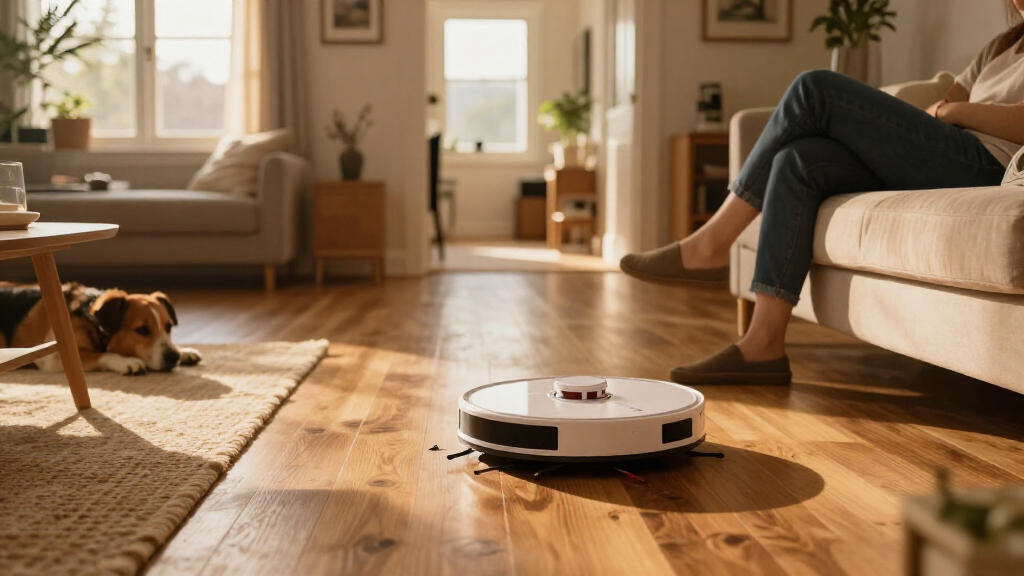
I compared the 14 models through the needs that become more demanding in a large home: consistent navigation across rooms, enough cleaning capacity to cover broad floor areas, practical handling of mixed surfaces, and less frequent hands-on upkeep. I also weighed whether a model includes a self-emptying dock, whether it adds mopping, and how clearly its listed features support a whole-home routine. Suction figures are treated as one clue rather than a direct measure of real-world coverage or pickup.
The ranking favors products whose stated capabilities suggest a strong balance of coverage, automation, and versatility. Premium combo models rank well for buyers seeking more dock support and mopping, while simpler self-emptying options suit those who want fewer chores without a more elaborate system. Models with fewer standout details remain useful for narrower needs, but have less evidence in this lineup of advantages that matter across a large floor plan. Exact package contents matter, especially for similarly named Shark and Roomba versions.
Factors to Consider When Choosing Robot Vacuums For Large Homes
A large-home robot needs to fit the way your rooms connect and the amount of routine care you’re willing to handle. I’d start with floor plan and flooring, then decide how much automation you actually need; the strongest spec sheet can still be a poor fit if the dock has nowhere convenient to live.
Match Cleaning Coverage to Your Floor Plan
Open layouts can be straightforward for a robot to map, while many small rooms, narrow passages, and closed doors create more chances for missed areas. Check whether the robot can save maps and support room selection or scheduled runs, since these features help split a large home into manageable cleaning sessions. A multi-level home also raises a separate question: whether you can save more than one map and carry the robot between floors. Don’t assume a single charge will cover every layout just because the home’s total area sounds compatible. Door thresholds, rugs, and furniture legs can interrupt a route and reduce useful coverage. Prioritize the floor plan’s bottlenecks before comparing headline suction figures.
Choose a Dock That Fits Your Routine
Self-emptying docks reduce how often you handle dust, which becomes more helpful when the robot runs over a broad area every day. Combo docks may also handle mop pads or water, but their added functions bring more parts to refill, clean, or replace. Consider where the dock will sit and whether you have room to reach its tanks and bags. A large household may fill a dust bag sooner than the advertised interval suggests, especially with pets or heavy shedding. Think about the chores you want removed: dust disposal, mop maintenance, or both. Buying a more elaborate dock makes sense when you’ll use its functions regularly.
Prioritize the Floors You Actually Have
Homes with mostly carpet should favor reliable vacuuming, brush design, and the ability to avoid dragging a damp mop over rugs. In mixed-floor homes, automatic carpet detection and mop lifting can reduce the need to intervene between rooms. Hard-floor-heavy homes may get more daily value from a combo model, though mopping robots still need human attention for stains and dried-on messes. Map out the transitions between surfaces and note any thick rugs or high thresholds. A high suction number does not tell you how well a robot handles hair wrap, edges, or a particular rug pile. Let your dominant flooring decide which features deserve priority.
Treat Suction Claims as One Part of the Picture
Pa ratings provide a comparison point, but they don’t describe cleaning coverage, brush contact, navigation, or how a robot behaves on carpet. A model with a lower listed figure may still suit a home with hard floors and light debris, while a higher figure can be useful for carpet and pet hair without resolving every pickup challenge. Look at the complete cleaning system and the dock alongside suction. Consider the debris your floors collect, including long hair, grit, and crumbs, and how frequently you expect to run the robot. If product details do not explain a feature that matters to your home, avoid assuming it is included. A balanced set of capabilities usually matters more than one large number.
Plan for Maintenance Across a Bigger Home
More rooms mean more total brushing, dust collection, and mop-pad care over time. Check how easy it is to reach the brush, clean sensors, and source replacement bags, filters, and pads. Self-emptying reduces one recurring task, but it does not remove the need to clear tangled hair or wipe sensors. Combo models add water tanks and mop parts that need attention even when the vacuum is automated. Pet owners should pay particular attention to hair handling and how the dock manages collected debris. Choose a maintenance routine you can keep up with, since neglected brushes and sensors can undermine navigation and cleaning.
Spend More Only for Features You’ll Use
Premium systems can make sense when you want frequent mopping, more dock automation, or fewer interruptions to a whole-home schedule. If you mainly need routine dust pickup, a simpler robot with self-emptying may cover the job with fewer components to maintain. Compare the time a feature saves with the attention it adds, especially for mop washing and water management. A second robot for another floor may be more practical than carrying one unit between levels if your home has separate living areas. Set priorities before shopping so a long feature list does not pull you toward functions that rarely affect your routine. The right upgrade is the one that addresses a repeated chore in your home.
Frequently Asked Questions
Can one robot vacuum clean a large home in a single run?
That depends on the home’s layout, flooring, obstacles, and the robot’s battery and navigation behavior. A broad open floor may be easier to cover than the same area divided by narrow rooms and thresholds. Check whether the model can resume a route after recharging, and whether it saves maps so it can clean selected rooms in separate sessions. For multiple floors, confirm map support and plan to move the robot or use a unit on each level. Scheduled room-by-room runs can be more realistic than expecting every area to be cleaned at once.
Is a self-emptying dock worth it for a large household?
It can reduce how often you empty the robot, especially in homes with pets, children, or frequent daily runs. The benefit depends on how much debris the home produces and how much capacity the dock bag holds. You’ll still need to replace bags, clean brushes, and maintain filters. Compare the dock’s size and access needs with the space where you plan to place it. If you rarely run the robot, a basic dock may be enough; frequent whole-home cleaning makes self-emptying more useful.
Should I choose a vacuum-and-mop combo for a home with rugs?
A combo can work well when most floors are hard surfaces, but rugs call for careful mop control. Check for carpet detection, mop lifting, or reliable no-mop zones, and confirm which features apply to the specific model you’re considering. Without those controls, you may need to set boundaries or remove mop components before a run. Homes with extensive carpet may get more value from a vacuum-focused model and occasional manual mopping. Think about the proportion of hard floor and carpet rather than assuming a combo is automatically more versatile.
Do higher Pa figures mean better cleaning across a large home?
Not by themselves. Pa figures describe suction claims, but whole-home results also depend on navigation, brush design, surface changes, and how well the robot reaches edges and furniture. A high figure may appeal in carpeted or debris-heavy homes, yet it won’t compensate for missed rooms or a brush that needs frequent clearing. Compare the complete set of features and the care routine. Use suction to narrow choices after you’ve confirmed the robot suits your floor plan and flooring.
What should I check before buying a robot for a multi-level home?
Confirm how many maps the robot can store and whether room names, no-go zones, and schedules remain available for each floor. Consider whether you are comfortable carrying the unit and whether its dock can stay on one level. Some homes may be better served by a separate robot on each floor, particularly when stairs or frequent cleaning make transfers inconvenient. Check thresholds and narrow access points that could prevent the robot from reaching rooms. Plan the setup around how people use each floor, not only the home’s total area.
Conclusion
For the best overall, I’d start with the Dreame L40 Ultra Gen 2 if its high stated suction and broad combo feature set match your needs. The best premium alternative is the Roborock Qrevo 2 Pro, while the eufy E25 also suits shoppers drawn to a 20,000 Pa combo system. For best value, compare the Roborock Q7 L5 and Tikom around the features you’ll use, particularly mopping and self-emptying. Beginners who want a straightforward self-emptying setup can look at the Shark AV2501S; buyers with mostly hard floors may favor a combo, while carpet-heavy homes should focus on vacuum performance and mop controls. Before choosing, verify the exact model and dock included, since several names in this lineup refer to closely related versions.
Halloween Picks

9 ft Halloween Inflatable Haunted Castle with Dragon and Ghost

Kalolary 12ft Halloween Witch Haunted House Inflatable Archway

HOPOCO Halloween Pumpkin Fog Machine with 12 LED Colors & Remote Control
As an affiliate, we earn on qualifying purchases.