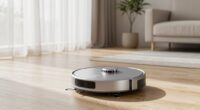
For a robot vacuum for under cabinets and edge cleaning, my best overall pick is the eufy 11S MAX for its slim profile and straightforward cleaning approach. The Shark AV2501S stands out for mapped, repeatable coverage, while the ILIFE V2 is a simpler option for buyers focused on basic floor pickup. The main tradeoff is between low clearance and edge reach versus mapping, strong automation, and self-emptying convenience. Cabinet toe-kick height and furniture layout matter as much as advertised suction, since a robot that cannot fit underneath cannot clean there. Read on for the full breakdown of how these ten options differ and which type of home each best suits.

Get cleaning gear delivered free with Prime
- Fast, free delivery on millions of items
- Prime Video, Amazon Music and more included
- Member-only deals all year
Complete the kit


Key Takeaways
- Low clearance changes the shortlist: The eufy 11S MAX is explicitly described as super thin, making its physical fit a more relevant advantage for low cabinets than features such as self-emptying.
- Mapping favors systematic coverage, not necessarily the lowest reach: The Shark AV2501S and TRDIOL pair LiDAR or mapping features with broader navigation functions, but buyers still need to check their height against cabinet clearance.
- Self-emptying solves a different problem from edge cleaning: Shark, TRDIOL, and Redroad models add dock convenience, but a larger dock and robot footprint may not help reach tight toe-kicks.
- Combo functions involve a tradeoff: The iMartine, TRDIOL, Dreame D20 Air Plus, and Redroad offer vacuum-and-mop formats, which may suit mixed-floor homes but add maintenance beyond a vacuum-only model.
- Small or simple models suit narrower jobs: The ILIFE V2, Lefant M210, and mini USB-rechargeable CHLHORT prioritize a more basic or compact use case, but buyers should not expect the same navigation and whole-home automation as mapped options.
| Shark AI Ultra Robot Vacuum with 60-Day Self-Emptying Base, AV2511AE |  | Best for Low-Under-Cabinet Coverage with Less Emptying | Model: AV2511AE | Navigation: 360° LiDAR mapping with obstacle detection | Cleaning pattern: Grid-pattern cleaning | VIEW ON AMAZON | See Our Full Breakdown |
| ILIFE V2 Robot Vacuum Cleaner |  | Best Value for Low-Clearance Edges | Model: V2 | Dimensions: 12.2 × 12.2 × 2.99 inches | Cleaning modes: Auto, spot, and edge | VIEW ON AMAZON | See Our Full Breakdown |
| iMartine BR151 Robot Vacuum and Mop Combo |  | Best Compact Vacuum-and-Mop Combo | Dimensions: 11.8 × 11.8 × 2.87 inches | Cleaning path width: 11.8 inches | Suction levels: 3: low, medium, and high | VIEW ON AMAZON | See Our Full Breakdown |
| Shark AV2501S AI Ultra Robot Vacuum with Matrix Clean and Self-Empty Base |  | Best for Allergy-Conscious, Mapped Edge Cleaning | Navigation: Matrix Clean with 360° LiDAR mapping | Obstacle detection: Yes | Recommended surfaces: Carpets and hard floors | VIEW ON AMAZON | See Our Full Breakdown |
| eufy 11S MAX Robot Vacuum Cleaner, Super Thin, Quiet |  | Best for Tight Cabinet Clearances | Profile: 2.85 inches | Runtime: Up to 100 minutes | Suction technology: BoostIQ adaptive suction | VIEW ON AMAZON | See Our Full Breakdown |
| TRDIOL Robot Vacuum and Mop with Self-Emptying Station, 6000Pa Suction, and LiDAR Mapping |  | Best for Multi-Floor Under-Cabinet Cleaning | Maximum suction: 6000Pa | Dust bag capacity: 4 liters | Mapping: LiDAR; saves up to 4 floor maps | VIEW ON AMAZON | See Our Full Breakdown |
| Dreame D20 Air Plus Robot Vacuum and Mop |  | Best for Strong Suction Along Cabinet Edges | Suction power: 20,000 Pa | Dust bag capacity: 4 liters | Battery life: 150 minutes | VIEW ON AMAZON | See Our Full Breakdown |
| CHLHORT Mini USB-Rechargeable Robot Vacuum with Obstacle Avoidance |  | Best Compact Pick for Light Cabinet-Toe-Kick Dust | Dimensions: 7.09 × 7.09 × 2.36 inches | Battery life: 20 minutes | Power source: USB rechargeable | VIEW ON AMAZON | See Our Full Breakdown |
| Redroad R11 Robot Vacuum and Mop with Self-Emptying Base |  | Best Feature-Rich Pick for Mapped Edge Routes | Suction: 20,000 Pa | Navigation: 360° LiDAR | Map storage: Up to 4 maps | VIEW ON AMAZON | See Our Full Breakdown |
| Lefant M210 Robot Vacuum Cleaner |  | Best Slim Pick for Frequent Edge-Mode Runs | Dimensions: 11-inch diameter, 2.99-inch height | Runtime: Up to 120 minutes in low-suction mode | Dustbin capacity: 500 ml | VIEW ON AMAZON | See Our Full Breakdown |
| robot vacuum for under cabinets edge cleaning | Runtime | Controls |
|---|---|---|
| Shark AI Ultra Robot Vacuum wi | Listed as up to 90 minutes in the description and 120 minutes in the specifications | App and voice control; compatible with Amazon Alexa and Google Assistant |
| ILIFE V2 Robot Vacuum Cleaner | Up to 120 minutes | — |
| iMartine BR151 Robot Vacuum an | Up to 100 minutes | App, remote, and voice |
| Shark AV2501S AI Ultra Robot V | Up to 120 minutes | App control and voice control with Amazon Alexa and Google Home |
| eufy 11S MAX Robot Vacuum Clea | Up to 100 minutes | Remote control and onboard buttons |
| TRDIOL Robot Vacuum and Mop wi | — | App, buttons, remote, and voice |
| Dreame D20 Air Plus Robot Vacu | — | — |
| CHLHORT Mini USB-Rechargeable | — | — |
| Redroad R11 Robot Vacuum and M | — | — |
| Lefant M210 Robot Vacuum Clean | Up to 120 minutes in low-suction mode | App, Alexa, and Google Assistant |
More Details on Our Top Picks
Shark AI Ultra Robot Vacuum with 60-Day Self-Emptying Base, AV2511AE
The Shark AI Ultra earns this spot for buyers who want mapped, repeatable cleaning around kitchen edges without frequent bin maintenance. Its 360° LiDAR mapping and grid-pattern routes favor orderly coverage over the less structured approach of the eufy 11S MAX, while obstacle detection can help it work around everyday floor clutter. The robot’s listed 0.27-gallon dust capacity belongs to the vacuum; the bigger convenience is the bagless base, which holds up to 60 days of debris according to the product details.
For under-cabinet cleaning, check the robot’s actual clearance against your toe-kick height: the supplied specs do not give its profile, so I can’t rank its physical access above the 2.85-inch eufy or 2.99-inch ILIFE. Pet owners may value the self-cleaning brushroll, but the stated runtime conflicts between 90 and 120 minutes, and the included-items list does not confirm a mop. Choose it for mapped maintenance and hands-off emptying, not for a verified low-clearance fit.
Pros:- LiDAR mapping and grid-pattern cleaning support orderly floor coverage.
- Bagless base is specified to hold up to 60 days of debris.
- Self-cleaning brushroll is designed to reduce pet-hair wrap.
- App scheduling, voice control, and Recharge and Resume support routine cleaning.
Cons:- Robot height is not provided, so under-cabinet fit cannot be checked from the listed specs.
- Runtime is inconsistent across the product details: 90 minutes in one place and 120 in another.
- Mopping is mentioned in the description, but no mop appears in the included-items list.
Best for: Pet-owning households that want mapped cleaning and a large self-emptying base, and can verify the robot clears their cabinet toe-kicks.
Not ideal for: Buyers choosing mainly by under-cabinet clearance or seeking confirmed mopping; its robot height is not listed, and a mop is not confirmed in the included items.
- Model:AV2511AE
- Navigation:360° LiDAR mapping with obstacle detection
- Cleaning pattern:Grid-pattern cleaning
- Recommended surfaces:Carpet and hard floors
- Self-emptying base:Bagless; holds up to 60 days of debris
- Robot dust capacity:0.27 gallons
- Runtime:Listed as up to 90 minutes in the description and 120 minutes in the specifications
- Controls:App and voice control; compatible with Amazon Alexa and Google Assistant
Our verdict“Pick the Shark AI Ultra for mapped cleaning and less frequent emptying, but verify its clearance before buying it specifically for under cabinets.”
ILIFE V2 Robot Vacuum Cleaner
The ILIFE V2 is a practical choice when the main problem is dust and pet hair beneath cabinets, not app-driven mapping. At 2.99 inches tall, it has a stated low profile, though the slimmer eufy 11S MAX measures 2.85 inches and may suit tighter gaps. Its dedicated edge cleaning mode is directly relevant to baseboards and cabinet runs; remote control and scheduled cleaning keep operation simple without requiring Wi-Fi.
Compared with the Shark AI Ultra, the V2 gives up LiDAR mapping and self-emptying, so it is a more hands-on option for larger homes or frequent cleaning. Tangle-free suction is intended to handle pet hair, but the single power level and low-pile-carpet recommendation limit its versatility. I’d choose it for accessible hard-floor edges and furniture clearance, while checking the gap height carefully and skipping it if deeper carpet or mapped room coverage is a priority.
Pros:- 2.99-inch profile gives a clear reference for checking furniture and cabinet clearance.
- Dedicated edge mode targets debris along cabinet fronts and walls.
- Tangle-free suction is designed for pet hair.
- Remote control, scheduling, and automatic dock return do not require Wi-Fi.
Cons:- The single power level offers less adjustment than the iMartine BR151’s three suction levels.
- Recommended for low-pile carpet, limiting its fit for thicker rugs.
- No mapping or self-emptying base is listed, so coverage and bin maintenance are less hands-off.
Best for: Buyers with hard floors, low cabinet toe-kicks around three inches high, and pet hair who prefer straightforward remote operation over Wi-Fi features.
Not ideal for: Homes with deep-pile carpet, very low clearances under 2.99 inches, or owners who want LiDAR maps and automatic debris disposal.
- Model:V2
- Dimensions:12.2 × 12.2 × 2.99 inches
- Cleaning modes:Auto, spot, and edge
- Recommended surfaces:Hard floors, pet hair, and low-pile carpet
- Runtime:Up to 120 minutes
- Dust capacity:300 ml
- Control:Remote control
- Charging:Automatic return to charging dock
- Noise level:69 dB
Our verdict“Choose the ILIFE V2 for simple edge cleaning under cabinets near three inches high, and choose the slimmer eufy if every fraction of an inch matters.”
iMartine BR151 Robot Vacuum and Mop Combo
The iMartine BR151 combines a slim, stated 2.87-inch profile with simultaneous vacuuming and mopping, making it a more versatile under-cabinet pick than the vacuum-only ILIFE V2. Its 11.8-inch cleaning path and infrared navigation are intended to help it move around obstacles, while three suction settings give more control over routine dust versus heavier debris. The profile is especially useful for toe-kicks and furniture gaps, but buyers should compare the listed height with their actual clearance rather than assume it will fit every cabinet.
The tradeoff is upkeep: its 200 ml dustbin and 230 ml water tank are modest, so larger kitchens or frequent wet cleaning may require more attention than the Shark AI Ultra’s self-emptying setup. Runtime is listed at up to 100 minutes, and operation is specified below 65 dB. High-pile carpet performance is not given. I’d favor this model when one compact robot needs to handle hard-floor edges and light mopping, not when bin capacity or carpet certainty comes first.
Pros:- 2.87-inch listed height is lower than the ILIFE V2’s 2.99-inch profile.
- Vacuuming and mopping can run simultaneously with two-level water flow control.
- Three suction levels offer more adjustment than the ILIFE V2’s single power level.
- App, remote, and voice control options support different operating preferences.
Cons:- The 200 ml dustbin and 230 ml water tank need more frequent attention than a self-emptying setup.
- High-pile carpet performance is not specified.
- Its stated 15 mm climbing ability may not handle taller thresholds.
Best for: Apartment dwellers and small-kitchen owners who need a low-profile robot for hard-floor edges and want vacuuming plus light mopping.
Not ideal for: Large homes, buyers who dislike frequent tank and bin refills, or households relying on documented performance on high-pile carpet.
- Dimensions:11.8 × 11.8 × 2.87 inches
- Cleaning path width:11.8 inches
- Suction levels:3: low, medium, and high
- Dustbin capacity:200 ml
- Water tank capacity:230 ml
- Runtime:Up to 100 minutes
- Noise level:Under 65 dB
- Climbing ability:15 mm
- Controls:App, remote, and voice
Our verdict“Choose the iMartine BR151 when a slim fit and combined vacuuming and mopping matter more than large capacity or proven deep-carpet performance.”
Shark AV2501S AI Ultra Robot Vacuum with Matrix Clean and Self-Empty Base
The Shark AV2501S suits buyers who value repeat cleaning passes and dust containment more than verified cabinet clearance. Its Matrix Clean navigation and 360° LiDAR organize coverage, while obstacle detection and Recharge and Resume help it continue routine floor cleaning. The HEPA-filtered self-empty base is specified to capture 99.97% of dust and allergens down to 0.3 microns, a distinction the more compact ILIFE V2 does not share.
For under-cabinet work, there is a notable gap in the data: no robot height is listed. That makes it harder to recommend over the 2.85-inch eufy 11S MAX when clearance is the deciding factor. The base holds up to 30 days of debris, less than the 60-day claim for the other Shark AI Ultra, and the listed dust capacity is only 0.09 liters. I’d pick this model for mapped coverage and filtration, but not for the longest emptying interval or a confirmed low-clearance fit.
Pros:- Matrix Clean and LiDAR mapping support organized, repeated floor coverage.
- HEPA filtration is specified to capture 99.97% of dust and allergens down to 0.3 microns.
- Self-cleaning brushroll is designed for pet hair.
- Recharge and Resume, app scheduling, and voice control support routine use.
Cons:- Robot height is not listed, so under-cabinet clearance cannot be verified from the supplied details.
- Base capacity is specified for up to 30 days, half the stated interval of the Shark AI Ultra AV2511AE.
- Listed dust capacity is 0.09 liters.
Best for: Pet-owning or allergy-conscious households seeking mapped cleaning, HEPA filtration, and a self-emptying base for mixed floors.
Not ideal for: Buyers whose first requirement is a confirmed slim profile, or those who want the longer stated emptying interval of the Shark AI Ultra AV2511AE.
- Navigation:Matrix Clean with 360° LiDAR mapping
- Obstacle detection:Yes
- Recommended surfaces:Carpets and hard floors
- Self-emptying base:Bagless; holds up to 30 days of debris
- Filtration:HEPA; captures 99.97% of dust and allergens down to 0.3 microns
- Runtime:Up to 120 minutes
- Dust capacity:0.09 liters
- Controls:App control and voice control with Amazon Alexa and Google Home
Our verdict“Choose the AV2501S for mapped cleaning and HEPA filtration, but choose a model with a published height if cabinet clearance is your main concern.”
eufy 11S MAX Robot Vacuum Cleaner, Super Thin, Quiet
For buyers who measure the gap before choosing a robot, the eufy 11S MAX has a useful advantage: its 2.85-inch profile is the shortest stated here, narrowly below the iMartine BR151 and the ILIFE V2. That makes it the clearest pick in this group for low toe-kicks, though actual fit still depends on the cabinet clearance and the robot’s approach. BoostIQ adjusts suction for different surfaces, and infrared and drop-sensing features support everyday obstacle and stair avoidance.
Unlike the mapped Shark models, the 11S MAX has no Wi-Fi or app support; operation uses its remote and onboard buttons. It also lacks a listed edge-cleaning mode like the ILIFE V2, so the slim body—not a named edge program—is its strongest under-cabinet argument. Runtime is up to 100 minutes, which may be limiting in larger homes. I’d choose it for quiet, simple cleaning in tight spaces, not for app scheduling or mapped coverage.
Pros:- At 2.85 inches tall, it has the shortest listed profile among these five products.
- Quiet operation is suited to cleaning while people are at home.
- BoostIQ adjusts suction for different surfaces.
- Infrared sensors, drop sensing, and self-recharging support basic autonomous use.
Cons:- No Wi-Fi or app support; controls are limited to the remote and buttons.
- No dedicated edge-cleaning mode is listed, unlike the ILIFE V2.
- Up to 100 minutes of runtime may not cover larger areas in one run.
Best for: People with low cabinet toe-kicks or furniture gaps who want a quiet, simple robot and are comfortable using a remote.
Not ideal for: Buyers who need app scheduling, mapped cleaning, a dedicated edge mode, or longer runtime for a large floor plan.
- Profile:2.85 inches
- Runtime:Up to 100 minutes
- Suction technology:BoostIQ adaptive suction
- Surface compatibility:Hardwood floors and other surfaces
- Controls:Remote control and onboard buttons
- Connectivity:No Wi-Fi or app support
- Sensors:Infrared obstacle sensors and drop-sensing technology
- Cover:Anti-scratch tempered glass
Our verdict“Choose the eufy 11S MAX when low clearance and quiet, uncomplicated cleaning matter more than app control or mapped edge coverage.”
TRDIOL Robot Vacuum and Mop with Self-Emptying Station, 6000Pa Suction, and LiDAR Mapping
The TRDIOL makes the most sense for homes where cabinet-edge cleaning spans several floors: LiDAR stores up to four maps, and app-set room cleaning and no-go zones let me direct runs around fixed obstacles. Its rectangular form may help it reach along straight cabinet fronts, but the supplied specs give no height or edge-brush reach, so I can’t confirm clearance or close wall pickup. Compared with the Redroad R11, it offers a lower stated suction figure and fewer connectivity details, but keeps the useful combination of mapping, a 4-liter self-emptying bag, and adjustable water flow. Carpet boost and an anti-tangle brush support mixed flooring; mopping is better treated as a pass for footprints and minor marks, not scrubbing. The advertised 120-day bag interval can vary with debris and use.
Pros:- Stores up to four LiDAR floor maps and supports room cleaning and no-go zones.
- 4-liter self-emptying dust bag reduces frequent bin emptying.
- Adjustable suction and water flow suit different floor types and cleaning needs.
- Anti-tangle brush and automatic carpet boost support homes with hair and mixed flooring.
Cons:- Robot height and specific edge-cleaning reach are not provided, making cabinet clearance hard to judge.
- Mopping is intended for footprints and minor stains rather than scrubbing.
- The advertised 120-day period between bag changes depends on household use and debris.
Best for: Households with multiple mapped floors, mixed hard flooring and carpet, and cabinet runs they want to target by room.
Not ideal for: Buyers who need verified low-clearance access beneath cabinets or a mop that scrubs dried, stubborn stains.
- Maximum suction:6000Pa
- Dust bag capacity:4 liters
- Mapping:LiDAR; saves up to 4 floor maps
- Battery life:180 minutes
- Cleaning modes:Vacuuming and mopping
- Controls:App, buttons, remote, and voice
- Form factor:Rectangular
Our verdict“Choose the TRDIOL if multi-floor mapping and scheduled cabinet-edge passes matter more than verified low-profile clearance or intensive mopping.”
Dreame D20 Air Plus Robot Vacuum and Mop
The Dreame D20 Air Plus stands out for its 20,000 Pa stated suction, a spec that favors pulling debris from hard-floor seams and carpet edges near cabinets. LiDAR navigation and app control give it more deliberate route planning than the CHLHORT Mini, which is a basic, short-runtime option for light pickup. A 4-liter sealed bag also limits hands-on dustbin work. That said, strong suction does not establish how close the robot cleans to a cabinet toe-kick: no robot dimensions or specific edge-brush design are listed. It vacuums and mops, but the available details do not describe scrubbing performance or water-flow levels. The 2.4 GHz-only Wi-Fi may also rule it out for buyers whose network setup depends on another band, and its listed USA-only use narrows suitability.
Pros:- 20,000 Pa stated suction is the strongest listed figure among these five products.
- LiDAR navigation supports more structured cleaning routes than the CHLHORT Mini’s simple operation.
- 4-liter sealed dust bag and auto-empty dock reduce routine bin handling.
- Anti-tangle brush design is intended to manage hair and pet fur.
Cons:- Only supports 2.4 GHz Wi-Fi.
- No dimensions or specific edge-cleaning mechanism are provided to confirm under-cabinet fit or toe-kick reach.
- Listed for USA use only, limiting suitability elsewhere.
Best for: Buyers who prioritize high stated suction, mapped routes, and an auto-empty dock for everyday cleaning around cabinets.
Not ideal for: Households that require 5 GHz Wi-Fi, verified low-clearance dimensions, or detailed evidence of close-edge pickup and mopping performance.
- Suction power:20,000 Pa
- Dust bag capacity:4 liters
- Battery life:150 minutes
- Navigation:LiDAR
- Surface recommendations:Carpet, wood, tile
- Wi-Fi:2.4 GHz only
- Cleaning:Vacuuming and mopping
Our verdict“Pick the Dreame if suction and mapped cleaning matter most, but verify its physical clearance before relying on it under cabinets.”
CHLHORT Mini USB-Rechargeable Robot Vacuum with Obstacle Avoidance
At 7.09 inches wide and 2.36 inches high, the CHLHORT Mini has the clearest physical case in this group for fitting into tighter spaces, though buyers still need to compare that height with their cabinet clearance. Its compact size and one-button control suit a small area where loose dust or hair collects along toe-kicks. Compared with the Lefant M210, it is much smaller, but gives up longer runtime, app control, and multiple cleaning modes. The 20-minute battery life makes it a spot cleaner rather than a whole-home solution, and its light-cleaning brief is not a substitute for stronger pickup on embedded debris. Obstacle avoidance is listed, but there is no mapping or scheduled edge route. The included mop is mentioned, but no detailed mopping capability is specified.
Pros:- Listed height of 2.36 inches offers a clear fit reference for low cabinet gaps.
- Compact 7.09-inch footprint suits small cleaning zones.
- One-button operation keeps setup and controls simple.
- USB-rechargeable design is portable between small areas.
Cons:- 20-minute battery life limits cleaning to small zones.
- Designed for light pickup rather than deep cleaning.
- No app, mapping, or scheduled edge-cleaning controls are listed.
Best for: People with a small kitchen or cabinet alcove who want a portable, simple robot for quick light-dust pickup and have measured adequate clearance.
Not ideal for: Whole-home cleaning, larger floor plans, embedded debris, or buyers who want app scheduling and mapped edge passes.
- Dimensions:7.09 × 7.09 × 2.36 inches
- Battery life:20 minutes
- Power source:USB rechargeable
- Battery type:Lithium polymer
- Control method:Push button
- Filter type:Foam
- Surface recommendation:Tile
Our verdict“Choose the CHLHORT Mini for a measured, tight cabinet gap and light spot cleaning, not as your main vacuum.”
Redroad R11 Robot Vacuum and Mop with Self-Emptying Base
The Redroad R11 earns its place with an extendable side brush, the most directly relevant listed feature here for sweeping debris from cabinet edges into the robot’s path. Its 360° LiDAR stores up to four maps, while app and voice controls help set repeatable room routines. Compared with the TRDIOL, the R11 adds an extendable brush and states 20,000 Pa suction, but its advertised 240-day dust collection interval relies on two included bags and will vary with use. Three water-flow levels support basic mopping, yet no scrubbing feature is specified, so I would not choose it to remove dried-on messes. The product data also provides no robot height, leaving under-cabinet clearance uncertain. Its broad feature set suits mapped homes, but buyers should measure the gap rather than assume edge reach means low-profile access.
Pros:- Extendable side brush is specifically relevant to reaching debris along cabinet edges.
- 360° LiDAR supports navigation and storage for up to four maps.
- 20,000 Pa stated suction, anti-tangle roller, and self-emptying base provide a feature-rich cleaning setup.
- Supports app, voice, and watch controls, with compatibility for Alexa and Google Home.
Cons:- Robot height is not listed, so under-cabinet fit cannot be verified from the supplied data.
- The advertised 240-day dust collection period depends on two bags and actual use.
- Three water-flow levels are listed, but no scrubbing feature is specified.
Best for: Homes with several mapped rooms or floors where an extendable side brush and app-directed cabinet-edge routines are priorities.
Not ideal for: Buyers who need confirmed low-profile clearance or a mop designed to scrub stubborn, dried stains.
- Suction:20,000 Pa
- Navigation:360° LiDAR
- Map storage:Up to 4 maps
- Dust bag capacity:4 L
- Battery:3,200 mAh lithium-ion
- Water flow:3 levels
- Wi-Fi:2.4 GHz and 5 GHz
- Cleaning modes:Vacuuming, sweeping, and mopping
Our verdict“The R11 is the strongest listed choice for planned cabinet-edge pickup, provided its unlisted height clears your cabinets.”
Lefant M210 Robot Vacuum Cleaner
The Lefant M210 is the more practical choice for routine cabinet-edge passes when low height and dedicated edge mode matter more than mapping. At 2.99 inches tall, it has a stated profile that some low-clearance robots lack, though buyers should measure their own gap before purchasing. Its six modes include edge cleaning, and brushless suction is designed to avoid hair tangles. Compared with the CHLHORT Mini, the M210 offers app and voice control plus up to 120 minutes in low-suction mode, making it better suited to regular home routines; it is also much larger in diameter. The tradeoff is less route precision than the LiDAR-equipped Redroad R11, and the longest runtime applies only at low suction. Zigzag mode is not recommended for carpet.
Pros:- 2.99-inch stated height helps buyers evaluate low-clearance access.
- Dedicated edge cleaning mode supports targeted runs along cabinet lines.
- Brushless suction is designed to reduce hair tangling.
- App, Alexa, and Google Assistant controls support scheduled cleaning.
Cons:- Up to 120 minutes of runtime applies in low-suction mode.
- Zigzag mode is not recommended for carpet.
- No LiDAR mapping or self-emptying base is listed.
Best for: Pet owners with hard floors or low-pile carpet who want scheduled edge-mode cleaning and a stated height to compare against cabinet clearance.
Not ideal for: Buyers seeking LiDAR-mapped routes, a self-emptying dock, or one robot for both cabinet-edge runs and high-pile carpet.
- Dimensions:11-inch diameter, 2.99-inch height
- Runtime:Up to 120 minutes in low-suction mode
- Dustbin capacity:500 ml
- Cleaning modes:Zigzag, random, spot, edge, scheduled, and manual
- Controls:App, Alexa, and Google Assistant
- Noise level:52 dB
- Surface recommendation:Wood, hard floors, and low-pile carpet
Our verdict“Choose the M210 for scheduled edge-mode cleaning and a relatively slim profile, but select the Redroad R11 if mapped routes and a side brush matter more.”

How We Picked
I ranked these models around the specific job implied by the search: reaching beneath cabinets and cleaning along edges. The main factors were stated height or slim-profile design, navigation and coverage features, whether the robot offers edge-oriented cleaning tools or patterns, and how well its form and functions suit tight layouts. I also weighed convenience features such as self-emptying and mopping against the upkeep and space they add. A product feature can help only when the robot physically fits the target gap.
The order favors clear relevance to under-cabinet access and useful edge coverage over feature count alone. The eufy 11S MAX leads for buyers whose first constraint is low clearance, while the Shark AV2501S and other mapped models make more sense when coverage consistency and automation matter more. Simpler and mini-format options rank lower for whole-home navigation or versatility, though they can suit smaller, less demanding cleaning tasks. Since cabinet clearances vary and the listed product names do not establish exact fit for every model, I recommend checking the manufacturer’s dimensions against the lowest obstruction in your home before choosing.
| robot vacuum for under cabinets edge cleaning | Runtime | Controls |
|---|---|---|
| Shark AI Ultra Robot Vacuum wi | Listed as up to 90 minutes in the description and 120 minutes in the specifications | App and voice control; compatible with Amazon Alexa and Google Assistant |
| ILIFE V2 Robot Vacuum Cleaner | Up to 120 minutes | — |
| iMartine BR151 Robot Vacuum an | Up to 100 minutes | App, remote, and voice |
| Shark AV2501S AI Ultra Robot V | Up to 120 minutes | App control and voice control with Amazon Alexa and Google Home |
| eufy 11S MAX Robot Vacuum Clea | Up to 100 minutes | Remote control and onboard buttons |
| TRDIOL Robot Vacuum and Mop wi | — | App, buttons, remote, and voice |
| Dreame D20 Air Plus Robot Vacu | — | — |
| CHLHORT Mini USB-Rechargeable | — | — |
| Redroad R11 Robot Vacuum and M | — | — |
| Lefant M210 Robot Vacuum Clean | Up to 120 minutes in low-suction mode | App, Alexa, and Google Assistant |
Factors to Consider When Choosing Robot Vacuum For Under Cabinets Edge Cleaning
Choosing for under-cabinet cleaning starts with the room, not the feature list. I would measure the tightest clearance, note how the cabinet toe-kick meets the floor, and then decide whether edge pickup, mapped coverage, or reduced maintenance matters most. These checks help avoid paying for functions that do not solve the access problem.
Measure the Tightest Gap, Not the Average
Measure from the floor to the lowest point along the route the robot must take, including trim, hanging fabric, and uneven flooring. Compare that number with the robot’s published height and leave some margin rather than choosing a near-exact match. Small differences in floor transitions or cabinet lips can stop a close-fitting robot or make it scrape. Also check whether the gap is wide enough for the robot to enter and turn, not just pass straight through. A low-profile design is useful only if the robot can get in and navigate back out.
Separate Edge Cleaning From Corner Access
“Edge cleaning” can mean following a wall, sweeping debris inward with a side brush, or repeatedly covering an edge through a navigation pattern. Those approaches do not guarantee that a robot will clean a recessed toe-kick or a sharp inside corner. Look for how the product describes its brushes and edge behavior, then consider the geometry of your cabinets. Long, uninterrupted cabinet runs may suit wall-following behavior, while island corners and narrow recesses demand more turning room. A side brush can move debris from the edge, but it may also scatter light particles if the robot approaches at an awkward angle.
Decide Whether Mapping Is Worth the Added Complexity
Mapping can make room-to-room coverage more orderly and may help a robot revisit missed zones, which matters in larger or cluttered homes. A simpler bump-and-go model can still be a reasonable fit for a small, open area with few obstacles. Do not assume that mapping means better under-cabinet reach: navigation cannot overcome a body that is too tall or a gap that is too narrow. Think about whether you need scheduled whole-home runs, room selection, or repeatable routes before paying for advanced navigation. For a single hard-to-reach cabinet line, physical fit and brush placement may matter more than a detailed map.
Account for the Dock and the Cleaning Routine
A self-emptying base can reduce how often you handle collected dust, but it takes floor space and does not make the robot itself slimmer. Check where the dock can sit and whether the robot has a clear path between the base and the cabinets. Combo models add a water tank or mop components that need cleaning and drying, so consider whether you will use the mopping function often enough to justify that routine. Vacuum-only designs keep the task simpler when under-cabinet dust is the main concern. Match convenience features to your habits rather than treating a longer feature list as an automatic upgrade.
Match the Robot to the Floor and Debris
Hard floors, rugs, pet hair, and crumbs place different demands on brushes and suction. A robot that is slim enough to reach below a cabinet may still struggle with thick rug edges or tangled hair, so check its stated floor compatibility and maintenance needs. Side brushes can help pull debris away from walls, while a main brush design affects how much hair needs removal by hand. If the cabinet edge borders a rug, consider whether the robot can cross that transition without getting stuck. A balanced choice should clean the hidden area without creating frequent brush or wheel cleanup elsewhere.
Treat Compact USB Models as Spot-Cleaning Tools
Mini or USB-rechargeable robots can appeal when space and simplicity are the priority, but a compact size alone does not establish strong edge coverage or room-scale navigation. Check the product’s intended use, battery expectations, obstacle handling, and whether it can return to a charging point on its own. These details matter more than assuming that a very small unit can replace a full-size vacuum. For a desk-side nook or a limited floor patch, a basic model may be enough. For several rooms and long cabinet runs, prioritize coverage and navigation suited to the larger job.
Frequently Asked Questions
How much clearance should I leave for a robot vacuum under my cabinets?
Use the robot’s published height as a starting point and measure the lowest point along its entire route, not just the open center of the cabinet. Leave extra room for floor unevenness, rugs, and cabinet trim rather than relying on a barely larger gap. A robot that fits exactly may scrape or get trapped when it meets a raised edge. Check the width and turning space too, since reaching the opening is not enough if it cannot maneuver underneath. If dimensions are uncertain, confirm them with the manufacturer before buying.
Will a slim robot vacuum always clean better along cabinet edges?
No. A slim body helps the robot enter beneath low cabinets, but edge pickup also depends on brush placement, navigation, and the shape of the toe-kick. A model may fit under a cabinet yet miss debris in a recessed corner or scatter it with a side brush. Consider both the robot’s height and how it handles walls and edges. For a cabinet run with a low overhang, access may be the limiting factor; for open baseboards, edge-following behavior may matter more.
Should I choose a mapped model or a simpler robot for a small kitchen?
For a compact, open kitchen, a simpler robot may cover the floor adequately if it can reach the cabinet gaps and avoid getting caught. Mapping becomes more useful when the space connects to other rooms, has frequent obstacles, or needs repeatable scheduled routes. It adds navigation capability, not extra clearance, so confirm the robot’s dimensions either way. Think about whether you want room selection and predictable coverage or just occasional pickup. That distinction can keep you from paying for features your layout does not need.
Is a self-emptying robot worth choosing for under-cabinet cleaning?
Self-emptying can cut down on bin handling, especially in homes with pets or frequent cleaning schedules. It does not improve access beneath cabinets, and the base needs a suitable parking area with a clear approach. If your main goal is reaching a low toe-kick, prioritize the robot’s own dimensions and edge behavior first. A docked model makes more sense when reduced day-to-day maintenance is also a priority. For a small area or occasional cleaning, a simpler bin may be easier to live with.
Is a vacuum-and-mop robot a good fit for cabinet edges?
It can be useful on hard floors if you want dust pickup and light mopping in the same routine, but the mop function does not guarantee better edge cleaning. Combo models add components that need regular rinsing, drying, or refilling, which can outweigh the benefit if you rarely mop. Check whether the unit can fit under the cabinets with its full cleaning setup and whether the floor is compatible with damp cleaning. For dry debris along toe-kicks, a vacuum-only model may offer a simpler routine. Choose a combo when you will make regular use of both functions.
Conclusion
For most shoppers focused on low cabinet clearance, I would start with the eufy 11S MAX as the best overall fit because its slim profile directly addresses access. For a more feature-led alternative with mapped coverage, the Shark AV2501S is my best premium-style choice, provided its height suits your cabinets. The ILIFE V2 is my best value direction for buyers who want a straightforward, basic robot rather than a dock-heavy setup. Beginners with a small, uncomplicated area may prefer a simple vacuum-only model, while shoppers who want vacuuming and mopping can compare the Dreame D20 Air Plus, iMartine, TRDIOL, and Redroad options. For a very limited nook, the CHLHORT mini may suit a narrow task, but I would not treat it as a substitute for whole-home coverage. Measure your lowest gap first, then choose between slim access, mapped routines, and reduced maintenance.