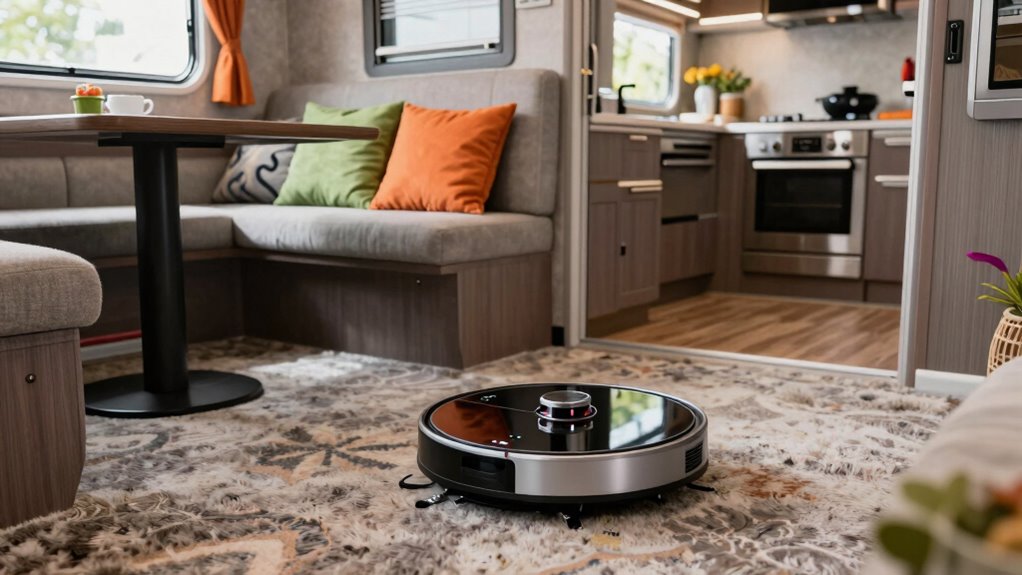
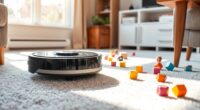
For most RV and camper owners, I’d start with the Roborock Q7 L5: its vacuum-and-mop format offers a practical balance for mixed hard floors and everyday mess. The ILIFE A30s stands out for mapped cleaning and no-go zones, while the Mini Low-Profile Robot Vacuum suits buyers who need a compact cleaner for tight spaces. The main tradeoffs are footprint and storage, reliable navigation in a narrow floor plan, and whether extra features add more upkeep than convenience. A robot vacuum can help with routine debris, but thresholds, loose cords, and an unevenly parked vehicle can limit where it travels. Read on for the full comparison and guidance on matching a model to your RV or camper.

Get cleaning gear delivered free with Prime
- Fast, free delivery on millions of items
- Prime Video, Amazon Music and more included
- Member-only deals all year
Complete the kit


Key Takeaways
- Mapping matters more in a tight floor plan: The ILIFE A30s and LiDAR-equipped options can offer more control over rooms and no-go areas than simpler navigation models, though a mapped layout may need to be refreshed if the furniture changes.
- A slim body is useful only if it fits your actual clearances: The MANVN’s stated 2.87-inch profile and the Mini Low-Profile model target low-clearance cleaning, but buyers should measure under-bed and dinette gaps before choosing.
- Self-emptying trades storage for less frequent bin care: The MONSGA and Bagotte include self-emptying docks, a convenience that may be less valuable in an RV where dock space and access to supplies are limited.
- Combo models ask for more maintenance than vacuum-only picks: Mopping can help on sealed hard floors, but water tanks, pads, and drying add chores that may not suit a small travel setup.
- The lineup spans very different levels of control: App- and mapping-focused models offer more scheduling and boundary options, while simpler options such as the ILIFE V2 may appeal to buyers who want fewer setup steps and can accept less precise coverage.


| robot vacuum for rv and camper | Navigation | Suction power |
|---|---|---|
| MANVN Robot Vacuum and Mop Com | — | — |
| Shark Navigator Robot Vacuum w | SmartPath with spot LiDAR | — |
| ILIFE A30s Robot Vacuum with 1 | LiDAR with home mapping and no-go zones | — |
| Roborock Q7 L5 Robot Vacuum an | 360° LiDAR | 8,000 Pa |
| ILIFE V2 Robot Vacuum Cleaner | — | — |
| ROPVACNIC Robot Vacuum and Mop | — | 5200 Pa |
| MONSGA Robot Vacuum and Mop wi | — | 8000 Pa |
| Smart Robot Vacuum with Self-C | Sensors and mapping technology | — |
| Tikom G8000 Max Robot Vacuum a | — | 5000 Pa |
| Bagotte Robot Vacuum and Mop C | LiDAR with mapping | 6000 Pa |
| iRobot Roomba 115X Combo Robot | ClearView LiDAR | 10,000 Pa |
| Robot Vacuum and Mop Combo: 50 | Intelligent navigation with obstacle avoidance | 5,000 Pa |
| BOTLUXE T20+ Robot Vacuum and | LiDAR | — |
| Mini Low-Profile Robot Vacuum | — | — |
More Details on Our Top Picks
MANVN Robot Vacuum and Mop Combo for Pet Hair, Ultra-Slim 2.87”, Wi-Fi/App/Voice Control, Self-Charging
For a camper where dust and pet hair collect beneath bunks or seating, the 2.87-inch profile is the MANVN’s clearest advantage: it can reach spaces that taller robots may miss. Its 2300Pa suction and adjustable two-level water flow make it a basic vacuum-and-mop option for mixed hard flooring, while app and voice controls allow scheduled runs without much effort. Compared with the Roborock Q7 L5, it offers less suction and lacks mapping memory, so it is a better fit for simpler layouts than for carefully divided cleaning zones. Its listed 1,290-square-foot coverage is generous for an RV, but onboard navigation still matters in tight, changing spaces. The tradeoff is hands-on upkeep: the mop cloth must come off before carpet cleaning, and brushes and filters need regular maintenance.
Pros:- 2.87-inch height can fit beneath low furniture and bunks.
- Vacuuming and electric mopping support routine hard-floor cleanup.
- Two water-flow settings offer a simple way to adjust mopping.
- App and voice control support scheduled cleaning.
Cons:- No mapping memory, limiting route control in cluttered or divided layouts.
- Mop cloth must be removed manually before carpet cleaning.
- Regular brush and filter maintenance adds upkeep.
Best for: RV owners with low-clearance furniture, mostly hard floors, and a need for occasional light mopping alongside pet-hair pickup.
Not ideal for: Campers with carpeted zones that need frequent mop-and-vacuum switching, or owners who want mapped routes and no-go zones.
- Maximum suction:2300Pa
- Height:2.87 inches
- Battery life:100 minutes
- Battery capacity:2500mAh
- Listed coverage:1290 sqft
- Water settings:2 (low/high)
- Wi-Fi:2.4GHz
- Compatibility:Google Assistant, Tuya Smart App
Our verdict“Choose the MANVN if low clearance and basic mopping matter more than mapped navigation or stronger suction.”
Shark Navigator Robot Vacuum with SmartPath Navigation, Steel Grey (RV2110)
The Shark Navigator makes the most sense for an RV owner who wants the robot to follow a more orderly route instead of wandering through a compact floor plan. Spot LiDAR SmartPath navigation maps rooms and cleans in rows, while object detection and recharge-and-resume help it manage routine sessions with less supervision. Its self-cleaning brushroll is designed to resist hair wrap, a practical benefit when a pet travels along. Compared with the ILIFE A30s, the Shark’s listed feature set emphasizes hair handling and object avoidance, while the ILIFE gives buyers clearer control over mapped no-go zones and specifies much stronger suction. The Navigator works across carpets and hard floors, but its listed single speed gives less flexibility for different surfaces. Its mapping advantage is most useful in a stable layout; frequent changes to furniture or stored gear can complicate any robot’s routes.
Pros:- Spot LiDAR mapping supports row-by-row room coverage.
- Object detection and avoidance can reduce collisions with belongings.
- Self-cleaning brushroll is designed to resist hair wrap.
- Recharge-and-resume supports longer cleaning sessions.
Cons:- Only one speed setting is listed, limiting control across floor types.
- No dimensions are provided to confirm clearance under RV furniture.
- Mapping may be less useful when the interior layout changes often.
Best for: RV owners with a consistent interior layout who want row-by-row cleaning, object detection, and a brushroll designed to resist hair wrap.
Not ideal for: Buyers who need adjustable cleaning intensity, explicit no-go-zone control, or a compact robot with a specified low profile.
- Model:RV2110
- Navigation:SmartPath with spot LiDAR
- Battery life:120 minutes
- Dust capacity:0.52 quarts
- Surface recommendation:Carpets and hard floors
- Controls:App and voice control
- Special features:Bagless, self-cleaning brushroll, object detection and avoidance, recharge and resume
- Included components:Docking station, robot vacuum, side brush
Our verdict“Pick the Shark Navigator for a stable RV layout where mapped routes and hair-resistant brushroll design are priorities.”
For travelers who bring pets or track in grit, the ILIFE A30s stands apart through its stated 10,000Pa maximum suction and LiDAR-based mapping. Its no-go zones are especially useful in a camper, where cables, pet bowls, or stored gear may occupy a small but sensitive area. A 150-minute battery life and three control methods—app, voice, and remote—give it more flexibility than the simpler ILIFE V2, which skips Wi-Fi and mapping in favor of straightforward operation. The A30s is vacuum-only, however, so it cannot handle light floor mopping like the Roborock Q7 L5. Its 3.74-inch height may also limit access beneath low bunks, making clearance checks important before choosing it for a compact cabin. It relies on 2.4GHz Wi-Fi for app functions.
Pros:- 10,000Pa maximum suction is the strongest stated figure in this group.
- LiDAR mapping and no-go zones help manage cluttered RV layouts.
- App, voice, and remote controls provide several operating options.
- 150-minute battery life supports extended cleaning sessions.
Cons:- Vacuum-only design does not provide mopping.
- At 3.74 inches tall, it may not fit beneath low furniture.
- App connectivity supports 2.4GHz Wi-Fi, not 5GHz.
Best for: Pet-owning RV travelers who want strong stated suction, mapped cleaning zones, and remote control options for hard floors and carpet.
Not ideal for: Campers needing a low-profile robot for under-bunk cleaning or anyone who wants a combined vacuum-and-mop unit.
- Maximum suction:10,000Pa
- Navigation:LiDAR with home mapping and no-go zones
- Battery life:150 minutes
- Dimensions:12.99 × 12.99 × 3.74 inches
- Weight:6 pounds
- Dust capacity:450 ml
- Controls:App, voice, and remote
- Surface recommendation:Hard floor and carpet
Our verdict“Choose the A30s if suction and mapped exclusion zones outweigh the need for mopping or a particularly slim body.”
Roborock Q7 L5 Robot Vacuum and Mop Combo
The Roborock Q7 L5 is the most feature-rich choice here for an RV owner who wants one robot to vacuum, mop, and follow planned routes. 360° LiDAR navigation, multi-floor mapping, and app-based no-go zones can help separate cleaning areas from cables or gear, while 8,000Pa suction gives it a substantial stated vacuuming capability. Three water levels add more mopping control than the MANVN’s two. Compared with the vacuum-only ILIFE A30s, the Roborock trades the ILIFE’s higher stated suction for an integrated mop and mapping features. That flexibility comes with compromises in a camper: its combined water tank and dustbin mean one integrated part to handle, and the 2.4GHz Wi-Fi requirement may not suit every network setup. At 60 dB, it is not a silent option for cleaning while people rest nearby.
Pros:- Combines vacuuming and mopping with three water levels.
- 360° LiDAR, multi-floor mapping, and no-go zones support controlled routes.
- Dual anti-tangle brushes are designed to reduce hair wrap.
- App and voice controls support scheduled cleaning.
Cons:- Requires a 2.4GHz Wi-Fi network.
- Integrated water tank and dustbin combine two maintenance tasks in one part.
- Listed 60 dB noise level may be noticeable in a small camper.
Best for: RV owners with mixed hard flooring who want mapped vacuuming, adjustable mopping, and app-based no-go zones in one unit.
Not ideal for: Campers with limited storage or low furniture clearance, or buyers who prefer a simpler vacuum-only robot with fewer components to maintain.
- Suction power:8,000 Pa
- Navigation:360° LiDAR
- Water tank capacity:270 ml
- Battery life:150 minutes
- Noise level:60 dB
- Filter:Washable
- Controls:App, buttons, and voice
- Wi-Fi requirement:2.4 GHz
- Compatible surfaces:Carpet, laminate, tile, vinyl, wood, and marble
Our verdict“Pick the Q7 L5 if mapped cleaning and adjustable mopping are worth the added setup and combined tank-bin handling.”
ILIFE V2 Robot Vacuum Cleaner with Tangle-Free Suction
The ILIFE V2 suits a camper owner who wants routine pickup without app setup or mapping. Its tangle-free suction port is designed for pet hair, while the 2.99-inch profile can reach under some low furniture. Remote and one-touch controls keep operation simple, and automatic return to the dock supports scheduled cleaning when the layout is familiar. Compared with the mapped Shark Navigator, the V2 gives up room mapping and object detection; compared with the MANVN, it also skips mopping and smart-home control. Those omissions make it a less capable cleaner, but a more straightforward choice for hard floors and low-pile carpet where basic debris pickup is the goal. It has one power level and is not specified for deeper or high-pile carpet, so it is best treated as a maintenance robot.
Pros:- Tangle-free suction port is designed to collect pet hair.
- 2.99-inch height can fit beneath some low furniture.
- Remote and one-touch controls do not require Wi-Fi.
- Scheduled cleaning and automatic dock return support routine use.
Cons:- No mapping or app-based zone control is listed.
- One power level limits adjustment for different surfaces.
- Carpet recommendation is limited to low-pile carpet.
Best for: Camper owners who want a basic, Wi-Fi-free robot for pet hair and everyday debris on hard floors and low-pile carpet.
Not ideal for: Buyers who need mapped routes, obstacle avoidance, mopping, adjustable suction, or cleaning on high-pile carpet.
- Suction design:Tangle-free suction port
- Dimensions:12.2 × 12.2 × 2.99 inches
- Runtime:Up to 120 minutes
- Dust capacity:300 ml
- Cleaning modes:Auto, spot, and edge
- Controls:Remote control and one-touch button
- Wi-Fi:Not required
- Noise level:69 dB
- Surface recommendation:Hard floors, pet hair, and low-pile carpet
Our verdict“Choose the V2 for uncomplicated, Wi-Fi-free upkeep on hard floors and low-pile carpet, not for mapped or mopping functions.”
ROPVACNIC Robot Vacuum and Mop Combo, 5200 Pa
The ROPVACNIC suits RV owners who want to switch between vacuuming and a light mop without relying on a single control method. Its app, remote, touchpad, and voice controls make it easier to start a quick cleanup whether the phone is handy or not, while four-stage water adjustment gives some control over mopping on hard floors. Compared with the Tikom G8000 Max, it lists slightly stronger suction, but Tikom provides a stated 150-minute runtime and a notably slim profile. ROPVACNIC lists 120 minutes and is recommended for low-pile carpets, so it is a less convincing match for longer carpet or extended cleaning runs. Obstacle avoidance and automatic recharging help with routine use, though the available details do not describe mapping for tight camper layouts.
Pros:- Offers app, remote, touchpad, and voice control options.
- Four-stage water adjustment helps tailor mopping to hard-floor cleanup.
- Brushless design and dual rotating side brushes are intended to reduce hair tangles.
- Obstacle avoidance and automatic recharging support less hands-on routine cleaning.
Cons:- Recommended for low-pile carpets rather than thicker carpet.
- Listed battery life is 120 minutes, shorter than the Tikom G8000 Max’s stated maximum runtime.
- Product details do not specify mapping or saved floor plans for a compact RV layout.
Best for: RV and camper owners who want app, remote, and voice controls plus adjustable mopping for mostly hard floors and low-pile rugs.
Not ideal for: Buyers with thicker carpets or long cleaning routes who need a stated runtime beyond 120 minutes or detailed room mapping.
- Suction power:5200 Pa
- Recommended surfaces:Hardwood floors and low-pile carpets
- Water adjustment:Four-stage
- Suction levels:3
- Battery life:120 minutes
- Control methods:App, remote, touchpad, and voice
- Voice compatibility:Amazon Echo and Google Home
- Filter:Multi-layer high-efficiency filtration
Our verdict“Choose ROPVACNIC if you value flexible controls and adjustable mopping more than long runtime or detailed mapping.”
MONSGA Robot Vacuum and Mop with Self-Emptying, 8000Pa Suction, LiDAR Navigation, Smart Mapping, 160-Minute Runtime, APP & Voice Control
MONSGA brings the strongest combination of listed suction, mapping, and runtime in this group, but its large-home setup is not automatically the best fit for a camper. LiDAR mapping and storage for five maps can help if the robot moves between a camper and home, while the 160-minute runtime exceeds the stated figures for ROPVACNIC and Bagotte. Its self-emptying dock also reduces how often dust needs attention, a useful advantage for pet owners. The tradeoff is physical scale: the 4L dustbin and 460ml water tank may take up valuable space, and the listing specifies 2.4GHz Wi-Fi only. Compared with the slimmer Tikom G8000 Max, MONSGA is better for longer routes and less frequent emptying, not for buyers prioritizing a compact footprint.
Pros:- 8000Pa listed suction is the highest among these five options.
- LiDAR mapping stores up to five maps for use across multiple layouts.
- Self-emptying dustbin is described as providing up to 90 days of hands-free cleaning.
- 160-minute runtime is longer than the stated runtimes for ROPVACNIC and Bagotte.
Cons:- The 4L dustbin and 460ml water tank may be bulky in an RV or camper.
- Wi-Fi compatibility is limited to 2.4GHz.
- Its larger-home feature set may be more equipment and setup than a compact camper needs.
Best for: Camper owners who also clean a larger home, have pets, and want saved maps, longer runtime, and less frequent dustbin emptying.
Not ideal for: Owners of very small RVs who lack room for a self-emptying dock or whose Wi-Fi setup relies only on 5GHz.
- Suction power:8000 Pa
- Runtime:160 minutes
- Battery capacity:3200 mAh
- Mapping technology:LiDAR
- Maps stored:5
- Dustbin capacity:4 L
- Water tank capacity:460 ml
- Wi-Fi compatibility:2.4GHz
- Control:App and voice control; Alexa and Google Assistant
Our verdict“Pick MONSGA for extended cleaning and mapping across multiple locations if you can accommodate its larger dock and tank.”
Smart Robot Vacuum with Self-Charging, Navigation, and 3-in-1 Cleaning
This model’s clearest camper-friendly feature is its stated 17 × 17 × 4 cm body, designed to reach under low furniture where dust gathers in tight quarters. It combines sweeping, vacuuming, and mopping, and returns to its dock when the battery runs low. Compared with the Tikom G8000 Max, however, it lacks the published suction, runtime, bin capacity, and height details that would let buyers judge how much floor it can handle between stops. Its navigation description mentions sensors and mapping technology, but not LiDAR or stored maps like the MONSGA. The compact dimensions may appeal to an RV owner with very little clearance, yet the listed weight and missing performance details make this a harder choice for anyone wanting predictable cleaning coverage.
Pros:- Stated 17 × 17 × 4 cm dimensions suit tight spaces and low-clearance furniture.
- Combines sweeping, vacuuming, and mopping.
- Returns to its docking station automatically when the battery is low.
- Mechanical collision sensing helps it respond to furniture and obstacles.
Cons:- Battery life and cleaning capacity are not specified.
- App and voice control are not mentioned.
- Navigation details are less specific than the LiDAR mapping listed for MONSGA and Bagotte.
Best for: RV owners focused on reaching under low furniture who want basic sweeping, vacuuming, and mopping in one compact-bodied unit.
Not ideal for: Buyers who need documented runtime, suction strength, bin capacity, app controls, or mapped route management before choosing.
- Cleaning modes:Sweeping, vacuuming, and mopping
- Recommended surfaces:Hard floors and carpets
- Navigation:Sensors and mapping technology
- Obstacle protection:Mechanical collision sensing
- Charging:Automatic return to docking station when battery is low
- Dimensions:17 × 17 × 4 cm
- Material:ABS
- Form factor:Rectangular
Our verdict“Consider this model for compact-body appeal, but choose a better-documented option if runtime and cleaning coverage matter most.”
Tikom G8000 Max Robot Vacuum and Mop Combo
The Tikom G8000 Max is the most clearly specified choice here for an RV where floor clearance and flexible operation matter. At 2.99 inches tall, it can fit under more low furniture than a typical taller robot, and its anti-collision and anti-fall sensors suit obstacle-filled interiors. It also pairs vacuuming with mopping, offers four modes, and lists up to 150 minutes of runtime. Compared with ROPVACNIC, Tikom has a longer stated runtime and a similarly broad set of controls; ROPVACNIC lists slightly higher suction and adjustable water flow. Tikom’s 300ml water tank may need frequent refills on larger areas, and its carpet guidance is limited to short- and medium-pile surfaces. That makes it a practical small-space pick, not a heavy-carpet specialist.
Pros:- 2.99-inch height suits many low-clearance areas in an RV.
- Up to 150 minutes of runtime is longer than the stated 120 minutes for ROPVACNIC and Bagotte.
- Vacuuming and mopping can run at the same time.
- Four cleaning modes and app, remote, voice, and button controls offer flexible operation.
Cons:- The 300ml water tank may require refills during larger mopping jobs.
- Carpet recommendations are limited to short- and medium-pile carpets.
- The listed details do not specify LiDAR or saved-map navigation like MONSGA.
Best for: RV and camper owners who need a slim robot for under-furniture cleaning, mostly hard floors, and short- or medium-pile rugs.
Not ideal for: Buyers with thick carpet or extensive mopping needs who want a larger water tank or more detailed mapping.
- Suction power:5000 Pa
- Maximum runtime:150 minutes
- Height:2.99 inches
- Dustbin capacity:450 ml
- Water tank capacity:300 ml
- Cleaning modes:Spot, edge, zig-zag, and manual
- Controls:App, remote, voice, and button
- Filter:HEPA
- Noise level:45 dB
Our verdict“Choose the Tikom G8000 Max if a slim profile and longer stated runtime matter more than LiDAR mapping or a larger mop tank.”
Bagotte Robot Vacuum and Mop Combo with LiDAR Navigation, Self-Emptying, 6000Pa Suction, Mapping, 90 Days Hands-Free Cleaning
Bagotte is a strong match for buyers who prefer planned routes and less frequent bin maintenance over a long list of camper-specific controls. Its LiDAR navigation and customizable app settings support mapped cleaning and no-go zones, which can help keep the robot away from clutter or delicate areas. The self-emptying system adds convenience, although the supplied details do not give dock dimensions, a point that matters when storage space is limited. Compared with the MONSGA, Bagotte lists lower suction and a shorter 120-minute battery life, but its stated 11.89-inch length and width may be easier to place than a system with MONSGA’s larger-capacity tanks. Its listed surface recommendation is wood, so I would favor Tikom for a broader stated range of hard floors, carpets, and rugs.
Pros:- LiDAR navigation supports mapped, directed cleaning.
- App controls include schedules and no-go zones.
- Combines sweeping, vacuuming, mopping, and self-emptying.
- Listed 2.91-inch height may help it reach beneath some furniture.
Cons:- Listed battery life is 120 minutes, shorter than MONSGA’s 160 minutes and Tikom’s 150 minutes.
- Surface recommendation lists wood, with no specific carpet guidance provided.
- Dock dimensions are not supplied, making storage fit harder to judge.
Best for: Camper owners with wood or other hard floors who want LiDAR-guided routes, app scheduling, no-go zones, and self-emptying.
Not ideal for: Buyers who need a stated carpet recommendation, longer runtime for large cleaning areas, or clear dock dimensions before committing camper storage space.
- Suction power:6000 Pa
- Navigation:LiDAR with mapping
- Battery life:120 minutes
- Surface recommendation:Wood
- Functions:Sweeping, vacuuming, mopping, and self-emptying
- Control:App and voice control
- Filter:H13
- Dimensions:11.89 × 11.89 × 2.91 inches
Our verdict“Choose Bagotte for mapped, low-touch cleaning on wood floors if its dock fits your storage space and 120-minute runtime is sufficient.”
iRobot Roomba 115X Combo Robot Vacuum and Mop
The Roomba 115X Combo is the clearest fit here for an RV or camper with mostly sealed hard floors and a rug or two. Its ClearView LiDAR mapping helps it follow a planned route, while No Mop Zones let you keep mopping away from rugs. Vacuuming and mopping in one pass can simplify daily upkeep in a compact living space, and the washable microfiber pad avoids disposable mop pads. Compared with the simpler Mini Low-Profile Robot Vacuum, this Roomba adds mapping and wet cleaning, but it also needs more setup and attention. Its 900 sq ft per-charge limit may suit many small layouts, yet larger RVs or campers with connected living areas may need a recharge before the job is done. Setup also requires 2.4 GHz Wi-Fi.
Pros:- Vacuums and mops in one pass for routine hard-floor cleanup.
- LiDAR mapping supports more systematic room coverage.
- No Mop Zones help keep rugs dry.
- Washable microfiber pad and adjustable cleaning levels offer flexible upkeep.
Cons:- Coverage is limited to up to 900 sq ft per charge.
- Setup requires a 2.4 GHz Wi-Fi network.
- Mopping is designed for sealed hard floors, not a carpet-heavy layout.
Best for: RV and camper owners with sealed hard floors, a few rugs, and a preference for mapped vacuum-and-mop cleaning.
Not ideal for: Travelers who need long uninterrupted coverage, lack 2.4 GHz Wi-Fi for setup, or have mostly carpeted floors.
- Suction power:10,000 Pa
- Coverage per charge:Up to 900 sq ft
- Navigation:ClearView LiDAR
- Cleaning functions:Vacuuming and mopping
- Mop pad:Washable microfiber
- Cleaning settings:1–2 passes, 4 suction levels, 3 mopping levels
- Connectivity:2.4 GHz Wi-Fi required for setup
- Charging:Returns to dock to recharge
Our verdict“Choose the Roomba 115X if mapped vacuuming and mopping matter more than maximum coverage or simple setup.”
Robot Vacuum and Mop Combo: 5000Pa 3-in-1 Robotic Vacuum with Intelligent Navigation, Alexa & App Control, Quiet and Slim, Self-Charging for Pet Hair, Hard Floors & Carpets
This 3-in-1 robot suits RV and camper owners who want app or Alexa control for routine debris pickup across mixed flooring. Its stated 5,000 Pa suction, edge-cleaning mode, and 120-minute runtime give it a broader cleaning mix than the quiet, low-profile Mini Low-Profile Robot Vacuum, which is described for small spaces but has no supplied mapping or wet-cleaning details. The tradeoff is that this model’s navigation is described only as intelligent obstacle avoidance, not LiDAR mapping, so buyers seeking carefully mapped routes may prefer the Roomba 115X Combo. Auto-recharging is useful when a run outlasts the battery, but the product data also flags limited battery life for very large areas. Mopping requires manual water refills, and performance on very thick carpet may vary.
Pros:- 5,000 Pa suction is specified for pet hair and everyday debris.
- Combines sweeping, vacuuming, mopping, and edge cleaning.
- App and Alexa controls offer flexible operation.
- Auto-recharge and resume support longer cleaning sessions.
Cons:- Mopping may require manual water refilling.
- Battery life may limit coverage in larger connected layouts.
- Performance on very thick carpets may vary.
Best for: Camper owners with pets and a mix of hard floors and low-pile carpet who want app or Alexa operation.
Not ideal for: Buyers who need LiDAR room maps, hands-off water management, or dependable cleaning on very thick carpet.
- Suction power:5,000 Pa
- Battery capacity:2,500 mAh
- Runtime:Up to 120 minutes
- Coverage:Up to 1,440 sq ft
- Controls:App and Alexa
- Functions:Sweep, vacuum, and mop
- Navigation:Intelligent navigation with obstacle avoidance
- Design:Slim
Our verdict“Pick this model for app-controlled mixed-floor and pet cleanup if mapped navigation is not a priority.”
BOTLUXE T20+ Robot Vacuum and Mop with LiDAR Navigation
For an RV or camper owner who wants a mapped clean but does not want to empty a small onboard bin after every run, the BOTLUXE T20+ is the standout in this group. Its 3.5 L self-emptying dust bag is designed for up to 75 days between emptying, and LiDAR supports planned cleaning and multi-floor maps. That makes it a more hands-off choice than the Roomba 115X Combo, whose listed setup centers on a charging dock and washable mop pad rather than a self-emptying bag. The T20+ also offers up to 180 minutes of runtime, useful when a camper’s cleaning area is spread across rooms. Still, its base and bag may be more equipment than a very small rig needs. It requires 2.4 GHz Wi-Fi, and its 110–120 V rating calls for a transformer in 220–230 V regions.
Pros:- 3.5 L self-emptying dust bag is designed for up to 75 days between emptying.
- LiDAR mapping supports systematic cleaning and multi-floor maps.
- Up to 180 minutes of runtime supports larger cleaning areas.
- App, Alexa, and Google Assistant controls include scheduling and no-go zones.
Cons:- Self-emptying equipment may take up valuable storage in a compact rig.
- Requires 2.4 GHz Wi-Fi.
- Designed for 110–120 V; a transformer is recommended for 220–230 V regions.
Best for: Owners of larger RVs or campers who want LiDAR mapping, longer runtime, and fewer dustbin-emptying chores.
Not ideal for: Minimalist van owners with very limited storage, or travelers whose power setup is 220–230 V without a suitable transformer.
- Suction:6,000 Pa
- Dust bag capacity:3.5 L
- Dustbin capacity:340 ml
- Water tank capacity:350 ml
- Runtime:Up to 180 minutes
- Navigation:LiDAR
- Filter:HEPA
- Controls and connectivity:App, Alexa, and Google Assistant; 2.4 GHz Wi-Fi
- Voltage:110–120 V
Our verdict“Choose the BOTLUXE T20+ if longer runtime and less frequent bin emptying outweigh the space and power requirements.”
Mini Low-Profile Robot Vacuum
The Mini Low-Profile Robot Vacuum is the simplest fit for a small camper where storage space and quiet operation matter more than mapping or mopping. Its compact, low-profile design is intended for small living spaces, making it a more restrained option than the BOTLUXE T20+, whose self-emptying setup and longer runtime suit larger cleaning areas but may feel like excess equipment in a tiny rig. The tradeoff is a sparse feature set: the supplied details do not specify suction, runtime, navigation, app control, or automatic recharging. That makes it hard to judge how much area it can cover or how well it handles pet hair and thresholds. Unlike the Roomba 115X Combo, it is described as a vacuum only, so it will not mop sealed floors. Pick it for basic maintenance, not feature-rich cleaning.
Pros:- Compact design is suited to smaller living spaces.
- Low-profile build may fit under low-clearance furniture.
- Quiet operation is useful in close quarters.
- Straightforward vacuum-only approach avoids adding a mop system.
Cons:- Product data does not specify suction power, runtime, or coverage.
- No mopping function is listed.
- Navigation, app control, and auto-recharging details are not provided.
Best for: Van and small-camper owners who want a compact, quiet robot for routine floor pickup and have modest cleaning needs.
Not ideal for: Buyers who need mapped routes, mopping, published runtime or suction specifications, or coverage for a larger RV.
- Product type:Robot vacuum
- Design:Low-profile
- Noise level:Quiet
- Intended use:Small apartments, dorms, and living spaces
Our verdict“Choose this mini model for quiet, basic vacuuming in a small rig, but skip it if you need mapped or wet cleaning.”

How We Picked
I ranked these models for the constraints that shape RV and camper cleaning: compact storage, useful clearance, manageable setup, and dependable coverage in a small layout. I also weighed stated navigation and control features, runtime, suction claims, vacuum-and-mop functions, and how much ongoing care a dock or mop system may require. A high suction figure or long feature list did not automatically earn a higher position; a feature is valuable only if it suits the space and the owner’s routine.
The order favors balanced options that appear adaptable to mixed floors and everyday debris, then models with a more specific strength or a clearer compromise. Mapping and no-go zones earned credit because RV layouts can include narrow passages and areas that are better left untouched. Compact and simple models remain relevant for buyers with limited storage or fewer needs, but I ranked them lower when their descriptions offer less navigation detail or flexibility. Since product specifications cannot establish how a robot will handle every RV threshold or moving setup, I treat fit and floor-plan checks as part of the buying decision.
Factors to Consider When Choosing Robot Vacuum For Rv And Camper
A robot vacuum made for a house may not fit the realities of a camper. I’d choose around the vehicle’s floor plan, storage, power routine, and the kinds of mess that collect while traveling—not the longest feature list. These checks can prevent a capable machine from becoming awkward cargo.
Measure the machine, dock, and storage route
Measure the narrowest doorway, the height below furniture, and the cupboard or compartment where the robot will live. Check the dock as well as the vacuum: self-emptying bases can take up more usable floor or storage space than a compact charger. A slim robot may reach under a bed but still be too wide for a passage or difficult to retrieve from a packed compartment. Include room to lift out the dustbin and clean the brushes. A common mistake is buying for cleaning reach while forgetting where the machine and accessories go between trips. If the robot cannot be stored safely and accessed easily, a smaller model with fewer extras may be the more practical choice.
Match navigation to the actual floor plan
Open layouts may be manageable with basic navigation, while separate zones, narrow aisles, and cluttered corners can benefit from mapping and boundary controls. Mapping is most useful when you can set a dependable route and mark areas around cables, pet bowls, or exposed steps. A map can become less useful after furniture moves or the vehicle is repositioned, so check whether the model makes it easy to start a fresh run or edit its layout. Do not assume that a robot will handle every threshold just because it has smart navigation. Identify height changes and test whether the unit can pass them without getting stuck. If your layout changes often, simple operation may matter more than detailed room maps.
Think about floor type, debris, and pets
Hard floors, entry grit, crumbs, hair, and rugs place different demands on a robot. A vacuum-and-mop combination can address light marks on sealed hard flooring, but it does not replace a more deliberate cleanup for sticky spills or heavy dirt. Pet owners should look beyond a suction claim and check brush access, hair removal, and dustbin capacity. Rugs need special attention: a mop pad can be a poor match for carpeted sections unless the robot can keep the damp pad away from them. Loose mats and cables may also interfere with travel in a narrow cabin. Choose around the mess you actually face, rather than paying for a mode you are unlikely to maintain.
Weigh runtime against the way you use the RV
Long runtime can help a robot cover a larger layout in one run, but it may matter less in a compact camper with a straightforward floor plan. Battery life also does not guarantee complete coverage if the robot gets caught on a threshold or needs repeated route corrections. Think about whether you want to clean while parked, between trips, or during a quiet period when the vehicle is connected to power. Check how the robot resumes or schedules cleaning and whether app access fits your travel routine. If you are often away from reliable connectivity, favor controls that do not depend entirely on an app. The best runtime is the one that suits your layout and charging habits, not simply the biggest stated figure.
Decide whether a mop or self-emptying dock earns its space
Extra automation can reduce hands-on work, but it adds parts to store, clean, and keep supplied. A mop system brings water handling and pad washing; a self-emptying dock needs room and replacement bags or other compatible supplies, depending on the design. In an RV, those needs compete with limited storage and may be inconvenient when you are moving between sites. Consider how often you would run the added feature and whether you have a suitable place to maintain it. A vacuum-only model can be easier to pack and clean after a dusty outing. Pay for added convenience when it solves a recurring chore, not just because the feature sounds useful.
Plan for travel-day safety and upkeep
A robot vacuum should not roam freely while the vehicle is moving. Secure it and its dock for travel, clear loose objects before cleaning, and run it only when the RV is parked on a stable surface. Small toys, charging cables, and hanging fabric can stop a robot or tangle in its brush. Frequent brush and filter checks matter more when grit and hair collect in a compact space, where a full bin can affect an entire run. Confirm that routine parts are accessible and that the robot can be lifted out if it becomes stuck. A little preparation can matter more to cleaning success than another control feature.
Frequently Asked Questions
Can I run a robot vacuum while my RV or camper is moving?
I would not run one while the vehicle is in motion. Movement can change the robot’s position, interrupt navigation, and increase the chance that it or its dock shifts or falls. Secure both before travel, then clean after parking on a stable surface. Clear items that may have shifted during the drive before starting a run. If cleaning during travel is a priority, a robot is not a reliable substitute for a securely stored handheld vacuum.
Is LiDAR mapping worth choosing for a small camper?
It can be worth choosing if your camper has several distinct areas, narrow passages, or spots you want the robot to avoid. Mapping can give you more control over routes and boundaries than a simpler navigation approach. In a single open area, that added control may not change the cleaning routine enough to justify the extra setup. Furniture changes and repositioning can also mean revising the map. I’d prioritize measured fit and easy operation first, then pay for mapping if you have a clear use for its controls.
Should I choose a robot vacuum and mop combo for an RV?
A combo can make sense if most of your floors are sealed hard surfaces and you will regularly maintain the water tank and pad. It is less appealing if your layout includes rugs, if water handling is inconvenient, or if storage is tight. Mopping features are best treated as an aid for light routine cleanup, not a replacement for washing away dried or sticky messes. Check how the robot deals with carpeted areas before running a damp pad through a mixed-floor layout. For buyers who mainly want to collect grit and hair, a simpler vacuum may be easier to live with.
Do I need a self-emptying dock in a camper?
Not necessarily. A self-emptying base can reduce how often you empty the robot’s bin, which may help if you clean frequently or collect lots of pet hair. The tradeoff is a larger storage and setup footprint, plus ongoing attention to the dock and its compatible supplies. In a compact RV, emptying a standard bin by hand may be less trouble than finding space for a bulky base. Compare the dock’s dimensions with your actual storage options before deciding. Choose self-emptying for a recurring cleanup problem, not as a default upgrade.
What should I check before using a robot vacuum on my RV floors?
Check the robot’s clearance against thresholds, rugs, and the lowest furniture gaps, then remove loose cables and small objects from its route. Look at the floor material before using any mop function, and keep a damp pad away from carpet or flooring that is not suited to moisture. Park on a stable, level surface so the robot’s route is not affected by an incline. Start with a supervised run to spot places where it gets stuck or misses an area. Also confirm that you can reach the dustbin, brushes, filter, and dock for routine care.
Conclusion
For the strongest all-around balance in this lineup, I’d choose the Roborock Q7 L5; it is the best overall starting point for buyers who want vacuuming and mopping without centering the decision on a large self-emptying dock. The ILIFE V2 is my best-value-style pick for someone who prefers a simpler vacuum-only setup, while the MONSGA is the best premium-style choice for buyers who prioritize mapping, strong stated suction, and self-emptying and have room for its dock. For beginners, the ILIFE V2 is the straightforward option to investigate first; shoppers who want more control from a mapped model should compare it with the ILIFE A30s. For low-clearance spaces, look closely at the MANVN and Mini Low-Profile, but measure before buying. My final rule: choose the smallest setup that fits your layout and cleaning routine, rather than adding features you will have to store and maintain.