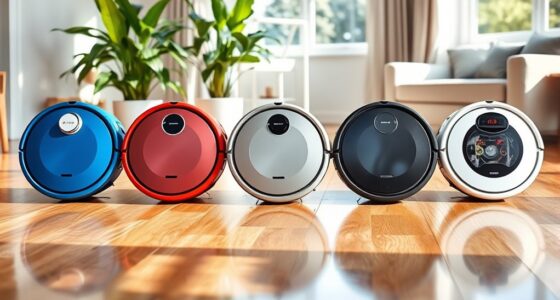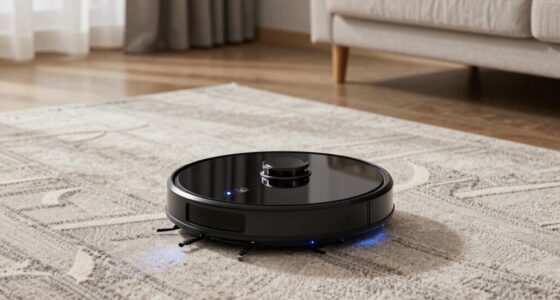
The eufy E25 is my best overall robotic floor scrubber because its HydroJet roller mop puts hard-floor washing ahead of basic damp wiping while retaining powerful vacuuming and dock automation. The Roborock Saro 10R is the stronger premium choice for complex homes, pairing a slim body and edge cleaning with hot-water mop washing, while the Roborock Q7 L5 offers better value for buyers willing to handle more maintenance themselves. The main choice is between stronger floor agitation, capable carpet handling, and a dock that reduces routine cleanup. Commercial models add autonomy and longer-duty potential, but their size, cost, and support needs rarely suit an ordinary home. Continue reading for the full breakdown of which design fits each buyer and where the compromises appear.

Get cleaning gear delivered free with Prime
- Fast, free delivery on millions of items
- Prime Video, Amazon Music and more included
- Member-only deals all year
Complete the kit


Key Takeaways
- I rank the eufy E25 first because its roller-based washing system is more closely aligned with real floor scrubbing than the passive mop pads used by many vacuum-first hybrids.
- The DREAME D30 Ultra CE has the highest stated suction in this lineup, but its 25,000Pa rating does not automatically make it the best scrubber; mop action and water management matter more for dried marks.
- The Roborock Saro 10R earns the premium position through its slim 3.14-inch body, edge cleaning, and hot-water dock rather than suction alone.
- Self-washing stations on the E25, Saro 10R, Qrevo, and D30 reduce daily handling, while simpler models such as the Roborock Q7 L5 trade automation for a lower entry point and smaller footprint.
- The two commercial robots are specialist choices rather than automatic upgrades: their autonomous mapping and charging suit large facilities, while residential models offer a friendlier balance of size, app control, and mixed-floor management.
| ROPVACNIC Robot S1 Vacuum and Mop Combo |  | Best Everyday Hybrid | Suction Power: 5,200Pa | Cleaning Functions: Vacuuming and mopping | Cleaning Modes: Multiple customizable modes | VIEW LATEST PRICE | See Our Full Breakdown |
| iRobot Braava Jet M6 (6110) Robot Mop |  | Best Dedicated Robot Mop | Model: Braava Jet M6 (6110) | Primary Function: Robot mopping | Navigation: vSLAM smart mapping | VIEW LATEST PRICE | See Our Full Breakdown |
| Autonomous Floor Scrubber Commercial Robot Cleaner |  | Best for Large Commercial Floors | Cleaning Functions: Sweeping, scrubbing, and mopping | Intelligent Mapping: Yes | Obstacle Avoidance: Yes | VIEW LATEST PRICE | See Our Full Breakdown |
| Roborock Saro 10R Robot Vacuum and Mop |  | Best Overall | Suction Power: 22,000Pa | Robot Height: 3.14 inches | Navigation System: StarSight Autonomous System 2.0 | VIEW LATEST PRICE | See Our Full Breakdown |
| Roborock Qrevo Series Robot Vacuum and Mop |  | Best for Pet-Hair Homes | Suction Power: 8,000Pa | Brush System: Anti-tangle side brush and full-rubber spiral main brush | Docking Station: Dust emptying, water refilling, and mop washing | VIEW LATEST PRICE | See Our Full Breakdown |
| DREAME D30 Ultra CE |  | Best for Low-Maintenance Cleaning | Suction Power: 25,000Pa | Mop Lifting Height: 0.41in | Station Dust Capacity: 3.2L | VIEW LATEST PRICE | See Our Full Breakdown |
| MONSGA Robot Vacuum and Mop |  | Best Value for Large Homes | Maximum Suction: 8,000Pa | Battery Capacity: 3,200mAh | Runtime: 160 minutes | VIEW LATEST PRICE | See Our Full Breakdown |
| Commercial Cleaning Robot |  | Best for Commercial Facilities | Navigation System: Advanced autonomous navigation | Cleaning Functions: Sweeping, scrubbing, and mopping | Remote Operation: Mobile app | VIEW LATEST PRICE | See Our Full Breakdown |
| eufy E25 |  | Best Roller-Mop Scrubbing | Suction Power: 20,000Pa | Mop System: HydroJet roller mop | Station Functions: Mop washing, self-refilling, and self-emptying | VIEW LATEST PRICE | See Our Full Breakdown |
| Eureka J15 Evo Ultra |  | Best for Edges and Pet Hair | Suction Power: 22,000Pa | Edge Cleaning: Claimed 99.99% | Mop Extension Technology: ScrubExtend | VIEW LATEST PRICE | See Our Full Breakdown |
| Tikom G8000 Max Robot Vacuum and Mop Combo |  | Best Slim Hybrid | Suction Power: 5000Pa | Battery Life: 150 minutes | Dustbin Capacity: 450 ml | VIEW LATEST PRICE | See Our Full Breakdown |
| EVERYBOT Three-Spin Robot Mop |  | Best Dedicated Hard-Floor Scrubber | Mopping Technology: Three independently spinning mop pads | Suitable Floors: Hardwood, tile, vinyl, laminate, and stone | Noise Level: 43dB | VIEW LATEST PRICE | See Our Full Breakdown |
| Roborock Q7 L5 Robot Vacuum and Mop Combo |  | Best for Pet Hair | Suction Power: 8000Pa | Brush Type: Dual anti-tangle brushes | Navigation: LiDAR | VIEW LATEST PRICE | See Our Full Breakdown |
| ILIFE V5s Plus Robot Vacuum and Mop Combo |  | Best for Voice-Controlled Basics | Runtime: 110 minutes | Cleaning Modes: Auto, spot, edge, max, and scheduling | Control Methods: App, voice, and remote | VIEW LATEST PRICE | See Our Full Breakdown |
| Tikom L8000 Plus Robot Vacuum and Mop |  | Best Low-Maintenance Pick | Suction Power: 6000Pa | Navigation: LiDAR with home mapping | Battery Life: 150 minutes | VIEW LATEST PRICE | See Our Full Breakdown |
| robotic floor scrubber | Suction Power |
|---|---|
| ROPVACNIC Robot S1 Vacuum and | 5,200Pa |
| iRobot Braava Jet M6 | — |
| Autonomous Floor Scrubber Comm | — |
| Roborock Saro 10R Robot Vacuum | 22,000Pa |
| Roborock Qrevo Series Robot Va | 8,000Pa |
| DREAME D30 Ultra CE | 25,000Pa |
| MONSGA Robot Vacuum and Mop | — |
| Commercial Cleaning Robot | — |
| eufy E25 | 20,000Pa |
| Eureka J15 Evo Ultra | 22,000Pa |
| Tikom G8000 Max Robot Vacuum a | 5000Pa |
| EVERYBOT Three-Spin Robot Mop | — |
| Roborock Q7 L5 Robot Vacuum an | 8000Pa |
| ILIFE V5s Plus Robot Vacuum an | — |
| Tikom L8000 Plus Robot Vacuum | 6000Pa |
More Details on Our Top Picks
ROPVACNIC Robot S1 Vacuum and Mop Combo
I rank the ROPVACNIC Robot S1 as the Best Everyday Hybrid because it balances 5,200Pa pickup with electronically controlled mopping in a compact body. Its four-stage water adjustment gives mixed-floor households more control over dampness, while the no-entanglement design makes routine pet-hair cleanup less fussy. Against the iRobot Braava Jet M6, it is the better single-machine choice when crumbs and fur matter as much as wiping; the Braava remains more focused on mapped hard-floor mopping. The S1 also sits well below the Roborock Saro 10R on raw suction and dock automation, so buyers still handle more maintenance themselves. I would choose it for practical daily cleaning, but app setup is part of the deal, runtime can shift with power settings, and the advanced feature set may carry a higher purchase price.
Pros:- 5,200Pa suction handles everyday dust, crumbs, and pet hair
- Four-stage electronic water adjustment offers better control across mixed hard floors
- Obstacle sensing and autonomous charging reduce routine supervision
- No-entanglement design is suited to homes with shedding pets
Cons:- App setup is required to access its connected controls
- Runtime can vary with suction level and cleaning mode
- Advanced features may make it more expensive than basic vacuum-and-mop robots
Best for: Apartment dwellers and pet owners seeking one compact robot for daily vacuuming and adjustable light mopping
Not ideal for: Buyers wanting a fully automated cleaning dock or a dedicated machine for intensive hard-floor scrubbing
- Suction Power:5,200Pa
- Cleaning Functions:Vacuuming and mopping
- Cleaning Modes:Multiple customizable modes
- Water Control:Four-stage electronic adjustment
- Navigation:Obstacle avoidance and sensing system
- Connectivity:Smartphone app, Alexa, and Google Assistant
Our verdict“I recommend the S1 to buyers who want capable vacuuming and adjustable mopping without moving into a large self-cleaning dock system.”
iRobot Braava Jet M6 (6110) Robot Mop
I give the iRobot Braava Jet M6 the Best Dedicated Robot Mop role because its priorities are room-aware washing, targeted mess cleanup, and hard-floor control rather than headline suction. Its vSLAM mapping can learn multiple rooms and keep away from sensitive zones, which makes it a sharper mopping specialist than the ROPVACNIC Robot S1. The tradeoff is equally clear: the S1 vacuums and mops, while the M6 is for buyers who already have vacuuming covered. Compared with the Roborock Qrevo Series, it also lacks an all-in-one dock that empties debris, refills water, and washes pads. I would pick the M6 for hardwood, tile, or stone homes that value specific-room and spot control. Large layouts may trigger more charging stops, and its best scheduling and map features depend on reliable Wi-Fi.
Pros:- vSLAM mapping supports targeted room and area cleaning
- Sensitive-zone avoidance provides control around vulnerable spaces
- Works across hardwood, tile, and stone floors
- App and Alexa controls make scheduled cleaning accessible
Cons:- It is a dedicated mop rather than a vacuum-and-mop replacement
- Full connected functionality depends on Wi-Fi
- Large multi-room layouts may require frequent charging
Best for: Hard-floor households that already own a vacuum and want precise room-by-room or spot mopping
Not ideal for: Homes needing carpet vacuuming, pet-hair pickup, or an all-in-one dock that manages water and pad cleaning
- Model:Braava Jet M6 (6110)
- Primary Function:Robot mopping
- Navigation:vSLAM smart mapping
- Connectivity:Wi-Fi
- Voice Compatibility:Alexa
- Floor Compatibility:Hardwood, tile, and stone
- Coverage:Multiple rooms and larger spaces
- Targeted Cleaning:Specific messes and selected areas
Our verdict“I recommend the Braava Jet M6 to buyers who value precise mapped mopping more than hybrid cleaning or dock automation.”
Autonomous Floor Scrubber Commercial Robot Cleaner
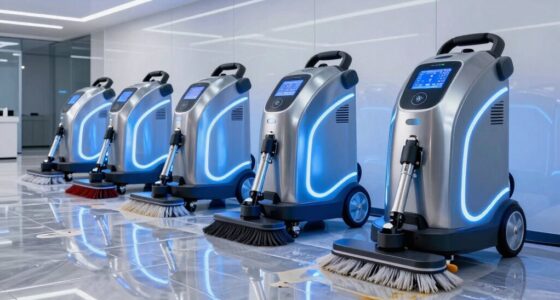
I place the Autonomous Floor Scrubber Commercial Robot Cleaner in the Best for Large Commercial Floors slot because it is the only pick here built around high-traffic venues rather than household rooms. It combines sweeping, scrubbing, and mopping, then uses intelligent mapping, obstacle avoidance, scheduling, and live app monitoring to cover marble, concrete, epoxy, tile, or hardwood. Next to the Roborock Saro 10R, this machine trades consumer-friendly dock details and a slim furniture-clearing body for broader site suitability across offices, hotels, schools, warehouses, and shopping centers. Quiet operation also makes daytime cleaning more workable. I rank it behind residential choices for home buyers because pricing varies by configuration, customization can add cost, and setup and maintenance may need technical support. For facility teams, though, its large-area autonomy is the stronger reason to buy.
Pros:- Combines sweeping, scrubbing, and mopping in one commercial platform
- Intelligent mapping and obstacle avoidance support autonomous large-area coverage
- App scheduling and real-time monitoring aid facility management
- Quiet operation suits daytime and nighttime cleaning schedules
Cons:- Configuration-dependent pricing may be expensive
- Setup and ongoing maintenance may require technical support
- Customization accessories can raise the total cost
Best for: Facility teams managing large, high-traffic floors in offices, hotels, schools, warehouses, or shopping centers
Not ideal for: Households and small businesses that lack technical support or cannot justify configuration-dependent commercial pricing
- Cleaning Functions:Sweeping, scrubbing, and mopping
- Intelligent Mapping:Yes
- Obstacle Avoidance:Yes
- Automatic Charging:Yes
- Remote Control:Mobile app
- Remote Features:Scheduling and real-time monitoring
- Floor Compatibility:Marble, tile, concrete, epoxy resin, and hardwood
- Suitable Environments:Shopping centers, offices, hotels, schools, and warehouses
Our verdict“I recommend this commercial scrubber to staffed facilities that need autonomous multi-function cleaning across broad, high-traffic floor areas.”
Roborock Saro 10R Robot Vacuum and Mop
I rank the Roborock Saro 10R Best Overall because it pairs the strongest suction in this group—22,000Pa—with unusually low-clearance access and a dock that tackles the messiest maintenance jobs. At 3.14 inches tall, it can reach under more furniture than bulkier robots, while detection for 108 obstacle types reduces the need to clear every cable or pet item first. The 176°F mop wash, air drying, automatic mop removal, and 60-day dust collection put it above the Roborock Qrevo Series for hands-off care; the Qrevo is the more measured choice when 8,000Pa and pet-hair brushes are enough. I would pay the premium for maximum automation, not for simplicity: the feature set has a learning curve, Wi-Fi is limited to 2.4GHz, and the provided data gives no price, making value harder to judge.
Pros:- 22,000Pa suction is the strongest among these five products
- 3.14-inch body reaches beneath low furniture
- Hot-water mop washing, air drying, and automatic mop removal reduce manual upkeep
- Detects 108 obstacle types for more dependable clutter avoidance
Cons:- Feature-rich operation may present a learning curve
- Wi-Fi support is limited to 2.4GHz networks
- A 2.5-hour runtime may still require charging breaks across very large areas
Best for: Busy households wanting strong suction, low-furniture access, and extensive dock-managed maintenance
Not ideal for: Budget-focused buyers or anyone wanting straightforward setup without a feature-heavy app and docking system
- Suction Power:22,000Pa
- Robot Height:3.14 inches
- Navigation System:StarSight Autonomous System 2.0
- Obstacle Detection:108 obstacle types
- Mop Washing Temperature:176°F
- Battery Life:Up to 2.5 hours
- Wi-Fi:2.4GHz only
- Dock Cleaning:Hot-water washing and air drying
- Dock Storage:Up to 60 days of dust collection
Our verdict“I recommend the Saro 10R to buyers willing to pay for the strongest blend of floor access, cleaning power, and hands-off dock care.”
Roborock Qrevo Series Robot Vacuum and Mop
I assign the Roborock Qrevo Series the Best for Pet-Hair Homes role because its anti-tangle side brush and full-rubber spiral main brush address a common failure point before hair reaches the bin. The all-in-one dock then empties dust, refills its 4L tank, and washes the dual spinning mops, cutting routine handling across larger or multi-floor homes. Compared with the ROPVACNIC Robot S1, the Qrevo offers stronger 8,000Pa suction, LiDAR maps for up to four floors, and much fuller dock automation. It cannot match the Saro 10R’s 22,000Pa pull, hot-water wash, or ultra-slim body, which keeps it below that model overall. I see the Qrevo as the balanced premium pick for pets and broad coverage, but setup is more involved, 2.4GHz Wi-Fi is mandatory, and its 10mm mop lift may not suit every thick rug.
Pros:- Anti-tangle side and main brushes reduce pet-hair wrapping
- All-in-one dock empties dust, refills water, and washes the mop pads
- PreciSense LiDAR maps as many as four floors
- Dual mops spin at 200 RPM for active hard-floor cleaning
Cons:- Wi-Fi connectivity is limited to 2.4GHz
- The large feature set makes initial setup more involved
- The 10mm mop lift may provide insufficient clearance for thick rugs
Best for: Multi-floor pet households wanting anti-tangle vacuuming, spinning mops, and automated dock maintenance
Not ideal for: Homes with thick rugs, 5GHz-only Wi-Fi, or buyers who prefer a simple robot without extensive setup
- Suction Power:8,000Pa
- Brush System:Anti-tangle side brush and full-rubber spiral main brush
- Docking Station:Dust emptying, water refilling, and mop washing
- Clean-Water Capacity:4L
- Dust Bag Capacity:2.7L
- Mopping Speed:200 RPM
- Mop Lift:10mm
- Navigation:PreciSense LiDAR with mapping for up to four floors
- Wi-Fi:2.4GHz only
Our verdict“I recommend the Qrevo Series to pet owners who want broad mapped coverage and low-touch maintenance without paying solely for the Saro 10R’s peak specifications.”
DREAME D30 Ultra CE
I place the DREAME D30 Ultra CE in the low-maintenance slot because its self-washing mops and 100-day dust cycle remove more routine handling than the MONSGA, which quotes a 90-day emptying interval but offers no comparable mop-washing detail. Its 25,000Pa suction also leads this batch, helping it collect grit before wet cleaning begins. The 0.41-inch mop lift is useful in mixed carpet and hard-floor homes, while mapping and obstacle detection support less supervision. For actual stain work, though, the eufy E25’s HydroJet roller has a clearer scrubbing advantage. I would also expect a steeper setup curve and a bulkier station than a basic robot. This is the stronger choice for automation and debris removal, not the most scrub-focused machine.
Pros:- Class-leading 25,000Pa suction removes grit before mopping
- Self-washing mops reduce contact with dirty pads
- 100-day auto-emptying cycle cuts routine bin maintenance
- Mop lifting and obstacle detection suit mixed-floor homes
Cons:- HydroJet-style roller scrubbing is absent, limiting its appeal for dried-on stains
- Advanced controls may take time to configure
- Large self-maintaining station can overwhelm compact rooms
Best for: Busy households with mixed flooring that want dust emptying, mop washing, and carpet-aware cleaning handled automatically
Not ideal for: Apartment dwellers with little dock space or buyers who prioritize forceful wet scrubbing over vacuum performance
- Suction Power:25,000Pa
- Mop Lifting Height:0.41in
- Station Dust Capacity:3.2L
- Robot Dust Box:300ml
- Water Spray Nozzles:20
- Navigation:Smart mapping and obstacle detection
- Auto-Emptying Cycle:Up to 100 days
- Connectivity:App control and scheduling
Our verdict“I recommend the D30 Ultra CE for buyers who value hands-off upkeep and powerful debris pickup more than dedicated roller scrubbing.”
MONSGA Robot Vacuum and Mop
I rank the MONSGA Robot Vacuum and Mop as the value-minded large-home pick because its 160-minute runtime and five-map memory cover more space and floors without demanding flagship hardware. The 460ml water tank also reduces refill interruptions, while LiDAR supports systematic routes rather than random passes. Its 8,000Pa suction cannot match the DREAME D30 Ultra CE’s 25,000Pa figure, yet the dual anti-tangle brushes make it appealing for pet hair. The 90-day self-emptying system adds convenience without making mop washing part of the package. That distinction matters: compared with the eufy E25 and its HydroJet roller, MONSGA is a capable maintenance mop rather than a focused stain scrubber. I see the best fit in multi-floor homes on a tighter budget, provided 2.4GHz Wi-Fi and app setup are acceptable.
Pros:- 160-minute runtime supports larger cleaning routes
- LiDAR stores maps for as many as five floors
- Dual anti-tangle brushes help manage pet hair
- 460ml water tank and 90-day self-emptying reduce interruptions
Cons:- Mopping system lacks the defined roller action of the eufy E25
- No automatic mop-washing feature is specified
- Wi-Fi support is limited to 2.4GHz
Best for: Pet-owning families in large or multi-story homes that need long runtime, stored maps, and infrequent dust-bin handling
Not ideal for: Buyers seeking aggressive stain scrubbing, automatic mop washing, or straightforward 5GHz Wi-Fi connectivity
- Maximum Suction:8,000Pa
- Battery Capacity:3,200mAh
- Runtime:160 minutes
- Water Tank:460ml
- Station Dustbin:4L
- Mapping:LiDAR with five-map memory
- Connectivity:2.4GHz Wi-Fi, Alexa, and Google Assistant
- Warranty:2 years
Our verdict“I would choose MONSGA for affordable multi-floor maintenance, but not when dried-on messes are the main cleaning problem.”
Commercial Cleaning Robot
I give the Commercial Cleaning Robot the facility-focused role because it explicitly combines sweeping, scrubbing, and mopping across marble, concrete, epoxy, tile, and hardwood. That makes it more closely aligned with robotic floor scrubbing than domestic vacuum-mop hybrids such as the DREAME D30 Ultra CE. Autonomous routing and mobile-app operation also suit repeated cleaning in malls, hotels, and warehouses, while quiet operation may permit work during occupied hours. The tradeoff is a major lack of purchasing detail: runtime, tank capacity, machine size, and price are not supplied. Those omissions make workload planning and ownership-cost comparisons difficult. Compared with the separately listed Autonomous Floor Scrubber Commercial Robot Cleaner, this model’s stated multi-surface compatibility is useful, but I would require a vendor demonstration, service terms, and accessory list before treating it as a procurement-ready choice.
Pros:- Performs sweeping, scrubbing, and mopping in one platform
- Supports several commercial flooring materials
- Autonomous routing reduces continuous operator involvement
- Quiet operation is better suited to occupied facilities
Cons:- No runtime, cleaning-path width, or tank capacities are supplied
- Unspecified price prevents a meaningful ownership-cost comparison
- Accessories, customization, and support terms may vary
Best for: Facility managers cleaning broad, high-traffic hard floors who need autonomous sweeping, wet scrubbing, and remote operation
Not ideal for: Small businesses or procurement teams that need published runtime, tank, dimensions, pricing, and service information before approval
- Navigation System:Advanced autonomous navigation
- Cleaning Functions:Sweeping, scrubbing, and mopping
- Remote Operation:Mobile app
- Scheduling:Supported through the mobile app
- Compatible Floors:Marble, tile, concrete, epoxy resin, and hardwood
- Suggested Environments:Malls, hotels, and warehouses
- Noise Profile:Quiet operation
Our verdict“I see this as a promising commercial shortlist candidate, but only for buyers able to verify capacity, support, and cost directly with the seller.”
eufy E25
I put the eufy E25 first for wet-cleaning performance because its HydroJet roller mop is designed around active floor washing, not merely dragging a damp pad. Its 20,000Pa suction sits below the DREAME D30 Ultra CE’s 25,000Pa, but suction is only part of a floor scrubber’s job; the roller gives eufy the clearer case for sticky residue and everyday spills. The all-in-one station washes, refills, and empties, giving it more complete mop care than MONSGA. AI obstacle avoidance and edge-to-corner cleaning add value in busy pet homes. Buyers pay for that broader automation, and maximum-mode noise may discourage overnight cleaning. It also lacks 5GHz Wi-Fi support, while pricing is not supplied. I rank it ahead for scrubbing-focused households, but below DREAME when raw debris pickup matters most.
Pros:- HydroJet roller provides a more purposeful scrubbing action than passive mop pads
- 20,000Pa suction handles substantial debris pickup
- Station washes, refills, and empties automatically
- Obstacle avoidance and edge cleaning suit cluttered family homes
Cons:- Maximum mode can be relatively noisy
- No 5GHz Wi-Fi support
- Unspecified price makes direct value comparison harder
Best for: Large households with pets, hard floors, and frequent sticky messes that want automated roller washing and refilling
Not ideal for: Noise-sensitive buyers, 5GHz-only networks, or homes where maximum carpet suction matters more than wet-floor scrubbing
- Suction Power:20,000Pa
- Mop System:HydroJet roller mop
- Station Functions:Mop washing, self-refilling, and self-emptying
- Obstacle Avoidance:AI obstacle avoidance
- Recommended Surfaces:Hard floor, carpet, wood, and tile
- Controls:App, button, touch, and voice
- Smart-Home Compatibility:Amazon Echo and Google Home
- Listed Capacity:2.5L
- Model Number:T2353
Our verdict“I favor the eufy E25 for buyers who want the strongest balance of active roller scrubbing and automated station care.”
Eureka J15 Evo Ultra
I assign the Eureka J15 Evo Ultra to edge cleaning and pet-heavy homes because ScrubExtend reaches toward walls and corners, places where round robots often leave a dirty border. The claimed greater-than-99.99% pet-hair removal and 22,000Pa suction give it a stronger fur-cleaning profile than the 8,000Pa MONSGA. A 10mm mop lift and 20mm threshold-climbing ability also help it move between rugs and hard floors with less intervention. Against the eufy E25, however, Eureka’s advantage is reach rather than the HydroJet roller’s dedicated stain action. Its self-emptying design lowers dust-bin handling, but the supplied data omits runtime, which makes large-home coverage harder to predict. The feature set may also require more setup and carry a premium price. I rank it for perimeter coverage and pet debris, not as the simplest scrubber.
Pros:- ScrubExtend targets wall edges and corners
- 22,000Pa suction supports deep pet-hair pickup
- 10mm mop lift reduces unwanted contact with carpet
- 20mm threshold climbing improves room-to-room access
Cons:- No battery runtime is provided
- ScrubExtend is less stain-focused than eufy’s HydroJet roller
- Advanced feature set may increase both setup effort and price
Best for: Pet owners with baseboard dust, corner debris, thresholds, and mixed carpet and hard-floor layouts
Not ideal for: Buyers who want a simple setup, published runtime, or a roller mop aimed squarely at stubborn stains
- Suction Power:22,000Pa
- Edge Cleaning:Claimed 99.99%
- Mop Extension Technology:ScrubExtend
- Mop Lifting Height:10mm
- Threshold Climbing:20mm
- Pet Hair Removal Rate:Claimed greater than 99.99%
Our verdict“I recommend the J15 Evo Ultra to pet households that care more about clean edges and mixed-floor mobility than simplified controls.”
Tikom G8000 Max Robot Vacuum and Mop Combo
I rank the Tikom G8000 Max as the best slim hybrid because its 2.99-inch height helps it reach beneath furniture while its 5000Pa suction handles everyday debris. Compared with the ILIFE V5s Plus, it offers stronger stated suction and 40 more minutes of runtime, making it better suited to larger cleaning routes. Its 450ml dustbin and 300ml water tank also support simultaneous vacuuming and mopping without constant stops. The compromise is navigation: smart obstacle sensors are less systematic than the LiDAR mapping offered by the Roborock Q7 L5. Its basic water-fed mop also lacks the stain-scrubbing action of the EVERYBOT Three-Spin. I see this as a capable under-furniture cleaner, but not the strongest choice for detailed maps or dried-on spills.
Pros:- 2.99-inch body reaches beneath low furniture
- 5000Pa suction supports carpet and hard-floor cleaning
- Vacuuming and mopping can run simultaneously
- 150-minute runtime reduces mid-cycle charging
Cons:- Sensor navigation is less precise than LiDAR-based mapping
- Mopping system lacks spinning or powered scrubbing pads
- App capabilities are not clearly detailed
Best for: Apartment residents who need a low-profile robot for vacuuming and light mopping beneath beds, sofas, and cabinets
Not ideal for: Buyers who need room-specific LiDAR maps or strong mechanical scrubbing for dried-on kitchen stains
- Suction Power:5000Pa
- Battery Life:150 minutes
- Dustbin Capacity:450 ml
- Water Tank Capacity:300 ml
- Height:2.99 inches
- Control Methods:App, remote, voice, and button
- Cleaning Modes:Spot, edge, zig-zag, and manual
Our verdict“Choose the G8000 Max for long, low-profile cleaning runs, but skip it if mapping precision or aggressive scrubbing matters more.”
EVERYBOT Three-Spin Robot Mop
The EVERYBOT Three-Spin earns its place through actual scrubbing emphasis rather than vacuum specifications. Its three independently rotating pads provide more mechanical stain removal than the passive mop attachments on the Tikom G8000 Max or Roborock Q7 L5. That makes it the better match for kitchens, entryways, and other hard-floor areas where sticky residue matters more than carpet debris. A 43dB operating level also suits homes where cleaning noise is disruptive, while the 120-minute runtime and 300ml tank cover a useful amount of flooring. Its narrow purpose is also its main drawback: it cannot vacuum carpets, and there is no app or Wi-Fi control. I would choose it as a focused second machine, not as an all-floor replacement for a vacuum-and-mop robot.
Pros:- Three independently spinning pads provide active scrubbing
- Quiet 43dB operation suits noise-sensitive households
- 120-minute runtime supports extended mopping sessions
- Works across several common sealed hard-floor types
Cons:- Cannot vacuum or clean carpets
- No app, Wi-Fi, or voice-assistant connectivity
- Water tank still requires manual refilling
Best for: Households with mostly hardwood, tile, vinyl, laminate, or stone floors that need powered scrubbing for stains and residue
Not ideal for: Carpeted homes or smart-home users who want mapping, scheduling, and app-based room control
- Mopping Technology:Three independently spinning mop pads
- Suitable Floors:Hardwood, tile, vinyl, laminate, and stone
- Noise Level:43dB
- Runtime:120 minutes
- Water Tank Capacity:300 ml
- Design Awards:Red Dot and iF
Our verdict“Buy the EVERYBOT when powered hard-floor scrubbing is the priority and a separate vacuum already handles loose debris.”
Roborock Q7 L5 Robot Vacuum and Mop Combo
I place the Roborock Q7 L5 ahead of the two basic hybrids for pet-heavy homes. Its 8000Pa suction exceeds the Tikom G8000 Max and Tikom L8000 Plus, while the dual anti-tangle brush system is designed to reduce the hair wrapping that creates extra maintenance. LiDAR navigation and multi-level mapping also give it a clear planning advantage over the sensor-led G8000 Max and ILIFE V5s Plus. The 270ml water tank supports adjustable mopping, but this remains a vacuum-first machine; the EVERYBOT Three-Spin supplies stronger physical scrubbing for stubborn marks. Buyers also get a combined dustbin and tank arrangement, which can make handling less flexible, and 2.4GHz-only Wi-Fi may require router setup. I rank it highly for mapped pet-hair collection, not specialist floor washing.
Pros:- 8000Pa suction is the strongest stated figure in this five-product batch
- Dual anti-tangle brushes reduce pet-hair wrapping
- LiDAR supports structured navigation and multi-level maps
- Adjustable water levels allow tailored light mopping
Cons:- Passive mopping is weaker on stuck-on stains than spinning pads
- Combined dustbin and water tank limits separate handling
- Wi-Fi connection supports only 2.4GHz networks
Best for: Pet owners in multi-level homes who need strong suction, reduced brush tangling, and map-based cleaning
Not ideal for: Buyers seeking powered stain scrubbing, separate dust and water containers, or straightforward 5GHz Wi-Fi setup
- Suction Power:8000Pa
- Brush Type:Dual anti-tangle brushes
- Navigation:LiDAR
- Mapping:Multi-level mapping
- Water Tank Capacity:270 ml
- Connectivity:2.4GHz Wi-Fi
- Cleaning Functions:Simultaneous vacuuming and mopping
- Color:Black
Our verdict“The Q7 L5 is my pick for mapped pet-hair cleanup, provided light mopping is enough for the household.”
ILIFE V5s Plus Robot Vacuum and Mop Combo
The ILIFE V5s Plus makes the most sense for buyers who want simple voice commands and several cleaning modes without paying for a mapping-focused design. Alexa and Google Home compatibility separates it from the remote-only EVERYBOT Three-Spin, while auto, spot, edge, max, and scheduling modes provide more control over routine pickup. Its 3.19-inch profile remains furniture-friendly, though the Tikom G8000 Max is slimmer and runs 40 minutes longer. The missing detail is mopping strength: no powered pad system or water-control capability is specified, so I would treat it as a light-maintenance mop rather than a stain remover. Sensor-based obstacle avoidance also cannot match the room mapping of the Roborock Q7 L5. This is the approachable choice for basic routines, but larger or more complex homes have better options.
Pros:- Supports Alexa and Google Home voice commands
- Five cleaning modes cover routine and targeted pickup
- Low-profile body can reach beneath many furnishings
- Automatic recharging reduces manual intervention
Cons:- Mopping performance and water delivery are poorly specified
- Sensor navigation lacks room-level LiDAR mapping
- 110-minute runtime trails both Tikom models
Best for: Small-home residents who want scheduled cleaning and Alexa or Google Home commands for routine dust and light floor wiping
Not ideal for: Large multi-room households that need LiDAR maps, longer runtime, or proven scrubbing performance
- Runtime:110 minutes
- Cleaning Modes:Auto, spot, edge, max, and scheduling
- Control Methods:App, voice, and remote
- Voice Compatibility:Amazon Alexa and Google Home
- Cleaning Path Width:11.8 inches
- Dimensions:11.8 x 11.8 x 3.19 inches
- Battery Type:Lithium ion
- Recommended Surfaces:Carpet, hard floors, and pet-hair areas
Our verdict“Pick the V5s Plus for straightforward voice-controlled routines in a smaller home, not for intensive scrubbing or advanced maps.”
Tikom L8000 Plus Robot Vacuum and Mop
I give the Tikom L8000 Plus the low-maintenance role because its self-emptying base and 3-liter capacity reduce how often collected debris needs attention. That is a meaningful convenience advantage over the Roborock Q7 L5 and Tikom G8000 Max, both of which lack a stated self-emptying system. Its LiDAR navigation also offers more orderly coverage than the G8000 Max, while 6000Pa suction and a 150-minute runtime suit pet hair and longer routes. It sits behind the Q7 L5 for raw suction and anti-tangle hardware, however. Mopping requires more management too: owners may need to remove the holder or create no-go zones around carpets. The base adds bulk, and app dependence may deter buyers wanting remote controls. I see it as the hands-off debris choice, not the strongest scrubber.
Pros:- Self-emptying base reduces routine dustbin handling
- 3-liter capacity supports longer intervals between emptying
- LiDAR navigation enables mapped cleaning routes
- 150-minute runtime supports larger floor plans
Cons:- Mop holder may need removal or no-go zones near carpets
- Dock occupies more space than a basic charging station
- 6000Pa suction trails the Roborock Q7 L5
Best for: Pet-owning households that want mapped cleaning and fewer manual dustbin-emptying sessions
Not ideal for: Tight apartments or mixed-floor homes where a bulky dock and manual mop-holder management would be inconvenient
- Suction Power:6000Pa
- Navigation:LiDAR with home mapping
- Battery Life:150 minutes
- Base Capacity:3 liters
- Filter Type:HEPA
- Control Method:Smartphone app
- Battery Type:Lithium ion
- Voltage:14.4 volts
- Item Weight:11 pounds
Our verdict“Choose the L8000 Plus when reduced dustbin maintenance matters more than compact storage or powered scrubbing.”

How We Picked
I ranked these products by how well their designs serve the phrase robotic floor scrubber, giving more weight to active mop movement, consistent floor contact, edge reach, and water handling than to headline suction figures. I then compared navigation, obstacle avoidance, carpet management, runtime, and the amount of manual work left after each cycle. Models with self-washing docks gained credit only when that automation supported better cleaning rather than merely adding bulk. This approach places the eufy E25 ahead of vacuum-led hybrids that may collect debris well but rely on lighter wiping action.
I also weighed build concept, maintenance burden, control options, floor-plan fit, and likely value within each product’s intended role. Premium placement required a meaningful improvement in coverage, access, or hands-off care, which is why the slim Saro 10R ranks above less specialized docked models. Simpler robots gained ground when they offered clear value or easier ownership, even without full station automation. Commercial machines were judged on facility-scale autonomy rather than household convenience, while dedicated mops were judged on scrubbing focus rather than vacuum performance. My final order reflects buyer usefulness and tradeoffs, not a contest based on the largest specification.
Factors to Consider When Choosing Robotic Floor Scrubbers
I would begin by deciding whether the robot needs to scrub, vacuum, or do both. That choice shapes everything from stain removal to carpet safety and daily maintenance. A strong vacuum-mop hybrid can be the better single-machine purchase, while a dedicated robotic mop may suit a home dominated by sealed hard flooring. The sections below explain the broader tradeoffs behind mop design, navigation, docks, and long-term cost.
Choose Active Scrubbing Over Passive Wiping
I separate true scrubbing systems from robots that simply drag a damp cloth. A roller or powered spinning pad creates repeated movement against the floor, making it better suited to dried spills and tracked-in grime. Passive pads can handle fresh dust and light footprints, but they may spread dirty water once the fabric becomes saturated. Roller designs can offer a cleaner contact surface during a run, while spinning pads often provide strong agitation with simpler parts. The tradeoff is that active mop hardware needs regular washing, hair removal, and occasional replacement. For kitchens, entryways, or homes with children, I would prioritize scrubbing action before chasing a higher suction number.
Match Carpet Handling to the Floor Plan
A combination robot must keep wet components away from rugs, and I would not rely on mapping alone when expensive carpet is involved. Mop lifting lets a robot cross low-pile carpet without ending the cleaning run, but the lift height must exceed the carpet pile. The DREAME model lists a 0.41-inch lift, which offers a useful reference point for measuring rugs before purchase. Thick or tasseled rugs may still need app-based exclusion zones or physical removal. A dedicated mop such as the Braava Jet M6 makes more sense when hard-floor rooms can be separated cleanly, while a lifting hybrid suits an open mixed-floor layout. I would also check whether the robot can vacuum carpets in a separate pass, since that keeps moisture control more predictable.
Decide How Much Dock Automation Is Worth
An all-in-one dock can empty dust, wash mop components, and reduce contact with dirty water, but it does not remove maintenance. I would expect to refill clean water, empty wastewater, clear hair, and clean the dock tray on a schedule. Hot-water mop washing, offered by the Saro 10R, is more attractive in homes dealing with greasy kitchen residue than in lightly used rooms. Large stations also consume floor space and need access to an outlet, so measuring the parking area matters before ordering. A basic charging base is cheaper and less intrusive, yet it shifts mop washing and bin emptying back to the owner. Paying more for automation makes the most sense when the robot will clean often enough to repay that convenience.
Judge Navigation by the Obstacles You Actually Have
LiDAR and smart mapping help a robot divide rooms, follow orderly paths, and resume work after charging. I give obstacle avoidance separate weight because mapping a room does not mean the machine can identify cables, socks, pet bowls, or low furniture. AI obstacle detection is valuable in busy households where floors cannot be cleared before every run, though small or transparent objects may still be missed. Slim height matters in a different way: the 3.14-inch Saro 10R can target spaces that taller robots may leave untouched. Multi-level maps are useful only if carrying the robot between floors fits the owner’s routine. I would choose navigation around the home’s recurring clutter and furniture rather than the longest list of mapping modes.
Treat Suction and Scrubbing as Separate Jobs
High suction helps remove crumbs, grit, and pet debris before wet cleaning, but it says little about stain removal. I view 20,000Pa-plus power as an advantage for debris-heavy homes, not proof of better mopping. Brush design can matter just as much because tangled hair reduces pickup and adds maintenance between runs. Anti-tangle systems on models such as the Qrevo and Q7 L5 may deliver a bigger ownership benefit than another jump in peak power. On mostly clean hard floors, consistent water delivery and mop pressure deserve higher priority. Buyers with shedding pets should seek a balanced hybrid, while buyers focused on sticky marks should favor the stronger scrubbing mechanism.
Separate Residential Value From Commercial Scale
Commercial cleaning robots are built around large coverage areas, repeatable routes, and autonomous charging, but their ownership model may involve setup, service access, and facility-specific support. I would choose one only when labor savings across a large site can justify the higher complexity. For a home, a compact residential robot usually provides easier controls, more practical obstacle handling, and parts that are simpler to source. Value should include replacement pads, rollers, brushes, bags, filters, and cleaning solution rather than purchase price alone. A low-cost machine that needs frequent intervention may be poor value in a multiroom home, while an expensive dock can be wasteful in a small apartment. I favor the Roborock Q7 L5 for residential value and reserve commercial autonomy for offices, retail floors, or other wide hard-surface areas.
Frequently Asked Questions
Is a Roller Mop Better Than Spinning Mop Pads?
I favor a roller mop for frequent dirty-water pickup because the rotating surface can keep making fresh contact with the floor when supported by good water management. Spinning pads provide strong agitation and can work well on dried spots, but soil may remain in the pads until the robot returns to its dock. Either format is more scrub-focused than a passive cloth dragged behind a vacuum. Roller assemblies may require more detailed cleaning, while pads are often easier to remove and replace. The eufy E25 suits buyers prioritizing continuous washing, while the Qrevo or EVERYBOT designs suit those who prefer spinning action.
Do I Need a Self-Cleaning Dock for a Robotic Floor Scrubber?
I recommend a self-cleaning dock when the robot will mop several times per week or cover multiple rooms per cycle. It reduces the need to handle a dirty mop after every run and can make frequent scheduling realistic. It still requires clean water, wastewater disposal, tray cleaning, and replacement consumables. Small homes may gain little from a bulky station if washing one pad takes only a minute. A model such as the Q7 L5 offers the leaner ownership setup, while the E25, Saro 10R, Qrevo, or D30 better fit hands-off routines.
Can a Robotic Floor Scrubber Replace Manual Mopping?
I see these robots as maintenance cleaners rather than total replacements for manual work. Frequent automated passes can prevent grime from building up, especially in kitchens and entryways. Corners, narrow gaps, grout lines, and sticky spills may still need direct attention, even when the robot offers edge cleaning. Performance also depends on using the right water level and cleaning solution for the flooring. A capable model can greatly extend the time between manual sessions, but periodic detailed cleaning remains realistic.
Which Type Works Best in a Home With Both Rugs and Hard Floors?
I would choose a vacuum-mop hybrid with automatic mop lifting, reliable carpet detection, and room-specific controls. Lift height needs to clear the actual rug pile; thick rugs may still require no-mop zones. A dedicated mop can work if hard-floor rooms have doors or boundaries that keep it away from carpet. Running vacuuming and mopping as separate scheduled jobs also reduces the chance of damp rug edges. Among this lineup, the DREAME D30 Ultra CE stands out because its listed 0.41-inch lift makes carpet clearance easier to judge before buying.
When Does a Commercial Cleaning Robot Make Sense?
I would move to a commercial autonomous scrubber when the cleaning area is large, open, and used often enough for labor savings to outweigh setup and service costs. Offices, retail spaces, schools, and warehouses can benefit from repeatable routes and automatic charging. A residential docked robot is usually easier to manage in rooms filled with cords, lightweight furniture, rugs, and small obstacles. Buyers should verify local parts, technical support, safety procedures, and the machine’s ability to handle the flooring and cleaning chemicals on site. For most homes, commercial scale adds complexity without a matching benefit.
Conclusion
For most households, I recommend the eufy E25 as the best overall because its HydroJet roller mop gives floor washing a clearer priority than the passive wiping systems found on many hybrids. The Roborock Q7 L5 is my best-value pick for buyers who want capable navigation, 8,000Pa suction, and anti-tangle hardware without paying for a large washing station. For a premium home, I would choose the Roborock Saro 10R for its slim profile, edge reach, powerful vacuuming, and hot-water dock care.
Beginners with mostly hard flooring should start with the iRobot Braava Jet M6, whose dedicated mopping role removes the mixed-floor complexity of a full hybrid. I would pick the DREAME D30 Ultra CE for rugs and pet debris, the EVERYBOT Three-Spin for buyers focused on powered hard-floor agitation, and the MONSGA for buyers wanting LiDAR mapping with a long listed runtime. Facilities with wide, repetitive cleaning routes should examine the autonomous commercial models, but I would keep them out of a typical household shortlist. The final choice comes down to whether the buyer values stronger scrubbing, lower upkeep, carpet flexibility, or commercial-scale autonomy most.