
Editorial update log
November 19, 2026:
Deal update: RoundupForge price history now flags ASIN B0GHNB78F7 on amazon.com as below its typical tracked range. RF labels the deal as all_time_low.
Exact pricing remains intentionally gated through the live Grimfaste price module in the article.
The best smart plant sensors make it easier to spot dry soil and track plant conditions, but the right choice depends on how you want to connect and monitor them. I rank the ThirdReality Smart Soil Moisture Sensor Gen2 as the best overall for buyers who already use a compatible smart-home hub, while the Mcbazel WiFi Smart Soil Tester stands out for direct Wi-Fi use without a separate hub. For broader readings, the Smart 3-in-1 Soil Moisture, Temperature, and Fertility Meter tracks more than moisture alone. The main tradeoffs are hub compatibility, the amount of data you need, and whether the sensor suits a single houseplant or an outdoor growing area. Read on for the full breakdown and guidance on matching a sensor to your setup.

Get cleaning gear delivered free with Prime
- Fast, free delivery on millions of items
- Prime Video, Amazon Music and more included
- Member-only deals all year
Complete the kit



Key Takeaways
- Connectivity shapes the shortlist: ThirdReality and Haozee options depend on Zigbee hub compatibility, while Mcbazel is positioned for Wi-Fi use without a separate hub.
- The best overall pick depends on your existing setup: ThirdReality ranks first for buyers with a compatible hub; Mcbazel is a more direct starting point for app-based Wi-Fi monitoring.
- More readings do not always mean a better fit: The 3-in-1 meter adds temperature and fertility readings, but a moisture-focused sensor may be easier to choose if watering is your main concern.
- Multi-sensor and add-on ecosystems serve different needs: Haozee‘s three-pack suits several pots, while Rainpoint‘s Bluetooth model is designed to work with separately sold hub and watering equipment.
- Outdoor use calls for a different shortlist: Netro‘s solar-powered lawn sensor is aimed at outdoor monitoring, unlike products focused on pots and general indoor plant care.
| Smart WiFi Soil Moisture Meter for Plants, 2-in-1 Sensor with App Alerts | 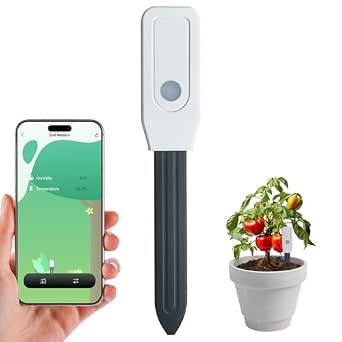 | Best for Direct WiFi Monitoring | Measurements: Soil moisture and temperature | Soil moisture range: 0–100% RH | Temperature range: -40°F to 176°F / -40°C to 80°C | VIEW LATEST PRICE | See Our Full Breakdown |
| ThirdReality Smart Soil Moisture Sensor Gen2, Zigbee Hub Required, Enhanced Signal Stability, Capacitive Monitoring, Compatible with Hubitat, SmartThings, Home Assistant, Homey |  | Best for Zigbee Smart-Home Setups | Sensor type: Capacitive soil moisture sensor | Operating humidity: 0% to 100% | Temperature reading accuracy: ±1.5°C | VIEW LATEST PRICE | See Our Full Breakdown |
| Rainpoint 2027 Bluetooth Soil Moisture Meter & Air Temp Sensor, 2-in-1 Smart Plant Monitor with App Control, Compatible with WiFi Hub TWG009 & Water Timer ITV102B (Not Included) |  | Best for Automated Watering | Measurements: Soil moisture and air temperature | Connectivity: Bluetooth | Data refresh rate: 2 seconds | VIEW LATEST PRICE | See Our Full Breakdown |
| Smart 3-in-1 Soil Moisture, Temperature, and Fertility Meter with WiFi App Control |  | Best for Larger Outdoor Growing Areas | Measurements: Soil moisture, temperature, and fertility (EC) | Probes: Three soil-testing probes | Connectivity: 2.4GHz WiFi | VIEW LATEST PRICE | See Our Full Breakdown |
| Haozee Smart Soil Moisture Sensor with Zigbee Hub Compatibility |  | Best Compact Zigbee Pick | Sensor type: Capacitive soil moisture, temperature, and light | Dimensions: 1.18 inches W × 6.3 inches H | Light sensor range: Up to 15,000 lux | VIEW LATEST PRICE | See Our Full Breakdown |
| Rainpoint Smart Soil Moisture Meter for Plants, Soil Hygrometer Sensor, Real-time Monitor Humidity Tester for Gardening and Indoor/Outdoor Use |  | Best for Automatic Watering Integration | Connectivity: Wi-Fi via compatible HWG023 or HWG040 hub | Measurement: Soil moisture | Stated accuracy: ±5% | VIEW LATEST PRICE | See Our Full Breakdown |
| Haozee Intelligent Soil Moisture Sensor, 3 Pack, Zigbee Hub Required |  | Best for Multi-Plant Zigbee Monitoring | Pack size: 3 sensors | Connectivity: Zigbee; hub or gateway required | Measurements: Soil moisture, air temperature, and humidity | VIEW LATEST PRICE | See Our Full Breakdown |
| Mcbazel WiFi Smart Soil Tester, No Hub Needed, Tuya/Smart Life App |  | Best Hub-Free Wi-Fi Pick | Connectivity: 2.4GHz Wi-Fi | App compatibility: Tuya / Smart Life | Measurements: Soil moisture and air temperature | VIEW LATEST PRICE | See Our Full Breakdown |
| RainPoint Smart Digital Wireless Plant Moisture Meter with Wi-Fi Hub and Alerts |  | Best Starter Kit for Remote Alerts | Connectivity: Wi-Fi, 2.4GHz | Included hub: Mini Wi-Fi Hub Gen2 | Monitoring: Soil moisture | VIEW LATEST PRICE | See Our Full Breakdown |
| Netro Solar Powered Outdoor Smart Plant Sensor 2.4G WiFi APP-Based for Lawn |  | Best for Outdoor Condition Tracking | Measurements: Soil moisture, temperature, ambient light | Connectivity: 2.4GHz Wi-Fi | Charging: Solar panel and Type-C cable | VIEW LATEST PRICE | See Our Full Breakdown |
| smart plant sensor | Connectivity | Measurements | Dimensions |
|---|---|---|---|
| Smart WiFi Soil Moisture Meter | 2.4GHz WiFi | Soil moisture and temperature | — |
| ThirdReality Smart Soil Moistu | Zigbee; hub required | — | 7.17 inches W × 1.18 inches H |
| Rainpoint 2027 Bluetooth Soil | Bluetooth | Soil moisture and air temperature | — |
| Smart 3-in-1 Soil Moisture | 2.4GHz WiFi | Soil moisture, temperature, and fertility (EC) | 3.6 × 3.6 × 6 inches |
| Haozee Smart Soil Moisture Sen | Zigbee; hub required | — | 1.18 inches W × 6.3 inches H |
| Rainpoint Smart Soil Moisture | Wi-Fi via compatible HWG023 or HWG040 hub | — | 2 x 1 x 8 inches |
| Haozee Intelligent Soil Moistu | Zigbee; hub or gateway required | Soil moisture, air temperature, and humidity | 0.98 inches wide x 6.1 inches high |
| Mcbazel WiFi Smart Soil Tester | 2.4GHz Wi-Fi | Soil moisture and air temperature | — |
| RainPoint Smart Digital Wirele | Wi-Fi, 2.4GHz | — | — |
| Netro Solar Powered Outdoor Sm | 2.4GHz Wi-Fi | Soil moisture, temperature, ambient light | 11 x 3.5 x 2.5 inches |
More Details on Our Top Picks
Smart WiFi Soil Moisture Meter for Plants, 2-in-1 Sensor with App Alerts
This sensor is the most straightforward fit for buyers who want remote readings without a separate smart-home hub. It tracks soil moisture and temperature in an app, with customizable alerts and Alexa and Google Assistant support. Its six-inch probe suits a range of pots and garden beds, while the waterproof construction makes it more flexible outdoors than the compact, splash-proof Haozee sensor, which is not designed for submersion.
The tradeoff is a more involved WiFi setup: this model only supports 2.4GHz networks, and its two AA batteries are not included. Unlike the ThirdReality Gen2, it does not depend on a Zigbee hub, but buyers who already run a Zigbee smart-home system may prefer that sensor’s ecosystem integration. Choose this pick for app access and voice control; skip it if you want a simple, hub-based installation.
Pros:- Tracks both soil moisture and temperature through a mobile app
- Remote access, customizable alerts, and Alexa and Google Assistant support
- Waterproof construction suits indoor pots and outdoor growing areas
- Specified battery life of up to 10–12 months reduces replacement frequency
Cons:- Requires two AA batteries, which are not included
- Works only with 2.4GHz WiFi
- Setup may be difficult for buyers unfamiliar with connected devices
Best for: Indoor and outdoor gardeners who want app alerts and voice control without buying a separate Zigbee hub
Not ideal for: Gardeners with only a 5GHz WiFi network or anyone who wants a setup that avoids app and network configuration
- Measurements:Soil moisture and temperature
- Soil moisture range:0–100% RH
- Temperature range:-40°F to 176°F / -40°C to 80°C
- Temperature accuracy:0.5°C
- Probe length:6 inches (15 cm)
- Power:2 AA batteries, not included
- Battery life:Up to 10–12 months
- Connectivity:2.4GHz WiFi
Our verdict“Choose this model if you want direct WiFi app monitoring and voice control, and can work with its 2.4GHz setup.”
ThirdReality Smart Soil Moisture Sensor Gen2, Zigbee Hub Required, Enhanced Signal Stability, Capacitive Monitoring, Compatible with Hubitat, SmartThings, Home Assistant, Homey
The ThirdReality Gen2 makes the most sense for gardeners who already use a Zigbee hub and want plant readings to join wider home automations. Its capacitive sensing is described as less affected by soil salinity and pH than other sensing approaches, which can help keep moisture readings useful across different growing conditions. An enhanced antenna is also aimed at steadier communication in complex environments, setting it apart from the direct-WiFi Smart WiFi Soil Moisture Meter, which avoids a hub but relies on a 2.4GHz network.
Compatibility spans Hubitat, SmartThings, Home Assistant, and Homey, but this flexibility comes with setup work: the sensor cannot operate without a Zigbee hub. Battery life is not specified, and its temperature accuracy is listed as ±1.5°C, so buyers focused on temperature precision may prefer a model with a tighter stated figure, such as the Smart WiFi Soil Moisture Meter. This is a platform-first choice, not the simplest standalone pick.
Pros:- Capacitive sensing is designed to be less affected by soil salinity and pH
- Enhanced antenna targets more stable connections across complex environments
- Works with Hubitat, SmartThings, Home Assistant, and Homey
- Can feed plant readings into smart-home automation and remote monitoring
Cons:- Requires a Zigbee hub to operate
- Battery life details are not provided
- Temperature reading accuracy is specified as ±1.5°C
Best for: Smart-home users with a compatible Zigbee hub who want soil readings available for monitoring or irrigation automations
Not ideal for: New plant owners without a Zigbee hub or buyers who want direct WiFi access and a stated battery-life estimate
- Sensor type:Capacitive soil moisture sensor
- Operating humidity:0% to 100%
- Temperature reading accuracy:±1.5°C
- Upper temperature range:50°C
- Connectivity:Zigbee; hub required
- Compatible platforms:Hubitat, SmartThings, Home Assistant, Homey
- Dimensions:7.17 inches W × 1.18 inches H
- Weight:2.4 ounces
Our verdict“Pick the ThirdReality Gen2 if you already have a compatible Zigbee hub and value smart-home integration over standalone WiFi simplicity.”
Rainpoint 2027 Bluetooth Soil Moisture Meter & Air Temp Sensor, 2-in-1 Smart Plant Monitor with App Control, Compatible with WiFi Hub TWG009 & Water Timer ITV102B (Not Included)
The Rainpoint 2027 stands out for linking plant monitoring with a compatible water timer. It tracks soil moisture and air temperature in the app, supports custom plant profiles, and lists a two-second refresh rate. That combination can help growers follow different care targets and pair readings with irrigation, a more automation-focused approach than the standalone Smart WiFi Soil Moisture Meter’s app alerts and voice control.
The key limitation is that the WiFi Hub TWG009 and Water Timer ITV102B are sold separately; without those devices, its broader remote and watering-control setup is incomplete. The product uses Bluetooth and app control, so it is less suited to buyers seeking a simple sensor they can monitor without additional equipment. Compared with the ThirdReality Gen2, Rainpoint centers on its own hub-and-timer pairing rather than support for several third-party smart-home platforms.
Pros:- Monitors both soil moisture and air temperature
- Two-second data refresh rate is specified
- Custom plant profiles allow different care settings for multiple plants
- Can integrate with the compatible Rainpoint WiFi hub and water timer
Cons:- WiFi Hub TWG009 and Water Timer ITV102B are not included
- Its watering automation depends on compatible additional equipment
- App-based control may not suit gardeners who prefer manual monitoring
Best for: Gardeners managing several plants who want custom care profiles and plan to pair sensor readings with the compatible Rainpoint water timer
Not ideal for: Buyers who want a complete standalone monitor, do not want app-based control, or are unwilling to add the compatible hub and timer
- Measurements:Soil moisture and air temperature
- Connectivity:Bluetooth
- Data refresh rate:2 seconds
- Control:App control
- Plant care:Custom plant profiles
- Compatible WiFi hub:Rainpoint TWG009, not included
- Compatible water timer:Rainpoint ITV102B, not included
- Item weight:4.2 ounces
Our verdict“Choose the Rainpoint 2027 if custom plant profiles and a compatible automated watering setup matter more than a standalone sensor.”
Smart 3-in-1 Soil Moisture, Temperature, and Fertility Meter with WiFi App Control
This three-probe tester is the broadest soil-checking option in this group: alongside moisture and temperature, it measures fertility through EC. That extra reading makes it more relevant to growers managing beds, lawns, greenhouses, or farm plots than to someone checking a few houseplant pots. Its 2.4GHz WiFi connection and Tuya or Smart Life app provide remote access, while the ThirdReality Gen2 focuses on moisture readings within Zigbee smart-home systems.
The added measurement comes with a clear physical tradeoff. The product description specifically advises against indoor potted plants, and its 10.9-ounce body and three probes are better matched to larger areas than compact containers. Buyers who only need a pot’s moisture level may find the Smart WiFi Soil Moisture Meter a more focused fit. This pick also requires app setup, and battery replacement is part of ongoing ownership; choose it for wider-area soil data, not minimal fuss.
Pros:- Measures soil moisture, temperature, and fertility through EC
- Three probes are designed for soil testing across larger growing areas
- Remote monitoring is available through Tuya or Smart Life
- Suitable for gardens, lawns, farms, and greenhouses
Cons:- Not recommended for indoor potted plants because of its probe size
- Requires 2.4GHz WiFi and app setup
- Battery replacement may be needed
Best for: Gardeners and growers monitoring soil moisture, temperature, and EC across lawns, garden beds, greenhouses, or farms
Not ideal for: Houseplant owners with small pots or buyers who only need a compact soil-moisture alert
- Measurements:Soil moisture, temperature, and fertility (EC)
- Probes:Three soil-testing probes
- Connectivity:2.4GHz WiFi
- Compatible apps:Tuya or Smart Life
- Dimensions:3.6 × 3.6 × 6 inches
- Weight:10.9 ounces
- Supported areas:Farms, greenhouses, lawns, parks, and gardens
Our verdict“Choose this tester for multi-measurement soil checks across outdoor beds or larger growing areas, not small indoor pots.”
Haozee Smart Soil Moisture Sensor with Zigbee Hub Compatibility
The Haozee is the compact choice for growers who want more than a moisture reading without placing a bulky tester in a pot. Its capacitive sensor tracks soil moisture, temperature, and light, and the light sensor’s range reaches 15,000 lux. A single AAA battery and splash-proof body suit everyday indoor use and sheltered outdoor spots. Compared with the ThirdReality Gen2, which is aimed at broad smart-home platform compatibility and signal stability, Haozee adds light monitoring in a smaller, straightforward form.
It still depends on a Zigbee hub, so it is not a direct-WiFi alternative to the Smart WiFi Soil Moisture Meter. Its splash resistance also does not mean it can be submerged, limiting exposure in wet outdoor locations. Buyers should check that their hub setup supports Home Assistant, Zigbee2MQTT, or ZHA before choosing it. The payoff is a compact sensor with three kinds of plant-care data; the tradeoff is hub dependence and modest water protection.
Pros:- Monitors soil moisture, temperature, and light
- Compact 1.18-inch-wide body fits a range of pots
- Compatible with Home Assistant, Zigbee2MQTT, and ZHA
- Runs on one AAA battery
Cons:- Requires a Zigbee hub for operation
- Splash-proof protection does not allow submersion
- Light readings top out at 15,000 lux
Best for: Houseplant owners using Home Assistant, Zigbee2MQTT, or ZHA who want moisture, temperature, and light readings from a compact sensor
Not ideal for: Gardeners without a compatible Zigbee hub or anyone needing a waterproof sensor for exposed, wet conditions
- Sensor type:Capacitive soil moisture, temperature, and light
- Dimensions:1.18 inches W × 6.3 inches H
- Light sensor range:Up to 15,000 lux
- Power:1 AAA battery
- Connectivity:Zigbee; hub required
- Compatible platforms:Home Assistant, Zigbee2MQTT, ZHA
- Water resistance:Splash-proof; not for submersion
Our verdict“Pick Haozee for compact, multi-sensor plant monitoring if you already have a compatible Zigbee setup and can keep it out of standing water.”
Rainpoint Smart Soil Moisture Meter for Plants, Soil Hygrometer Sensor, Real-time Monitor Humidity Tester for Gardening and Indoor/Outdoor Use
The Rainpoint Smart Soil Moisture Meter makes the most sense for gardeners who want soil readings to feed into a larger watering setup. Its ±5% moisture accuracy gives a clearer basis for deciding when to water, while hub-linked app alerts can help catch dry soil before plants show stress. Compared with the RainPoint Smart Digital Wireless Plant Moisture Meter, this model’s appeal is its stated integration with automatic watering systems, but the Wi-Fi hub is not included here. Its waterproof, corrosion-resistant construction also suits outdoor beds better than a sensor intended mainly for pots. The tradeoff is a more involved setup: remote monitoring requires a compatible HWG023 or HWG040 hub, and timers or other automation components may be separate purchases. I’d choose it for an expandable system, not a standalone monitor.
Pros:- Stated ±5% accuracy supports more consistent soil-moisture decisions
- Customizable app alerts and remote monitoring are available with a compatible hub
- Waterproof, corrosion-resistant design suits indoor and outdoor use
- Can integrate with automatic watering systems
Cons:- Remote features require a separately purchased HWG023 or HWG040 hub
- Timers and other automation components may need to be purchased separately
- Setup may be more involved than the direct-to-Wi-Fi Mcbazel tester
Best for: Gardeners who already own, or plan to build, a Rainpoint hub-and-timer watering setup for indoor plants or outdoor beds
Not ideal for: Plant owners seeking a ready-to-use remote monitor without buying a compatible hub or configuring additional watering components
- Connectivity:Wi-Fi via compatible HWG023 or HWG040 hub
- Measurement:Soil moisture
- Stated accuracy:±5%
- Measurement methods:Manual and automatic
- Construction:Waterproof and corrosion-resistant
- Dimensions:2 x 1 x 8 inches
- Weight:4.8 ounces
- Model:HCS026FRF-2
Our verdict“Choose this Rainpoint sensor if you want accurate readings that can become part of a hub-based automatic watering system.”
Haozee Intelligent Soil Moisture Sensor, 3 Pack, Zigbee Hub Required
For gardeners tracking several areas at once, the Haozee’s three-sensor pack is its main advantage: place units in different pots, greenhouse zones, or lawn areas and compare their conditions. Each sensor also reports soil moisture, air temperature, and humidity, giving more context than the Rainpoint moisture-focused meter. Temperature accuracy is listed as 0.5°C, and the stated upper temperature range is 55°C. This is a better fit for an existing Zigbee setup than for someone starting from scratch, since a compatible hub or gateway is required to read the data. The sensor surface also needs to stay clean for accurate readings, adding upkeep across all three units. I’d pick it over the Mcbazel Wi-Fi tester when monitoring multiple locations matters more than avoiding a hub.
Pros:- Three sensors allow monitoring across multiple pots or garden zones
- Tracks soil moisture, air temperature, and humidity
- Listed temperature accuracy is 0.5°C
- Durable, impact-resistant construction suits varied gardening settings
Cons:- A Zigbee hub or gateway is required to read sensor data
- Sensor surfaces need regular cleaning to support accurate readings
- AAA batteries are required, adding a recurring replacement task
Best for: Greenhouse owners and gardeners with several plant zones who already have a Zigbee hub and want moisture plus air-condition readings
Not ideal for: New smart-gardening users without a Zigbee gateway, or anyone wanting a simple single-sensor setup with minimal upkeep
- Pack size:3 sensors
- Connectivity:Zigbee; hub or gateway required
- Measurements:Soil moisture, air temperature, and humidity
- Battery:2 AAA alkaline batteries
- Temperature accuracy:0.5°C
- Upper temperature range:55°C
- Dimensions:0.98 inches wide x 6.1 inches high
- Construction:Impact-resistant materials
Our verdict“Choose the Haozee three-pack if you already use Zigbee and want to compare conditions across several planting areas.”
Mcbazel WiFi Smart Soil Tester, No Hub Needed, Tuya/Smart Life App
The Mcbazel stands out for one practical reason: it connects directly to 2.4GHz Wi-Fi, so there’s no separate hub between the sensor and its app. That makes it easier to start with than the hub-dependent Rainpoint and Haozee options, while measurement history can help reveal whether a pot dries quickly or stays wet too long. It reports soil moisture and air temperature, not the broader set of conditions tracked by the Netro outdoor sensor, and its 3.7-inch probe needs at least 4.7 inches of soil depth. That rules it out for shallow planters and hydroponic setups. Two AA batteries are not included, and the stated battery life is three to six months, so direct Wi-Fi convenience comes with ongoing battery changes. I’d choose it for ordinary pots with enough soil depth.
Pros:- Connects directly to 2.4GHz Wi-Fi without a hub
- Works with Tuya and Smart Life apps
- Stores measurement history alongside real-time moisture and temperature readings
- IP66 waterproof rating supports use around wet gardening conditions
Cons:- Two AA batteries are not included and stated battery life is three to six months
- The 3.7-inch probe needs at least 4.7 inches of soil depth
- Not suitable for hydroponic setups
Best for: Indoor plant owners with standard-depth pots who want app monitoring over Wi-Fi without buying a separate hub
Not ideal for: People with shallow containers, hydroponic systems, or gardens where tracking light and broader outdoor conditions is a priority
- Connectivity:2.4GHz Wi-Fi
- App compatibility:Tuya / Smart Life
- Measurements:Soil moisture and air temperature
- Moisture range:0–100%
- Air temperature range:-10°C to 60°C (14°F–140°F)
- Probe length:3.7 inches (9.3 cm)
- Batteries:2 AA, not included
- Stated battery life:3–6 months
- Water resistance:IP66
Our verdict“Choose the Mcbazel if you want hub-free app readings for conventional pots and can accommodate its probe depth and battery needs.”
RainPoint Smart Digital Wireless Plant Moisture Meter with Wi-Fi Hub and Alerts
This RainPoint package is the more straightforward choice for remote monitoring because it includes a Mini Wi-Fi Hub Gen2, unlike the Rainpoint HCS026FRF-2, which requires a separately obtained compatible hub. Its customizable high- and low-moisture alerts turn readings into useful prompts, and the waterproof sensor can serve plants indoors or outdoors. The included pH test strips add a basic soil-checking extra, though the sensor’s listed monitoring focus remains moisture rather than the Netro’s moisture, temperature, and light data. Remote functions depend on 2.4GHz Wi-Fi, and the battery is not included, so the package is not fully ready without those pieces. I’d favor this bundle over a hub-free sensor when alerts and RainPoint watering-system compatibility matter more than avoiding a hub altogether.
Pros:- Includes a Mini Wi-Fi Hub Gen2 for remote monitoring
- Customizable low- and high-moisture alerts can prompt timely watering
- Waterproof design supports indoor and outdoor placement
- Includes pH test strips and a screwdriver
Cons:- Battery is not included
- Remote features use 2.4GHz Wi-Fi and depend on the included hub
- Moisture-focused monitoring provides less environmental data than the Netro sensor
Best for: Plant owners who want app alerts and a bundled hub for remote moisture monitoring, especially those considering RainPoint watering automation
Not ideal for: Buyers who need a sensor that connects directly to Wi-Fi without a hub, or who require readings for light and temperature
- Connectivity:Wi-Fi, 2.4GHz
- Included hub:Mini Wi-Fi Hub Gen2
- Monitoring:Soil moisture
- Alerts:Customizable high- and low-moisture alerts
- Battery:Not included
- Waterproof:Yes
- Included items:Moisture meter, Mini Wi-Fi Hub Gen2, pH test strips, screwdriver
- Model:026+023
Our verdict“Choose this RainPoint bundle if you want a hub and app alerts in the package rather than sourcing a compatible hub separately.”
Netro Solar Powered Outdoor Smart Plant Sensor 2.4G WiFi APP-Based for Lawn
The Netro is the most outdoor-focused pick here: it tracks soil moisture, temperature, and ambient light, helping lawn and garden owners judge more than watering needs alone. Solar charging, with USB-C as a backup, can reduce how often the sensor needs attention, although its stated battery life is two to four weeks per full charge. That makes its power story less hands-off than the direct-Wi-Fi Mcbazel, which is better suited to individual pots, while the Mcbazel also avoids requiring a smartphone app for its main monitoring path only if app use is acceptable here; Netro relies on the app for full functionality. Weather forecasting and a plant database add useful context, but may be unnecessary for someone who only wants a moisture alert. I’d choose it for outdoor beds or lawns, not as a compact indoor-pot sensor.
Pros:- Tracks soil moisture, temperature, and ambient light
- Solar charging is backed by USB-C charging
- Waterproof design is suited to outdoor use
- App includes weather forecasting, community sharing, and a plant database
Cons:- Full functionality requires the mobile app
- Stated battery life is two to four weeks per full charge
- Outdoor-focused design is less suitable for small indoor pots than the Mcbazel tester
Best for: Outdoor gardeners and lawn owners who want moisture, temperature, and light data plus app-based weather and plant information
Not ideal for: Indoor plant owners seeking a compact pot sensor, or buyers who do not want to rely on a smartphone app and periodic charging
- Measurements:Soil moisture, temperature, ambient light
- Connectivity:2.4GHz Wi-Fi
- Charging:Solar panel and Type-C cable
- Stated battery life:2–4 weeks per full charge
- App compatibility:iOS 8.3+ and Android 5.0+
- Dimensions:11 x 3.5 x 2.5 inches
- Weight:9.6 ounces
- Waterproof:Yes
Our verdict“Choose the Netro for outdoor planting areas where light and temperature readings are as useful as moisture data.”

How We Picked
I ranked these sensors by how clearly they serve a real plant-care setup: connection requirements, monitoring scope, app-based alerts, and intended use. I gave more weight to options with a distinct fit than to products whose names promise similar moisture readings. Hub requirements matter because an otherwise suitable sensor may not connect to a buyer’s existing system, while a wider set of readings is only useful when it supports the care decisions the buyer actually makes.
The order reflects versatility and setup fit, not a claim that every sensor measures soil identically. ThirdReality leads for smart-home users who can use its Zigbee compatibility; Mcbazel is a more straightforward Wi-Fi pick for those avoiding a separate hub. Multi-packs, multi-reading meters, and outdoor-focused models rank for narrower needs, while products with unclear ecosystem details or a specific companion-device requirement are best matched to buyers willing to check compatibility before buying.
| smart plant sensor | Measurements |
|---|---|
| Smart WiFi Soil Moisture Meter | Soil moisture and temperature |
| ThirdReality Smart Soil Moistu | — |
| Rainpoint 2027 Bluetooth Soil | Soil moisture and air temperature |
| Smart 3-in-1 Soil Moisture | Soil moisture, temperature, and fertility (EC) |
| Haozee Smart Soil Moisture Sen | — |
| Rainpoint Smart Soil Moisture | — |
| Haozee Intelligent Soil Moistu | Soil moisture, air temperature, and humidity |
| Mcbazel WiFi Smart Soil Tester | Soil moisture and air temperature |
| RainPoint Smart Digital Wirele | — |
| Netro Solar Powered Outdoor Sm | Soil moisture, temperature, ambient light |
Factors to Consider When Choosing Best Smart Plant Sensors
Before choosing a sensor, I would match its connection method and measurement purpose to the way I care for plants. Compatibility and placement can matter more than the number of features listed on the box.
Match the Connection to Your Home Setup
Start by checking whether the sensor uses Wi-Fi, Bluetooth, or Zigbee, then confirm what other equipment it needs. A Zigbee model may fit neatly into a smart-home system you already own, but it can require a compatible hub and app configuration. Wi-Fi models can be simpler for a single plant-care setup, though the network band and app requirements still matter. Bluetooth can suit nearby monitoring, but remote alerts may depend on a separate gateway. A common mistake is choosing by the sensor name alone and discovering later that the required hub is not included. Check the exact model and accessories before treating two products with similar app claims as interchangeable.
Choose Readings That Answer a Care Question
For many houseplants, soil moisture is the first reading that changes a watering decision. Temperature or fertility readings may help with broader tracking, but they do not automatically make a sensor more useful for every plant owner. Ask what you would do differently with each additional measurement; if the answer is unclear, a simpler moisture monitor may be easier to interpret. Soil conditions also vary by potting mix, container size, and how deeply the probe sits, so readings are most useful as a trend rather than a universal watering command. Avoid treating an app alert as a substitute for checking the plant and its soil. The best sensor is the one whose information you can act on consistently.
Plan for the Number of Plants You Monitor
A one-sensor purchase makes sense when you want to learn how a particular pot dries between waterings. Several sensors can be more useful for a collection because different plants, pot sizes, and locations dry at different rates. A multi-pack such as Haozee’s three-sensor option may reduce the need to buy units one at a time, but only if its hub and app fit your setup. Before buying a pack, check whether readings stay separated by plant in the app and whether you can label each sensor clearly. Placing one sensor in a representative pot and applying its schedule to every plant is a frequent source of overwatering or underwatering. Scale monitoring to the number of distinct watering conditions, not just the number of pots.
Treat Indoor and Outdoor Use as Separate Jobs
A sensor for a pot on a windowsill faces different conditions from one left in a garden bed or lawn. Outdoor placement can bring changing temperatures, weather exposure, longer distances from the router, and a need for power that does not rely on frequent access. Netro’s solar-powered design is specifically aimed at outdoor lawn monitoring, while many other options in this lineup are framed around pots or general plant care. Do not assume that an indoor-oriented app sensor will hold up outdoors just because its probe enters soil. Check the maker’s stated placement guidance and power method for the exact model. If you care for both indoor plants and a lawn, a purpose-built outdoor sensor may be a better companion than a single do-everything device.
Decide Whether Alerts or Automation Matter
Alerts can help when you are away from your plants, but an alert is only useful if the sensor can communicate reliably from its location. Thick walls, distant garden beds, and a Bluetooth-only connection can limit how quickly information reaches your phone. If you want watering equipment to respond to readings, confirm that the sensor and watering device are actually compatible; sharing a brand name does not prove they work together. Rainpoint’s Bluetooth sensor, for example, is described for use with specific separately sold hub and timer models, so buyers should verify the intended setup. For manual watering, a clear moisture notification may be enough. Pay for automation only when you plan to use the compatible hardware and can maintain it.
Compare Ongoing Upkeep, Not Just Setup
Smart sensors add small but recurring tasks: checking batteries or charging, keeping an app and hub connected, and moving probes as plants are repotted. A solar-powered outdoor model changes the power routine, but it still needs suitable placement for its intended use. Probe position can affect readings, so note how deeply the sensor sits and avoid moving it casually between pots with different soil. If you monitor many plants, think about how easy it is to identify each reading and notice a failing connection. A low-maintenance setup may be a better match than a feature-rich one that needs frequent attention. The right choice balances useful information with the effort you are willing to spend keeping the system running.
Frequently Asked Questions
Can I use a Zigbee plant sensor without a hub?
Usually, a Zigbee sensor needs a compatible hub or coordinator to communicate with an app or smart-home system. That applies to the ThirdReality and Haozee options described here, so check whether your existing hub supports the specific model before buying. A hub from one ecosystem may not automatically support every Zigbee device. If you do not already have compatible equipment, a Wi-Fi model such as Mcbazel may be a simpler route, though you should still check app and network requirements. Choose based on the system you can reliably maintain, not just the sensor’s wireless label.
Should I choose a sensor that measures fertility as well as soil moisture?
Choose a multi-reading sensor only if the extra information will affect how you care for your plants. The 3-in-1 meter adds temperature and fertility readings to moisture monitoring, which may appeal to buyers who want a broader view of growing conditions. If your main problem is remembering when a pot needs water, a moisture-focused model may be easier to understand. Readings also need context: soil type and plant needs affect how useful a number is. More measurements do not replace observing the plant or following suitable care guidance.
Will one smart plant sensor work for all my pots?
One sensor can help you learn about a particular pot, but it cannot reliably represent every plant in a collection. Pots differ in size, soil mix, light, and how quickly they dry, so a reading from one location may not suit another. If you have several distinct plant groups, consider monitoring a representative pot in each group or choosing a multi-pack such as Haozee’s three-sensor option. Check whether the app lets you tell the readings apart. Use the sensor to guide checks, rather than applying one plant’s watering schedule to every pot.
Can a Bluetooth plant sensor send alerts when I am away from home?
Bluetooth usually works over a shorter range than a connected hub or Wi-Fi system, so remote alerts may rely on an additional gateway. Rainpoint’s Bluetooth model is described as compatible with the TWG009 Wi-Fi hub and ITV102B water timer, which are not included. Confirm which accessory is needed for the alerts and functions you want before choosing it. Without the required connection path, the sensor may be better suited to checking plants nearby. For away-from-home monitoring, prioritize a clearly specified remote connection rather than assuming Bluetooth alone provides it.
What should I choose for outdoor lawn monitoring rather than indoor pots?
For lawn use, favor a model designed for outdoor monitoring and check its power and connectivity needs before installation. Netro’s solar-powered sensor is specifically aimed at lawns, making it a more natural fit than options described mainly for pots and indoor plants. Outdoor distance from a router and exposure to changing conditions can affect how practical a connected sensor is. Confirm the maker’s guidance for placement and app connection at your site. If you want to monitor both a lawn and indoor pots, separate purpose-built sensors may fit better than expecting one unit to cover both jobs.
Conclusion
For most buyers who already have a compatible smart-home hub, I recommend the ThirdReality Smart Soil Moisture Sensor Gen2 as best overall because its Zigbee setup and moisture focus make it a clear fit within an existing system. The Mcbazel WiFi Smart Soil Tester is my best value-style pick for hub-free Wi-Fi monitoring, while the Smart 3-in-1 meter is the best premium-style choice for broader readings such as temperature and fertility. Beginners who want a direct app-based setup should start by checking whether Mcbazel’s Wi-Fi requirements suit their home; buyers with an established Zigbee setup may find ThirdReality the easier addition. For several pots, consider Haozee’s three-pack after confirming hub compatibility; for outdoor lawns, look to Netro’s solar-powered model. If you need sensor-to-watering coordination, verify Rainpoint’s separately sold hub and timer requirements before choosing it.