Beyond LiDAR and cameras, advanced sensor technologies like radar, ultrasonic sensors, infrared, and magnetic sensors play essential roles in autonomous systems. Radar works well in various weather conditions and offers long-range detection, while ultrasonic sensors excel at short-range obstacle detection. Infrared sensors help with night vision and heat signatures. These technologies combine to improve safety, accuracy, and robustness. Keep exploring to discover how these sensors are shaping the future of intelligent and reliable autonomous solutions.
Key Takeaways
- Radar sensors provide long-range object detection and velocity measurement, complementing LiDAR and cameras.
- Infrared sensors detect heat signatures, useful for night vision and low-light conditions.
- Ultrasonic sensors excel at short-range obstacle detection, especially in close-quarters and parking scenarios.
- Magnetometers and gyroscopes help with orientation and movement tracking in autonomous systems.
- Acoustic sensors, such as sound-based localization, assist in environmental awareness and obstacle detection.
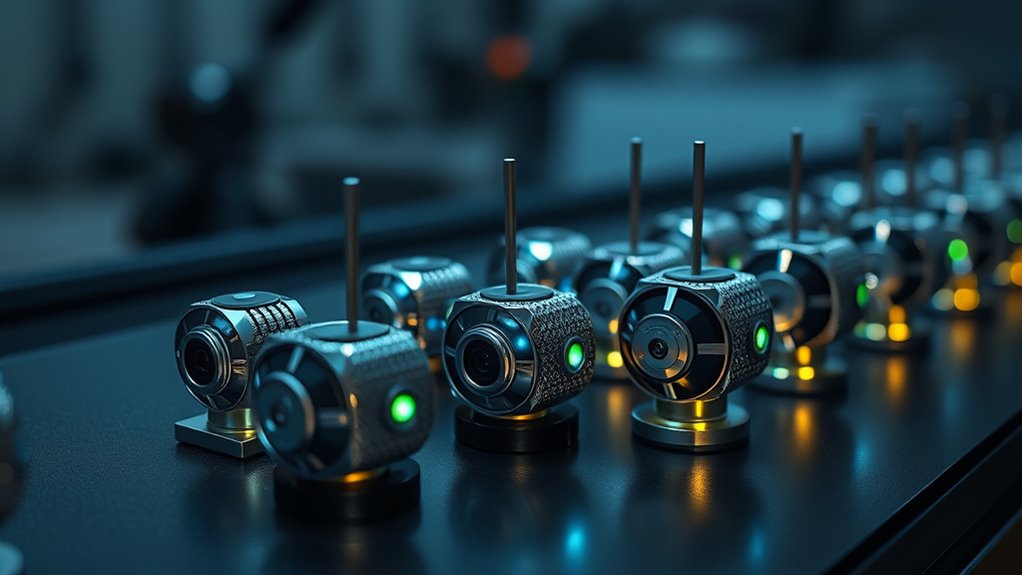
While LiDAR and cameras have dominated the landscape of sensor technology, innovative solutions are emerging that expand our ability to perceive the environment. One of the most promising developments is sensor fusion, which combines data from multiple sensor types to create a more all-encompassing understanding of surroundings. Instead of relying solely on high-resolution cameras or laser scanners, sensor fusion integrates inputs from ultrasonic sensors, radar, infrared, and other devices. This approach enhances accuracy, reliability, and robustness, especially in challenging conditions like poor visibility or adverse weather. For example, ultrasonic sensors, which emit high-frequency sound waves, excel at short-range object detection and are less affected by lighting conditions or dirt. When combined with other sensors through sensor fusion, they provide precise proximity information, helping autonomous vehicles navigate complex environments more safely.
Ultrasonic sensors are particularly valuable because they’re simple, cost-effective, and fast. They work by sending out sound pulses and measuring the time it takes for echoes to return, enabling quick detection of nearby objects. This makes them ideal for parking assistance, collision avoidance, and low-speed maneuvers. While ultrasonic sensors lack the range and resolution of LiDAR or radar, their strength lies in close-quarters detection. When integrated with other sensors, their data complements the broader perception system, filling in gaps that might otherwise go unnoticed. For instance, ultrasonic sensors can detect obstacles that are too close for cameras to interpret effectively, especially in cluttered or low-light environments.
Ultrasonic sensors excel at close-range detection, complementing other sensors in complex, low-light, or cluttered environments.
Sensor fusion leverages the strengths of ultrasonic sensors alongside other technologies to create a layered understanding of the environment. By combining the detailed, long-range data from radar or LiDAR with the short-range, high-precision signals from ultrasonic sensors, systems can make better-informed decisions. This integration reduces false positives, improves reaction times, and allows for more nuanced perception of complex scenes. It also helps sensors compensate for each other’s weaknesses, ensuring consistent performance across various conditions. As a result, you’ll find that many advanced driver-assistance systems (ADAS) and autonomous vehicles increasingly depend on sensor fusion techniques that incorporate ultrasonic sensors, elevating safety and efficiency. Additionally, advances in AI-driven data processing further enhance the effectiveness of sensor fusion systems, enabling more sophisticated environmental interpretation.
In essence, while traditional sensors like LiDAR and cameras continue to lead, the rise of sensor fusion and ultrasonic sensors marks a significant evolution. These innovations empower your vehicle or robotic system to perceive its environment more accurately, safely, and reliably, even in scenarios where conventional sensors struggle. By embracing these technologies, you’re paving the way toward smarter, more resilient autonomous systems that can better navigate the complexities of real-world environments.
Frequently Asked Questions
What Are the Limitations of Ultrasonic Sensors in Autonomous Vehicles?
Ultrasonic sensors, or ultrasonic rangefinders, face limitations in autonomous vehicles, especially with their short-range detection. You might find they struggle with accuracy in complex environments or when objects are at odd angles. Sensor calibration becomes essential to maintain reliability, but environmental factors like rain or dirt can impair their performance. While useful for close-range detection, they can’t replace long-range sensors, limiting their overall effectiveness in autonomous driving systems.
How Do Radar Sensors Perform in Adverse Weather Conditions?
Radar sensors perform well in adverse weather conditions, showcasing high sensor resilience. Their reliability remains steady despite fog, rain, or snow, as radio waves penetrate these elements better than optical sensors. You can depend on radar for consistent obstacle detection and tracking, making it a crucial component for autonomous vehicles. Its ability to operate reliably in challenging environments ensures safer navigation, even when visibility is compromised.
What Emerging Sensor Technologies Are Expected to Replace Current Systems?
Imagine sensors as the eyes of the future, constantly evolving. You’ll see emerging tech like sensor miniaturization and data processing innovations taking the spotlight. These advancements promise smarter, more efficient systems that outperform current sensors, even in challenging conditions. As miniaturized sensors become more integrated, and data processing speeds soar, you’ll experience safer, more reliable autonomous vehicles, pushing beyond the limits of LiDAR and cameras.
How Do Sensor Fusion Techniques Enhance Perception Accuracy?
Sensor fusion techniques combine data from multiple sensors, improving perception accuracy by providing a more extensive view of the environment. You benefit from enhanced perception enhancement as sensor integration reduces blind spots and compensates for individual sensor limitations. This multi-sensor approach guarantees you get reliable, real-time information, which is vital for decision-making, especially in complex or challenging conditions. Overall, sensor fusion dramatically boosts the effectiveness of autonomous systems.
What Are the Cost Implications of Deploying Advanced Sensor Systems?
Did you know that advanced sensor systems can cost up to 50% more than traditional setups? When you do a cost analysis, you’ll see that deploying these sensors impacts your budget considerations markedly. While they improve perception accuracy, you need to weigh the benefits against expenses. Planning carefully ensures you get the most value without overspending, helping you make smarter decisions for your autonomous system investments.
Conclusion
As you venture beyond LiDAR and cameras, you’ll find sensor technologies that open new horizons, like stars guiding your way through uncharted skies. These innovations pulse with potential, transforming the landscape of perception into a symphony of signals. Embrace these unseen frontiers, where every sensor becomes a whisper in the data wind, steering your journey forward with silent strength. Together, they compose a future where sensing knows no bounds, only endless possibilities.