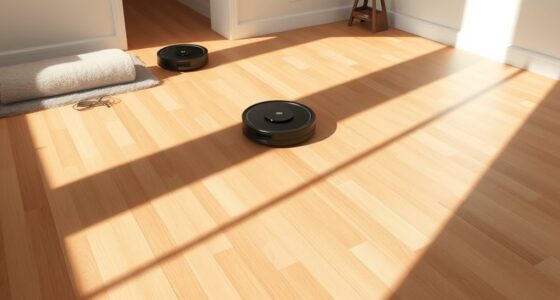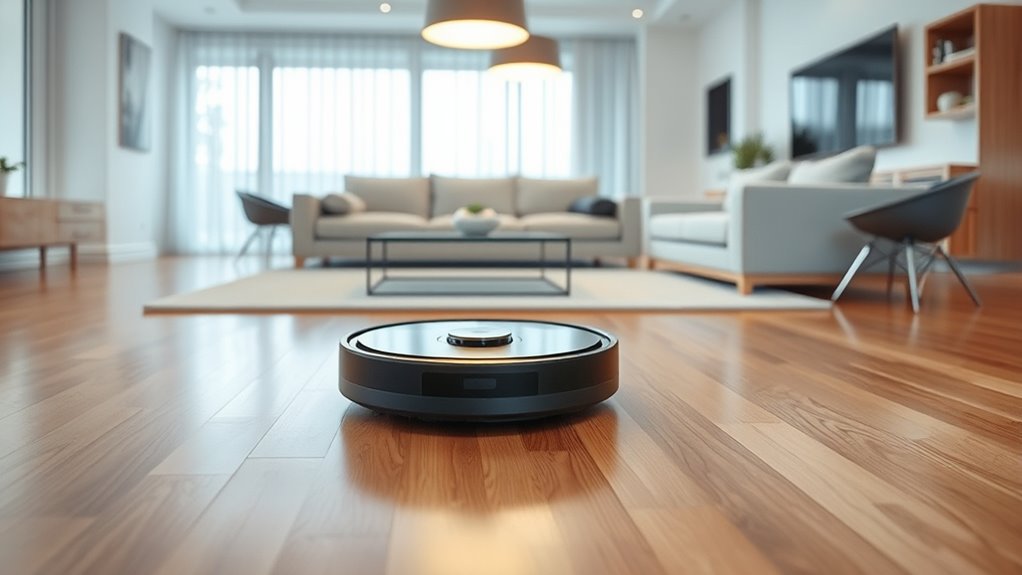
To adapt your robot vacuum for open floor plans, start by cleaning and recalibrating its sensors regularly to guarantee accurate obstacle detection. Adjust navigation settings and enable virtual boundaries to create designated zones, preventing it from wandering into cluttered areas. Keep the floor clear of cords and clutter to help sensors work effectively. Regular firmware updates also improve obstacle avoidance. Continuing with some simple steps can make your vacuum more efficient in large open spaces.
Key Takeaways
- Regularly clean and calibrate sensors to ensure accurate obstacle detection in open spaces.
- Use adjustable cleaning modes to enhance obstacle avoidance and navigation performance.
- Set up virtual boundaries or zone management to prevent the vacuum from wandering into cluttered areas.
- Keep the floor clear of cords, shoes, and clutter to prevent sensor confusion and improve efficiency.
- Install firmware updates to benefit from improved sensor calibration algorithms and navigation capabilities.
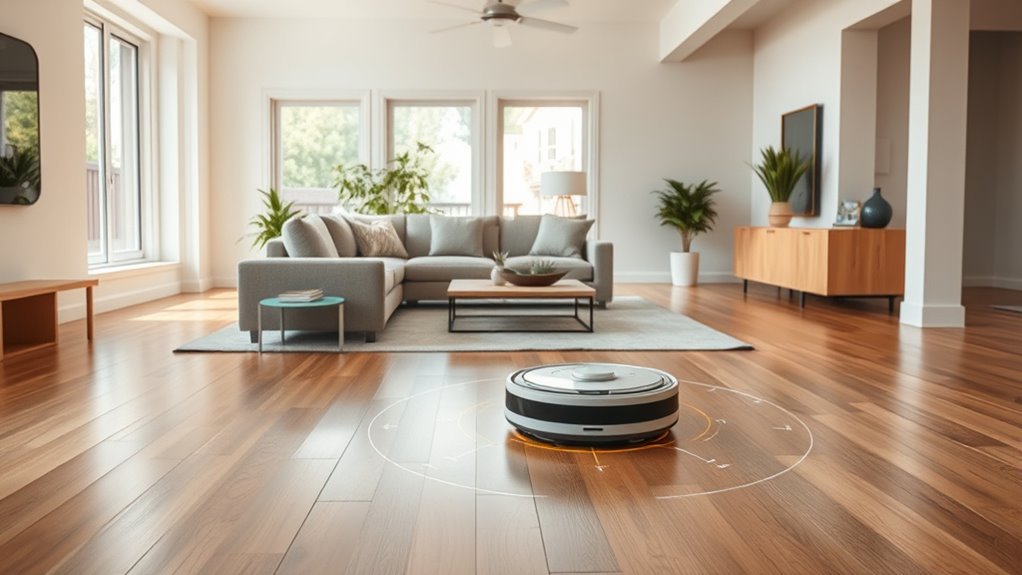
Open floor plans offer a spacious, seamless environment that can challenge traditional robot vacuum navigation. Without walls or distinct rooms to guide it, your vacuum needs to adapt to avoid missing spots or bumping into furniture. The key to successful cleaning in these open spaces lies in optimizing sensor calibration and obstacle detection. Proper sensor calibration ensures your vacuum’s sensors are accurately interpreting the environment, leading to more precise movement and better obstacle avoidance. If the sensors are misaligned or dirty, your robot might misjudge distances, resulting in inefficient cleaning or collisions. Regularly check and clean the sensors, and recalibrate them if your vacuum allows, to keep navigation smooth and accurate.
Optimize robot vacuum performance in open spaces by calibrating sensors and enhancing obstacle detection for thorough cleaning.
Obstacle detection becomes even more critical in open floor plans. Without walls to contain its path, your vacuum relies heavily on sensors like infrared, lidar, or cameras to identify objects and navigate around them. To enhance obstacle detection, consider placing your vacuum in an open area and running calibration routines if your device has them. This process helps sensors better recognize furniture, rugs, or clutter, so it can adapt its route accordingly. You might also want to clear the floor of unexpected obstacles like cords, shoes, or small items that can confuse the sensors. This not only prevents the vacuum from getting stuck but also allows it to learn your space more effectively.
Additionally, some robot vacuums feature adjustable cleaning modes tailored for open environments. Switching to a mode that emphasizes obstacle avoidance can help your vacuum navigate more confidently. You may also want to customize the boundaries or virtual walls if your model supports them, creating designated zones where the vacuum should or shouldn’t go. This can help prevent it from getting overwhelmed by too much open space or wandering into areas you want to keep off-limits.
Lastly, keep software updates current. Manufacturers often release firmware improvements that enhance sensor calibration algorithms and obstacle detection capabilities. Regular updates ensure your robot vacuum benefits from the latest navigation enhancements, especially crucial in open floor plans where navigation is more complex. Consistently maintaining sensor cleanliness, recalibrating when needed, and customizing navigation settings will considerably improve your vacuum’s performance. In doing so, you’ll help it adapt to the open environment, ensuring a thorough clean without frequent bumps or missed spots. With these steps, your robot vacuum becomes more efficient at tackling open floor plans, making your cleaning routine smoother and more effective.
Frequently Asked Questions
Can Robot Vacuums Handle Multiple Room Transitions Effectively?
Robot vacuums can handle multiple room crossings effectively, but mapping challenges and obstacle detection play vital roles. If your vacuum has advanced sensors, it navigates smoothly, avoiding obstacles and updating its map as it moves through different rooms. However, if it struggles with clutter or complex layouts, transitions may be less efficient. Upgrading to a model with better obstacle detection can improve its ability to clean multiple rooms seamlessly.
How Do Open Floor Plans Affect Robot Vacuum Battery Life?
Open floor plans can impact your robot vacuum’s battery life by requiring more power for longer cleaning sessions. You’ll notice reduced battery efficiency if the vacuum has to cover larger, uninterrupted spaces. To improve this, focus on power optimization by scheduling cleanings during low-traffic times and ensuring your device’s sensors are clean. This helps your vacuum operate more efficiently, extending battery life and keeping your floors spotless.
Are There Specific Robot Vacuum Features Ideal for Open Spaces?
You want a robot vacuum with smart navigation and obstacle detection for open spaces. These features help it efficiently map large areas, avoid obstacles, and adjust cleaning paths on the fly. Look for models with advanced sensors and mapping technology, so your vacuum can seamlessly cover open floor plans without missing spots or getting stuck. These features guarantee thorough cleaning and maximize battery life in expansive areas.
How Can I Prevent My Robot Vacuum From Missing Large Open Areas?
To prevent your robot vacuum from missing large open areas, focus on improving its mapping capabilities. You can do this by choosing a model with advanced obstacle detection and mapping challenges features, which help the vacuum navigate efficiently. Regularly clear the area of clutter, and guarantee the sensors are clean. Running the vacuum in sections or using a floor plan app can also improve coverage and prevent missed spots.
Do Open Layouts Require Different Robot Vacuum Maintenance Routines?
Open layouts do call for different maintenance routines and cleaning schedules. You should regularly check for debris buildup and empty the bin more often, since larger areas mean more dirt. Keep brushes and filters clean to maintain suction power, and update your cleaning schedule based on how much foot traffic the space gets. This way, your robot vacuum stays efficient and keeps your open floor plan spotless.
Conclusion
Adapting your robot vacuum for open floor plans is like tuning a musical instrument—you need to adjust settings and placements until everything works harmoniously. By customizing your vacuum’s navigation, setting boundaries, and choosing the right features, you’ll keep your space spotless without a hitch. With a little effort, your robot will glide smoothly across your open space, like a gentle breeze through an open window, making cleaning effortless and efficient.