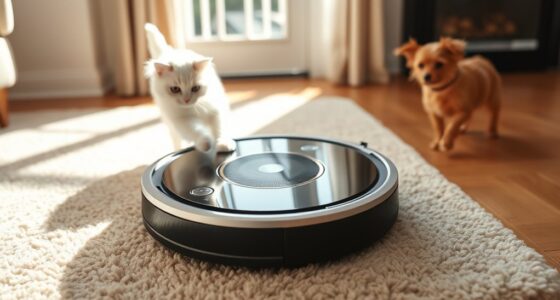
Effective multi-robot coordination in fleet cleaning involves seamless communication, smart task allocation, and decentralized decision-making. You’ll see robots sharing real-time status updates, adjusting routes, and reassigning tasks based on environment changes. This synchronization boosts efficiency, reduces operational costs, and allows the fleet to adapt quickly to obstacles. As you explore further, you’ll discover how these strategies create autonomous, high-performing cleaning systems that handle complex environments with ease.

Get cleaning gear delivered free with Prime
- Fast, free delivery on millions of items
- Prime Video, Amazon Music and more included
- Member-only deals all year
Key Takeaways
- Effective communication enables real-time information sharing for coordination, obstacle avoidance, and adaptive environment responses.
- Task allocation algorithms distribute work based on location, capability, and battery life to optimize fleet efficiency.
- Robots continuously relay status updates, such as obstacle encounters or maintenance needs, for proactive adjustments.
- Advanced strategies like decentralized decision-making promote self-organizing teams that adapt to environmental changes.
- Proper coordination enhances cleaning effectiveness, reduces costs, and allows autonomous operation with minimal human oversight.

Multi-robot coordination involves managing multiple robots working together efficiently to achieve shared goals. In fleet cleaning, this means guaranteeing each robot contributes effectively to the overall task, whether it’s sweeping floors, vacuuming, or wiping surfaces. To do this successfully, you need seamless robot communication. When robots can share information in real-time, they can coordinate their actions better, avoid collisions, and adapt quickly to changing environments. For example, if one robot detects a particularly dirty area, it can signal others to assist or avoid that zone, preventing redundant efforts. Clear, reliable communication channels are essential because they allow the robots to act as a cohesive team rather than isolated units. Incorporating collaborative design principles can further enhance coordination by optimizing how the robots interact and share tasks. Task allocation plays a critical role in this process. You have to assign specific jobs to each robot based on their current location, battery life, or capability. This guarantees that no robot is overwhelmed, and the workload is balanced across the fleet. Effective task allocation minimizes downtime and increases efficiency, as robots are always directed toward the most suitable tasks without unnecessary overlap. For instance, if a robot finishes its assigned cleaning zone early, it can be re-tasked to assist another robot, keeping the entire operation moving smoothly. Advanced algorithms often handle this process, dynamically reallocating tasks as conditions change, which is essential for maintaining high productivity levels in fleet cleaning. You also need to contemplate how robots communicate their status and progress. If a robot encounters an obstacle or needs maintenance, it should immediately relay this information to the team. This way, other robots can adjust their routes or tasks accordingly, avoiding delays or mishaps. Robust robot communication systems often incorporate wireless networks, such as Wi-Fi or mesh networks, to facilitate fast and reliable data exchange. This constant flow of information helps the entire fleet operate as a synchronized unit, rather than a collection of individual machines working independently. In fleet cleaning, task allocation and robot communication work hand-in-hand. When communication is smooth and data sharing is instantaneous, you can implement sophisticated strategies like decentralized decision-making or self-organizing teams. These approaches allow the robots to adapt to unexpected obstacles or changes in the environment without needing constant human intervention. As a result, your cleaning operation becomes more autonomous, efficient, and capable of handling complex, large-scale environments with minimal oversight. Ultimately, mastering these core aspects of multi-robot coordination ensures your fleet performs at its best, saving time, reducing costs, and maintaining high cleaning standards.
multi-robot fleet cleaning system
As an affiliate, we earn on qualifying purchases.
As an affiliate, we earn on qualifying purchases.
Frequently Asked Questions
How Do Robots Communicate in a Fleet?
You set up robot communication through wireless networks like Wi-Fi or Bluetooth, allowing your robots to exchange information seamlessly. They use fleet messaging protocols to coordinate tasks, share locations, and update task statuses in real-time. This constant data exchange guarantees your robots work efficiently together, avoid collisions, and adapt to changing environments, making the entire fleet operate smoothly and effectively without your manual intervention.
What Are the Main Challenges in Fleet Coordination?
You face main challenges like tackling scalability issues, managing energy efficiently, and ensuring seamless communication. You need to balance the fleet’s size without overloading the system, optimize energy use to keep robots operational longer, and coordinate tasks smoothly to prevent conflicts. These challenges demand adaptive algorithms, robust communication, and effective resource management, so your fleet works harmoniously, stays productive, and adapts to changing environments without losing efficiency or reliability.
How Is Collision Avoidance Managed Among Robots?
You manage collision avoidance by using sensor calibration to guarantee accurate obstacle detection. When robots detect obstacles, they adjust their paths dynamically, avoiding collisions. This involves real-time data processing from sensors like lidar or ultrasonic detectors. By continuously calibrating sensors and updating obstacle maps, your robots can navigate efficiently without bumping into each other, maintaining smooth operation and safety during fleet cleaning tasks.
What Algorithms Optimize Task Distribution?
You might think task distribution is straightforward, but behind the scenes, sophisticated algorithms like auction-based methods and market-driven models optimize task allocation and load balancing. These algorithms dynamically assign tasks based on each robot’s capabilities and current workload, ensuring efficiency and minimizing downtime. They adapt in real-time, balancing the load across your fleet and preventing bottlenecks, ultimately making your cleaning operation smooth, coordinated, and highly effective.
How Does Real-Time Data Influence Coordination?
Real-time data substantially improves coordination by enabling sensor integration and data synchronization among robots. You benefit by receiving up-to-date information on each robot’s position, battery life, and environment, allowing you to adapt tasks dynamically. This continuous data flow helps prevent overlaps and gaps, optimizing efficiency. When sensors are integrated and data is synchronized, your fleet can respond swiftly to changing conditions, ensuring seamless, coordinated cleaning operations with minimal delays or errors.
robot communication modules for cleaning robots
As an affiliate, we earn on qualifying purchases.
As an affiliate, we earn on qualifying purchases.
Conclusion
Now, as you watch these robots work seamlessly together, the future feels within reach. But behind every smooth move lies complex coordination, waiting to be accessed. Imagine the potential when this technology evolves—cleaning not just floors, but entire cities. Are you ready to see what’s next? The secret to flawless multi-robot harmony is just on the horizon, and once revealed, everything you thought you knew about automation will change forever.
autonomous cleaning robot with task allocation
As an affiliate, we earn on qualifying purchases.
As an affiliate, we earn on qualifying purchases.
wireless mesh network for robots
As an affiliate, we earn on qualifying purchases.
As an affiliate, we earn on qualifying purchases.
Halloween Picks
halloween
As an affiliate, we earn on qualifying purchases.