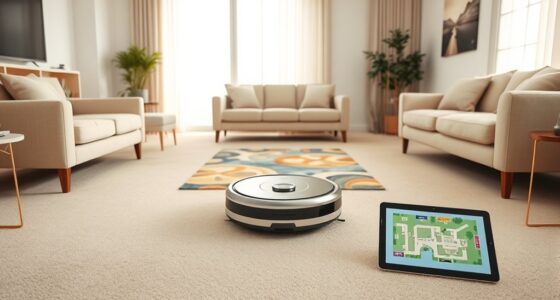
AI object recognition is changing how industries work, making tasks faster and more efficient, from security to retail. However, it also raises privacy concerns, as your personal data and images can be captured without your permission. Accuracy issues can lead to mistakes, and ethical questions about bias and data use come into play. If you want to understand how these challenges and benefits shape the future, keep exploring what’s really happening behind the scenes.
Key Takeaways
- AI object recognition enhances vacuum cleaning robots by enabling precise navigation and obstacle avoidance.
- It improves security and surveillance systems by identifying intruders or objects in real-time.
- Privacy concerns arise from data collection in smart home devices using AI for object detection.
- Accuracy limitations can lead to misclassification, affecting the effectiveness of AI-powered systems.
- Responsible development focuses on balancing technological benefits with privacy safeguards and ethical standards.
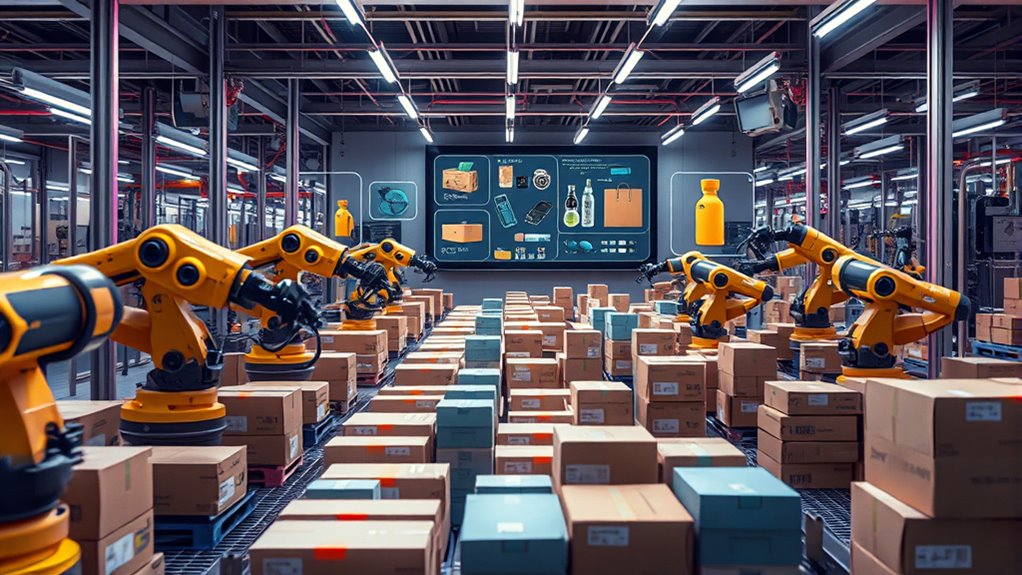
Artificial intelligence object recognition is transforming the way we interact with technology and the world around us. It’s changing how devices understand and interpret visual data, making tasks like security monitoring, autonomous driving, and retail management more efficient and responsive. However, as you start to rely more on these systems, it’s essential to recognize the challenges that come with their implementation. Two of the most pressing issues are privacy concerns and accuracy challenges.
When you use AI for object recognition, it often involves collecting and analyzing vast amounts of visual data. This can raise significant privacy concerns because personal information might be captured without explicit consent. For example, surveillance cameras equipped with AI can identify individuals in public spaces, which can feel intrusive or invasive if not managed properly. People worry about how their data is stored, who has access to it, and whether it’s being used for purposes beyond what they’ve agreed to. These privacy issues can slow down adoption or lead to stricter regulations, forcing you and other users to navigate a landscape of potential data misuse and surveillance fears.
On the technical side, accuracy challenges pose another obstacle. AI object recognition systems aren’t perfect; they can misidentify objects or fail to recognize them altogether. For instance, an autonomous vehicle might misclassify a plastic bag as a traffic obstacle, or a security system might mistake a harmless person for a threat. These errors can have serious consequences, especially in safety-critical applications. Improving accuracy requires massive amounts of high-quality data, advanced algorithms, and continuous training, which can be resource-intensive. Even with these efforts, biases in datasets can lead to skewed results, making some objects or individuals less likely to be recognized correctly. This inconsistency can undermine trust in AI systems, causing frustration and hesitancy among users and developers alike. Additionally, ongoing research into robust algorithms aims to address these issues, but progress remains gradual.
Despite these challenges, the potential benefits of AI object recognition are enormous. It can enhance security, streamline workflows, and provide deeper insights into complex environments. To harness these advantages responsibly, you need to be aware of the privacy risks and technical limitations involved. Developers and organizations are working on solutions, such as anonymizing data and improving algorithm robustness, but it’s crucial for you to stay informed and advocate for ethical practices. As the technology evolves, balancing innovation with privacy and accuracy will be key to ensuring that AI object recognition benefits everyone without compromising fundamental rights or safety.

Amcrest 4K Night Color AI Turret IP PoE Camera 49ft Full Color Nightvision, Security IP Camera, Built-in Microphone, Human Detection, Perimeter Protection, 129° FOV, 4K@15fps IP8M-2779EB-AI (Black)
- AI Human and Vehicle Detection: Detects humans, faces, and vehicles with filtering
- Dual Illumination Night Vision: Full color night vision up to 49ft
- 4K Video at 15fps: High-resolution video with wide 129° FOV
As an affiliate, we earn on qualifying purchases.
As an affiliate, we earn on qualifying purchases.
Frequently Asked Questions
How Does AI Object Recognition Handle Complex or Cluttered Backgrounds?
AI object recognition handles complex backgrounds and occlusion challenges by using advanced algorithms like deep learning and convolutional neural networks. These techniques help you distinguish objects even when background complexity makes detection harder or when objects are partially hidden. You benefit from improved accuracy because the system learns to focus on distinctive features, reducing false positives and maintaining reliable recognition despite cluttered scenes.
What Are the Privacy Concerns Associated With AI Object Recognition Technology?
You should know that AI object recognition raises serious privacy concerns, with over 60% of people worried about data privacy. It enables extensive surveillance, capturing detailed images without consent. This technology risks infringing on your privacy rights, especially when used by governments or corporations. Surveillance risks increase as AI can track individuals continuously, making it crucial to regulate how data is collected, stored, and used to protect your personal information.
How Accurate Is AI Object Recognition Across Different Environmental Conditions?
You’ll find that AI object recognition accuracy varies with environmental conditions. When sensors are well-calibrated, the system performs better across different lighting, weather, and clutter levels. Dataset diversity also plays a crucial role, as models trained on varied data adapt more effectively to real-world scenarios. Together, proper sensor calibration and extensive datasets help improve accuracy, but challenging conditions can still cause occasional misrecognitions.
Can AI Object Recognition Systems Identify Objects in Real-Time Applications Effectively?
You can rely on AI object recognition systems in real-time applications, but keep in mind their algorithm limitations. They often perform well, yet privacy concerns arise, especially when sensitive data is involved. Always guarantee proper safeguards and transparency. While these systems are effective, their accuracy may fluctuate depending on environmental conditions. So, while they’re useful, you should remain cautious about potential privacy issues and inherent algorithm constraints.
What Are the Limitations of Current AI Object Recognition Algorithms?
You’ll find that current AI object recognition algorithms face limitations like training biases, which can skew results and reduce accuracy across diverse environments. Additionally, issues with algorithm robustness mean they often struggle with new or complex scenarios, making their performance less dependable. These challenges highlight the need for more diverse training data and improved algorithms to guarantee consistent, accurate recognition in real-world applications.

Smart Home Protection for Beginners: Secure Your Devices, Cameras, Network, and Family Privacy
As an affiliate, we earn on qualifying purchases.
As an affiliate, we earn on qualifying purchases.
Conclusion
Just like a lighthouse guides ships through darkness, AI object recognition steers us through a sea of information. It illuminates hidden patterns and reveals unseen opportunities, helping you navigate a complex world with confidence. But remember, even the brightest light can cast shadows—so stay vigilant and ethical. Embrace this technology as your guiding beacon, ensuring you harness its power wisely, steering toward a future where innovation and responsibility sail side by side.

Commercial Floor Cleaning Robot, 4-in-1 Autonomous Sweep Mop Scrub Vacuum with Obstacle Avoidance, Low Noise for Office Building School Hospital Hard Floors
- Customizable Design: Full customization available upon request
- 4-in-1 Cleaning Functions: Sweeping, scrubbing, vacuuming, dust pushing
- All-in-One Floor Care: Handles multiple cleaning tasks in one pass
As an affiliate, we earn on qualifying purchases.
As an affiliate, we earn on qualifying purchases.

ONWOTE 32 Channel Security Camera System, AcuSearch, 12MP NVR, 20x 5MP Audio PoE IP Cameras, AI Human Vehicle Detection, 32CH 6K 4K Commercial NVR 8TB, 4 HDD Ports Support 40TB, Business CCTV
- AcuSearch Technology: Precise suspect location and quick search
- AI Human Vehicle Detection: Reduces false alarms and saves storage
- 5MP Super HD Video: Sharp images at 25FPS for smooth footage
As an affiliate, we earn on qualifying purchases.
As an affiliate, we earn on qualifying purchases.