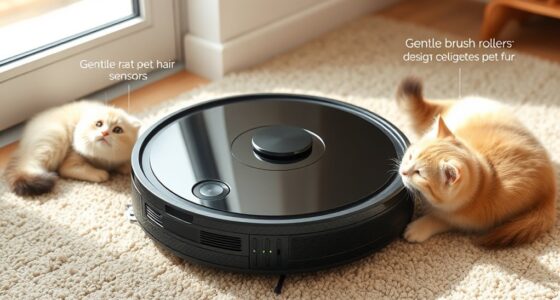
Robot vacuums navigate rooms by using advanced sensors, cameras, and mapping algorithms to create virtual layouts of your home. They detect obstacles like furniture and pets in real-time, stopping and rerouting as needed. These devices plan efficient routes, update their maps, and avoid repeating areas. Their seamless integration of technology guarantees thorough cleaning without much intervention. If you want to discover how these smart systems adapt to different spaces, stay tuned for more details.
Key Takeaways
- Robot vacuums use advanced mapping algorithms to create detailed virtual blueprints of home layouts.
- They combine sensors like infrared, bumpers, and cameras for real-time obstacle detection.
- Mapping data guides systematic cleaning, avoiding repeated passes and missed spots.
- Continuous environmental scanning allows quick obstacle recognition and route adjustment.
- Integration of sensing systems and planning algorithms enables adaptive and efficient navigation.

Robot vacuums have revolutionized home cleaning by effortlessly maneuvering rooms and avoiding obstacles. When you set one to work, it uses advanced technology to navigate your space efficiently, ensuring thorough cleaning without much input from you. Central to this process are sophisticated mapping algorithms and obstacle detection systems. These components work together to help your robot understand the layout of your home and avoid collisions, making cleaning smarter and more effective. High refresh rates in some models help improve the speed and responsiveness of obstacle detection, leading to smoother navigation. Mapping algorithms are at the heart of how robot vacuums create a mental map of your living space. As soon as you turn the device on, it starts exploring, collecting data through sensors and cameras. This data feeds into the mapping algorithm, which constructs a virtual blueprint of your rooms, identifying walls, furniture, and other significant objects. The more advanced the algorithm, the more detailed and accurate the map becomes. This allows the robot to plan the most efficient cleaning routes, covering every corner without wasting time retracing its steps or missing spots. Some models update their maps over time, learning the layout as they go, which helps them adapt to changes like moved furniture or new obstacles. Obstacle detection complements the mapping process by providing real-time awareness of your environment. Equipped with infrared sensors, bumpers, or cameras, the robot constantly scans for obstacles in its path. When it detects an object—be it a chair leg, a shoe, or a pet—its obstacle detection system kicks in. It quickly halts, analyzes the obstacle’s position, and determines the best way to navigate around it. This prevents the robot from bumping into furniture or getting stuck. Many modern vacuums use a combination of ultrasonic sensors and computer vision to improve obstacle detection accuracy, allowing for smoother maneuvering even in cluttered spaces. Together, mapping algorithms and obstacle detection systems make robot vacuums highly autonomous. They enable the device to clean systematically, avoiding repeated passes over the same area and minimizing missed spots. You benefit from less intervention and a cleaner home. As the robot refines its map during each cleaning session, it becomes more efficient, reducing cleaning time and increasing coverage. This synergy between planning and sensing technologies is what allows your robot vacuum to navigate rooms with precision, avoiding obstacles and adapting to your home’s unique layout. In short, these technological features ensure your device cleans thoroughly, intelligently, and with minimal fuss on your part.

eufy C10 Robot Vacuum Self Emptying, 8 Weeks Hands Free, Advanced Smart Mapping with LiDAR Navigation, 2.85-Inch Slim Design, Powerful Suction, Edge Expansion Brush for Pet Hair, Carpet Detection
【Self-Empty Station】Robotic vacuum C10's dust bin is automatically emptied into the station's 3L dust bag. Thanks to its…
As an affiliate, we earn on qualifying purchases.
As an affiliate, we earn on qualifying purchases.
Frequently Asked Questions
How Do Robot Vacuums Detect Stairs or Drop-Offs?
Robot vacuums detect stairs or drop-offs using navigation sensors and obstacle detection. These sensors, like cliff sensors or anti-drop sensors, sense changes in height and prevent the vacuum from falling. When they approach a drop-off, the sensors detect the edge and send signals to reverse or change direction. This active obstacle detection guarantees your vacuum navigates safely around stairs and prevents accidents while cleaning.
Can Robot Vacuums Recognize and Avoid Pet Toys?
Ever wonder if your robot vacuum can spot pet toys? Most models use advanced obstacle avoidance and pet toy detection to prevent accidents. They recognize common objects like toys and furniture, steering clear to avoid damage or getting stuck. While they’re pretty good at avoiding pet toys, some smaller or lightweight items might still pose a challenge. Isn’t it great to have a cleaner home without constantly checking behind your furry friend’s playthings?
Do Robot Vacuums Map Multiple Floors?
Yes, many robot vacuums can map multiple floors for efficient cleaning. They use advanced sensors and mapping technology, including floor transition detection, to recognize when they move between levels. This feature guarantees thorough multi-floor cleaning without losing track of where they’ve been. You simply set up the maps once, and the vacuum intelligently navigates different floors, saving you time and effort while maintaining a consistent clean.
How Do Robot Vacuums Handle Under Furniture?
You’ll find that robot vacuums handle under furniture by using their low-profile design and smart sensors. Their suction power is optimized to clean tight spaces, while their sensors detect obstacles and prevent getting stuck. Battery life guarantees they can clean under furniture without interruption, and some models even have brushes that bend or rotate for better access. This way, you get thorough cleaning without worrying about their ability to reach under low furniture.
Are Robot Vacuums Capable of Learning Room Layouts Over Time?
Think of your robot vacuum as a curious explorer, enthusiastic to map new territories. It uses machine learning for adaptive navigation, so over time, it learns your room’s layout, avoiding obstacles more efficiently. Yes, it can recognize patterns and remember furniture placement, making cleaning smarter with every pass. This ongoing learning helps it navigate more smoothly, turning your cleaning routine into a seamless dance of technology and convenience.

roborock Qrevo S5V Robot Vacuum and Mop, FlexiArm Edge Mopping, 12,000Pa Suction, Dual Zero-Tangle System, Smart Obstacle Avoidance, 10mm Mop Lifting, Auto Mop Washing&Drying, Self-Emptying&Refilling
12,000Pa HyperForce Suction: Powered by a brushless motor, the Roborock Qrevo S5V delivers intense 12,000Pa suction to lift…
As an affiliate, we earn on qualifying purchases.
As an affiliate, we earn on qualifying purchases.
Conclusion
Now that you know how robot vacuums navigate rooms, you might be surprised to learn that over 70% of users find their devices save hours of cleaning time each week. With advanced sensors and smart mapping, these vacuums efficiently cover every corner, making your life easier. So, next time you see your robot in action, remember it’s not just cleaning — it’s saving you precious time and effort every day.

eitton Robot Vacuum and Mop Combo, 6000Pa Strong Suction, LiDAR Navigation, Self-Emptying Dock,90-Day Hands-Free,Smart Mapping,WiFi/App/Alexa,Robotic Vacuum for Pet Hair, Dust, Hard Floors and Carpets
✅【6000Pa Super Strong Suction】Power through daily messes with 6000Pa of intense suction. This robotic vacuum easily lifts embedded…
As an affiliate, we earn on qualifying purchases.
As an affiliate, we earn on qualifying purchases.

Obito X3 Window Cleaning Robot, Dual Nozzles with Ultrasonic Spray, 5.0 AI Path Planning, Max 3200Pa & Steady-Climbing System, Automatic Edge Detection, Robot Window Cleaner Inside/Outside, Black
【Intelligent Path Planning, Deep Cleaning with No Dead Zones】 Upgrade AI 5.0 bow-shaped path planning, detect the window…
As an affiliate, we earn on qualifying purchases.
As an affiliate, we earn on qualifying purchases.