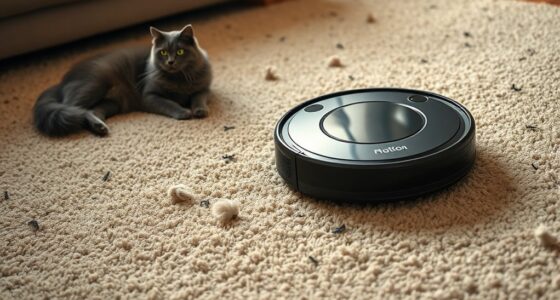
AI robots learn your home layout through active mapping during each cleaning session. They use sensors like lidar, infrared, and ultrasound to detect furniture, obstacles, and room boundaries. Over time, they update their maps, recognize patterns, and adapt to changes such as new furniture or rearranged rooms. This ongoing process helps them improve navigation accuracy and efficiency. If you want to discover the detailed steps behind their learning journey, keep exploring further.

Get cleaning gear delivered free with Prime
- Fast, free delivery on millions of items
- Prime Video, Amazon Music and more included
- Member-only deals all year
Key Takeaways
- Robots actively map and update home layouts during cleaning to improve navigation accuracy over time.
- They use sensors like lidar, infrared, and ultrasound to detect obstacles and redefine routes dynamically.
- Continuous learning enables robots to recognize furniture, furniture rearrangements, and new objects in the environment.
- AI algorithms analyze sensor data repeatedly to refine obstacle prediction and route planning efficiency.
- Over multiple cycles, robots become more autonomous, reducing missed spots and optimizing cleaning paths.

AI robots are increasingly able to learn and navigate home layouts with remarkable accuracy. When you set a robot to clean your house, it doesn’t just wander randomly; it actively maps your space, creating a detailed layout that guides its movements. This process hinges on advanced robot navigation techniques that allow the robot to understand the environment around it. Using sensors and cameras, the robot continuously gathers data about the space, updating its map as it moves. Over time, it becomes more efficient, knowing where furniture is located and which areas require more attention. This ongoing learning process means your robot adapts to changes in your home, such as new furniture or rearranged rooms.
One of the key elements that make this possible is obstacle detection. Your robot employs a variety of sensors—ultrasound, infrared, and lidar—to identify objects in its path. These sensors help the robot detect obstacles like chairs, toys, or even pets, preventing collisions and ensuring smooth navigation. When an obstacle is encountered, the robot quickly recalculates its route, avoiding the object and continuing its cleaning task seamlessly. Over multiple cleaning cycles, the robot becomes better at predicting where obstacles are likely to be, improving its ability to navigate efficiently without getting stuck. This obstacle detection capability is essential for safe operation, especially in dynamic environments where objects might move or be introduced unexpectedly.
As your robot learns your home’s layout, it also develops a sense of spatial awareness. It understands the boundaries of each room, the location of doorways, and areas that are off-limits. This knowledge allows it to plan the most effective cleaning routes, covering every corner without wasting time or energy. The more the robot operates, the more refined its navigation becomes, reducing the chances of missing spots or bumping into furniture. This continuous improvement is driven by algorithms that process sensor data, analyze patterns, and update the map in real time. Consequently, your robot becomes more autonomous and reliable, requiring less intervention from you.
Furthermore, advancements in AI Security contribute to the robot’s ability to learn and adapt safely, ensuring it maintains privacy and operates securely within your home. This combination of sophisticated robot navigation systems and obstacle detection technologies enables AI robots to learn your home’s layout over time. They become increasingly adept at maneuvering through complex environments, providing thorough cleaning while avoiding mishaps. This ongoing learning process not only makes your smart home more efficient but also enhances the overall experience, giving you peace of mind that your robot is operating safely and effectively.
Frequently Asked Questions
How Do AI Robots Handle Unexpected Changes in Home Layouts?
When you encounter unexpected changes in home layouts, AI robots handle them by relying on obstacle detection and sensor calibration. They quickly identify new obstacles or altered spaces, updating their maps in real-time. This allows them to adapt their cleaning paths efficiently, avoiding obstacles and charting new layouts without missing areas. Your robot’s ability to recalibrate sensors ensures smooth handling of surprises, keeping your home clean despite layout changes.
What Privacy Measures Protect User Data During Robot Mapping?
Think of your data as a treasure guarded by a vigilant dragon. Your robot uses encryption protocols to lock your information, ensuring only authorized access. It also employs data anonymization, disguising personal details like a mask at a masquerade ball. These privacy measures protect your home layout and personal info from prying eyes, giving you peace of mind while your robot maps and learns your space safely and securely.
Can AI Robots Recognize Individual Objects Within a Home?
Yes, AI robots can recognize individual objects within your home through object recognition technology. They analyze shapes, sizes, and features to identify items like furniture or household objects. This ability enables personalized mapping, allowing the robot to better navigate and optimize cleaning routes based on your home’s specific layout and objects. As a result, your robot becomes more efficient and effective, adapting to your environment over time.
How Long Does It Take for an AI Robot to Fully Learn a Home Layout?
It usually takes an AI robot a few days to a week to fully learn a home layout, but learning speed varies based on the complexity of your space. During this time, the robot improves mapping accuracy by constantly updating its internal map with new data. The more obstacles and rooms, the longer it might take. Regular use helps speed up learning and enhances overall mapping accuracy.
Do AI Robots Improve Their Mapping Accuracy Over Time?
Yes, AI robots do improve their mapping accuracy over time, and you’ll notice the difference as their learning progress unfolds. At first, they might miss details or make mistakes, but with each pass, their understanding deepens. This ongoing process sharpens their ability to navigate your home more efficiently, revealing a fascinating journey of technological growth that keeps you guessing what they’ll master next.
Conclusion
As you watch these AI robots master home layouts, it’s like witnessing a supercomputer memorize every crack and corner in record time. Their ability to adapt and optimize navigation is nothing short of revolutionary, transforming the way we think about smart homes. Soon, your house’s every nook and cranny will be mapped out by these tiny geniuses, making cleaning and security effortless—like having a team of robots with minds sharper than a laser. The future’s closer than you think!
Halloween Picks
halloween
As an affiliate, we earn on qualifying purchases.