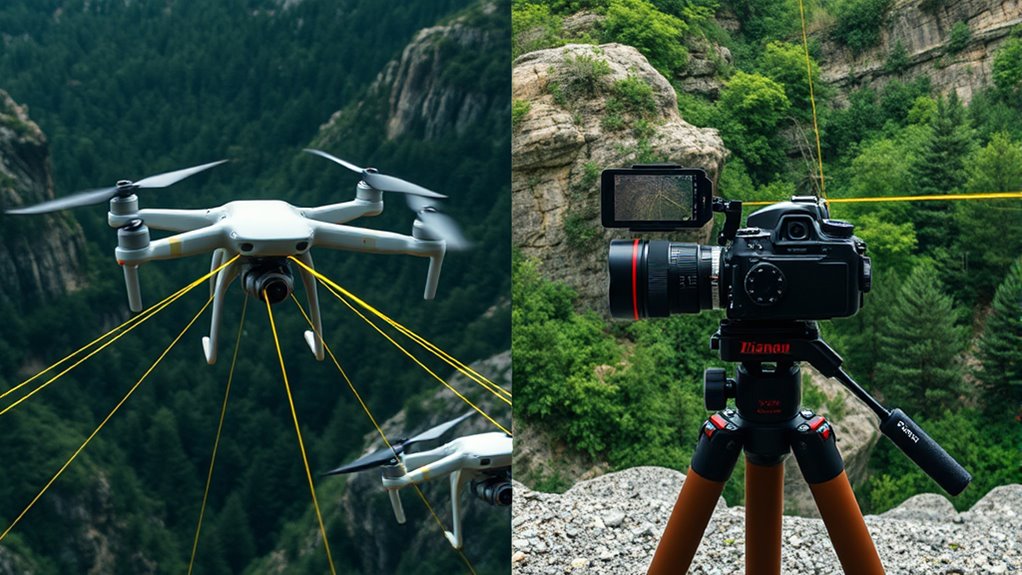

When comparing Lidar and camera technologies for mapping, you’ll find that Lidar provides precise 3D measurements, is less affected by lighting and weather, and offers fast processing for real-time updates. Cameras capture rich visual images ideal for detailed visuals but depend on good lighting and need more processing power. Understanding these strengths can help you decide which suits your needs best, and if you keep exploring, you’ll uncover even more insights into their differences.
Key Takeaways
- Lidar provides precise 3D spatial data with high accuracy, ideal for real-time mapping and navigation.
- Cameras capture high-resolution images suitable for detailed visual mapping but are affected by lighting conditions.
- Lidar operates effectively in various environments regardless of lighting, while camera accuracy declines in low-light or poor visibility.
- Lidar offers faster data processing for immediate environment updates compared to the intensive image processing required by cameras.
- The choice depends on whether precise spatial measurement or detailed visual imagery is prioritized for the mapping application.

Mapping technologies have revolutionized how we explore and understand the world around us. When comparing Lidar and camera-based systems, one of the key considerations is the sensor accuracy each offers. Lidar sensors emit laser pulses and measure the time it takes for the light to bounce back, creating highly precise 3D maps of the environment. This means you get detailed spatial data with minimal ambiguity, which is essential for applications like autonomous vehicles or topographical surveying. Cameras, on the other hand, rely on visual data captured through lenses, making their accuracy dependent on factors like lighting conditions and image resolution. While high-quality cameras can produce stunning images, their spatial accuracy isn’t as consistent as Lidar, especially in low-light scenarios where image clarity drops. So, if your priority is precise measurement and reliable 3D modeling regardless of environmental conditions, Lidar’s sensor accuracy generally surpasses that of cameras.
Processing speed is another critical aspect where these technologies differ markedly. Lidar systems tend to process data rapidly because laser pulses generate sparse point clouds that can be quickly interpreted with dedicated hardware. This fast processing speed allows real-time mapping and immediate decision-making, which is crucial for dynamic environments like self-driving cars or robotics. Cameras, however, produce large volumes of visual data that require intensive processing to extract useful information, such as depth perception or object recognition. This can introduce latency, especially if you’re working with standard hardware or complex algorithms. If your application demands instant feedback and rapid updates, Lidar’s processing speed gives it a noticeable advantage. Its ability to generate and interpret high-resolution 3D data swiftly means you can respond to changes in your environment almost instantly.
However, it’s important to recognize that these differences don’t mean one technology is universally better than the other. Cameras excel in capturing rich visual details, making them ideal for tasks that require high-resolution imagery, like surveillance or mapping aesthetics. Meanwhile, Lidar’s strength lies in its consistent sensor accuracy and quick data processing, making it preferable for precise modeling and real-time navigation. When choosing between the two, consider your application’s specific needs—whether it’s the importance of detailed imagery or the necessity for rapid, accurate spatial data. Both technologies continue to evolve, but understanding their core strengths and limitations ensures you make informed decisions tailored to your project’s demands.

TOFFUTURE XT-M60 Flash Lidar 15m Detect Range 120°x45°FOV Pure Solid Lidar, Advanced High Sensitivity & Aimbient Light Surpression ToF Technology Lidar Sensor for Autonomous Vehicles Robotics IOT
- Detection Range: Detects obstacles up to 15 meters
- Wide Field of View: 120° x 45° coverage
- Compact Size: 65x35x45mm, lightweight design
As an affiliate, we earn on qualifying purchases.
As an affiliate, we earn on qualifying purchases.
Frequently Asked Questions
How Do Lidar and Cameras Perform in Adverse Weather Conditions?
In adverse weather, lidar generally performs better than cameras because its sensor accuracy isn’t affected by rain, fog, or snow. Cameras struggle with poor visibility, making data processing more difficult and less reliable. You’ll find lidar provides more consistent, accurate data under challenging conditions, while camera performance drops markedly. So, if you need reliable mapping in bad weather, lidar is usually the better choice for maintaining sensor accuracy.
What Are the Cost Differences Between Lidar and Camera Systems?
Back in the days of floppy disks, lidar systems cost considerably more than camera setups. Today, the cost comparison still favors cameras, which are generally more budget-friendly and easier to deploy. If you’re considering your options, think about your project’s scope and budget considerations. Lidar offers higher precision but at a higher price, while cameras provide a cost-effective alternative, especially for large-scale or budget-conscious applications.
Which Technology Offers Better Real-Time Mapping Capabilities?
Lidar offers better real-time mapping capabilities because of its superior sensor accuracy and faster data processing. You’ll find that Lidar quickly captures detailed 3D data, making it ideal for dynamic environments. Cameras, while useful, rely heavily on image processing and can lag in accuracy and speed. So, if real-time, precise mapping is your priority, Lidar’s advanced sensor technology and rapid data handling give it the edge.
How Do Lidar and Cameras Handle Complex Indoor Environments?
You find that lidar handles complex indoor environments better because of its high sensor accuracy, capturing precise 3D data even in cluttered spaces. It quickly processes large amounts of data, creating detailed maps. Cameras, on the other hand, struggle with poor lighting and occlusions, requiring more extensive data processing and often less accurate results. Overall, lidar provides more reliable and detailed mapping in complex indoor settings.
What Are the Long-Term Maintenance Requirements for Each Technology?
You’ll need to account for sensor durability and calibration frequency for long-term maintenance. Lidar sensors generally require less frequent calibration but need protection from dust, moisture, and physical impacts to guarantee sensor durability. Cameras, on the other hand, need regular calibration to maintain accuracy and are more vulnerable to environmental wear. Regular cleaning, protective casing, and periodic calibration help keep both technologies functioning at their best over time.

TORINKIND GPS Receiver Module for Dual-Channel Dash Cameras, USB Interface, High-Resolution Maps, Lightweight Positioning System
- Dual-Channel Compatibility: Supports front and rear dash cameras
- Compact and Lightweight: Easy to install and reposition
- USB Plug-and-Play: Quick setup with reliable power
As an affiliate, we earn on qualifying purchases.
As an affiliate, we earn on qualifying purchases.
Conclusion
So, now that you’ve seen how LiDAR and cameras each have their strengths, it’s clear that choosing the right tech depends on your needs. Whether you’re steering through a bustling city or exploring deep caves, both tools help map the world around you. Just like the explorers of yore relied on their trusty compasses, today’s tech adventurers must pick the best instrument. Remember, in the end, it’s about finding the perfect fit for your mapping quest.

SHARE SLAM S20 Handheld 3D LiDAR Scanner – Professional Spatial Mapping Camera for Surveying & Architecture | 1cm Relative Accuracy, 70m Range, Dual 1-Inch Sensor | True-Color Point Cloud & 3DGS Ready
- High-Precision Range: 1cm accuracy, 70m range
- Dual 1-Inch CMOS Sensors: 16MP resolution per lens
- Wide Field of View: 360° horizontal, 59° vertical
As an affiliate, we earn on qualifying purchases.
As an affiliate, we earn on qualifying purchases.

LOFOV Hidden Camera Detectors, Elecvos Anti-Spy Camera Finder Bug Listening Devices Scanner RF Signal GPS Tracker Detector Portable Wireless Rechargeable for Hotel,Travel,Bathroom,Office,Car,Airbnb
- Expanded Detection Range: 1MHz to 6.5GHz coverage
- Detects Multiple Signal Types: 2G to 6G signals including GSM
- Four Detection Modes: WiFi, GPS, IR, Flashlight
As an affiliate, we earn on qualifying purchases.
As an affiliate, we earn on qualifying purchases.