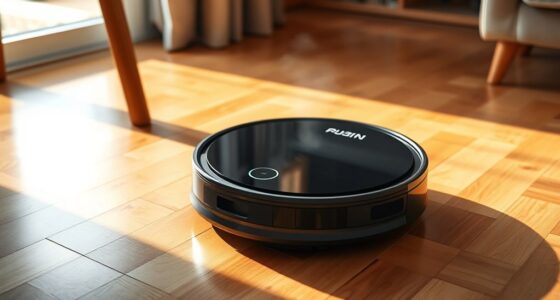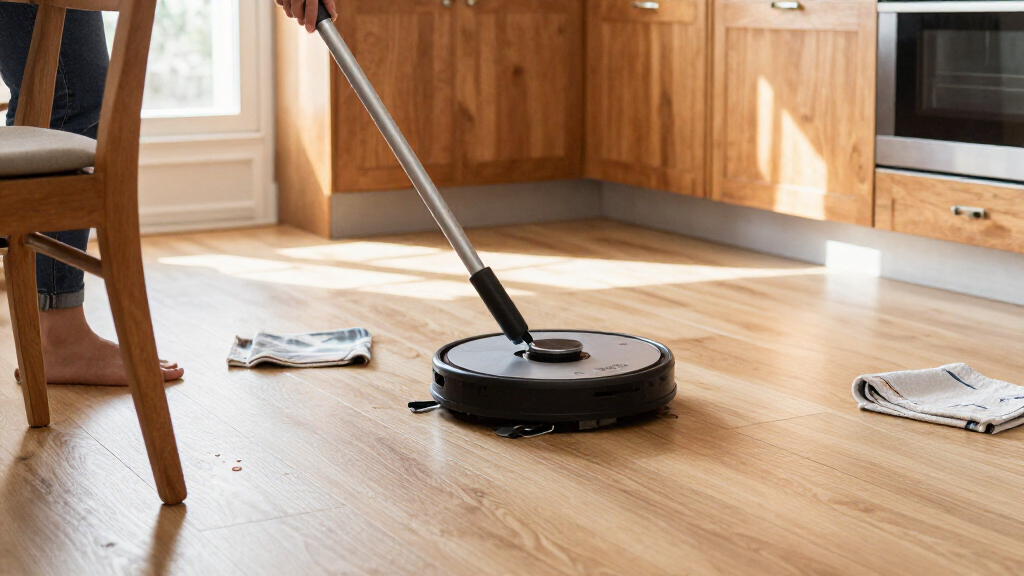

For most kitchens, I would start with the Roborock Qrevo S Pro: its vacuum-and-mop format and feature-rich dock make it the strongest all-around fit among these picks. The eufy C28 stands out for its roller-mop design, while the iRobot Braava Jet M6 suits buyers who want a dedicated mop rather than a combo unit. The main tradeoff is between focused hard-floor mopping and a single machine that also handles crumbs, plus how much dock maintenance you want to take on. Kitchen layouts, floor type, and everyday spills can change which choice makes sense. Read on for the full breakdown and guidance on matching a robot to your kitchen.

Get cleaning gear delivered free with Prime
- Fast, free delivery on millions of items
- Prime Video, Amazon Music and more included
- Member-only deals all year
Complete the kit


Key Takeaways
- The lineup splits into dedicated mops and vacuum-mop combos: the Braava Jet M6 and several Everybot models focus on hard-floor mopping, while most other picks also vacuum.
- Dock features separate convenience-focused picks: self-emptying models such as the Tikom L8000 Plus and Roborock Q7 M5+ reduce some routine bin work, but a dock does not eliminate mop-pad care.
- Different mop designs suit different routines: the Everybot options use spinning pads, while the eufy C28 uses a roller system; buyers should match the cleaning method to their spill and maintenance preferences.
- Strong suction is not the same as better kitchen mopping: several Roborock and combo models advertise substantial suction, but floor-wiping performance, water handling, and navigation matter more for dried splashes.
- Repeated model names need careful checking: the list includes two Roborock Qrevo S Pro entries, so compare the exact listing and included configuration rather than treating them as separate models.
| iRobot Braava Jet M6 Wi-Fi Robot Mop, White |  | Best Dedicated Mop for Kitchen Messes | Brand and model: iRobot Braava Jet M6 (6110) | Recommended surface: Hard floors | Battery life: 150 minutes | VIEW LATEST PRICE | See Our Full Breakdown |
| Tikom G8000 Max Robot Vacuum and Mop Combo |  | Best Value for Vacuum-and-Mop Basics | Suction power: 5,000 Pa | Dustbin capacity: 450 ml | Water tank capacity: 300 ml | VIEW LATEST PRICE | See Our Full Breakdown |
| Roborock Q10 S5+ Robot Vacuum and Mop |  | Best for Low-Maintenance Vacuuming with Mop Lift | Suction: 10,000 Pa | Dust bag capacity: 2.7 L | Battery life: 150 minutes | VIEW LATEST PRICE | See Our Full Breakdown |
| EVERYBOT EDEG2 Robot Mop for Hard Floors with Dual Spinning Mops |  | Best Quiet Scrubber for Hard Floors | Brand and model: EVERYBOT RS350 | Recommended surface: Hard floor | Water tank capacity: 210 ml (7.1 fl oz) | VIEW LATEST PRICE | See Our Full Breakdown |
| Roborock Qrevo S Pro Robot Vacuum and Mop, 18,500 Pa, Black |  | Best Premium Self-Cleaning Dock | Suction power: 18,500 Pa | Dust bag capacity: 2.7 L | Battery life: 180 minutes | VIEW LATEST PRICE | See Our Full Breakdown |
| Everybot Three-Spin Slim Robot Mop for Hard Floors |  | Best for Cleaning Under Low Furniture | Height: 3.27 inches | Weight: 5.3 lbs | Cleaning path width: 12.6 inches | VIEW LATEST PRICE | See Our Full Breakdown |
| Everybot Three-Spin Mopping Robot for Hard Floors with 3 Spinning Mops |  | Best for Straightforward Scrubbing | Dimensions: 12.8 × 12.05 × 3.9 inches | Weight: 2 kg | Water tank capacity: 0.3 L | VIEW LATEST PRICE | See Our Full Breakdown |
| ROPVACNIC S1 Robot Vacuum and Mop Combo, 5200 Pa |  | Best for App-Controlled Daily Cleanup | Maximum suction: 5200 Pa | Battery life: Up to 120 minutes | Suction levels: 3 | VIEW LATEST PRICE | See Our Full Breakdown |
| eufy C28 Robot Vacuum and Mop with HydroJet Roller and 15,000 Pa Suction |  | Best for Low-Touch Mop Maintenance | Suction power: 15,000 Pa | Mop roller width: 28 cm | Mop roller speed: 270 RPM | VIEW LATEST PRICE | See Our Full Breakdown |
| Tikom L8000 Plus Robot Vacuum and Mop with Self-Emptying Base |  | Best for Multi-Floor Homes | Maximum suction: 6000 Pa | Dust bag capacity: 3 L | Navigation: 360° LiDAR | VIEW LATEST PRICE | See Our Full Breakdown |
| Roborock Qrevo 2 Pro Robot Vacuum and Mop |  | Best for Pet Hair and Hands-Off Mop Care | Suction power: 20,000 Pa | Battery life: 253 minutes | Navigation: LiDAR with Reactive Tech obstacle avoidance | VIEW LATEST PRICE | See Our Full Breakdown |
| Madtue G2 Robot Vacuum and Mop Combo, 6500 Pa, Self-Charging, Anti-Tangle, 2.4 GHz Wi-Fi and App Control |  | Best Value for Basic Kitchen Maintenance | Model: G2 | Maximum suction: 6,500 Pa | Battery life: 120 minutes | VIEW LATEST PRICE | See Our Full Breakdown |
| Roborock Q7 L5 Robot Vacuum and Mop Combo, 8,000 Pa Suction |  | Best for Mapped Kitchen Cleaning on a Simpler Setup | Suction: 8,000 Pa | Navigation: LiDAR | Water tank capacity: 270 ml | VIEW LATEST PRICE | See Our Full Breakdown |
| Roborock Qrevo S Pro Robot Vacuum and Mop, 18,500 Pa Suction |  | Best Premium Pick for Spinning Mop Care | Suction: 18,500 Pa | Navigation: LiDAR | Battery life: 180 minutes | VIEW LATEST PRICE | See Our Full Breakdown |
| Roborock Q7 M5+ Robot Vacuum and Mop with Self-Emptying Dock |  | Best for Less-Frequent Dust Emptying | Maximum suction: 10,000 Pa | Navigation: PreciSense LiDAR | Dust bag capacity: 2.7 L | VIEW LATEST PRICE | See Our Full Breakdown |
| robot mops for kitchen floor | Battery life | Noise level | Navigation |
|---|---|---|---|
| iRobot Braava Jet M6 Wi-Fi Rob | 150 minutes | — | iAdapt 3.0 with vSLAM |
| Tikom G8000 Max Robot Vacuum a | Up to 150 minutes in quiet mode | 45 dB | — |
| Roborock Q10 S5+ Robot Vacuum | 150 minutes | — | LiDAR with multi-level mapping |
| EVERYBOT EDEG2 Robot Mop for H | — | 42 dB | — |
| Roborock Qrevo S Pro Robot Vac | 180 minutes | — | LiDAR with obstacle avoidance |
| Everybot Three-Spin Slim Robot | — | 43 dB | — |
| Everybot Three-Spin Mopping Ro | — | 43 dB | — |
| ROPVACNIC S1 Robot Vacuum and | Up to 120 minutes | — | — |
| eufy C28 Robot Vacuum and Mop | Up to 140 minutes | 54.89 dB | Camera-free LiDAR |
| Tikom L8000 Plus Robot Vacuum | — | 60 dB | 360° LiDAR |
| Roborock Qrevo 2 Pro Robot Vac | 253 minutes | 54 dB | LiDAR with Reactive Tech obstacle avoidance |
| Madtue G2 Robot Vacuum and Mop | 120 minutes | 58 dB | — |
| Roborock Q7 L5 Robot Vacuum an | 150 minutes | 60 dB | LiDAR |
| Roborock Qrevo S Pro Robot Vac | 180 minutes | — | LiDAR |
| Roborock Q7 M5+ Robot Vacuum a | 150 minutes | 65 dB | PreciSense LiDAR |
More Details on Our Top Picks
iRobot Braava Jet M6 Wi-Fi Robot Mop, White
The Braava Jet M6 is my pick for kitchens where sticky spills and grease matter more than vacuuming. Its precision jet spray targets messes on hard floors, while smart mapping lets me send it through the kitchen or multiple rooms rather than relying on a simple random route. It can recharge and resume, a practical advantage for larger floor plans. Compared with the EVERYBOT EDEG2, it adds app and voice control plus mapped multi-room cleaning; the EVERYBOT instead uses dual spinning pads for scrubbing and offers quieter operation. The M6’s tradeoff is that it does not vacuum up dry debris, and it needs a mopping or sweeping pad attached. I’d choose it when targeted wet cleaning is the priority, not as an all-in-one floor cleaner.
Pros:- Precision jet spray is aimed at sticky messes and kitchen grease.
- Smart mapping supports targeted cleaning across multiple rooms.
- Automatically recharges and resumes a cleaning run.
- Works with the iRobot app and Alexa or Google Assistant.
Cons:- Does not vacuum dry crumbs, dust, or other debris.
- Requires attaching a mopping or sweeping pad before cleaning.
- Designed for hard floors rather than mixed carpeted areas.
Best for: Households with hard-floor kitchens that want mapped, app-controlled mopping for sticky food spills and grease.
Not ideal for: Buyers who want one robot to collect crumbs and mop in the same run, or homes with substantial carpet.
- Brand and model:iRobot Braava Jet M6 (6110)
- Recommended surface:Hard floors
- Battery life:150 minutes
- Navigation:iAdapt 3.0 with vSLAM
- Controls:App and voice control
- Dimensions:10.6 × 10.6 × 3.5 inches
- Weight:4.9 pounds
- Warranty:1-year limited
Our verdict“Choose the Braava Jet M6 if mapped, dedicated wet cleaning matters more than having vacuuming built in.”
Tikom G8000 Max Robot Vacuum and Mop Combo
The Tikom G8000 Max suits a kitchen that needs crumb pickup and light mopping in one pass. Its 5,000 Pa suction and simultaneous vacuum-and-mop function give it a broader daily-cleaning role than the dedicated iRobot Braava Jet M6, which focuses on wet floor care. At just under 3 inches tall, the Tikom can also reach beneath some cabinets and furniture where taller robots may not fit. Multiple controls—app, remote, voice, and onboard buttons—make it approachable for households that prefer a physical remote as a fallback. There are limits: the stated 150-minute runtime is in quiet mode, and carpet support is specified for short- and medium-pile rugs, not every carpet type. Its mopping is part of a combo clean, so buyers seeking a dedicated scrubbing machine should look to the EVERYBOT EDEG2 instead.
Pros:- Can vacuum and mop simultaneously for everyday kitchen upkeep.
- 5,000 Pa suction is specified for pet hair, dust, and debris.
- Slim 2.99-inch profile can fit under some low-clearance furniture.
- Offers app, remote, voice, and button controls.
Cons:- The up-to-150-minute runtime applies to quiet mode.
- Carpet guidance is limited to short- and medium-pile carpets.
- Combo mopping is less specialized for scrubbing than the EVERYBOT EDEG2’s dual spinning pads.
Best for: Kitchen owners who want one lower-profile robot for routine crumbs, dust, and light damp cleaning on hard floors, with occasional short- or medium-pile carpet nearby.
Not ideal for: Buyers who need dedicated pad-based scrubbing for dried-on kitchen spills or who expect the listed maximum runtime at every setting.
- Suction power:5,000 Pa
- Dustbin capacity:450 ml
- Water tank capacity:300 ml
- Battery life:Up to 150 minutes in quiet mode
- Height:2.99 inches
- Noise level:45 dB
- Cleaning modes:Spot, edge, zig-zag, and manual
- Controls:App, remote, voice, and buttons
Our verdict“Pick the Tikom G8000 Max for flexible everyday pickup and mopping, rather than dedicated scrubbing of stubborn kitchen residue.”
Roborock Q10 S5+ Robot Vacuum and Mop
For kitchens that collect both crumbs and tracked-in grit, the Q10 S5+ pairs strong vacuuming with sonic mopping. Its mop scrubs up to 3,000 times per minute, while LiDAR mapping and obstacle avoidance support planned routes around furniture and kitchen clutter. The self-emptying 2.7 L dust bag reduces how often I need to deal with vacuum debris compared with the Tikom G8000 Max, which has a 450 ml dustbin. Carpet detection and an 8 mm mop lift help when the kitchen connects to rugs, although that lift is modest rather than a way to keep the mop far above every thick carpet. Compared with the more automated Roborock Qrevo S Pro, the Q10 S5+ lacks the described mop-washing and drying dock. Its 2.4 GHz Wi-Fi requirement and listed 65 dB noise level also narrow its appeal.
Pros:- Sonic mopping provides up to 3,000 scrubs per minute.
- Self-emptying station holds a 2.7 L dust bag.
- LiDAR mapping and structured-light obstacle avoidance support planned cleaning.
- Detects carpets and lifts the mop up to 8 mm.
Cons:- Supports 2.4 GHz Wi-Fi only.
- Listed noise level is 65 dB.
- The dock does not include the mop-washing and drying functions described for the Roborock Qrevo S Pro.
Best for: Busy households with hard-floor kitchens and nearby rugs that want mapped vacuuming, sonic mopping, and less frequent dustbin emptying.
Not ideal for: Buyers seeking a dock that washes and dries mop pads, homes using only 5 GHz Wi-Fi, or people sensitive to louder cleaning noise.
- Suction:10,000 Pa
- Dust bag capacity:2.7 L
- Battery life:150 minutes
- Mopping system:VibraRise 2.0 sonic vibration, up to 3,000 scrubs per minute
- Mop lift:Up to 8 mm
- Navigation:LiDAR with multi-level mapping
- Obstacle avoidance:ReactiveTech structured light
- Wi-Fi:2.4 GHz
Our verdict“Choose the Q10 S5+ if mapped vacuuming, sonic kitchen mopping, and reduced dustbin handling matter more than automatic mop-pad washing.”
EVERYBOT EDEG2 Robot Mop for Hard Floors with Dual Spinning Mops
The EVERYBOT EDEG2 is the specialist choice here for a kitchen where quiet, pad-driven scrubbing is more appealing than a vacuum-mop combo. Its dual spinning discs use the robot’s weight and friction to work across hard floors, and a protruding mop is intended to improve edge and corner coverage. Four water levels let me adjust how much water it uses, while its 42 dB operation is quieter than the listed 65 dB for the Roborock Q10 S5+. It is not as hands-off as the iRobot Braava Jet M6: the EDEG2 relies on remote control rather than app-based mapping or voice control. It also has no vacuum function, so crumbs need another cleaner before or after mopping. This pick makes sense for focused hard-floor maintenance, not mixed-surface, fully automated cleaning.
Pros:- Dual spinning discs scrub hard floors using pressure and friction.
- Operates at a listed 42 dB.
- Four adjustable water levels allow different water delivery settings.
- Slim 3.5-inch profile and protruding mop support cleaning beneath furniture and along edges.
Cons:- Has no vacuum function, so it cannot collect dry kitchen debris.
- Designed for hard floors and is unsuitable for carpeted areas.
- Remote-only control lacks app connectivity and autonomous navigation.
Best for: People with hard-floor kitchens who want quiet, spinning-pad mopping and are comfortable controlling the robot with a remote.
Not ideal for: Households needing crumb pickup, carpet cleaning, app scheduling, or autonomous mapped room-by-room navigation.
- Brand and model:EVERYBOT RS350
- Recommended surface:Hard floor
- Water tank capacity:210 ml (7.1 fl oz)
- Noise level:42 dB
- Weight:3.2 pounds
- Height:3.5 inches
- Control method:Remote control
- Included components:Instruction guide, mop pads, and charging cradle
Our verdict“Pick the EDEG2 for quiet, dedicated hard-floor scrubbing if you are willing to handle dry debris separately and control it by remote.”
Roborock Qrevo S Pro Robot Vacuum and Mop, 18,500 Pa, Black
The Qrevo S Pro is the most hands-off option in this group for a kitchen connected to several floor types. Its dock empties dust, washes and dries the mops, and supports self-refilling, taking more routine upkeep off the owner than the Roborock Q10 S5+ dock, which is described as self-emptying. With 18,500 Pa suction, LiDAR navigation, obstacle avoidance, and multi-floor mapping, it is built for a broader whole-home routine than a kitchen-only mop such as the EVERYBOT EDEG2. The 10 mm mop lift helps when the route includes carpet, and anti-tangle brushes suit homes dealing with hair. This convenience comes with a larger system and network limits: it supports 2.4 GHz Wi-Fi only, and its listed noise figures vary between 55 and 60 dB. It is a lot of automation for buyers who only need occasional kitchen mopping.
Pros:- Dock empties dust, washes and dries mops, and supports self-refilling.
- 18,500 Pa suction and anti-tangle brushes suit homes with hair and dry debris.
- LiDAR navigation, obstacle avoidance, and multi-floor mapping support tailored routes.
- Lifts the mop up to 10 mm when moving across carpet.
Cons:- Supports 2.4 GHz Wi-Fi only.
- Listed noise level varies between 55 dB and 60 dB.
- Dock features and whole-home automation may be excessive for buyers seeking only occasional kitchen mopping.
Best for: Households with pets, mixed hard floors and carpet, and multiple floors that want a dock to handle dust disposal and mop care.
Not ideal for: Buyers who only need a simple kitchen mop, use 5 GHz-only Wi-Fi, or want to avoid the footprint and complexity of a multifunction dock.
- Suction power:18,500 Pa
- Dust bag capacity:2.7 L
- Battery life:180 minutes
- Mop lifting height:10 mm
- Navigation:LiDAR with obstacle avoidance
- Mop self-cleaning temperature:167°F
- Mop drying temperature:113°F
- Supported Wi-Fi:2.4 GHz only
Our verdict“Choose the Qrevo S Pro if you want a whole-home robot whose dock handles much of the dust and mop maintenance.”
Everybot Three-Spin Slim Robot Mop for Hard Floors
For kitchen floors where crumbs and dried splashes collect beneath cabinets or low furniture, the 3.27-inch profile is this Everybot’s main advantage. Its three-motor, wheelless design presses the pads against the floor, a better fit for stubborn spots than a basic maintenance pass. It also runs for up to 200 minutes and operates at a reported 43 dB, so it can cover a larger area without adding much noise. Compared with the taller Everybot Three-Spin Mopping Robot, this model is the stronger choice for reaching under obstacles, while the taller version lists a 300 ml tank. The tradeoff is hands-on control: there’s no app or Wi-Fi scheduling, and the remote is central to choosing modes.
Pros:- Low 3.27-inch height can reach under more furniture than the other listed Everybot Three-Spin model.
- Three-motor wheelless design applies downward pressure for targeted stain scrubbing.
- Up to 200 minutes of runtime suits longer cleaning sessions.
- Reported 43 dB operation is suited to quieter cleaning.
Cons:- No Wi-Fi, app, or voice control for scheduling and remote monitoring.
- Mode selection depends on the included remote rather than a smartphone interface.
Best for: Kitchen owners with low-clearance furniture who want quiet, extended hard-floor mopping and are comfortable using a remote.
Not ideal for: Buyers who want app scheduling, voice control, or a robot that can also vacuum kitchen debris.
- Height:3.27 inches
- Weight:5.3 lbs
- Cleaning path width:12.6 inches
- Battery runtime:Up to 200 minutes
- Battery type:Lithium-ion
- Noise level:43 dB
- Controls:Button and remote control
- Warranty:1 year
Our verdict“Choose this Everybot if low-clearance access and quiet, long-running mop sessions matter more than app control or vacuuming.”
Everybot Three-Spin Mopping Robot for Hard Floors with 3 Spinning Mops
The three independently spinning pads make this Everybot a focused choice for kitchen tile or other hard floors that need more than a light wipe. Its 43 dB operating noise and remote control keep the setup simple: there’s no app pairing or Wi-Fi configuration. Against the slimmer Everybot Three-Spin Slim, this model gives up some under-furniture access and runtime, but it specifies a 300 ml water tank and seven power levels. That makes it a practical pick for buyers who want adjustable scrubbing without smart-home features. The compromises are clear for kitchen use: it doesn’t vacuum crumbs, its tank may need refilling across larger floor areas, and its hard-floor focus makes it a poor choice for homes expecting one robot to cover carpet too.
Pros:- Three spinning pads scrub hard floors rather than relying on a passive wipe.
- 300 ml water tank supports a dedicated mopping session.
- Reported 43 dB noise level suits quieter cleaning.
- Remote control and seven power levels allow direct, app-free operation.
Cons:- The 0.3 L tank may require refilling for larger kitchen and adjoining floor areas.
- Does not vacuum crumbs or other dry debris before mopping.
- At 3.9 inches tall, it is less suited to low-clearance spaces than the Everybot Three-Spin Slim.
Best for: People with mostly tile or other hard kitchen flooring who want spinning-pad scrubbing and uncomplicated remote operation.
Not ideal for: Households seeking vacuum-and-mop cleanup, app-based schedules, or a single robot for hard floors and carpet.
- Dimensions:12.8 × 12.05 × 3.9 inches
- Weight:2 kg
- Water tank capacity:0.3 L
- Battery runtime:Up to 120 minutes
- Noise level:43 dB
- Power levels:7
- Controls:Remote control
- Warranty:12 months
Our verdict“Pick this model for simple, quiet scrubbing on hard kitchen floors if you don’t need vacuuming or app controls.”
ROPVACNIC S1 Robot Vacuum and Mop Combo, 5200 Pa
The ROPVACNIC S1 suits kitchens where dry crumbs and light floor marks arrive together: it vacuums and mops in one run, with four-stage water adjustment and three suction levels. App, remote, and voice controls also make it more flexible to schedule than either Everybot Three-Spin model, which uses remote control. Its brush-free design and dual rotating side brushes are intended to reduce hair tangles, a useful detail for homes with pets. The key limitation is that the product information doesn’t specify water-tank capacity, so it’s harder to judge how much kitchen flooring a mopping run can cover. Its listed surfaces are hardwood and low-pile carpet, while the eufy C28 adds a self-cleaning roller and mop-washing station for buyers willing to prioritize more automated mop care.
Pros:- Combines vacuuming and mopping to collect crumbs and address light floor marks in one routine.
- Four-stage water adjustment allows mopping output to be varied.
- App, remote, and voice controls support flexible scheduling and operation.
- Brush-free design and dual side brushes are intended to reduce hair tangles.
Cons:- Water-tank capacity is not provided, making mopping coverage harder to estimate.
- Listed surface recommendations are limited to hardwood and low-pile carpet.
- Does not list the mop washing and drying station offered with the eufy C28.
Best for: Pet owners with hardwood kitchen floors who want scheduled vacuuming and adjustable mopping through an app or voice assistant.
Not ideal for: Buyers who need a known water capacity, self-washing mop care, or cleaning support for surfaces beyond hardwood and low-pile carpet.
- Maximum suction:5200 Pa
- Battery life:Up to 120 minutes
- Suction levels:3
- Water adjustment:Four-stage
- Compatible surfaces:Hardwood floors and low-pile carpets
- Controls:App, remote, touchpad, and voice
- Compatible devices:Amazon Echo, Google Home, and smartphones
- Filter:Multi-layer high-efficiency filtration
Our verdict“Choose the ROPVACNIC S1 for app- or voice-managed vacuum-and-mop routines on hardwood when the unspecified tank capacity is acceptable.”
eufy C28 Robot Vacuum and Mop with HydroJet Roller and 15,000 Pa Suction
For kitchens where the mop itself is the chore, the eufy C28’s HydroJet roller and all-in-one station set it apart: the roller self-cleans while mopping, and the station washes and dries the mop, empties dust, and collects wastewater. That reduces routine handling compared with the ROPVACNIC S1, whose description doesn’t list automated mop washing. Its camera-free LiDAR navigation and 10.8 mm mop lift also help it map rooms and cross short-pile carpet without dragging a wet roller across it. The tradeoff is a more involved dock and a 54.89 dB listed noise level. For kitchen buyers who only want a quiet, simple hard-floor mop, either Everybot is less elaborate; the C28 makes most sense when vacuuming and mop upkeep need automation too.
Pros:- HydroJet roller self-cleans while mopping.
- Station washes and dries the mop, empties dust, and collects wastewater.
- DuoSpiral brush is designed to reduce hair tangles.
- Camera-free LiDAR navigation and automatic mop lift support mixed hard-floor and short-pile-carpet homes.
Cons:- The all-in-one station requires more space than the simpler Everybot mop setup.
- Listed noise level is 54.89 dB, higher than the 43 dB Everybot models.
- Surface recommendations are limited to hard floors, wooden floors, and short-wool carpet.
Best for: Households with hard kitchen floors, shedding hair, and short-pile rugs that want automated mop washing, drying, and dust emptying.
Not ideal for: Buyers seeking a compact, quiet, mop-only machine or those who don’t want to accommodate an all-in-one station.
- Suction power:15,000 Pa
- Mop roller width:28 cm
- Mop roller speed:270 RPM
- Battery life:Up to 140 minutes
- Dust bag capacity:3 L
- Mop drying:50°C hot air
- Mop lift:10.8 mm
- Navigation:Camera-free LiDAR
- Noise level:54.89 dB
Our verdict“Choose the C28 if you want a vacuum-mop that automates mop care and dust handling, rather than a simpler, quieter kitchen-only mop.”
Tikom L8000 Plus Robot Vacuum and Mop with Self-Emptying Base
The Tikom L8000 Plus is the strongest fit here for a home where kitchen cleanup is part of a larger, multi-floor routine. Its 360° LiDAR mapping can save up to five floor maps, while app and voice controls offer room selection, schedules, and restricted zones. A 3-liter self-emptying dust bag cuts down on vacuum debris handling, and the robot can recharge and resume a job. Compared with the eufy C28, the Tikom lists multi-floor map storage but doesn’t specify automated mop washing or drying; it’s more about mapped vacuum-and-mop coverage than hands-off mop maintenance. There’s also a kitchen-specific catch: the mop holder must come off, or carpet needs a no-go zone, during mopping. Its 150-minute runtime applies only in gentle suction mode.
Pros:- LiDAR navigation stores maps for up to five floors.
- Self-emptying base has a 3-liter dust bag.
- App and voice controls support room selection, schedules, and restricted zones.
- Automatic recharge and resume can continue longer cleaning jobs.
Cons:- Mop holder must be removed or carpet marked as a no-go zone during mopping.
- The up-to-150-minute runtime is specified only for gentle suction mode.
- Unlike the eufy C28, the listed features don’t include automated mop washing and drying.
Best for: Owners of multi-floor homes who want mapped room cleaning, app or voice controls, and less frequent dustbin emptying.
Not ideal for: Buyers who want a mop that washes and dries itself, or who need uncomplicated mopping across rooms with carpet.
- Maximum suction:6000 Pa
- Dust bag capacity:3 L
- Navigation:360° LiDAR
- Saved floor maps:Up to 5
- Runtime:Up to 150 minutes in gentle suction mode
- Water flow settings:3
- Connectivity:2.4 GHz and 5 GHz Wi-Fi
- Noise level:60 dB
- Filter:HEPA
Our verdict“Pick the L8000 Plus for mapped vacuum-and-mop routines across several floors if you can manage its carpet restrictions during mopping.”
Roborock Qrevo 2 Pro Robot Vacuum and Mop
The Qrevo 2 Pro is the strongest fit here for kitchens that collect both pet hair and stuck-on everyday debris. Its 20,000 Pa suction and Dual Zero-Tangle System target hair pickup while limiting brush cleanup, and FlexiArm reaches along edges where crumbs often gather. The dock also empties dust, refills water, and dries the mops with warm air, so upkeep is more automated than on the Roborock Q7 L5, which has a smaller tank and no comparable dock functions listed. The tradeoff is a large dock footprint, plus 2.4 GHz-only Wi-Fi and Reactive Tech obstacle avoidance rather than an AI-based system. Choose it for reduced routine maintenance, not for a compact setup or the most advanced obstacle handling.
Pros:- 20,000 Pa suction and a Dual Zero-Tangle System suit kitchens with pet hair and tracked-in debris.
- FlexiArm is designed to reach edges and corners where crumbs collect.
- Dock handles dust emptying, water refilling, and warm-air mop drying.
- 253-minute battery life supports longer cleaning sessions.
Cons:- Multifunction dock takes substantial floor space.
- Wi-Fi is limited to 2.4 GHz.
- Reactive Tech obstacle avoidance may be less capable than AI-based systems.
Best for: Pet households with open kitchen floor space that want strong hair pickup and automated mop and dust maintenance.
Not ideal for: Apartment kitchens with little room for a dock, or homes that rely on 5 GHz Wi-Fi or need advanced obstacle recognition.
- Suction power:20,000 Pa
- Battery life:253 minutes
- Navigation:LiDAR with Reactive Tech obstacle avoidance
- Noise level:54 dB
- Control methods:App, voice, and button
- Surface compatibility:Hard floor, marble, wood, tile, and carpet
- Connectivity:2.4 GHz Wi-Fi
- Dock functions:Self-empties dust, refills water, and dries mops with warm air
Our verdict“Choose the Qrevo 2 Pro if pet hair and minimizing mop upkeep matter more than dock size or advanced obstacle detection.”
Madtue G2 Robot Vacuum and Mop Combo, 6500 Pa, Self-Charging, Anti-Tangle, 2.4 GHz Wi-Fi and App Control
The Madtue G2 keeps the setup straightforward: it combines vacuuming and wet mopping, returns to its charging dock, and has a removable 500 ml water tank. That makes it a practical match for regular crumbs and light floor upkeep on hard surfaces, without the larger maintenance dock found on the Roborock Qrevo 2 Pro. Its 6,500 Pa suction and anti-tangle port add useful help with everyday debris and pet hair, but the product data does not list LiDAR mapping or no-go-zone controls, so I would not treat it as the most precise choice for a kitchen with many obstacles or room boundaries. A 120-minute battery life and hard-floor-focused recommendations also make it better suited to modest routines than whole-home, mixed-floor demands.
Pros:- Combines vacuuming and wet mopping in one routine.
- Removable 500 ml water tank makes refilling and handling more direct.
- Anti-tangle suction port is designed for pet hair.
- Automatically returns to its charging dock.
Cons:- Supports 2.4 GHz Wi-Fi only.
- 120-minute battery life is shorter than the Roborock Qrevo 2 Pro’s listed runtime.
- Product data does not specify LiDAR mapping or no-go-zone features.
Best for: Shoppers who want a basic vacuum-and-mop routine for a hard-floor kitchen, with a removable tank and simple controls.
Not ideal for: Buyers who need mapped room cleaning, detailed no-go zones, 5 GHz Wi-Fi, or regular cleaning across larger mixed-floor homes.
- Model:G2
- Maximum suction:6,500 Pa
- Battery life:120 minutes
- Water tank capacity:500 ml
- Cleaning path width:6.81 inches
- Noise level:58 dB
- Surface recommendation:Hard floor, hardwood, and low-pile carpet
- Controls and connectivity:App, button, and voice; 2.4 GHz Wi-Fi
Our verdict“Pick the G2 for uncomplicated hard-floor kitchen upkeep, but choose a mapped model if you need more control over where it cleans.”
Roborock Q7 L5 Robot Vacuum and Mop Combo, 8,000 Pa Suction
For a kitchen where reliable room coverage matters more than dock automation, the Roborock Q7 L5 offers a useful middle ground. Its LiDAR navigation maps rooms, while scheduling and no-go zones let you keep the robot away from areas that should stay dry or cluttered. It can vacuum and mop at the same time, which is more flexible for routine cleaning than the Madtue G2’s less-specified navigation setup. Compared with the Roborock Q7 M5+, though, the L5 has less suction and a much smaller 270 ml water tank, and its listed features do not include a self-emptying dock. That smaller reservoir may mean more refills during frequent kitchen runs. It makes sense for buyers who want mapped cleaning without stepping up to a multifunction dock.
Pros:- LiDAR mapping supports room-aware cleaning and multiple floor maps.
- Vacuuming and mopping can run simultaneously with three water levels.
- App and voice controls include schedules and no-go zones.
- Dual anti-tangle brushes are designed to reduce hair wrap.
Cons:- The 270 ml water tank is smaller than the Madtue G2’s 500 ml tank.
- 2.4 GHz Wi-Fi only.
- No self-emptying or mop-washing dock is listed.
Best for: Households that want LiDAR-mapped kitchen routines, app scheduling, and no-go zones without a multifunction dock.
Not ideal for: People who want long intervals between refills or automated dust disposal, or kitchens that need larger-capacity mopping.
- Suction:8,000 Pa
- Navigation:LiDAR
- Water tank capacity:270 ml
- Battery life:150 minutes
- Noise level:60 dB
- Power levels:6
- Surface recommendations:Carpet, laminate, tile, vinyl, wood, and marble
- Controls and connectivity:App, buttons, and voice; 2.4 GHz Wi-Fi
Our verdict“Choose the Q7 L5 for mapped, customizable kitchen cleaning if you can accept a small water tank and manual dock upkeep.”
Roborock Qrevo S Pro Robot Vacuum and Mop, 18,500 Pa Suction
The Qrevo S Pro is the premium choice for buyers who want the robot to handle more of the mop-cleaning cycle, not just the kitchen floor. Its dual liftable spinning mops pair with a dock that washes, dries, and refills, while automatic mop lifting and carpet settings help it move between kitchen tile and nearby rugs. Compared with the Roborock Q7 L5, it offers much more dock automation and a spinning-mop system, but the L5 is the simpler fit if you mainly want mapped vacuuming and mopping. The Qrevo’s 18,500 Pa suction is also below the Qrevo 2 Pro’s 20,000 Pa, while its 180-minute battery life is shorter. Its 3.8-inch height can restrict access under low cabinets or furniture, and the dock needs dedicated space.
Pros:- Dock empties dust, washes and dries mops, and refills the robot.
- Dual liftable spinning mops suit more active hard-floor mopping.
- Carpet settings include boosted suction and automatic mop lifting.
- LiDAR navigation supports customized cleaning.
Cons:- The 3.8-inch height may prevent access beneath low-clearance furniture.
- Robot and dock need dedicated indoor floor space.
- Its 18,500 Pa suction and 180-minute runtime are below the Qrevo 2 Pro’s listed figures.
Best for: Buyers with mixed kitchen and carpet areas who want spinning mops, automatic mop care, and carpet-aware cleaning.
Not ideal for: Homes with low-clearance furniture or tight floor space for a dock, and buyers who want the longest runtime or highest suction in this group.
- Suction:18,500 Pa
- Navigation:LiDAR
- Battery life:180 minutes
- Dust bag capacity:2.7 L
- Mop lift:10 mm
- Mop self-cleaning temperature:167°F
- Mop drying:113°F warm air
- Height:3.8 inches
Our verdict“Choose the Qrevo S Pro if automatic spinning-mop care and carpet handling outweigh its height, dock footprint, and shorter runtime.”
Roborock Q7 M5+ Robot Vacuum and Mop with Self-Emptying Dock
The Roborock Q7 M5+ is a practical step up from the Q7 L5 for kitchens where vacuum debris is the bigger recurring chore. Its 2.7 L sealed dust bag is designed to collect debris for up to 7–9 weeks, reducing how often you need to empty the robot, while LiDAR mapping and no-go zones support scheduled cleaning. Three water-flow settings give some control over routine mopping, but this is not the mop-care setup of the Roborock Qrevo S Pro, whose dock washes and dries its mops. The M5+ instead prioritizes dust capacity and a simpler mopping system. Its 10,000 Pa suction sits between the Q7 L5 and the Qrevo models, and the listed 65 dB noise level may be less welcome during kitchen cleaning.
Pros:- Large 2.7 L sealed dust bag is designed for extended intervals between emptying.
- PreciSense LiDAR supports mapped cleaning and scheduled routes.
- Three water-flow settings allow some adjustment for kitchen floors.
- Dual anti-tangle brushes are designed to reduce pet-hair wrap.
Cons:- Noise level is listed at 65 dB.
- Mopping offers three water-flow settings rather than more detailed adjustment.
- Unlike the Qrevo S Pro, the listed dock does not wash or dry mops.
Best for: Busy households that want mapped kitchen cleaning and fewer dustbin-emptying chores, but do not need a mop-washing dock.
Not ideal for: Buyers who prioritize quiet operation, finely adjustable mopping, or automated mop washing and drying.
- Maximum suction:10,000 Pa
- Navigation:PreciSense LiDAR
- Dust bag capacity:2.7 L
- Battery life:150 minutes
- Water flow settings:3
- Cleaning path width:12.8 inches
- Noise level:65 dB
- Wi-Fi:2.4 GHz only
Our verdict“Pick the Q7 M5+ if reducing dust-emptying chores matters more than quiet operation or automated mop care.”
How We Picked
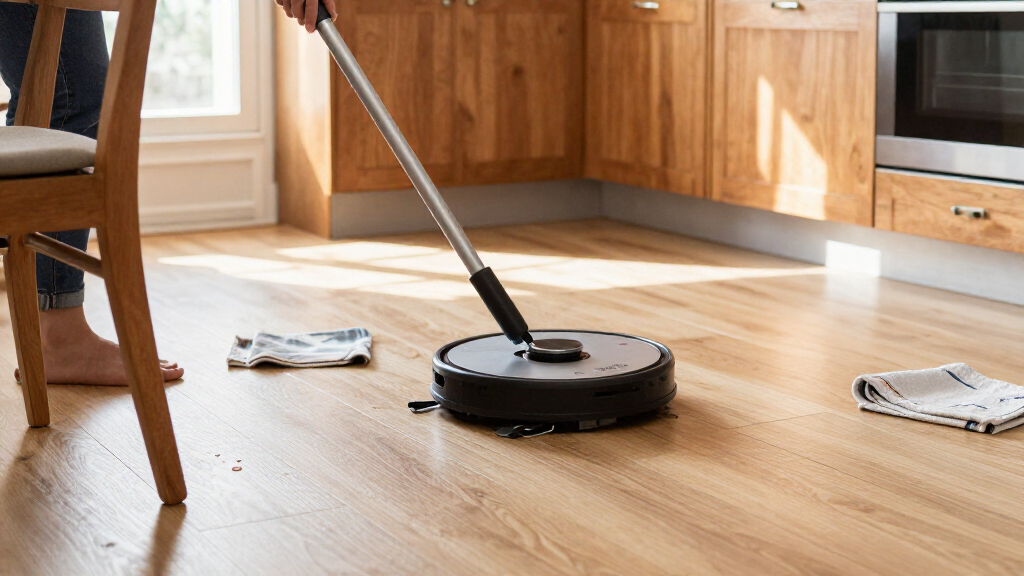
I compared these 15 options around the needs that make kitchen floors different from other rooms: crumbs and debris, frequent small spills, hard-floor coverage, and the desire to avoid extra daily chores. I gave weight to whether a product is a dedicated mop or a vacuum-mop combo, its stated cleaning approach, available dock features, and the expected upkeep of pads, rollers, tanks, and bins. I also considered how useful each type is for a kitchen with mixed flooring, furniture, or a nearby dining area.
The ranking favors a balance of mopping usefulness, day-to-day convenience, and versatility rather than suction claims alone. That puts the Roborock Qrevo S Pro near the top as a feature-rich combo, while the eufy C28 earns distinction for its roller approach and the Braava Jet M6 for dedicated mopping. Lower-ranked options may be a better fit for specific budgets or preferences, but offer fewer advantages across the full range of kitchen tasks. The two Qrevo S Pro entries appear to name the same model with different wording, so I treat them as one product configuration rather than two meaningfully distinct choices.
Factors to Consider When Choosing Robot Mops For Kitchen Floors
A kitchen robot should fit the way messes happen in your home, not just the room’s square footage. I would settle the following questions before choosing a mop style, dock, or app feature set.
Choose Between a Dedicated Mop and a Combo
A dedicated robot mop puts its effort into wiping hard floors, while a combo can collect dry debris before or alongside mopping. If crumbs, pet hair, or cereal are common, a combo may replace more of your routine cleaning. A dedicated mop can make more sense when a separate vacuum already handles debris and your priority is frequent floor wiping. One common mistake is assuming every combo scrubs as well as a purpose-built mop; mop mechanics and water control matter, not just the word “mop” on the box. Consider whether you want one appliance to do two jobs or a focused device that complements what you already own.
Match the Mop Mechanism to Your Spills
Pad-based, spinning-pad, and roller systems approach floor contact differently, and each asks for a different kind of care. Spinning pads may suit routine wipe-downs, while a roller design may appeal to buyers who prefer a continuous cleaning surface. Neither mechanism automatically guarantees better results on sticky or dried-on messes. Think about whether your typical problem is light footprints, cooking splashes, or food residue that needs attention before a robot pass. Check how the manufacturer instructs you to clean or replace the contact parts, since a neglected mop surface can spread grime rather than remove it.
Treat Dock Convenience as a Tradeoff
A self-emptying base can cut down on handling vacuum debris, which is useful in a kitchen that collects crumbs every day. More advanced docks may also reduce some mop-related chores, but buyers should verify exactly which tasks the dock performs. A base takes up floor space and adds another area to keep clean; it does not make the whole system maintenance-free. Before paying for dock features, measure the intended parking spot and check whether the base can sit near an outlet without blocking a walkway. If you run the robot often, convenience may matter more than a compact footprint; for occasional cleaning, a simpler setup may be easier to live with.
Check Floor Compatibility and Water Control
Kitchen floors can include sealed tile, vinyl, stone, or wood, and each surface may have different care instructions. Confirm that the robot’s wet-cleaning method is appropriate for your specific flooring, especially if you have delicate finishes or seams that should not stay damp. Look for clear control over water use and cleaning settings rather than assuming a single mode suits every surface. Rugs near sinks and doorways also complicate mopping, so consider how the robot handles carpet boundaries and no-mop areas. When the floor maker recommends limited moisture, that guidance should take priority over a robot’s general hard-floor claims.
Plan for Navigation, Obstacles, and Scheduling
Kitchen chairs, pet bowls, narrow gaps, and cords can interrupt a cleaning run more than open floor area does. Map controls and restricted zones help keep a robot away from water bowls, rugs, or clutter, but they still rely on a workable layout and sensible setup. Think about whether you can clear the floor before scheduled runs or need the robot to work around everyday obstacles. A smaller kitchen may benefit more from reliable access under tables than from headline suction figures. If you want routine cleaning while away, check app and scheduling functions and decide whether the setup feels manageable for everyone in the household.
Budget for Upkeep, Not Just the Machine
Robot mops need regular attention to pads or rollers, tanks, filters, brushes, and bins, with the exact list varying by design. Before choosing, find out which parts are washable, which need replacement, and how easily they can be removed for cleaning. Combo models may add vacuum components to the maintenance list, while dedicated mops can still need frequent pad care. Paying more makes sense when the added dock or automation removes a task you genuinely dislike; it is less compelling if the extra hardware adds space and upkeep without solving a daily problem. The best match is the one whose maintenance routine you are likely to keep up with.
Frequently Asked Questions
Should I choose a dedicated robot mop or a vacuum-mop combo for my kitchen?
I would choose a combo if your kitchen routinely collects crumbs, hair, or dry food debris and you want one robot to handle both jobs. A dedicated mop is a better match when you already have a vacuum and want a separate machine focused on hard-floor wiping. Do not assume a combo’s mop attachment will replace more intensive scrubbing for sticky spills. Compare how each model handles debris before mopping and what it requires after a run. Your existing cleaning tools and everyday messes should decide the category.
Can a robot mop handle dried food or sticky kitchen spills?
Some mop designs may handle routine residue better than a light wipe, but a robot is not a substitute for promptly removing thick or dried-on food. Results depend on the spill, the floor surface, the mop mechanism, and the machine’s cleaning settings. I would lift solid food and blot liquids before sending a robot over the area. Check the manufacturer’s guidance for spot cleaning and avoid letting a robot drag a sticky mess across a wider section of floor. For recurring cooked-on splashes, plan for occasional manual scrubbing even if the robot runs often.
Is a self-emptying dock worth choosing for kitchen cleaning?
It can be useful if the robot vacuums crumbs frequently and you want fewer trips to empty its debris bin. The feature is less decisive if your main goal is mopping, because self-emptying a vacuum bin does not necessarily clean or dry mop parts. Check the exact dock functions and the space it needs before choosing a model around the base. Also account for ongoing care of the dock, bags or other consumables where applicable, and the robot’s water system. I would pay for the dock when reduced vacuum-bin handling solves a regular annoyance.
What should I check before using a robot mop on wood or mixed flooring?
Start with the flooring manufacturer’s cleaning guidance, especially for wood, stone, and surfaces with sensitive finishes. Confirm that the robot supports settings suited to the floor and that you can keep it away from rugs or areas that should remain dry. A kitchen that opens into another room may need mapped boundaries or no-mop zones to avoid unwanted wet cleaning. Do not rely on a general “hard floor” label as proof that every finish is compatible. If you cannot control moisture or restrict the route adequately, a manual mop may be the safer choice for that section.
Why are two Roborock Qrevo S Pro entries listed, and how should I compare them?
The supplied product list includes two entries named Roborock Qrevo S Pro, one with a stated suction figure and one without it. That wording alone does not establish that they are different machines. Check the exact model identifier, included dock, region, and listed accessories before treating the entries as separate options. If those details match, compare the same model once rather than reading the duplicate as an alternative. This check also helps avoid choosing a listing whose included configuration differs from the one you expected.
Conclusion
For most buyers, I would choose the Roborock Qrevo S Pro as the best overall because it combines vacuuming and mopping with a feature-rich dock. The best premium direction is the same Qrevo S Pro when you want an advanced combo setup and can accommodate its dock; the duplicate listing should be checked for configuration rather than treated as a separate model. For a dedicated-mop beginner, the iRobot Braava Jet M6 is the clearest focused option, while buyers seeking a distinctive mop mechanism can look at the eufy C28 and its roller design. I would treat the Tikom G8000 Max as a value-oriented combo to investigate if you want vacuuming and mopping without moving to a more elaborate dock setup, while the Everybot spinning-mop models fit shoppers who already have vacuuming covered. Choose by your main kitchen mess and maintenance tolerance: debris-heavy households benefit from a combo, while homes focused on hard-floor wiping may prefer a dedicated mop.