For hydroponic growers, maintaining optimal nutrient and pH levels is essential for healthy plant growth. A hydroponic auto dosing pump system automates this process, saving time and reducing errors. The best systems offer precise control and reliable operation, but they vary widely in features, complexity, and price. The top pick for overall performance is the Automatic pH Controller with Dosing Pump, thanks to its dual relay output and compatibility. Meanwhile, the AC Infinity Peristaltic Dosing Pump stands out for its adjustable dosing levels and quiet operation. However, higher-end models tend to be more expensive and complex to set up, while budget options may lack advanced features. Continue reading for a detailed comparison to find the right fit for your hydroponic needs.

Get cleaning gear delivered free with Prime
- Fast, free delivery on millions of items
- Prime Video, Amazon Music and more included
- Member-only deals all year
Complete the kit


Key Takeaways
- Precision control of pH and nutrient dosing is critical for optimal plant growth in hydroponics.
- Models with adjustable dosing levels and temperature compensation offer better customization and accuracy.
- Ease of setup and user interface significantly impact day-to-day usability, especially for beginners.
- Higher-priced systems generally provide more advanced features like Wi-Fi connectivity and data logging.
- Balancing cost and features is key; budget models may lack reliability or advanced control options.




More Details on Our Top Picks
Automatic pH Controller with Dosing Pump & Dual Relay Output for Aquariums and Hydroponics
This digital pH controller excels in automating pH regulation for both hydroponic systems and aquariums, offering a comprehensive set of features including a data chart display for trend analysis and automatic temperature compensation. Unlike the simpler pH Controller with Dual Relay Output & Dosing Pump, this model integrates detailed monitoring with multifunctionality, making it suitable for users who want precise control and data insights. However, its setup can be complex, and space for wall mounting may be a concern. The combination of automatic dosing, data tracking, and temperature adjustment makes it a versatile choice for dedicated growers or aquarists who need reliable pH stability and want to analyze trends over several days.
Pros:- Automates pH regulation with precision
- Includes data chart for long-term trend analysis
- Automatic temperature compensation enhances accuracy
- Multifunctional with max/min/avg readings
Cons:- Requires wall mounting space
- Setup can be complex for beginners
- Limited to specific applications
Best for: Professional hydroponic growers or serious hobbyists seeking comprehensive pH control and trend analysis.
Not ideal for: Beginners or those with limited space who prefer plug-and-play solutions without complex setup.
- Dosing Pumps:Yes
- Dual Relay Output:Yes
- Data Chart Display:Yes
- Temperature Compensation:Yes
- Functions:Max/Min/Avg, Dose Count
Our verdict“This product suits experienced users who prioritize detailed data and automatic control over simplicity.”
AC Infinity Peristaltic Dosing Pump, Precise 10-Level Liquid Dosing Control
Compared with the more advanced pH controllers, the AC Infinity Peristaltic Dosing Pump provides highly adjustable liquid dosing across 10 levels, ideal for applications requiring steady nutrient or additive delivery. Its quiet operation and WiFi app control make it a flexible option for users who want to automate dosing with minimal noise and energy use. However, full functionality depends on WiFi connectivity and compatible controllers, which could be a limitation for users seeking a completely standalone device. This pump is especially suited for hobbyists or small-scale commercial setups that value customizable dosing and remote operation without the complexity of integrated pH monitoring.
Pros:- Precise 10-level liquid dosing control
- Quiet, energy-efficient operation
- WiFi app and smart controller compatibility
- Leak-free, sealed system for safety
Cons:- Requires WiFi and compatible controllers for full use
- Limited to liquid applications only
Best for: Hydroponic growers and hobbyists needing adjustable, remote-controlled liquid dosing.
Not ideal for: Users seeking integrated pH monitoring or those without reliable WiFi connection, as full features depend on network compatibility.
- Flow Rate:up to 210 mL per minute
- Dosing Levels:10 levels
- Interval Control:seconds intervals via WiFi app
- Compatibility:AI and UIS controllers
Our verdict“This pump is a smart, customizable choice for users focused on precise, remote liquid dosing in controlled environments.”
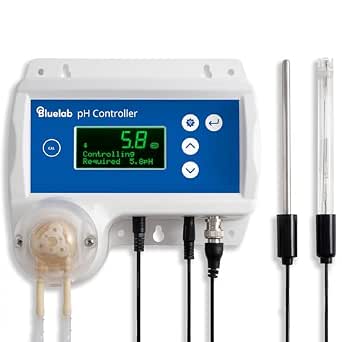
Bluelab pH Controller Wi-Fi, Automated Nutrient Dosing
The Bluelab pH Controller Wi-Fi stands out for remote operation, allowing users to monitor and adjust pH levels via a mobile app, which is a significant advantage over simpler wired systems like the pH Controller with Dual Relay Output & Dosing Pump. Its built-in safety lockouts and auto-resume features improve reliability, although it hinges on Wi-Fi connection for full functionality. This device makes sense for growers or aquarists who want the convenience of remote control combined with precise dosing, especially in setups where consistent pH regulation is critical. The limited user reviews, however, suggest that some may need to confirm long-term reliability.
Pros:- Remote monitoring and control via mobile app
- Precise dosing with built-in peristaltic pump
- Safety lockouts and auto-resume enhance reliability
- High/low pH alarms for safety
Cons:- Dependent on Wi-Fi connection for full features
- Limited detailed user feedback
Best for: Remote-minded growers or aquarists who need to control pH levels from afar with mobile convenience.
Not ideal for: Users without strong Wi-Fi connectivity or those preferring manual control, as remote features are central to this device.
- Connectivity:Wi-Fi (can be disabled)
- Control:Remote via mobile app
- Dosing Method:Peristaltic pump
- Maximum Pump Rate:120 ml/min
Our verdict“This model suits users wanting remote, automated pH management with reliable safety features and mobile control.”
pH Controller with Dual Relay Output & Dosing Pump, Digital pH Monitor with Auto Temperature Compensation for Hydroponics and Aquariums
Compared to simpler dosing systems like the AC Infinity pump, this digital pH controller offers advanced features such as dual relay output, data trend display, and auto temperature compensation, making it ideal for users who need consistent pH stability. Its detailed monitoring and automatic pH adjustment provide a higher level of control, but the setup can be complex and calibration critical for accuracy. This makes it a strong choice for experienced growers or professionals managing sensitive systems where pH fluctuations can impact plant or aquatic health. The higher cost and technical demands are tradeoffs for its precision and data tracking capabilities.
Pros:- Accurate pH measurement with auto temperature compensation
- Automatic pH adjustment for stability
- Data trend display and chart tracking
- Dual relay output for up/down pH control
Cons:- Complex setup requiring calibration
- Potentially higher cost compared to basic models
- Requires technical knowledge for optimal use
Best for: Experienced hydroponic or aquarium operators requiring stable pH control with detailed data monitoring.
Not ideal for: Beginners or hobbyists seeking a simple, plug-and-play solution without the need for calibration and setup.
- Type:pH Controller
- Features:Dual Relay Output, Dosing Pump, Auto Temp Compensation, Data Trend
- Application:Hydroponics, Aquariums
- Display:LCD
Our verdict“This device is tailored for users who need precise, automatic pH regulation with trend analysis and are comfortable with setup complexity.”
Peristaltic Pump 6L/Min Dosing Pump 12V 24V Water Pump for Liquid Transfer
Unlike the specialized pH or nutrient dosing systems, the Peristaltic Pump 6L/Min offers straightforward liquid transfer capabilities, making it suitable for general dosing tasks rather than precise pH control. Its high flow rate and durable aluminum alloy construction provide reliable performance in applications that require bulk liquid movement. However, it lacks integrated control features or data monitoring, which limits its use in sophisticated hydroponic auto dosing setups. This pump makes the most sense for users seeking a robust, high-volume liquid transfer pump that can be incorporated into a larger, custom automation system.
Pros:- High-strength aluminum alloy construction
- Compatible with 12V and 24V systems
- Reliable, long-lasting components
- High flow rate of 6L/min
Cons:- No detailed info on maximum pressure
- Lacks integrated control or monitoring
- Installation complexity may vary without instructions
Best for: Users needing a durable, high-flow liquid transfer pump for custom or large-scale dosing systems.
Not ideal for: Growers or hobbyists looking for precise, automatic pH or nutrient dosing solutions with control and monitoring features.
- Flow Rate:6L/Min
- Voltage:12V / 24V
- Material:High-strength aluminum alloy
- Application:Liquid transfer, dosing system
Our verdict“This pump suits users needing a tough, high-volume liquid transfer solution as part of a custom hydroponic system.”
Smart pH Controller with Dosing Pump – Dual Relay Output, LCD Display, Temp Compensation, Auto Data Logging for Hydroponics, Aquariums, Indoor Grow
This smart pH controller excels for growers who prioritize detailed data tracking and precise pH adjustments, especially compared to simpler units like the manual analog controllers. Its high-precision pH sensor with temperature compensation ensures reliable measurements, while the LCD display offers real-time insights. The inclusion of auto data logging and dual relay outputs enables automated pH adjustments, making it ideal for those managing complex nutrient schedules. However, its setup can be daunting for beginners and requires calibration for sustained accuracy. Compared to the Dual Relay pH Controller & Monitor, this model provides more detailed data logging but may be less intuitive for first-time users.
Pros:- High-precision pH measurement with temperature compensation
- Auto data logging supports long-term water quality tracking
- Dual relay outputs automate pH adjustments effectively
- Easy installation with included hardware
Cons:- Complex setup may challenge beginners
- Requires regular calibration for accuracy
- Durability details are limited, raising questions about long-term reliability
Best for: Hydroponic growers and aquarists who need accurate, logged pH control and are comfortable with technical setups
Not ideal for: Home gardeners or hobbyists seeking a plug-and-play solution due to its complex installation and calibration process
- Dimensions:7.7 x 4.7 x 1.7 inches
- Weight:4.19 pounds
- Sensor Type:High-precision pH sensor with temperature compensation
- Display:LCD screen
- Outputs:Dual relay outputs
- Includes:Peristaltic dosing pump, silicone tubing, mounting hardware
Our verdict“This pick is best suited for advanced users who need detailed data logging and precise pH control in their hydroponic systems.”
Dual Relay pH Controller & Monitor, Digital 0.00–14.00 pH Control for Hydroponics with Auto Dosing System, Temp Compensation, LCD Display, pH Temperature Monitor for Water Treatment & Grow Systems
This digital pH controller stands out for its high accuracy and broad measurement range, making it suitable for both hydroponic systems and water treatment setups. Its automatic temperature compensation and data tracking over a few days support consistent water quality management, similar to the Smart pH Controller but with a focus on high resolution and control precision. The larger size and more complex setup might deter casual users, and the price point could be a barrier for hobbyists. Unlike the previous model, this device offers a wider measurement range and a more straightforward digital interface, but at the expense of portability and simplicity.
Pros:- High-resolution pH measurement (0.00–14.00 pH)
- Supports automatic pH dosing with dual relay control
- Includes temperature compensation for stable readings
- Data tracking over up to 3 days enhances water condition monitoring
Cons:- Setup process may require technical expertise
- Bulkier design less suitable for tight spaces
- Cost could be prohibitive for casual users
Best for: Experienced hydroponic growers and water treatment professionals who need precise pH control with comprehensive data tracking
Not ideal for: Beginners or small-scale hobbyists who prefer simple, quick-install solutions due to its complexity and size
- Measurement Range:0.00–14.00 pH
- Resolution:0.1 pH
- Accuracy:±0.2 pH
- Temperature Compensation:Automatic (ATC)
- Data Tracking:Up to 3 days
- Power Input:100–240VAC
- Item Weight:4.19 pounds
- Package Dimensions:11.61 x 11.61 x 4.53 inches
Our verdict“This device is ideal for users who demand high accuracy and robust data management in their hydroponic or water treatment systems.”

How We Picked
The products in this roundup were evaluated based on performance, build quality, ease of use, and feature set. Priority was given to systems that ensure accurate, stable dosing with minimal maintenance. We also considered connectivity options like Wi-Fi or data logging, as these can enhance control and monitoring. Price was a factor but not the sole determinant; higher-value systems that offer durability and precision earned higher rankings. Our goal was to identify options suitable for a range of users—from beginners to advanced growers—while maintaining a focus on reliability and ease of integration into existing hydroponic setups.Factors to Consider When Choosing Hydroponic Auto Dosing Pump System
When selecting a hydroponic auto dosing pump system, understanding key factors can help you avoid common pitfalls and choose a setup that matches your growing needs. Consider the level of automation, compatibility with your existing system, and the ease of calibration. Budget constraints are important, but investing in a reliable, accurate system can improve crop yields and reduce manual labor over time. The right system balances precision, user controls, and durability, ensuring long-term satisfaction.Control Precision and Reliability
Accurate dosing depends on the system’s ability to maintain stable pH and nutrient levels. Look for pumps with adjustable flow rates and features like auto temperature compensation, which prevent dosing errors caused by environmental changes. Reliability is especially important in continuous operation; a system that clogs or drifts can compromise plant health and increase maintenance. Consider models with proven durability and consistent performance, even in demanding conditions.
Ease of Use and Setup
User-friendly interfaces, clear calibration procedures, and straightforward installation are essential, particularly for those new to automated systems. Features like LCD displays, simple controls, and Wi-Fi connectivity can streamline operation and monitoring. However, more advanced features may require additional training or technical knowledge, which could be a barrier for beginners. Prioritize intuitive design if you want hassle-free operation, but don’t sacrifice essential control features for simplicity.
Connectivity and Data Logging
Some systems include Wi-Fi or Bluetooth connectivity, enabling remote control and data monitoring. Data logging can help track system performance over time, revealing patterns or issues before they become critical. For commercial growers or serious hobbyists, these features add significant value, but they come at a higher cost and complexity. If you prefer a straightforward setup, a system without connectivity might suffice, but consider future scalability when making your choice.
Build Quality and Maintenance
Durability is key for long-term operation, especially in environments with water and nutrients. Look for corrosion-resistant materials and easy-to-clean components. Pumps with simple disassembly and maintenance routines minimize downtime and extend lifespan. Cheaper units may require more frequent repairs or replacements, which can negate initial savings. Investing in a well-built system pays off through consistent performance and lower ongoing costs.
Price and Value
While budget options are tempting, they often lack the durability or precision needed for stable hydroponic operation. Higher-priced systems tend to offer more features, better build quality, and longer warranties. Assess your specific needs: for hobbyists with small setups, a basic model may suffice; commercial growers should prioritize reliability and advanced controls. Consider long-term value rather than initial cost to ensure your investment supports healthy, productive plants.
Frequently Asked Questions
Do I really need an auto dosing system for hydroponics?
Auto dosing systems can significantly reduce manual labor and improve accuracy in maintaining optimal nutrient and pH levels. They help prevent issues caused by fluctuating water quality or environmental conditions, leading to healthier plants and potentially better yields. However, for very small or beginner setups, manual adjustments might be manageable. If you aim for consistent results and less daily maintenance, investing in an auto dosing system makes sense.
Can I upgrade my existing hydroponic system with an auto dosing pump?
Many auto dosing pumps are designed to be compatible with a variety of hydroponic setups, often through standard tubing or fittings. Before purchasing, check compatibility with your existing system’s size and control interfaces. Upgrading can be straightforward if the pump supports remote or automated operation, but some systems may require additional adapters or controllers. Compatibility and ease of integration are key factors to consider during purchase.
What maintenance is required for an auto dosing pump?
Regular maintenance typically involves cleaning the pump and tubing to prevent clogs and bacterial buildup, especially when dosing nutrient solutions. Calibration of dosing levels should be checked periodically to maintain accuracy. Some models feature easy disassembly for cleaning, which reduces downtime. Neglecting maintenance can lead to inaccuracies or pump failures, so choosing a model with simple upkeep can save time and prevent crop issues.
Are Wi-Fi-enabled dosing systems worth the extra cost?
Wi-Fi-enabled systems offer the convenience of remote monitoring and control, which can be a major advantage for busy or large-scale growers. They also often include data logging, alerts, and system diagnostics. However, they tend to be more complex and pricier, and require a stable internet connection. For hobbyists or small growers, a simpler, non-connected model may be sufficient, but for those wanting advanced control, the investment can be justified.
How do I choose the right dosing pump capacity?
The capacity needed depends on your hydroponic system size and the volume of water or nutrients you need to dose daily. Larger setups require higher flow rates to keep up with plant demands, while small systems may only need minimal dosing. Overestimating capacity can lead to unnecessary expense, but undersizing can result in insufficient dosing and inconsistent conditions. Evaluate your system’s volume and growth stage to select a pump that balances power and efficiency.
Conclusion
For those seeking a reliable, high-performance system that handles complex setups, the Automatic pH Controller with Dosing Pump is the best overall choice. Hobbyists or smaller growers on a budget might prefer the AC Infinity Peristaltic Dosing Pump for its balance of precision and affordability. Newcomers to automation will find the Smart pH Controller with Dosing Pump straightforward and easy to operate, making it ideal for beginners. Commercial growers or tech-savvy enthusiasts who want detailed monitoring and customization should consider premium options with Wi-Fi and data logging capabilities. Ultimately, matching the system’s features and complexity with your specific needs and budget will ensure healthy plants and successful harvests.